


Executive Overview
As geopolitical fault lines fracture international cooperation, the global community stands at a precarious juncture regarding climate action. Ahead of the upcoming UN climate summit—COP31—slated for November in the Turkish city of Antalya, global leaders, negotiators, and frontline advocates gathered in Nadi, Fiji, for a high-stakes pre-COP meeting. The gathering was designed to recalibrate the world’s climate ambition, refocus attention on the existential vulnerabilities of Pacific Island nations, and hammer out difficult compromises on financing and energy transitions.
However, the road to Antalya is fraught with tension. Murat Kurum, the incoming COP31 president-designate and Turkey’s climate change minister, ignited immediate controversy by asserting that wealthy nations should drastically outspend their defense commitments on the climate crisis, arguing that "the climate issue is the security issue." Yet, in the same breath, Kurum hedged on whether nations should formally recommit to the historic language agreed upon at COP28 in Dubai—specifically, the mandate to "transition away from fossil fuels."
Coupled with a sparse turnout of global leaders—attributable to war, economic crises, and an unpredictable US political landscape—the pre-COP underscored a profound dissonance between the rhetorical urgency of climate survival and the sluggish, hypocritical policy implementations of major economies. With recent UN environment reports warning that global heating is on track to breach the critical 1.5°C threshold and reach at least 1.8°C under optimistic projections, the stakes in Antalya have never been higher.
Detailed Chronology: From the Shores of Nadi to the Atolls of Tuvalu
The pre-COP31 summit kicked off in Fiji under unique geographic and diplomatic parameters. Australia, assuming the newly minted role of "president of negotiations" for COP31, deliberately pushed to host the preliminary sessions in the Pacific to drag the geopolitical spotlight away from traditional Western capitals and thrust it onto the communities facing the immediate brunt of rising sea levels.
The Pacific Gathering and the Tuvalu Delegation
Despite high ambitions, the physical turnout of national leaders was starkly limited. Alongside Australian Prime Minister Anthony Albanese, only 12 other national leaders—predominantly from Pacific microstates—made the journey to Nadi. Analysts pointed to ongoing global conflicts, a stubborn energy crisis, and the shadow of a climate-skeptic US administration as primary deterrents. Nevertheless, the summit drew roughly 30 international ministers, high-level representatives from major emitters like China and Saudi Arabia, agency heads, and over 4,000 delegates.
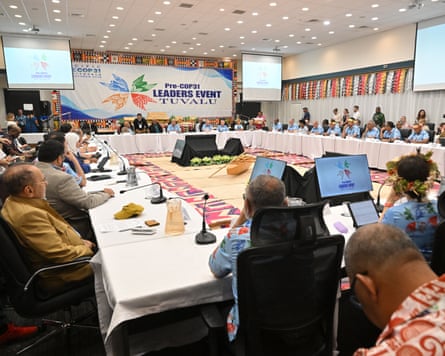
On the second day of the summit, a high-level diplomatic delegation boarded a flight north to Tuvalu, a low-lying Polynesian island nation with a population of approximately 10,000. Standing perilously at an average elevation of just two meters above sea level, Tuvalu represents ground zero for the climate crisis.

Delegates were given a firsthand look at a 20-hectare (49-acre) land reclamation project—a desperate adaptation measure to buy physical space against encroaching tides. The visit was anchored by the poignant testimony of 13-year-old Melelusi Sokotia. Addressing the global dignitaries, Sokotia delivered a sobering reminder of what is at stake, noting that her peers’ dreams of becoming teachers, doctors, and builders are constantly eclipsed by a singular, terrifying question: Can we grow safely here in Tuvalu?
Closing Emotional Pleas and the Road to Antalya
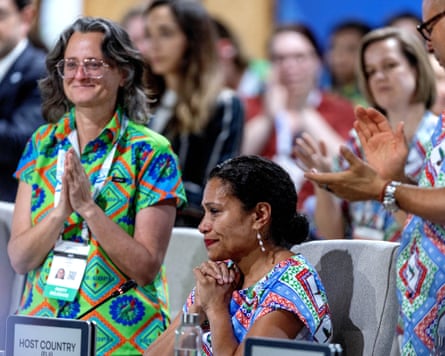
Back in Nadi, the emotional gravity of the field visit culminated in the summit’s closing sessions. Fiji’s climate minister, Lynda Tabuya, delivered a tearful address that earned a prolonged standing ovation. Urging delegates not to treat the pre-COP as a mere bureaucratic checkbox, Tabuya implored them to "remember the people you met" and "carry something of the Pacific with you."
"This pre-COP draws to a close tonight," Tabuya declared. "Our responsibility does not."
With the preliminary groundwork laid, the governments of roughly 190 nations are now preparing to converge on Antalya, Turkey. They do so under the heavy shadow of scientific consensus showing that current NDCs (Nationally Determined Contributions) are falling dangerously short.
Supporting Context & Metrics: The Mathematics of Crisis and Security
To fully understand the gravity of the pre-COP31 debates, one must examine the staggering metrics governing modern climate economics, emissions trajectories, and adaptation funding deficits.
The 1.8°C Reality Check
According to a recent report by the United Nations Environment Programme (UNEP), even under the most optimistic emissions-reduction scenarios currently pledged by governments, global heating will peak at at least 1.8°C. This trajectory blows past the aspirational 1.5°C ceiling established by the landmark Paris Agreement. Scientists continue to stress that every fraction of a degree avoided prevents catastrophic loss of human life and trillions of dollars in economic damages.

The Climate Finance Deficit
Vulnerable island nations face a severe mismatch between financial need and capital disbursement. Australian Climate Change Minister Chris Bowen highlighted a glaring statistic during the summit: only 0.2% of global climate finance is currently channeled toward helping small island developing states (SIDS) adapt to changing conditions.
- The Irony of Aid: Nations like Tuvalu, which contribute negligibly to global greenhouse gas emissions yet suffer the most acute existential threats, receive the least amount of support.
- The Pre-Disaster Economic Argument: Murat Kurum crystallized the economic imperative by comparing climate funding to military spending. While NATO members have committed to scaling defense budgets to 5% of GDP by 2035 out of security concerns, Kurum argued that climate funding should vastly exceed this figure. "If you don’t spend one unit of money prior to the disasters, then you are left in a position where you have to spend 10 units of money after the disaster. It’s cheaper pre-disaster," he noted via an interpreter.
The Electrification Target
In an effort to establish tangible metrics for COP31, Turkey and Australia are aggressively championing a global target: 35% of all energy required to power homes, businesses, factories, and vehicles must come from direct electricity by 2035. Currently, that figure hovers globally at approximately 21%.
Official Statements and Competing Visions
The ideological battlegrounds of COP31 were clearly mapped out through the polarizing rhetoric of key ministers and negotiators in Nadi.
Murat Kurum on Security and Fossil Fuels
Murat Kurum’s positioning as COP31 president-designate has drawn immediate scrutiny from environmental groups. By framing the climate crisis purely as a security imperative, Kurum attempted to bridge the gap between traditional geopolitical defense spending and ecological preservation.
However, his reluctance to firmly back explicit language on phasing out fossil fuels threatens to derail consensus in Antalya. While Kurum acknowledged that the world is "already in a transition," he questioned the strategic utility of rehashing the exact wording adopted at COP28 ("transition away from fossil fuels"), suggesting that political stalemates with oil-producing nations render such phrasing a diminishing return.
Chris Bowen on Supply versus Demand
Australian Climate Minister Chris Bowen sought to thread the needle between Australia’s status as a massive fossil fuel exporter and its role as a COP31 co-host. Bowen argued that the most effective strategy for curbing fossil fuel consumption is not necessarily restricting supply, but rather rapidly accelerating the deployment of renewable energy capacity until fossil fuel power plants are rendered economically obsolete.
"That has got to change," Bowen said regarding adaptation finance for small islands, emphasizing that rectifying this disparity is the cornerstone of Australia’s diplomatic agenda for the Antalya summit.
Pushback from Civil Society and Vulnerable States
This supply-side agnosticism has drawn fierce pushback from climate activists and Pacific delegations. Tzeporah Berman, chair of the Fossil Fuel Non-Proliferation Treaty Initiative, sharply criticized the approach during the summit.
"Pacific leaders have been clear: you can’t phase something out by building more of it," Berman stated, pointing directly at the continued approval of new coal and gas projects by both Australia and Turkey.
Frustrated by what they perceive as a systemic paralysis within the UN framework—largely driven by obstructionist oil-producing states like Saudi Arabia and Russia—dozens of nations held a breakaway summit in Colombia earlier this year. These nations are organizing a follow-up meeting in Tuvalu next July, vowing to force a binding fossil fuel phaseout mechanism onto the agenda in Antalya, regardless of resistance from host governments.
Future Outlook: The Road to Antalya and Beyond
As the diplomatic caravan prepares to move from the tropical shores of the Pacific to the Mediterranean coast of Turkey in November, the overarching question remains: Will COP31 be a summit of historic breakthroughs or diplomatic stagnation?
The fault lines are clear. On one side stand vulnerable island nations and progressive coalitions demanding rigorous, time-bound phaseouts of coal, oil, and gas, backed by robust, accessible adaptation financing. On the other side stand pragmatic hosts like Turkey and Australia—economies still deeply entangled in fossil fuel extraction—who prefer to focus on broad electrification targets and indirect market transitions while dodging explicit commitments to curb supply.
Furthermore, the external geopolitical climate remains hostile. With shifting political tides in Washington and ongoing international conflicts straining state treasuries, securing the massive capital inflows demanded by developing nations will require unprecedented political will.
If Murat Kurum’s assertion that "the climate issue is the security issue" is to transcend empty rhetoric, the delegations gathering in Antalya must convert military-scale budgetary logic into immediate, binding ecological action. Failure to do so risks not only the submersion of nations like Tuvalu, but the erosion of trust in the multilateral climate process itself.



