
Executive Overview
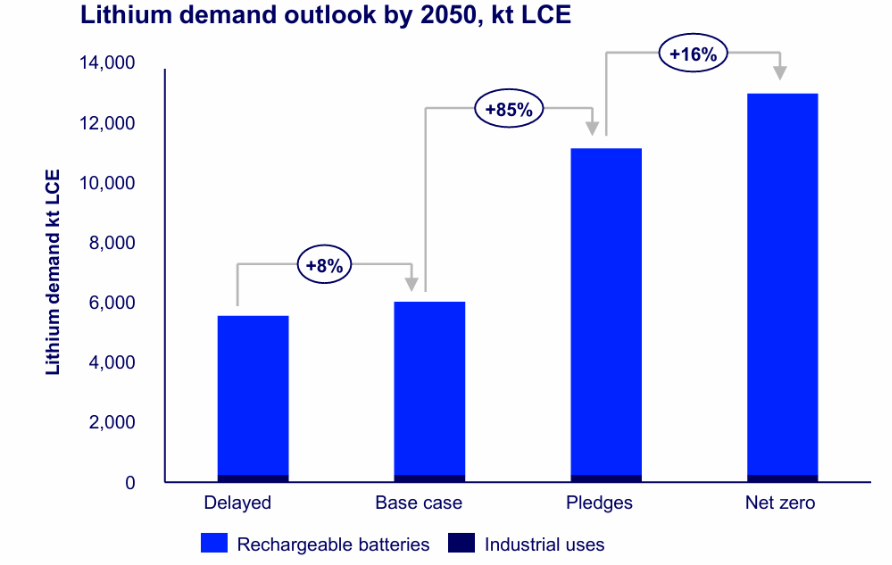
As the global economy accelerates its pivot away from fossil fuels, a critical bottleneck threatens to choke the green energy transition before it reaches maturity. According to a landmark analysis released by energy research powerhouse Wood Mackenzie in its latest Energy Transition Outlook for Lithium, worldwide demand for lithium could skyrocket to a staggering 13 million tonnes annually by 2050.
The report issues a stark, unambiguous warning: without a massive and immediate influx of capital expenditure, strategic extraction projects, and refined processing infrastructure, severe global lithium shortages could emerge as early as 2028.
Far from being a distant problem for the middle of the century, the impending supply deficit is a near-term crisis. Driven predominantly by the explosive adoption of electric vehicles (EVs) and grid-scale energy storage systems, the demand curve is steepening exponentially. While battery recycling initiatives and alternative extraction technologies—such as harvesting lithium from oilfield wastewater—offer glimmers of hope, they will not scale fast enough to avert the looming shortfall.
Closing the impending supply gap will require an unprecedented global industrial buildout, with capital requirements estimated between $100 billion and $276 billion. As governments worldwide enshrine aggressive net-zero policies into law, the ultimate question facing the energy sector is no longer whether the world will need more lithium, but whether the industry can mobilize fast enough to fund, build, and secure the vital white metal of the future.
The EV Surge: Propelling Unprecedented Demand
To understand the magnitude of the upcoming lithium deficit, one must examine the fundamental drivers of consumption. Wood Mackenzie’s latest modeling outlines four distinct energy transition pathways, forecasting global lithium demand to range anywhere from 5.6 million tonnes of lithium carbonate equivalent (LCE) under a delayed transition scenario, up to a monumental 13.2 million tonnes under a strict, accelerated net-zero pathway by 2050.
At the heart of this soaring consumption are electric vehicles. Across all modeled scenarios, light-, medium-, and heavy-duty EVs account for a staggering 72% to 80% of total global lithium demand. The trajectory of passenger vehicle electrification dictates the severity of the market pressure:
- Country Pledges Pathway: If governments adhere strictly to their currently stated climate commitments, electric vehicles are projected to capture approximately 75% of global new vehicle sales by 2040.
- Net-Zero Pathway: In a more aggressive, accelerated climate-action scenario, EV adoption surges to capture 95% of total global vehicle sales over the same timeframe.
By mid-century, rechargeable lithium-ion batteries across all applications—spanning consumer electronics, mobility, and industrial power—will comprise between 96% and 98% of total global lithium consumption.
However, the automotive sector is not the sole catalyst. The rapid expansion of renewable energy generation, such as wind and solar farms, has created an equally pressing need for grid stabilization. Because renewable energy sources are intermittent, utility providers increasingly rely on massive, large-scale battery energy storage systems (BESS) to store excess power during peak generation and discharge it during high-demand intervals. Wood Mackenzie projects that global energy storage demand will expand by a robust 6% to 7% annually across all forward-looking scenarios, further cementing the metal’s status as a critical geostrategic commodity.
The Recycling Illusion: Why Circular Economies Won’t Save Us Yet
As policymakers and industry leaders grapple with raw material scarcity, battery recycling is frequently touted as a silver bullet. Proponents envision a closed-loop economy where spent EV batteries are continuously melted down and repurposed to build new cells, theoretically decoupling the energy transition from the environmental and geopolitical friction of primary mining.
While recycling will undoubtedly play a vital foundational role in the long-term sustainability of the battery supply chain, Wood Mackenzie’s analysis reveals a sobering reality: recycling cannot prevent near-term shortages.
According to the outlook, recycled lithium supply is expected to grow at a healthy clip of 13% to 16% annually. However, meaningful, high-volume contributions from recycling will not materialize until the 2040s. This lag is a simple matter of industrial math: modern electric vehicle batteries boast operational lifespans of 10 to 20 years. The vast majority of batteries powering EVs on global roadways today will not reach their end-of-life processing threshold until well into the next decade.
By 2050, ambitious circular economy frameworks could yield between 2.3 million and 2.7 million tonnes of LCE annually from recycled sources. Even so, this impressive output falls drastically short of total market requirements.
- Under the Country Pledges scenario, the structural supply shortfall is projected to reach an alarming 6.7 million tonnes LCE by 2050.
- Under the Net-Zero scenario, that deficit widens further to an immense 8.5 million tonnes LCE.
Simply put, primary extraction must scale aggressively alongside recycling if the world is to avoid crippling supply bottlenecks.
A $100 Billion to $276 Billion Industrial Buildout
Bridging the widening gap between supply and demand will require an astronomical mobilization of capital. Building a secure, diversified lithium supply chain involves much more than digging holes in the ground; it necessitates complex chemical refining facilities, regional supply chain integration, logistical networks, and environmental compliance frameworks.

Wood Mackenzie estimates that total cumulative investment needs will range widely depending on the velocity of the energy transition:
- Delayed Transition Scenario: ~$104 billion
- Base Case Scenario: ~$114 billion
- Country Pledges Scenario: ~$236 billion
- Net-Zero Pathway Scenario: ~$276 billion
Industry experts note that this capital expenditure cannot be distributed evenly over the next two decades. Instead, investment is projected to experience a violent peak between 2030 and 2034. During this four-year window, mining conglomerates, chemical processors, and automotive original equipment manufacturers (OEMs) will need to simultaneously finance and construct scores of new hard-rock pegmatite mines, brine extraction operations, and direct lithium extraction (DLE) plants.
Furthermore, geographic concentration remains a persistent vulnerability. A significant share of global lithium extraction and refining has historically been concentrated in a handful of regions, exposing the clean energy transition to geopolitical flashpoints, trade restrictions, and supply chain disruptions. Developing diversified, localized supply chains—such as extracting lithium from domestic oilfield wastewaters or geothermal brines—will be essential to mitigating these risks.
Official Perspectives: Industry Leaders Sound the Alarm
The consensus among market analysts and mining executives is that the lithium sector is standing at a historic crossroads. The friction between long development lead times for mining projects and the hyper-accelerated timelines of climate policies has created a dangerous temporal mismatch.
"The lithium market is heading into a supply crunch much sooner than many industry players expect," warns Allan Pedersen, research director at Wood Mackenzie. "Under ambitious climate scenarios, we see deficits emerging from 2028. The industry needs to act now, as governments progress policies toward Net Zero."

Pedersen’s warning echoes sentiments expressed across the mining and automotive sectors. Historically, developing a greenfield lithium mine from initial geological discovery to first commercial production takes anywhere from 7 to 10 years, plagued by lengthy environmental permitting processes, community consultations, and complex engineering challenges. By contrast, a government policy targeting a complete phase-out of internal combustion engine sales by 2035 can be enacted with the stroke of a pen.
This structural disconnect means that demand can—and likely will—outpace supply capacity within the decade unless capital deployment accelerates immediately. Automakers are increasingly bypassing traditional supply chains, forging direct equity partnerships with mining startups, and investing hundreds of millions of dollars directly into extraction and refining technologies to secure their future battery-grade feedstock.
Future Outlook: Navigating the Post-2028 Landscape
As the world edges closer to 2028, the implications of Wood Mackenzie’s findings will ripple across global markets. The upcoming lithium supply crunch will likely trigger heightened price volatility, driving up battery pack manufacturing costs and temporarily slowing the downward trajectory of EV pricing unless proactive measures are taken.
To successfully navigate the transition, several strategic imperatives must be met:
- Accelerated Permitting and Regulation: Governments must streamline regulatory frameworks for environmentally responsible mining and processing, cutting through bureaucratic red tape without sacrificing ecological standards.
- Technological Innovation: Continued investment in alternative extraction methodologies—such as Direct Lithium Extraction (DLE) and recovering lithium from industrial and oilfield wastewaters—will be vital to unlocking new, non-traditional reserves rapidly.
- Strategic Partnerships: Deeper vertical integration between automakers, chemical refiners, and mining enterprises will be necessary to de-risk capital projects and ensure stable, long-term offtake agreements.
Ultimately, the global transition to clean energy is no longer a matter of technological feasibility; it is a race of resource logistics and industrial execution. Whether the international community can rise to the challenge of funding and constructing the necessary lithium infrastructure will define the success—or failure—of the global net-zero movement over the next quarter-century.