Executive Overview
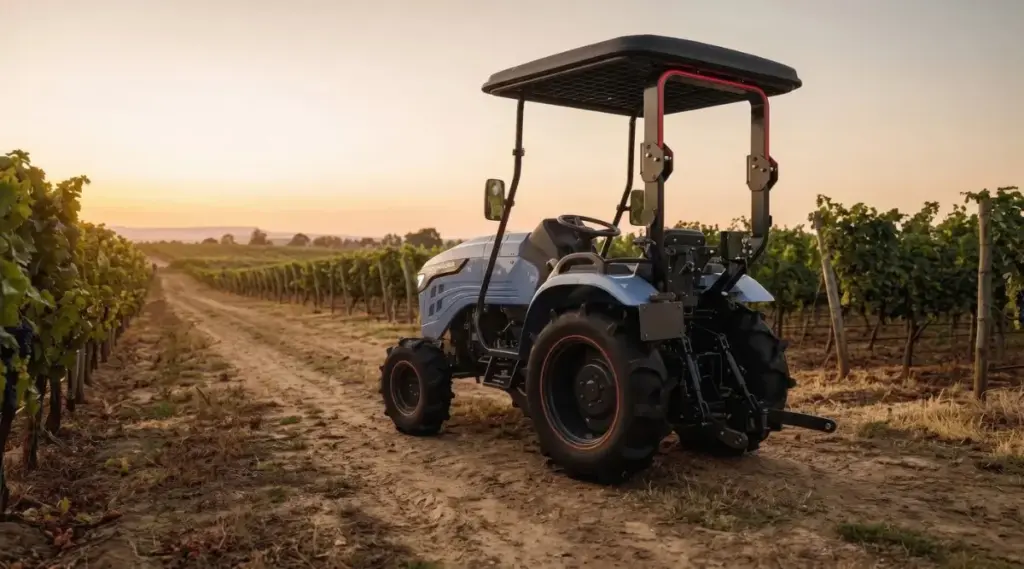
The intersection of agriculture, off-grid technology, and renewable energy has reached a compelling new milestone with the introduction of the Moonrider battery-electric tractor. Manufactured in India and brought to North American markets via a strategic cooperation and marketing agreement with Cincinnati-based clean energy pioneer GoSun, the Moonrider 27 made its high-profile debut at the Farm Progress Show in Boone, Iowa. Priced at an aggressive $19,995, the machine undercuts comparable internal combustion engine (ICE) utility tractors by thousands of dollars while offering zero tailpipe emissions, whisper-quiet operation, and low-end electric torque.
Designed specifically for small-scale farmers, homesteaders, landscapers, and property managers, the Moonrider 27 seeks to break what GoSun CEO Patrick Sherwin characterizes as an "extractive trend" of rising fossil fuel costs, recurring software fees, and burdensome maintenance cycles associated with traditional diesel machinery. Equipped with a 24 kWh Lithium Iron Phosphate (LFP) battery and optional integrated foldout solar panels—or a dedicated solar canopy—the tractor introduces the radical proposition of continuous off-grid self-charging.
While the machine is not intended to replace heavy-duty diesel workhorses on sprawling commercial row-crop farms, it addresses a vital market segment: light-to-medium property maintenance and small acreage farming. By combining affordability, direct solar integration, and low operating costs, the Moonrider 27 stands as a case study in the electrification of niche utility vehicles, highlighting both the profound potential and the practical limitations of modern agricultural decarbonization.
Support CleanTechnica’s work through a Substack subscription, on Patreon, or on Stripe. Help us produce all of the high-quality, original content we publish week after week despite the challenges of content-scraping AI, antisocial media, inflation, and other hurdles.
Detailed Chronology & Introduction to the Market
The path toward the North American debut of the Moonrider 27 reflects GoSun’s broader evolution from a developer of portable solar cookers and off-grid cooling solutions into a comprehensive provider of personal clean energy ecosystems. Founded in 2016, GoSun earned industry recognition through innovative thermal and photovoltaic consumer technologies, ranging from solar-powered refrigerators to water purification units. However, the step into agricultural and property maintenance machinery represents a significant scaling of the company’s "free energy" philosophy.
The partnership with Moonrider—an Indian manufacturer specializing in accessible electric mobility and agricultural machinery—bridged the gap between GoSun’s marketing reach and advanced overseas manufacturing capabilities. Recognizing the immense financial strain that conventional diesel utility vehicles place on smallholders, the two entities structured a distribution agreement aimed squarely at North America’s burgeoning homesteading and small-farm demographic.
The rollout culminated at Booth VITW2200 during the Farm Progress Show in Boone, Iowa, where attendees were given a firsthand look at the machine. Positioned alongside heavy industrial agricultural behemoths, the compact electric tractor offered a striking contrast: a machine capable of performing typical utility tasks without the associated roar of a diesel engine, exhaust fumes, or the need to haul fuel cans from town. Pre-orders immediately opened via GoSun’s digital storefront, with official customer deliveries slated to commence in early 2027.
Supporting Context & Metrics: Specifications and Performance
To understand where the Moonrider 27 fits within the broader equipment landscape, it is necessary to examine its engineering specifications, charging parameters, and operational capabilities.
Core Specifications
- Price Point: $19,995 (USD)
- Battery Capacity: 24 kWh Lithium Iron Phosphate (LFP) chemistry
- Estimated Run Time: Approximately 5 hours under mixed utility workloads
- Charging Time (220V Source): 2.5 hours from depletion to full charge
- Hitch & PTO: Standard three-point hitch and hydraulic rear Power Take-Off (PTO)
- Solar Integration: Optional high-efficiency foldout solar panels and specialized solar canopy for continuous off-grid recharging
- Availability: Pre-orders active now; initial deliveries targeted for early 2027
The Mechanics of Electric Utility
Unlike traditional diesel engines, which must reach specific RPM thresholds to generate maximum torque, electric motors deliver maximum torque instantaneously from a standstill. For property maintenance tasks—such as pulling loads, grading driveways, operating a rear-mounted tiller, or lifting material with a front loader—this immediate response translates to a high level of responsiveness and control.

Furthermore, the 24 kWh LFP battery pack is inherently stable, fire-resistant, and capable of enduring thousands of charge cycles with minimal degradation. While a 5-hour run time may appear constrained compared to a fuel tank that can be refilled in seconds with diesel, it closely matches the actual active operating window of many small-scale homesteaders and property managers. When coupled with a 220-volt outlet, the tractor can be fully replenished in two and a half hours.
More revolutionary is the vehicle’s capacity for passive solar replenishment. While parked outdoors or even while operating in the field under the optional solar canopy or foldout array, the tractor continuously harvests photovoltaic energy. This significantly dampens grid dependency, transforming the vehicle into a decentralized energy asset.
Official Statements and Industry Philosophy
The corporate ethos driving the Moonrider 27 centers on a critique of modern agricultural dependency. Speaking on the release of the tractor, GoSun founder and CEO Patrick Sherwin outlined the ideological and practical motivations behind the venture.
“At GoSun, our vision has always been to build solutions that allow people to live, work, and thrive off the grid using the power of the sun,” Sherwin stated. “Small-scale farming and property management have relied on noisy, costly diesel utility vehicles for far too long. With our new All-Electric Tractor, we are empowering farmers and land managers to literally work on sunshine — reducing operational costs while protecting the soil and air. Electric tractors are the future of farming.”
Sherwin expanded on the hidden costs embedded in legacy agricultural machinery, touching upon a growing concern among modern farmers regarding the "right to repair" and proprietary software locks imposed by major farm equipment conglomerates.
“We know diesel has helped the farmer be more productive. But their machines have become a jail sentence of rising fuel costs, maintenance, and software fees,” Sherwin noted. “The GoSun Moonrider bucks this extractive trend and gives its owners the feel of a free energy machine — always ready, with endless possibilities.”
Practical Reality Check: Input from the Field
While the technical and financial appeal of a $19,995 solar-assisted electric tractor is undeniable on paper, bridging the gap between urban clean-tech marketing and actual agricultural grit requires rigorous scrutiny. To gain a grounded perspective, industry evaluations must account for the lived experiences of working farmers.
Dan Allard, a working farmer based in New Hampshire, offered a grounded appraisal when asked about the Moonrider 27. Allard expressed immediate skepticism regarding whether the machine’s 5-hour run time would suffice for the demanding, uninterrupted workflows typical of his daily farming routine.
This skepticism is entirely warranted. For heavy-duty, continuous commercial operations—such as multi-acre plowing, heavy hauling across rugged terrain, or running high-draw implements for twelve-hour stretches—a 24 kWh battery pack and a light utility chassis will inevitably fall short. Much like early electric automobiles, small electric tractors are subject to distinct operational envelopes. Just as an electric sedan is ideal for daily commuting and local errands but ill-suited for towing massive loads across cross-country mountain ranges in sub-zero weather, an electric utility tractor must be matched precisely to its intended application.

However, for the vast demographic of hobby farmers, vineyard operators, orchard keepers, horse-property owners, and municipal parks departments, the Moonrider 27 represents an ideal fit. These users typically utilize tractors in short bursts interspersed with loading, unloading, or administrative tasks, during which the vehicle can sit parked beneath the sun, silently recharging its LFP pack.
Beyond raw run-time metrics, the secondary benefits of electrification carry profound weight. Eliminating diesel exhaust fumes directly improves the health and comfort of the operator—a factor frequently cited by those who spend hours enclosed in tractor cabs or working in confined barns and greenhouses. Additionally, the elimination of oil changes, fuel filters, spark plugs (in gas alternatives), transmission fluids, and complex emissions control systems (such as Diesel Exhaust Fluid [DEF] systems) radically slashes ongoing maintenance overhead.
Future Outlook
The launch of the GoSun Moonrider 27 underscores a broader structural shift in off-road mobility. As battery energy densities improve, power electronics become more efficient, and photovoltaic materials become cheaper and more flexible, the economics of agricultural machinery are undergoing a quiet decentralization.
Regional incentives also play a pivotal role in accelerating adoption. Programs such as California’s Carl Moyer Memorial Air Quality Standards Attainment Program—and similar clean-air initiatives emerging across North America—frequently offer substantial voucher incentives that can reduce the purchase price of electric agricultural equipment by tens of thousands of dollars, pushing machines like the Moonrider well into impulse-buy territory for qualifying operations.
As early adopters take delivery of the Moonrider 27 in early 2027, the market will gain vital empirical data regarding the durability, reliability, and true solar-harvesting capabilities of foldout panels in working agricultural environments. While it will not single-handedly displace the multi-ton diesel tractor from the American Midwest’s expansive commercial corn and soybean belts, it carves out a vital, highly sustainable niche.
Ultimately, the Moonrider 27 offers choice. For those whose daily chores match its capabilities, it provides a quiet, emission-free, and virtually free-to-run alternative to the extractive economics of fossil fuels. For others with heavier demands, traditional machinery remains available. In an era transitioning rapidly toward sustainable energy, having dependable, accessible, and clean choices is the true hallmark of progress.