Executive Overview
Deep within the ancient, misty rainforests of Cambodia’s Cardamom Mountains, a silent devastation is unfolding. Officially touted as bastions of clean energy security and sustainable development, major hydropower projects in the region have become fronts for extensive, unauthorized industrial logging. Recent satellite telemetry, corroborated by expert forestry analysis and terrified local testimonies, reveals that commercial timber operations are carving deep into legally protected zones far beyond authorized construction footprints.
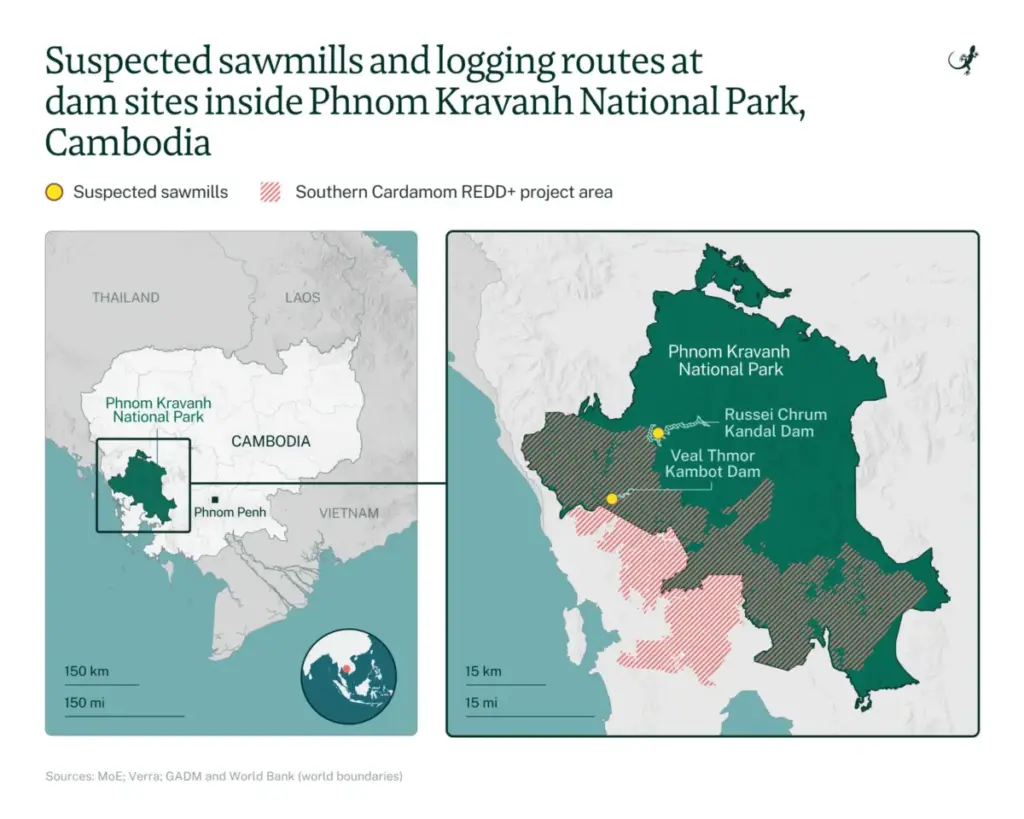
At the center of this environmental and governance crisis are the Stung Russei Chrum Kandal (Middle Russei Chrum River) and Veal Thmor Kambot hydropower dams. Situated inside the critically endangered ecosystems of the Phnom Kravanh National Park and the Phnom Samkos Wildlife Sanctuary, these projects are developed by Khmer Electrical Power—a subsidiary of the Anco Brothers conglomerate. The company is controlled by Kok An, a ruling party senator recently hit with international sanctions.
While developers hold permits to clear vegetation within designated reservoir flood zones, high-resolution satellite imagery exposes a web of secret logging roads, illegal sawmills, and selective extraction of high-value timber stretching kilometers into pristine old-growth forests. Protected by armed forces and shielded by a wall of official silence, these operations threaten not only rare megafauna—including Asian elephants and critically endangered Sunda pangolins—but also expose deep-seated systemic corruption at the nexus of Cambodian corporate power and state infrastructure.

Detailed Chronology: The Escalation of Deforestation in Protected Paradigms
The unfolding environmental catastrophe within Phnom Kravanh National Park did not happen overnight; it represents a calculated progression of land-clearing activities that accelerated sharply between 2023 and 2026.
2023: Groundbreaking and the Sealing of the Forest
Construction officially commenced in 2023 on the 70-megawatt Stung Russei Chrum Kandal dam, which spans the Russei Chrum River in Koh Kong province, and the 100-megawatt Veal Thmor Kambot dam further south. From the outset, local communities noticed a drastic shift in access to ancestral lands.
Phphan, a resident of O’Soam commune in Pursat province whose real identity is shielded for safety, described the immediate lockdown of the area. Once freely accessed for fishing and foraging, local forests were swiftly cordoned off. Armed personnel wearing Royal Cambodian Armed Forces (RCAF) uniforms erected checkpoints, ostensibly to guard the national park. In practice, locals noted these forces functioned as private security details for the dam developers, sealing off entry and exit points to shroud the interior works from public scrutiny.

2024–2025: Milestones and Surreptitious Expansion
By late 2024, high-profile milestones were celebrated with much fanfare. In December 2024, Cambodian Minister of Energy and Mines Keo Rottanak sat shoulder-to-shoulder with Khmer Electrical Power chairman Kok An and notorious tycoon Ly Yong Phat during a major project milestone ceremony.
However, behind the political pageantry, satellite tracking indicates a darker reality. Around March 2025, a suspicious 14-hectare (35-acre) clearing manifested north of the planned Russei Chrum Kandal reservoir. Aerial telemetry revealed structures highly characteristic of timber processing hubs, complete with long, narrow buildings housing band saws and massive stacks resembling processed sawn timber. Radiating out from this hub, a newly cut industrial road breached the Koh Kong-Pursat provincial border, spawning a spiderweb of secondary logging tracks deep into untouched canopies.
2025–2026: Dry-Season Surges and Systematic Timber Extraction
As seasonal cycles shifted into the dry seasons of 2025 and 2026, logging intensity spiked. Forest crime monitors noted striking similarities between these operations and historical clearing patterns observed at the Stung Meteuk dam inside the Phnom Samkos Wildlife Sanctuary.

By mid-2026, satellite data from July 2026 confirmed that industrial sawmills remained fully operational just outside the designated reservoir parameters. Despite token ministerial logging bans previously issued by Ministry of Environment Eang Sophalleth, unauthorized felling persisted unabated. In July 2026, local media reports captured a tangible slip in the logistical veil: transport trucks belonging to Khmer Electrical Power—ostensibly permitted to haul saplings—were intercepted in Kandal province loaded down with Grade 1 timber, the second-most valuable timber class in Cambodia.
Supporting Context & Metrics: Biodiversity Under Siege and the Corporate Web
To fully understand the gravity of the deforestation occurring around these hydropower sites, one must examine the ecological weight of the Cardamom Mountains and the powerful syndicate driving its exploitation.
Ecological Sanctuary at Risk
Spanning more than 926,000 hectares (2.3 million acres)—roughly triple the size of Yosemite National Park—the Phnom Kravanh landscape represents one of Southeast Asia’s last unbroken expanses of old-growth tropical rainforest. It acts as an irreplaceable Ark for threatened and endangered wildlife, including:

- Asian Elephants (Elephas maximus): Endangered migratory populations relying on unfragmented forest corridors.
- Sunda Pangolins (Manis javanica): Critically endangered mammals heavily targeted by illegal wildlife trade networks.
- Smooth-Coated Otters (Lutrogale perspicillata): Vulnerable aquatic predators dependent on clean, un-dammed river systems.
- Asiatic Black Bears (Ursus thibetanus): Vulnerable forest-dwelling carnivores facing severe habitat contraction.
Furthermore, these forests overlap with the Southern Cardamoms REDD+ project area—a flagship carbon-offsetting initiative managed by the local conservation NGO Wildlife Alliance. Yet, rather than halting illicit activities, conservation easements have repeatedly bowed to industrial development. Across Phnom Kravanh National Park and the Samkos Wildlife Sanctuary, five dams are operational, and five more are under active construction. Together, their planned reservoirs will permanently inundate and fragment more than 15,000 hectares (37,066 acres) of high-carbon wilderness.
The Crony Capitalist Network
The impunity with which these dams operate traces directly to Cambodia’s political elite. Khmer Electrical Power operates as a subsidiary of the Anco Brothers conglomerate, steered by Senator Kok An.
Kok An’s political and financial standing has faced international fallout. In April 2026, the U.S. Treasury Department sanctioned Kok An for his alleged central role in human trafficking and cyber-scam compounds operating across Cambodia. Shortly thereafter, Thai authorities issued an arrest warrant for An—dubbed the "Godfather of Poipet"—seizing roughly 560 million baht ($17 million) in assets, revoking his residence visa, and stripping Thai citizenship from his three children.

Complicating matters further, An’s family ties intertwine with fellow sanctioned senator Ly Yong Phat, another elite tycoon tied to Cardamom dam developments and transnational cyber-fraud rings. According to veteran forest crime expert Marcus Hardtke, this dynamic echoes historical precedents, pointing to the 2009–2012 rosewood logging blitzes led by Try Pheap—another advisor to former Prime Minister Hun Sen who faced U.S. sanctions for corruption.
"Every hydropower construction project in Cambodia in the last two decades has been massively abused for large-scale, organized illegal logging operations by regime cronies, especially in the Cardamom Mountains," Hardtke noted.
Official Statements and Institutional Silence
The systemic nature of the logging operations is further underscored by the conspicuous lack of intervention or transparency from state regulators and conservation partners.

- The Ministry of Environment: Minister Eang Sophalleth was reached via Telegram messaging regarding the satellite evidence and unauthorized sawmills. While Sophalleth has previously garnered public attention for issuing localized logging bans at suspect hydropower sites, he read the inquiries but ultimately declined to provide an official response.
- Wildlife Alliance: As the primary NGO overseeing the Southern Cardamom REDD+ project area—where much of the spillover deforestation has occurred—Wildlife Alliance has faced mounting scrutiny from local indigenous communities and conservation researchers. CEO John Willis did not respond to written inquiries sent by investigative journalists regarding the organization’s failure to halt or publicly report the extensive canopy loss within its project boundaries.
- Corporate Developers: Khmer Electrical Power and the Anco Brothers conglomerate failed to respond to multiple electronic mail inquiries sent to addresses listed in official Cambodian commerce registries.
Local testimonies paint a grim picture of institutional complicity. Forest monitors and residents emphasize that operating heavily industrialized sawmills, moving multi-ton timber trucks through military checkpoints, and clearing thousands of hectares outside legal boundaries would be entirely impossible without the explicit knowledge, coordination, and protection of the dam developers and aligned security forces.
Future Outlook: A Precarious Path for Cambodia’s Green Transition
As Cambodia pushes aggressively toward its "clean energy" targets through hydropower expansion, the reality on the ground tells a contradictory story. The transformation of protected national parks into industrial timber extraction zones raises profound questions about the true cost of national electrification.
- Compromised Carbon Credits: The systematic destruction of primary forests within the Southern Cardamoms REDD+ project area severely undermines the environmental integrity of carbon-credit schemes operating in Cambodia, likely inviting international skepticism and buyer reluctance.
- Biodiversity Collapse: The ongoing fragmentation of elephant migratory routes and the destruction of pangolin and otter habitats push these flagship species closer to regional extinction, jeopardizing state-backed wildlife reintroduction initiatives, such as planned tiger restorations.
- Marginalization of Indigenous Communities: Traditional forest-dependent communities face ongoing disenfranchisement, losing access to ancestral foraging grounds while being locked out by military-backed security perimeters designed to protect corporate interests rather than ecological assets.
Ultimately, unless independent oversight bodies, international financial institutions, and conservation watchdogs demand radical transparency and strict enforcement of environmental laws, projects like the Stung Russei Chrum Kandal and Veal Thmor Kambot dams will continue to serve as a blueprint for institutionalized forest pillage—sacrificing Cambodia’s natural heritage on the altar of crony capitalism under the guise of green energy.