Executive Overview
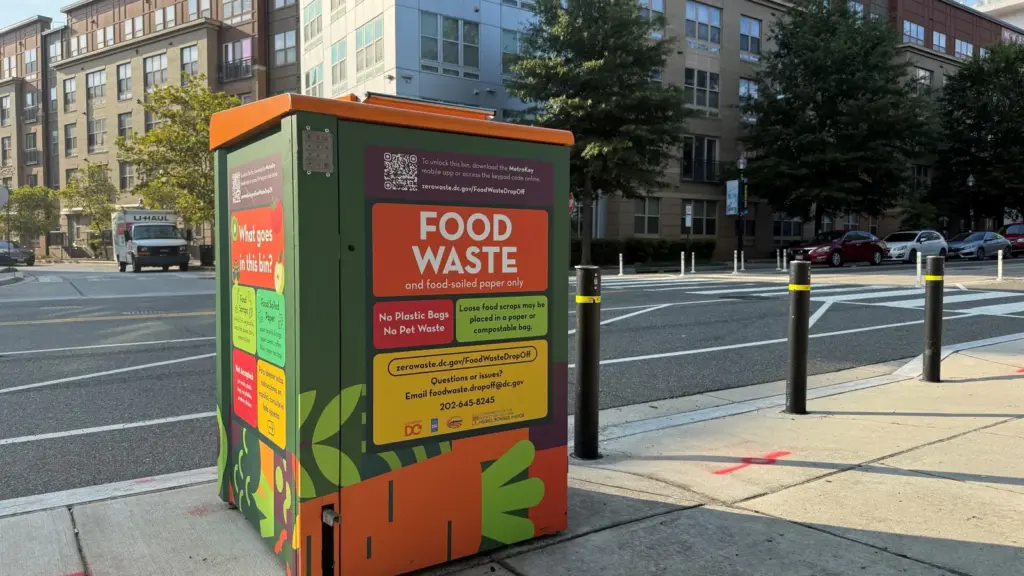
Washington, D.C., is quietly transforming its urban landscape through a high-tech, community-driven approach to municipal sustainability. At the heart of this urban evolution is an aggressive expansion of the District’s public food waste drop-off infrastructure—specifically, a rapidly growing network of keypad-access "smart bins" managed by the Department of Public Works (DPW).
This initiative is far more than a localized green project; it serves as a critical linchpin in the District’s overarching zero-waste strategy. Under Mayor Muriel Bowser’s updated zero-waste plan, D.C. has set a formidable benchmark: diverting 80% of the city’s municipal solid waste away from landfills and incineration facilities by the year 2040.
Because multifamily housing units—apartments and condominiums—comprise the overwhelming majority of residential living spaces throughout the District, standard suburban-style green-bin curbside collection models are largely unviable. To bridge this logistical gap, the D.C. Office of Waste Diversion has pioneered accessible, decentralized composting solutions that cater specifically to apartment-dwellers.
By leveraging user-friendly technology, public-private partnerships, and a strategic distribution of secure drop-off bins, the city is successfully democratizing sustainability. In the process, D.C. is proving that densely populated urban centers can effectively tackle organic waste diversion at scale.
Detailed Chronology: The Evolution of D.C.’s Waste Diversion Framework
To fully understand the significance of the current smart bin expansion, one must examine the chronological progression of Washington, D.C.’s waste management policies over the past decade.
Foundations and Early Milestones (2014–2020)
- 2014: The D.C. Department of Public Works formally initiates comprehensive municipal food waste collection efforts. In the ensuing decade, the city aggregates more than 11 million pounds of organic waste through various programs, laying the groundwork for broader public engagement.
- The Multifamily Challenge: While the city establishes mandates requiring large apartment building managers to supply standard waste and recycling infrastructure, composting remains a blind spot. Tenants wishing to compost are historically forced to travel to localized farmers markets or purchase expensive, high-maintenance countertop composting appliances for individual apartment use.
The Smart Bin Revolution (2022–2023)
- The Pilot Phase: Recognizing the geographical and infrastructural limitations of apartment living, the Office of Waste Diversion introduces the concept of secure, 24-hour smart bins.
- Rapid Adoption: Over an 18-month deployment window, the program strikes a chord with urban residents. Approximately 10,000 D.C. residents proactively sign up for keypad access, illustrating an immense, previously untapped public appetite for convenient organic waste disposal options.
Modern Scaling and Multi-Material Integration (2024–Present)
- The 2024 Zero-Waste Plan Update: The District updates its comprehensive zero-waste roadmap, setting stringent targets to slash the citywide solid waste stream by 18% and eliminate millions of metric tons of greenhouse gas emissions.
- Battery Drop-Off Pilot: In a strategic effort to broaden the scope of waste diversion, the city launches a multi-material collection trial at eight farmers market food waste drop-off sites in late 2024, enabling residents to recycle used household batteries alongside their organic waste.
- Facility Redevelopment Planning: Concurrently, DPW begins community consultations regarding the long-term reconstruction of the fire-decommissioned Benning Road transfer station, envisioning it as a state-of-the-art green facility.
Supporting Context & Metrics: The Numbers Behind the Movement
Achieving an 80% waste diversion rate by 2040 requires rigorous data tracking, strategic logistical partnerships, and measurable milestones. The metrics surrounding D.C.’s current composting ecosystem illuminate both its early successes and the scale of the challenge ahead.
Current Waste Composition and Disposal Realities
Historically, the vast majority of Washington, D.C.’s municipal solid waste has been funneled to the Reworld waste-to-energy facility situated near Lorton, Virginia. While waste-to-energy incineration is preferable to open-air landfill decomposition in terms of immediate space management, it still generates substantial carbon emissions and fails to return valuable nutrients to the soil.
The 2024 update to D.C.’s zero-waste plan aims to radically alter this trajectory by targeting an 18% absolute reduction in the citywide solid waste stream. Accomplishing this is calculated to abate approximately 1.38 million metric tons of carbon dioxide equivalent ($textCO_2texte$) greenhouse gas emissions.
Smart Bin Performance Metrics
- 11 Million Pounds: The total cumulative weight of food waste collected by DPW programs since tracking began in 2014.
- 10 Percent: The impressive share of that total volume generated exclusively by the smart bin network over the past year and a half. Given that the smart bins represent a relatively recent addition to the city’s infrastructure, their outsized yield underscores their hyper-efficient utilization rates.
- 10,000 Users: The active roster of residents who have formally registered for keypad access, demonstrating that convenience is the ultimate driver of civic environmental participation.
The Operational Supply Chain
The success of D.C.’s smart bin initiative relies heavily on coordinated private-sector and regional partnerships:
- Collection: Compost Crew—an established regional contractor specializing in organic waste logistics—services the bins on a regular schedule, safely transporting the material out of residential neighborhoods.
- Processing: Maryland Environmental Services takes custody of the collected organic matter, overseeing the large-scale industrial composting process that transforms food scraps into nutrient-rich soil amendments.
Official Statements and Administrative Insights
Key municipal leaders emphasize that equity, accessibility, and long-term infrastructure investment are the foundational pillars of the District’s ongoing environmental strategy.
Bridging the Accessibility Gap
John Johnson, program manager for the D.C. Office of Waste Diversion, highlights the psychological and geographical factors that dictate program utilization:
"It’s been a phenomenal program that’s really making up that gap in accessibility for residents. Users can find a nearby bin using an interactive map and unlock the lid using a key code, making the service available 24 hours a day."
However, Johnson stresses that technological availability alone is insufficient if physical proximity is lacking. To maximize participation, the city applies a rigorous equity lens to its rollout strategy:
"Residents are more likely to use the bin if it’s close to their home, so the goal is to make sure that we have equitable distribution throughout the city."
Beyond public drop-off sites, the city is actively empowering residents who prefer decentralized, home-based solutions. According to Johnson, the District has recently rolled out comprehensive educational workshops alongside a targeted equipment rebate program designed to make home composting hardware affordable for everyday taxpayers.
Reimagining Municipal Infrastructure
Anthony Crispino, Director of the D.C. Department of Public Works, points to larger structural projects as vital to sustaining the momentum generated by the smart bins. Chief among these is the planned revitalization of the Benning Road transfer station, which has remained offline following a devastating fire.
Crispino notes that the city is currently collaborating closely with the Office of Waste Diversion and local neighborhood advisory boards to redesign the facility from the ground up. The objective is to create a dynamic, future-proof urban hub tailored to the needs of a growing population over the next two decades:
"The vision is for a new green facility that is going to expand our capacity to accept composting materials, recycling, and other residential drop-off. There’s a whole plethora of ideas."
Future Outlook: Scaling Beyond Food Waste
As Washington, D.C. looks toward its 2040 zero-waste horizon, the immediate success of the smart composting initiative is serving as a testing ground for broader environmental programs.
City planners have recognized that consumer habits built around organic waste diversion can be leveraged to capture other hazardous or hard-to-recycle materials. The recent pilot program launched at eight farmers market drop-off sites—allowing residents to recycle used household batteries alongside their food scraps—is a prime example of this philosophy in action. By piggybacking on an already popular routine, the city minimizes consumer friction while simultaneously driving attendance at specialized household hazardous waste collection events.
Challenges on the Horizon
Despite notable progress, obstacles remain. Urban density introduces unique contaminants into organic waste streams, requiring constant public education to prevent non-compostable plastics and foreign debris from ruining batches of industrial compost. Furthermore, securing capital funding to rebuild critical infrastructure like the Benning Road facility will require sustained political will and cross-jurisdictional cooperation.
Conclusion
Washington, D.C.’s smart bin expansion demonstrates how municipal governments can successfully partner with residents to overcome the unique structural challenges of urban environments. By combining digital accessibility, strategic urban planning, and robust regional processing partnerships, the District is not merely managing garbage—it is building a resilient, circular economy capable of meeting the climate challenges of the 21st century.