The intersection of biodiversity conservation and Indigenous human rights has long been a battleground of competing ideologies, colonial histories, and urgent ecological imperatives. For decades, the mainstream conservation movement operated under a exclusionary paradigm: wildlife and pristine ecosystems could only be saved by fencing off land and removing, restricting, or ignoring the human communities living within or adjacent to them.
Michael D. Painter, an ecological anthropologist whose storied career spanned more than four decades, fundamentally challenged and helped dismantle this paradigm. Painter, who passed away on February 11, 2026—with news of his passing reverberating through international conservation circles months later—spent his life demonstrating that ecological degradation is rarely just an environmental problem. Instead, it is a symptom of unequal social relations, structural poverty, skewed land distribution, and political marginalization.
Operating primarily through the Wildlife Conservation Society (WCS), as well as academic institutions and philanthropic organizations like the Gordon and Betty Moore Foundation, Painter revolutionized how major conservation NGOs engage with Indigenous peoples. From the sprawling plains of the Bolivian Chaco to the high canopy of the Amazon rainforest and the corporate boardrooms of New York conservation agencies, Painter argued a radical proposition: Indigenous communities are not merely obstacles to conservation, nor are they helpless victims of environmental change. Rather, they are indispensable political, technical, and moral partners whose territorial rights are inextricably linked to the survival of the planet’s most vital ecosystems.
This in-depth retrospective explores Painter’s life, his pioneering work in South America, his institutional battles to institutionalize human rights within the conservation sector, and the enduring legacy of a man who believed that social justice and ecological integrity must rise or fall together.
Detailed Chronology: A Life Dedicated to the Political Ecology of Land
From the Academy to the Field: Early Academic Foundations
Michael Painter’s journey toward becoming one of the most influential thinkers in modern conservation was grounded in rigorous social science. He earned his Ph.D. in anthropology from the University of Florida, a crucible for tropical conservation and development studies. Rather than retreating into an ivory tower, Painter immediately applied his methodological toolkit to the messy realities of rural development and agrarian change in Latin America.
In the early stages of his career, Painter joined the Institute for Development Anthropology in Binghamton, New York. There, his research focused on the complex human dynamics of lowland agricultural settlement in Bolivia, the socioeconomic impacts of the Chapare development program, systemic land degradation, and the formation of social classes. In 1985, he published a landmark study examining the interplay between ethnicity and social class in Santa Cruz, Bolivia. His work consistently probed the underlying mechanisms driving human interaction with the natural world: who gets to use the land, under what legal and economic pretexts, and who bears the ultimate cost of environmental transformation?
Painter’s intellectual curiosity also took him far beyond South America. As an adviser to Botswana’s Department of Wildlife and National Parks, he evaluated community-based natural-resource management programs. Though the geography and ecosystems shifted, his core preoccupation remained fixed: land-use decisions are driven just as much by economics, political power, and institutional design as they are by ecological principles.
The Turning Point: The Bolivian Chaco and Kaa-Iya del Gran Chaco
In 1995, Painter reached a defining milestone in his career when he co-edited (with Stanford University’s William Durham) the influential volume The Social Causes of Environmental Destruction in Latin America. The book directly challenged Malthusian narratives that blamed environmental degradation primarily on unchecked population growth among the poor. Instead, Painter and Durham argued that environmental destruction is driven by structural inequities: unequal access to land, pervasive poverty, extractive concessions granted to powerful economic elites, and skewed social relations. They posited that social equity had direct, measurable ecological consequences.
That same year, Painter joined WCS to direct a project that would put these exact theories to the test: the creation of the Kaa-Iya del Gran Chaco National Park in Bolivia.
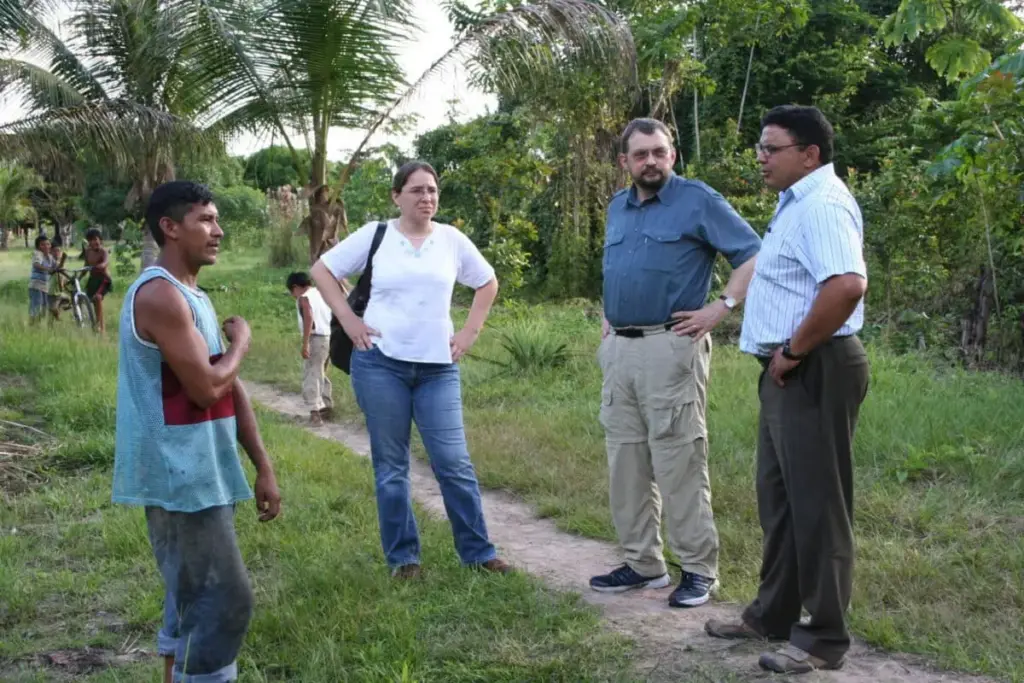
In the Bolivian Chaco, the Isoceño Guaraní people were already acutely aware that their ancestral lands were under severe pressure from advancing agricultural settlements. Their representative organization, the Capitanía de Alto y Bajo Izozog (CABI), held clear territorial aims but lacked the institutional leverage, scientific data, legal architecture, and financial resources required to secure their land rights against national and corporate interests.
Rather than imposing a top-down park model, WCS and CABI forged a pioneering alliance. Working alongside CABI, Painter and his colleagues helped design the proposal for the Kaa-Iya del Gran Chaco National Park, established by the Bolivian government in 1995. Spanning a staggering 3.4 million hectares, it was gargantuan even by South American standards. Crucially, CABI became the co-administrator of the park—an unprecedented governance arrangement at the time.
Furthermore, this collaborative framework catalyzed a broader mechanism for securing Indigenous territorial rights under Bolivia’s evolving agrarian reform laws. This legal and political machinery eventually secured official land titles for:
560,000 hectares for the Isoceño Guaraní.
273,000 hectares for the Ayoreode people.
Extensive ancestral territories for 43 distinct Chiquitano communities.
According to WCS, this ambitious multi-stakeholder process laid down critical legal and operational precedents for Indigenous land titling across Bolivia, proving that conservation could actively enhance, rather than undermine, Indigenous sovereignty.
Expanding into the Amazon: Madidi, Tacana, and Lecos
Building upon the successes in the Chaco, Painter’s operational footprint expanded deep into the Amazon basin. Serving successively as WCS country director in Bolivia and Peru before stepping up to direct the organization’s broader Amazon program, Painter championed landscape-level conservation frameworks that integrated protected areas with Indigenous territories.
In the Greater Madidi landscape, WCS operated on a dual track: supporting state-run protected-area authorities while simultaneously empowering local Indigenous organizations seeking legal control over adjacent buffer zones and ancestral lands. By 2008, these efforts culminated in the official titling of 372,000 hectares of the Tacana I Indigenous Community Land, strategically positioned alongside Madidi National Park. Similar territorial defense and management initiatives were launched for Lecos communities and the Pilón Lajas Biosphere Reserve.
Colleagues like Zulema Lehm of WCS Bolivia noted that navigating the bureaucratic labyrinth of land titling was fraught with political danger and legal ambiguity. Painter was renowned for steering his teams through these high-stakes administrative battles with unwavering patience. The research ethics frameworks and community engagement methodologies he developed during this era continued to be used by WCS to train field staff and local partners years later.
Institutional Transformation in New York
In 2009, Painter transitioned from field operations to the WCS headquarters in New York, embarking on his most ambitious institutional challenge: reforming the internal culture and operational policies of a global conservation giant from within.
Recognizing that conservation interventions inevitably generate profound political consequences—affecting resource access, altering local power dynamics, and frequently empowering one group at the expense of another—Painter argued that conservationists could no longer remain agnostic about human rights. He spearheaded WCS’s transition toward a human-rights-based approach to conservation, emphasizing livelihoods, equity, and local governance.
His institutional contributions during this phase included:
The Conservation Initiative on Human Rights (CIHR): Painter helped establish and officially represent WCS within this collaborative network of international conservation NGOs committed to integrating human rights standards into conservation practice.
Institutional Review Board (IRB): Recognizing the ethical complexities of social and biological research involving human subjects, Painter helped create WCS’s first IRB, serving as its chair from 2018 until 2025.
In 2015, Painter briefly transitioned to the Gordon and Betty Moore Foundation to shape its Andes-Amazon Initiative, before returning to WCS two years later. Alongside colleague David Wilkie, he laid the foundational architecture for what eventually evolved into WCS’s dedicated Rights and Communities Program.
Supporting Context & Metrics: The Paradigm Shift in Numbers
To understand the magnitude of Michael Painter’s life work, one must examine the measurable shifts in land tenure and institutional policy that occurred during his tenure.
Milestone / Region
Hectares Secured / Impact
Key Indigenous Partners
Kaa-Iya del Gran Chaco (Bolivia)
3.4 million hectares (Park established 1995)
Capitanía de Alto y Bajo Izozog (CABI)
Isoceño Guaraní Titling
560,000 hectares
Isoceño Guaraní Communities
Ayoreode Titling
273,000 hectares
Ayoreode People
Tacana I Territory (Amazon)
372,000 hectares (Titled by 2008)
Tacana Indigenous Communities
Chiquitano Communities
Multiple collective titles
43 Chiquitano Villages
Beyond these impressive spatial metrics, Painter’s intellectual contributions reshaped global conservation literature. Through essays in publications like Scientific American (2017) and commentaries for environmental journalism platforms like Mongabay (2014), he popularized the concept of biodiversity loss as a "double injustice." He argued that when ecosystems are degraded, it is not merely species that suffer; the fundamental survival, cultural heritage, and livelihoods of traditional peoples who depend on those ecosystems are systematically undermined.
Painter was fiercely pragmatic. He harbored no romantic illusions about Indigenous communities being infallible conservationists, nor did he believe that sustainable development was an effortless win-win proposition. He understood that community interests and conservation targets could—and frequently did—clash. His unique contribution was not pretending these contradictions did not exist, but rather building the durable, transparent institutions required to negotiate them equitably.
Official Statements and Tributes
The announcement of Painter’s passing—delayed to the wider WCS community until late August 2026, over six months after his death—prompted an outpouring of grief, reflection, and professional reverence from colleagues across the globe.
Lilian Painter, reflecting on his professional and personal journey, highlighted his defining characteristics:
"His pragmatism, patience, and generosity… his rare ability to navigate impossible political landscapes and build genuine alliances where others saw only conflict."
John Polisar, a WCS conservationist whose foundational jaguar research in the Gran Chaco built upon decades of prior groundwork, acknowledged the debt owed to Painter’s early institution-building:
"Much of the conservation architecture we take for granted today in South America simply would not have been possible without the foundational partnerships Mike helped put in place during the 1990s."
Zulema Lehm of WCS Bolivia captured the sentiment of many field researchers who relied on his steady counsel:
"I had grown so accustomed to knowing that Mike was there—always available to kindly answer any questions, guide us through complex social research ethics, and remind us why the human element of conservation can never be compromised."
Future Outlook: The Enduring Relevance of Painter’s Vision
As the global conservation community grapples with ambitious international targets—such as the global push to effectively protect 30% of the planet’s land and oceans by 2030 (the 30×30 initiative)—Michael Painter’s life work serves as both a roadmap and a cautionary warning.
The modern conservation movement faces an existential choice. Protected areas established via "fortress conservation" models continue to face intense scrutiny over human rights abuses, displacement of Indigenous populations, and long-term political unsustainability. Conversely, empirical studies increasingly demonstrate that forests, grasslands, and marine areas managed under the stewardship of Indigenous peoples and local communities exhibit superior biodiversity retention and carbon sequestration rates compared to state-managed parks lacking local buy-in.
Painter’s legacy asserts that the future of biodiversity conservation does not lie in the exclusion of human populations, but in the rigorous defense of Indigenous territorial rights, equitable governance models, and deep institutional respect for traditional knowledge systems. By embedding human rights into the DNA of major conservation organizations, Painter ensured that the voices of communities like the Isoceño Guaraní and the Tacana would not be silenced by the march of industrial settlement or sidelined by well-meaning conservationists.
As a mentor, anthropologist, institutional reformer, and tireless ally, Michael D. Painter transformed the conservation sector’s conscience. His work proves that protecting the natural world is fundamentally an exercise in human dignity, political equity, and social justice—a truth that will guide conservation science and policy for generations to come.