

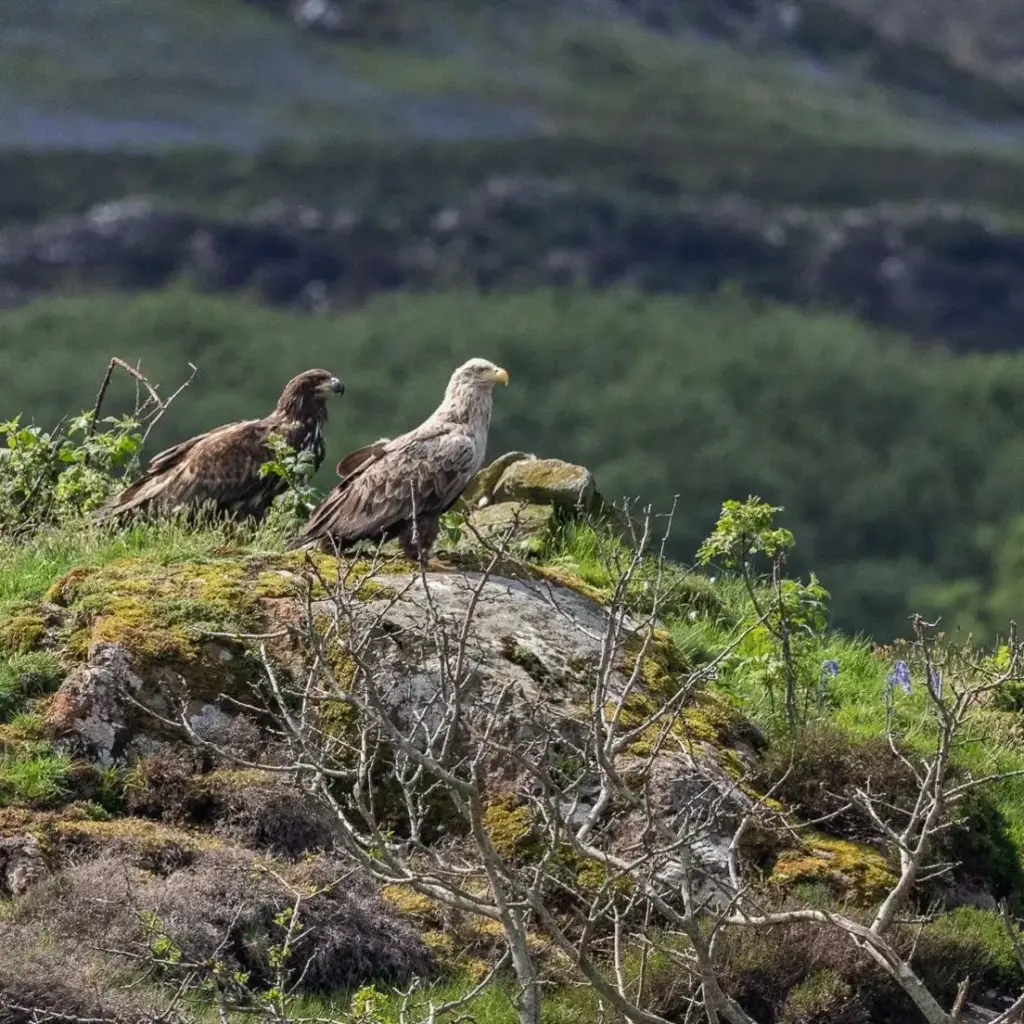
By Victoria Gill, Science Correspondent
Executive Overview
In the rugged, windswept landscapes of the Inner Hebrides, nature frequently writes stories of raw survival, but few have captivated ornithologists and wildlife conservationists quite like the white-tailed sea eagle known locally as "Kinky." Defying the grim statistical realities of avian trauma, predation, and the unforgiving Scottish climate, this remarkable raptor has once again been spotted soaring above the dramatic coastlines of the Isle of Mull.
Kinky’s journey from a doomed chick with a shattered wing to a resilient, semi-independent sub-adult is a narrative of biological improbability. Having plummeted from its cliffside nest during a violent storm in 2023, the young male white-tailed eagle (Haliaeetus albicilla)—the United Kingdom’s largest bird of prey—suffered a severe, compound wing fracture that experts predicted would be fatal. Yet, through a combination of parental devotion that broke standard avian behavioral norms and sheer tenacity, the bird has beaten the odds.
Now, three years after its initial catastrophic fall, recent photographic evidence confirms that Kinky has successfully navigated its first winter of solitude. As this extraordinary survivor enters the next precarious phase of its life cycle, its continued existence serves as a living testament to the resilience of a reintroduced species that clawed its way back from total British extinction a century ago.
Detailed Chronology: From Catastrophe to Coastal Flight
The Fall: Spring 2023
The saga began high on the rocky cliffs of the Isle of Mull during an unseasonably vicious spring storm in 2023. As gale-force winds lashed the rugged coastlines, buffeting ancient trees and nesting ledges alike, a fledgling white-tailed eagle chick was violently dislodged from its sanctuary.
The impact of the fall resulted in a severe, highly visible fracture to the left wing. For a young raptor dependent entirely on aerodynamic stability for survival, a broken wing is almost universally a death sentence. In the wild, flightless birds cannot hunt, cannot evade territorial adults, and quickly succumb to starvation or opportunistic predators. When local monitoring teams from the Royal Society for the Protection of Birds (RSPB) assessed the situation, expectations for the chick’s survival were virtually non-existent.
The Unprecedented Parental Response: 2023–2024
What followed next stunned seasoned ornithologists. Typically, white-tailed eagle parents invest heavily in a single breeding season, raising their young through the spring and summer before cutting ties in the autumn. This encourages juveniles to disperse and prepares the adults for the rigorous metabolic demands of the next year’s reproductive cycle.

However, Kinky’s parents exhibited a profound, behaviorally anomalous deviation from the norm. Recognizing their offspring’s profound physical disability, the adult pair refused to abandon him. In an extraordinary display of extended parental care, the mother and father continued to provision the flightless, injured juvenile with fish and small mammals well into his second year. Crucially, this level of investment required the adult pair to entirely skip a breeding season—a rare sacrifice in the avian world that ultimately bought Kinky the precious time his bones needed to calcify and heal.
Dave Sexton, a retired RSPB officer who has monitored Mull’s sea eagle population for over two decades, noted the uniqueness of the event. "The parents went above and beyond standard biological programming," Sexton observed. "By choosing to invest another entire year into a single, injured chick, they gave him a fighting chance that nature rarely affords."
The Solitary Milestone: 2024–2025
By late 2024, footage captured from local boats demonstrated that Kinky had begun experimenting with short, rudimentary flights, carrying a prominent, crooked wing where the bone had improperly fused, leaving a permanent structural bump.
The true test of the eagle’s viability, however, lay in the transition to independence. Would the bird, structurally compromised and dependent on parental handouts for over a year, be able to hunt, scavenge, and survive the biting Scottish winter alone?
The answer arrived with recent sightings in the south-east of Mull. Photographed by local wildlife enthusiasts Beth Sheils and Stephen Magee, Kinky was spotted soaring gracefully above Loch Spelve, a picturesque sea loch renowned for its tidal currents and rich marine life. The photographs confirmed that the bird had successfully navigated its first winter flying solo, its distinctive crooked wing slicing effortlessly through the North Atlantic wind.
Supporting Context & Metrics: The Rebuilding of a Giant
To understand the magnitude of Kinky’s survival, one must examine the precarious history of the white-tailed sea eagle in the United Kingdom. Often referred to as "flying barn doors" due to their massive wingspans—which can reach up to 2.5 meters (8 feet)—these apex predators were once a common sight across British coastal skies.
However, centuries of systematic persecution by farmers, landowners, and gamekeepers drove the species to the brink. The final nail in the coffin for the native British population occurred in 1918, when the last known breeding female in Shetland was shot dead. For over half a century, the British Isles were entirely devoid of their largest native raptor.

The Great Reintroduction Program
The resurrection of the white-tailed eagle stands as one of modern conservation’s greatest success stories:
- 1975: The Nature Conservancy Council (now NatureScot) initiated a daring reintroduction program, importing young eagles from Norway and releasing them onto the rugged Isle of Rum.
- 1980s: The pioneering birds naturally expanded their range, establishing a foothold on the neighboring Isle of Mull, which quickly blossomed into a global hotspot for sea eagle watching.
- Present Day: Thanks to decades of careful monitoring, legal protection, and community support, the UK population has grown into a self-sustaining network of hundreds of breeding pairs, with Scotland acting as the vital engine room for this population recovery.
Despite this macro-level success, individual survivability remains brutal. Juvenile mortality rates among white-tailed eagles are naturally high; roughly 50% to 60% of young eagles fail to survive their first three years due to starvation, disease, accidental poisoning, or collisions with infrastructure. Adding a severe skeletal deformity to this baseline equation makes Kinky’s ongoing survival statistically anomalous.
Official Statements & Expert Perspectives
The wildlife community on the Inner Hebrides has rallied around the bird, whose resilience has become a symbol of wild endurance.
"I am simply in awe of this bird," Dave Sexton remarked following the latest confirmed sightings near Loch Spelve. "You see a lot of things working in conservation over a 20-year career, but Kinky has rewritten the rulebook on avian adaptation. The way he compensates for aerodynamic drag with that fused, crooked wing joint is an absolute masterclass in physics and determination."
Photographers who have managed to capture the eagle in flight emphasize that despite its physical anomaly, Kinky does not appear to struggle with basic aerial maneuvers. Beth Sheils, who photographed the raptor in southern Mull, noted: "When you see him through the lens, the bump is unmistakable. But once he’s up in the thermals, he rides the wind just as confidently as any other sub-adult in the territory."
Future Outlook: The Perils of Sub-Adulthood
While Kinky has conquered infancy and mastered the art of solo flight, wildlife experts caution that the eagle’s trials are far from over. The bird has now entered the critical "sub-adult" life stage—a transitional window that brings its own distinct sets of social and territorial hazards.
White-tailed eagles are fiercely territorial creatures. Established adult breeding pairs stake out large, exclusive territories along the Scottish coastline, defending their hunting grounds and nesting sites from intruders.

"He is entering a very dangerous phase of his life," warned Dave Sexton. "Up until now, he has been viewed simply as an unfortunate youngster. But as he matures, established adult pairs will no longer tolerate an unfamiliar sub-adult lingering in their airspace. He is going to encounter some serious ‘you’re not welcome here’ behavior."
Territorial disputes among sea eagles can be vicious, involving aerial combat, talon-locking, and physical ground fights that can result in severe injury or drowning. For an eagle with a pre-existing structural weakness in its left wing, sustaining an attack from a healthy, fully grown territorial pair could prove catastrophic.
Nevertheless, those who have tracked Kinky’s progress remain stubbornly optimistic. The bird has already defied veterinary science, meteorological extremes, and biological predictions.
"Kinky is a born survivor," Sexton concluded, echoing the sentiments of conservationists and nature lovers across the UK. "He has beaten the odds at every single turn. I’m keeping everything crossed that his incredible luck—and his fierce will to live—holds out for many years to come over the Scottish coast."



