

Executive Overview
When South Korean battery titan LG Energy Solution (LGES) formally aborted its participation in an $8.45 billion integrated electric vehicle (EV) battery investment in early 2024, the announcement sent shockwaves through Jakarta’s economic ministries. Known internally as Project Titan, the ambitious initiative was designed as the crown jewel of Indonesia’s national economic vision: a fully integrated, end-to-end EV battery ecosystem spanning from raw ore extraction in eastern island provinces to high-tech battery cell manufacturing on the main island of Java.
The abrupt departure of LGES threatened to derail a central pillar of Indonesia’s industrial modernization policy—the hilirisasi (downstreaming) strategy pioneered under former President Joko Widodo and aggressively sustained by his successor, President Prabowo Subianto. The strategy mandates that Indonesia’s vast mineral wealth, particularly its world-leading nickel reserves, must be refined and processed domestically rather than exported as raw ore.
However, the vacuum created by LGES’s exit was short-lived. A consortium of Chinese industrial heavyweights rapidly stepped into the breach, injecting fresh capital, technical expertise, and supply chain commitments into Project Titan. This strategic realigning underscores two defining trends in the global energy transition: the growing reluctance of Western and allied Asian firms to commit heavy capital expenditures amid fluctuating EV demand, and Beijing’s unrelenting drive to secure a near-monopolistic grip over the global EV supply chain.
By bridging a 2,000-kilometer maritime supply route between the nickel-rich mines of East Halmahera in North Maluku and the manufacturing hubs of West Java, Project Titan is now set to proceed under Chinese stewardship—fundamentally altering the geopolitical geography of Southeast Asia’s clean energy transition.
       PROJECT TITAN: SUPPLY CHAIN LOGISTICS BRIDGE
       ===========================================

       [ East Halmahera (North Maluku) ]
            │
            │  • Raw Nickel Extraction (Limonite & Saprolite)
            │  • HPAL Refining (Mixed Hydroxide Precipitate)
            │  • Smelting & Intermediate Processing
            │
            ▼  ~2,000 km Maritime Transport Route
            │
       [ Karawang / Cikarang (West Java) ]
            │
            │  • Precursor & Cathode Fabrication
            │  • Battery Cell Manufacturing
            │  • Pack Assembly & Domestic/Export Distribution
Detailed Chronology: From South Korean Hesitation to Chinese Intervention
The saga of Project Titan mirrors the broader volatility of the global electric vehicle sector over the past four years, marked by shifting regulatory landscapes, shifting battery chemistry preferences, and geopolitical friction between Washington and Beijing.
+-------------------------------------------------------------------------------+
| TIMELINE OF PROJECT TITAN                                                     |
+-------------------------------------------------------------------------------+
| 2020          | Indonesia enforces full raw nickel export ban.                 |
| Dec 2020      | Indonesia signs initial $9.8B framework MoU with LGES.        |
| 2021–2022     | Feasibility studies stall over CapEx, equity, and HPAL tech.   |
| Aug 2022      | US passes Inflation Reduction Act (IRA) with FEOC rules.      |
| Late 2023     | Global EV growth slows; LGES reassesses CapEx exposure.       |
| Early 2024    | LGES formally exits Project Titan, citing market conditions.  |
| Mid 2024      | Chinese consortium steps in to take over equity and tech.     |
+-------------------------------------------------------------------------------+
The Origins of the Megadeal (2020–2021)
In December 2020, following Indonesia’s strict enforcement of a total ban on raw nickel ore exports, LG Energy Solution signed a non-binding Memorandum of Understanding (MoU) with the Indonesian government and state enterprise consortium Indonesia Battery Corporation (IBC). The proposed $9.8 billion framework (later recalibrated to an $8.45 billion dedicated scope for Project Titan) promised an integrated value chain:
- Upstream mining with state mining company PT Aneka Tambang (Antam);
- High-Pressure Acid Leaching (HPAL) refining;
- Precursor and cathode material fabrication; and
- A 10-to-30 gigawatt-hour (GWh) cell manufacturing plant in Karawang, West Java.
The Stalling Phase (2022–2023)
Despite public fanfare, progress bogged down almost immediately. Feasibility studies dragged on for years as LGES and its consortium partners clashed over key operational parameters:
- Capital Allocation & Equity Splitting: Disputes arose over the equity structure between Indonesian state enterprises and South Korean entities across upstream smelting versus downstream cell manufacturing assets.
- Technology Risk in HPAL: Processing low-grade limonite nickel ore into battery-grade Mixed Hydroxide Precipitate (MHP) via High-Pressure Acid Leaching requires high CapEx and carries significant operational risk. LGES hesitated to shoulder the technological burden alone.
- The US Inflation Reduction Act (IRA) Impact: Enacted in August 2022, the US IRA introduced stringent Foreign Entity of Concern (FEOC) restrictions. To qualify for lucrative US consumer tax credits ($7,500 per vehicle), EV batteries could not contain critical minerals processed by entities controlled by China or foreign adversaries. As Chinese firms already dominated Indonesia’s nickel smelting landscape, LGES realized that producing batteries in Indonesia risked disqualifying its North American customers from receiving US subsidies.
The Exit and the Chinese Takeover (2024)
Faced with a cooling global EV market, plummeting battery chemical prices, and geopolitical constraints in the United States, LGES officially pulled the plug on its participation in Project Titan, citing "unfavorable market conditions and strategic portfolio realignments."
Recognizing the existential threat to its industrial flagship, the Indonesian Ministry of Investment rapidly pivoted. Leveraging established relationships built during the development of the Morowali and Weda Bay industrial parks, Indonesian officials finalized negotiations with a consortium of Chinese battery materials producers and industrial developers.
By taking over LGES’s abandoned stakes and restructuring the joint ventures with Antam and IBC, the incoming Chinese consortium provided the required funding and HPAL operational expertise, ensuring Project Titan survived its most critical crisis.
Supporting Context & Metrics: Nickel Dynamics, Logistics, and Industrial Geography
To understand the strategic rationale of Project Titan, one must examine the economic and physical logistics connecting Indonesia’s remote islands to its industrial heartland on Java.
+-------------------------------------------------------------------------------+
| PROJECT TITAN: KEY METRICS AT A GLANCE                                         |
+-------------------------------------------------------------------------------+
| Total Envisioned Capital Expenditure | $8.45 Billion                          |
| Upstream Mining & Refining Hub       | East Halmahera, North Maluku           |
| Downstream Cell Manufacturing Hub    | Karawang / Cikarang, West Java         |
| Transport Distance (Maritime Route)  | ~2,000 Kilometers                      |
| Primary Upstream Ore Target          | Low-grade Limonite (0.9%–1.4% Nickel)  |
| Target Refining Technology           | High-Pressure Acid Leaching (HPAL)     |
| Intermediate Output                  | Mixed Hydroxide Precipitate (MHP)      |
| Secondary Output                     | Battery-grade Nickel Sulfate (NiSO4)   |
| Envisioned Initial Cell Capacity     | 10 GWh to 30 GWh annually              |
+-------------------------------------------------------------------------------+
The Spatial Divide: East Halmahera vs. West Java
Project Titan relies on a 2,000-kilometer maritime supply chain that connects resource extraction in Eastern Indonesia with heavy industrial manufacturing in Western Indonesia:
 EAST HALMAHERA (North Maluku)                 WEST JAVA (Karawang Hub)
  - Vast Limonite Nickel Reserves              - High-Skilled Labor & Infrastructure
  - Onsite HPAL Refineries                      - Precursor & Cathode Plants
  - Intermediate MHP Production                 - Battery Cell & Pack Assembly
            │                                              ▲
            │                                              │
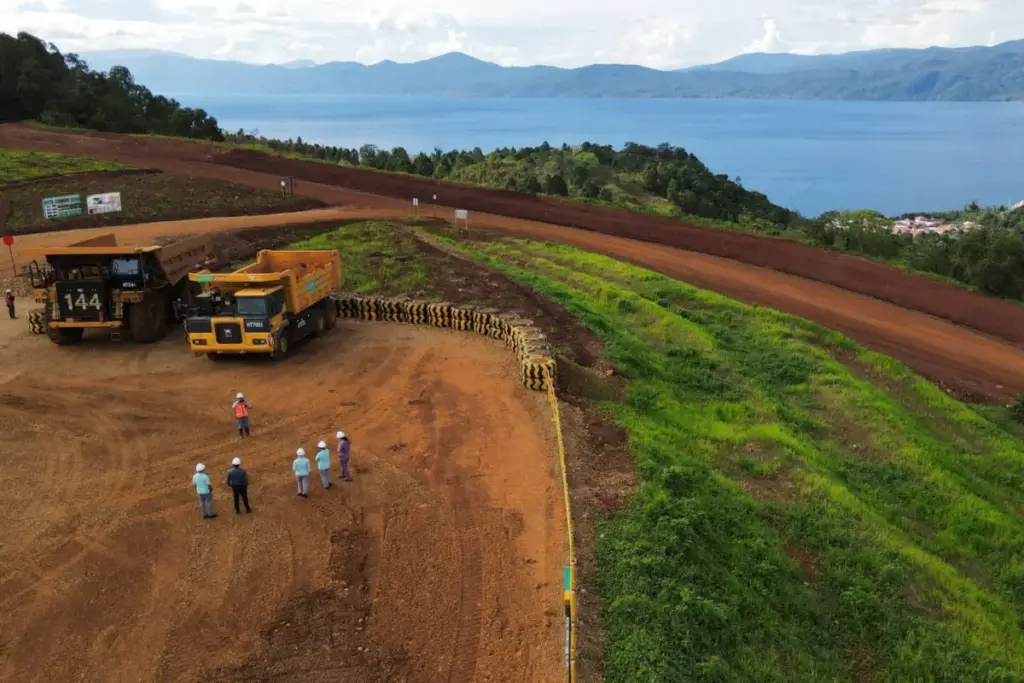
└──────────── ~2,000 km Sea Route ─────────────┘- East Halmahera (North Maluku): Located in the Maluku archipelago, East Halmahera holds some of the world’s dense concentration of limonite and saprolite nickel deposits. Under Project Titan, mining concessions in East Halmahera will feed directly into adjacent HPAL facilities. HPAL processing uses high temperatures and high pressure with sulfuric acid to leach nickel and cobalt from low-grade limonite ore (typically 0.9% to 1.4% nickel content), converting raw dirt into refined Mixed Hydroxide Precipitate (MHP).
- The Maritime Bridge: The processed MHP and nickel sulfates will be loaded onto specialized chemical bulk carriers and shipped ~2,000 kilometers southwest across the Maluku Sea, Java Sea, and into the ports of West Java.
- West Java (Karawang/Cikarang Industrial Corridor): Upon arrival in West Java, intermediate materials enter an advanced manufacturing hub. Here, MHP is further processed into battery-grade nickel and cobalt sulfates, synthesized into precursor cathodes, combined with lithium and manganese to produce active cathode materials, and finally assembled into lithium-nickel-manganese-cobalt (NMC) battery cells.
The Macroeconomics of Indonesian Nickel
Indonesia controls over 21% of global proven nickel reserves (over 21 million metric tons of contained metal), with unproven resources vastly exceeding this figure.
GLOBAL PROVEN NICKEL RESERVES SHARE (APPROX.)
=============================================
Indonesia : [####################] 21%
Australia : [#################] 17%
Brazil    : [##############] 15%
Russia    : [##########] 10%
Rest of Wld: [###################] 37%
Historically, Indonesia’s nickel was processed primarily through Rotary Kiln-Electric Furnace (RKEF) smelters to create Nickel Pig Iron (NPI) and ferronickel for the stainless steel sector. However, the EV revolution requires Class 1 battery-grade nickel, achievable primarily through HPAL plants.
By securing Chinese partners who have successfully commercialized low-cost HPAL technology in Indonesia (such as at the Morowali and Weda Bay complexes), Project Titan lowers capital cost per ton of production capacity compared to traditional Western-designed facilities.
HPAL CAPITAL EXPENDITURE PER TON OF CAPACITY (ESTIMATED)
========================================================
Western-Designed Projects : $65,000 - $100,000 / ton
Chinese-Engineered (Indo) : $30,000 - $45,000 / ton  [~50% lower CapEx]
Official Statements & Industry Reactions
The transition of Project Titan from a South Korean-led venture to a Chinese-anchored consortium has drawn sharp reactions across industrial, political, and financial sectors.
Indonesian Government Perspective
An official from Indonesia’s Ministry of Investment / Investment Coordinating Board (BKPM), speaking on condition of anonymity, underscored Jakarta’s pragmatic stance regarding capital deployment:
"Our priority has always been crystal clear: Indonesia will not remain a simple exporter of dirt. We gave our South Korean partners every opportunity over a three-year period to realize Project Titan. However, global market dynamics and internal corporate hesitation stalled progress. Indonesia cannot wait while the global energy transition accelerates. Our Chinese partners brought immediate capital, proven operational HPAL technology, and a commitment to maintain our downstreaming timeline. Project Titan remains alive, on track, and fully supported."
The Indonesia Battery Corporation (IBC) reinforced this stance, highlighting that the core target—establishing an integrated 10 to 30 GWh battery facility in Karawang—remains active despite the change in partner composition.
South Korean Corporate Position
In a formal disclosure statement regarding its broader capital reallocation strategy, LG Energy Solution framed its decision around financial discipline and market headwinds:
"While we recognize the immense long-term potential of Indonesia’s nickel ecosystem, various macroeconomic factors—including global EV demand adjustments, fluctuating battery raw material prices, and evolving international trade regulations—necessitated a reevaluation of our major CapEx projects. We remain committed to our existing joint venture commitments in Southeast Asia, but we must optimize our capital allocation to prioritize risk-managed returns."
Commodity & Financial Market Analysis
Industry analysts view the handover as a strategic win for Chinese capital, though one that comes with long-term market access trade-offs.
A senior analyst at a Singapore-based energy transition consultancy observed:
"LGES was trapped between two opposing forces. On one side, they wanted access to cheap, abundant Indonesian nickel. On the other side, Washington’s Inflation Reduction Act made it nearly impossible to utilize Indonesian nickel enriched by Chinese-dominated supply chains without losing access to lucrative US EV subsidies.
When LGES backed out, Chinese companies stepped in naturally. They don’t face the same US regulatory pressures for their domestic and non-US export supply chains. They have perfected the HPAL playbook in Maluku and Sulawesi, and they can execute faster and at roughly half the CapEx per ton of Western or South Korean competitors."
Future Outlook & Geopolitical Implications
The rescue of Project Titan by Chinese companies reinforces Beijing’s industrial footprint in Southeast Asia, while illustrating the fragmentation of the global clean energy economy.
+-------------------------------------------------------------------------------+
| PROJECT TITAN: DUAL REALITIES                                                 |
+-------------------------------------------------------------------------------+
| STRENGTHS / OPPORTUNITIES              | RISKS / CHALLENGES                   |
+----------------------------------------+--------------------------------------+
| • Rapid execution via proven Chinese   | • Exclusion from US market under     |
|   HPAL engineering.                    |   IRA Foreign Entity rules.          |
| • Full integration from mine (Maluku)  | • Environmental exposure regarding   |
|   to manufacturing (West Java).        |   tailings & carbon footprint.       |
| • Lowers unit capital expenditure per  | • High concentration risk on Chinese |
|   gigawatt-hour of capacity.           |   offtake and tech licenses.         |
+----------------------------------------+--------------------------------------+
The US-China EV Supply Chain Bifurcation
The takeover of Project Titan highlights a growing split in the global EV ecosystem:
- The Western / US-Centric Axis: Relying on supply chains that exclude Chinese ownership to comply with IRA Foreign Entity of Concern (FEOC) restrictions. This axis faces higher capital costs, raw material bottlenecks, and slower construction timelines.
- The Non-US / Global South Axis: Led by Chinese technology and Indonesian mineral wealth, this supply chain offers rapid scaling, lower CapEx, and cheap production costs. It targets domestic Southeast Asian markets, China, Europe, and non-US destinations.
By turning to Chinese capital for Project Titan, Indonesia has effectively signaled that maintaining the speed and scale of its industrial growth takes priority over strict alignment with US subsidy rules.
                  GLOBAL EV SUPPLY CHAIN BIFURCATION
                  ==================================

      WESTERN / US AXIS                     GLOBAL SOUTH / ASIAN AXIS
  (US, NAFTA, Select Partners)           (Indonesia, China, EU/Rest of World)
  ---------------------------           -----------------------------------
  • Strict IRA / FEOC Compliance        • Integrated Chinese Tech & Capital
  • Higher Capital Expenditures (CapEx) • Lower CapEx via Proven HPAL
  • Raw Material Scarcity Risks         • Rapid Scaling & Dominant Reserves
Operational & Environmental Challenges Ahead
Despite the successful transition, Project Titan faces operational hurdles:
- Tailings Management: HPAL refining generates high volumes of toxic residue (dry-stacked tailings or deep-sea tailing placement), presenting severe environmental risks in earthquake-prone island regions like East Halmahera.
- Carbon Footprint of Smelting: Much of the energy powering refining operations in North Maluku relies on captive coal-fired power plants. To market EV batteries globally—particularly in Europe, where strict battery carbon-footprint passports are coming into effect—Project Titan will need to rapidly integrate renewable energy into its processing hubs.
- Supply Chain Distance: Transporting hazardous intermediate materials (such as sulfuric acid and liquid nickel chemical streams) over 2,000 kilometers of maritime territory requires robust marine safety infrastructure to prevent accidental spills in delicate marine ecosystems.
Conclusion
The transformation of Project Titan from a South Korean venture into a Chinese-backed industrial engine demonstrates how market forces and policy decisions are reshaping the global energy transition.
As raw nickel moves from the red soils of East Halmahera across the Java Sea to advanced manufacturing plants in West Java, Indonesia moves closer to its goal of becoming an indispensable hub for electric vehicles. However, with Chinese capital now firming up its foundation, Project Titan stands as a stark reminder that Western efforts to decouple clean energy supply chains from Beijing face tough economic realities in the resource-rich nations of the Global South.



