

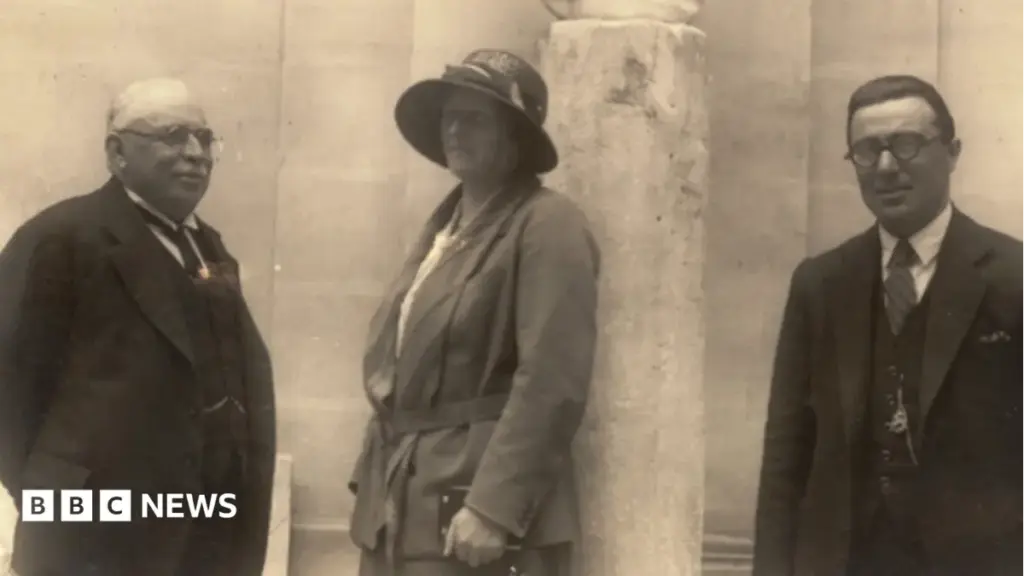
Executive Overview
In a long-overdue celebration of a formidable scientific trailblazer, the legacy of Dorothea Bate has been etched into history once more. A pioneering fossil hunter, self-taught researcher, and one of the very first women ever employed by the Natural History Museum, Bate has been posthumously honoured with a national blue plaque. Unveiled at the Natural History Museum in Tring, Hertfordshire—where she once served as Officer-in-Charge—the commemorative marker cement her status as a titan of palaeontology.
Bate, who passed away in 1951 at the age of 72, spent more than half a century unravelling the deep secrets of prehistoric ecosystems. Operating during an era when institutional science was almost exclusively the domain of men, she traversed rugged Mediterranean landscapes alone, unearthing extinct species and fundamentally reshaping our understanding of ancient environments. Despite publishing over 80 scientific papers and making groundbreaking discoveries that continue to inform modern evolutionary biology, Bate spent the vast majority of her career labouring without a permanent, salaried position.
This new blue plaque joins a previous tribute dedicated to her birthplace in Carmarthen, Wales, serving as a powerful institutional acknowledgment of her monumental contributions. As heritage bodies, government officials, and contemporary scientists rally to celebrate her life, Bate’s story emerges not merely as a historical footnote, but as a masterclass in resilience, intellectual curiosity, and the relentless pursuit of discovery against the odds.
Detailed Chronology: A Life Spent Unearthing Prehistory
Early Curiosity and Self-Taught Beginnings (1878–1900)
Born in Carmarthen, Wales, in 1878, Dorothea Minola Alice Bate developed an intense, consuming fascination with the natural world from an early age. While formal educational opportunities for women of her social standing were severely restricted during the Victorian era, Bate possessed an insatiable appetite for empirical observation.
As a young woman, she moved with her family to rural Gloucestershire. There, she spent countless hours exploring the undulating countryside, navigating treacherous subterranean caverns, and scouring the landscape for geological specimens. Without the benefit of a university education, Bate became largely self-taught, meticulously reading scientific texts and honing her eye for fossil identification.
By 1900, at the age of 22, Bate’s ambition crystallized. She boldly wrote to the Natural History Museum in London, requesting work behind the scenes. Her raw determination, coupled with an already impressive foundational knowledge of fossils, deeply impressed the museum’s staff. She was offered a position as an assistant—a milestone that marked the beginning of an extraordinary, half-century-long association with the institution and broke open the doors for future generations of women in the sciences.
Breaking Ground and Mediterranean Expeditions (1901–1910)
Bate wasted no time making her mark in the academic community. In 1901, she published her inaugural scientific paper, titled A Short Account Of A Bone Cave In The Carboniferous Limestone Of The Wye Valley. The publication signalled the arrival of a sharp, rigorous analytical mind capable of interpreting complex stratigraphical and osteological data.
Soon, Bate’s ambitions outgrew the British Isles. She embarked on a series of daring, solo expeditions across the Mediterranean. Travelling to remote, inhospitable, and often dangerous locations by herself, she sought out cave systems that held the fossilized remnants of ancient fauna.
Her field methods were meticulous and physically demanding. In Cyprus, her tenacity paid off when she discovered a previously unknown species of dwarf elephant (Palaeoloxodon cypriotes), a startling evolutionary adaptation driven by the ecological pressures of island isolation—a phenomenon known as island dwarfism.
Not one to rest on her laurels, Bate travelled to the Balearic Islands in 1909. There, she made another monumental discovery: the Myotragus balearicus, an extraordinary, extinct goat-like antelope characterised by forward-facing eyes and rodent-like incisors. These discoveries challenged prevailing paleontological paradigms and established Bate as a world-class authority on island biogeography and ancient vertebrate evolution.
Resilience Through Decades of Precarity (1911–1947)
Despite her staggering productivity and international acclaim, Bate’s professional life was characterized by breathtaking precarity. For the vast majority of her career, she operated without a permanent paid position or a steady salary, often relying on piecework, small grants, and sheer grit to sustain her research.
World Wars and global economic instability did little to deter her. While male colleagues were conscripted or shifted to wartime duties, Bate maintained her analytical work, continuously studying bone fragments, cataloguing specimens, and expanding the museum’s collections. Her ability to reconstruct entire biological profiles and ancient environments from mere fragments of bone became legendary within the scientific community. Over her lifetime, she authored more than 80 published scientific papers—a prolific output by any standard, let alone for someone working from the institutional margins.
Leadership, Later Years, and Legacy (1948–1951)
Recognition of Bate’s administrative and scientific capabilities finally materialized in a formal capacity later in life. In 1948, she was appointed Officer-in-Charge of the Natural History Museum’s outstation in Tring, Hertfordshire—the very site where her new blue plaque is now proudly displayed.
For the final years of her life, she managed the Tring museum with the same rigorous dedication that defined her field expeditions. Bate passed away in 1951 at the age of 72, leaving behind an intellectual legacy that fundamentally reshaped our understanding of how extinct species interacted with shifting ancient climates and geographies.
Supporting Context & Metrics: The Scale of Bate’s Impact
To fully appreciate the weight of Dorothea Bate’s blue plaque recognition, one must examine the metrics of her career against the socio-historical backdrop of 20th-century science.
- 50+ Years of Service: Her tenure at the Natural History Museum spanned over half a century, making her one of the longest-serving researchers of her era.
- 80+ Publications: She authored and co-authored more than 80 peer-reviewed scientific papers, spanning vertebrate palaeontology, archaeology, and quaternary geology.
- Pioneering Discoveries: Among her most celebrated finds were the Cyprus dwarf elephant and the Balearic Myotragus, both of which became landmark case studies in evolutionary biology regarding island dwarfing and anatomical specialization.
- Solo Expeditions: At a time when Victorian and Edwardian societal norms heavily discouraged women from travelling unchaperoned—let alone descending into dark, uncharted Mediterranean caves—Bate routinely undertook solitary field missions across Greece, Cyprus, Crete, and the Balearics.
- The Institutional Glass Ceiling: Bate entered the Natural History Museum at a time when women were explicitly barred from many scientific societies, professional posts, and university degrees. Her longevity and eventual leadership role at the Tring museum serve as a crucial historical bridge toward gender equity in the STEM fields.
Official Statements: Honoring a Scientific Giant
The unveiling of the blue plaque at the Natural History Museum in Tring elicited powerful reflections from contemporary heritage leaders, government officials, and senior scientists, all of whom underscored the transformative nature of Bate’s work.
In a joint statement, Historic England Co-CEOs Claudia Kenyatta and Emma Squire highlighted the intellectual drive that defined her existence:
"Dorothea Bate’s life was defined by her intense curiosity and desire to understand the natural world. She used this drive to make sense of ancient life through fragments of bone, bringing it to life once again. Her research transformed our understanding of prehistoric animals and ancient environments."
Kenyatta and Squire further emphasized her role as a gender pioneer:
"Not only does her work continue to be invaluable in the field that she helped to establish, but as one of the first women to be employed by the Natural History Museum, she was instrumental in paving the way for future women in science. This plaque ensures that her pioneering contributions to science receive the wider recognition it deserves."
Echoing these sentiments, Heritage Minister Baroness Twycross praised Bate’s capacity to overcome systemic barriers:
"Dorothea Bate’s achievements helped break through the glass ceiling and paved the way for women in palaeontology."
From within the institution that housed her life’s work, Dr. Sandra Knapp, Director of Research at the Natural History Museum, reflected on the often-invisible labour of female scientists throughout history:
"The role of women scientists in natural history is often hidden—but Dorothea Bate’s work with fossil mammals was both innovative and set a path for others, despite obstacles. The installation of this plaque not only honours her but also serves as a reminder that women have been, and continue to be, key contributors to our understanding of the natural world."
Future Outlook: Inspiring the Next Generation of Scientists
While a blue plaque is a physical marker affixed to a wall in Tring—joining her previous commemorative marker at Napier House in Carmarthen, unveiled in 2017—its broader cultural and educational implications extend far beyond Hertfordshire and Wales.
In recent years, the scientific community has undergone a concerted reckoning regarding the erasure of female, minority, and working-class pioneers from the annals of academic history. Figures like Dorothea Bate, who laboured in obscurity for decades despite foundational achievements, are finally being brought from the margins to the centre of public consciousness.
For young women entering the fields of geology, evolutionary biology, and palaeontology today, Bate stands as an ancestral role model. Her life demonstrates that curiosity, persistence, and scientific rigour can transcend systemic limitations, even when institutional structures lag behind individual brilliance.
As climate change and shifting ecosystems force modern scientists to look ever more closely at how prehistoric animals adapted to environmental pressures, Bate’s historical research on island species and quaternary environments remains profoundly relevant. Through national blue plaques, academic retrospectives, and public storytelling, Dorothea Bate’s legacy is permanently secured—ensuring that the woman who spent her life listening to the silent stories told by ancient bones will never again be forgotten.



