

Executive Overview
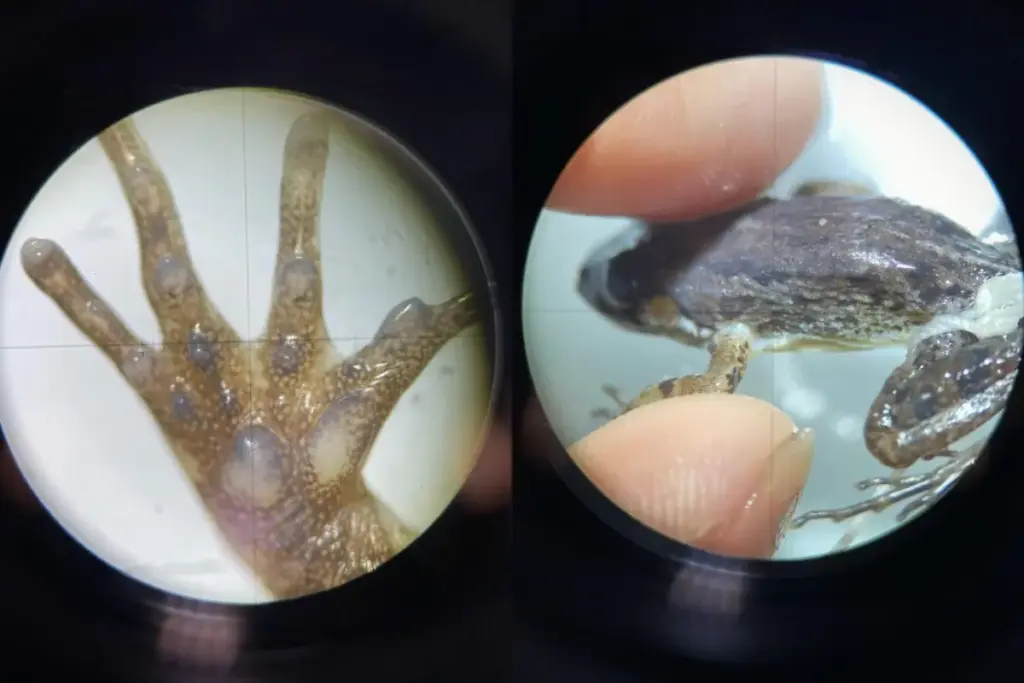
Deep within the damp, seasonally inundated floodplain forests of the Amazon basin, a tiny amphibian is quietly making evolutionary history. Measuring just 22 to 24 millimeters (roughly 0.9 inches)—about the size of a thumbnail—the newly described species Adenomera varcena blends seamlessly into the leaf litter of its tropical habitat. Adorned in unassuming shades of brown with subtle, dark blotchy patterns, this terrestrial, foam-nesting frog might easily be mistaken for any number of its close relatives by an untrained eye. Yet, beneath its unremarkable exterior lies a fascinating evolutionary divergence that has captured the attention of the herpetological community.
Described recently in the journal Ichthyology and Herpetology, Adenomera varcena was identified through a meticulous combination of acoustic analysis and genetic sequencing. While its physical traits are virtually indistinguishable from other members of the Adenomera simonstuarti species complex, its voice tells a radically different story. Unlike related species that produce rapid, rhythmic vocalizations numbering up to 70 notes per minute, A. varcena broadcasts an exceptionally sparse, slow-paced call consisting of just one to five notes per minute. This unhurried mating call represents the slowest vocal rate ever documented within its genus.
The discovery of Adenomera varcena is far more than a routine taxonomy update; it serves as a compelling case study in cryptic speciation and acoustic evolution. As human pressures, deforestation, and shifting climatic patterns continue to imperil the fragile ecosystems of South America, this unassuming forest dweller underscores a fundamental truth of conservation biology: we cannot protect what we do not know. This report explores the discovery, behavioral ecology, genetic lineage, and broader conservation implications of science’s newest Amazonian icon.
Detailed Chronology: From Genetic Hints to a Formal Description
The path to formally describing Adenomera varcena spans years of rigorous fieldwork, laboratory analysis, and taxonomic detective work across multiple Brazilian and international academic institutions.
The 2020 Genetic Breakthrough
The story of this cryptic frog began in earnest during a broad-scale genetic assessment of the Adenomera simonstuarti species complex. In 2020, herpetologist Thiago Carvalho of the Federal University of Minas Gerais (UFMG) in Brazil, alongside a team of collaborators, published a landmark study utilizing DNA sequencing to map out potential lineages within the group. Their molecular data hinted at a complex web of hidden diversity—revealing that what was long considered a single widespread species was actually a mosaic of at least nine genetically distinct groups. Among these genetic outliers was a lineage tentatively flagged for further investigation near the upper Juruá River basin.
Expeditions into the Flooded Forests (2021)
Acting on the molecular clues generated a year prior, researchers mounted targeted expeditions into the seasonally flooded forests of northwestern Brazil and neighboring Ecuador. In 2021, field teams braved the challenging terrain of the Amazonian floodplains to collect physical specimens, record auditory behaviors, and secure fresh tissue samples.

It was during this phase that Marianna Borburema—then an undergraduate student at the Federal University of Minas Gerais—became deeply immersed in the project. Tasked with analyzing the acoustic data, Borburema spent intensive weeks listening to and decoding the sonic signatures of the collected frogs. While her senior colleagues focused on the genetic sequencing, Borburema zeroed in on the acoustic divergence that would ultimately cement A. varcena as a distinct species.
The Formal Description (2025–2026)
Following extensive morphological comparisons, vocalization analyses, and final phylogenetic verifications, the formal scientific description of Adenomera varcena was published. The discovery expanded our understanding of Amazonian biodiversity and highlighted the invaluable contributions of early-career researchers who champion the ecological significance of oft-overlooked taxa.
Supporting Context & Metrics: The Science of Cryptic Speciation and Acoustic Evolution
To fully appreciate the significance of Adenomera varcena, one must examine the evolutionary pressures that shape Amazonian amphibians. In evolutionary biology, a "cryptic species" refers to two or more distinct species that are classified as a single nominal species because they are morphologically indistinguishable.
Morphology vs. Acoustic Selection
In the case of Adenomera varcena, natural selection has favored functional conservation of its body plan over visual diversification. Measuring between 22 and 24 millimeters, the frog’s drab brown coloration and mottled patterns provide camouflage against the damp, decomposing organic matter of the forest floor. However, because visual cues play a minimal role in mate selection within the dark, cluttered understory of the Amazonian floodplain, evolutionary pressure shifted decisively toward auditory signaling.
[Evolutionary Pressure in Amazonian Floodplains]
       │
       ├──> Visual Traits (Morphology): Stabilizing Selection (Remains cryptic, tiny, brown)
       │
       └──> Auditory Traits (Mating Call): Directional Selection (Rapidly evolving, hyper-slow song)
As lead author Marianna Borburema notes, evolution operates at a significantly accelerated pace within the acoustic repertoires of these frogs because the song is the primary driver of female choice.
A Record-Breaking Lack of Urgency
The vocalization metrics of Adenomera varcena shatter behavioral norms for the genus Adenomera. While typical species launch into frequent, high-tempo acoustic displays—sometimes reaching up to 70 notes per minute—A. varcena adopts a remarkably sluggish cadence:

- Call Frequency: 1 to 5 notes per minute (the slowest rate documented in the genus).
- Note Duration: Less than one-tenth of a second per note.
- Structural Rhythm: Completely lacks the pulsing modulation characteristic of most related species’ calls.
Describing this behavioral anomaly, Borburema remarked, "It’s as if the frog is feeling lazy." Yet, this minimalist auditory footprint is precisely what distinguishes A. varcena from sympatric relatives, preventing hybridization and maintaining reproductive isolation in the wild.
Ecological Divergence: The Floodplain Specialist
Beyond its unique song, Adenomera varcena stands out among its lineage due to its specialized habitat selection. While all its closest known relatives within the A. simonstuarti complex inhabit dry-land (terra firme) forests, A. varcena is uniquely adapted to life in seasonally flooded forests. This ecological shift underscores how micro-habitat specialization can drive lineage divergence in the sprawling Amazon basin.
Official Statements and Perspectives
The discovery of Adenomera varcena has sparked lively discussions within the scientific community, particularly concerning the subjective human biases often applied to wildlife conservation priorities.
Lead author Marianna Borburema, now a researcher at the University of São Paulo, shared her personal experiences defending her study organism against unfair aesthetic judgments:
"I’ve had to get into arguments because people said the frog I study is ugly. I find it absurd. The frog I study is beautiful! It is super cute."
Borburema’s passion highlights a broader ethical challenge in conservation: charismatic megafauna often monopolize public funding and affection, while small, cryptic organisms face institutional neglect. She emphasizes that every species plays an irreplaceable role in the planetary web of life, regardless of whether it meets conventional human standards of beauty:

"Even though it’s a small, brown frog that doesn’t call much, it is worthy of being studied, it is worthy of being known, and more than that, it is worthy of being protected. A species can only be protected if it is known."
Co-author Thiago Carvalho and the wider research team reinforce this perspective, noting that the vast hidden diversity within Amazonian micro-habitats remains severely under-documented. Their collaborative work serves as a reminder that cutting-edge taxonomic tools—such as next-generation sequencing and bioacoustic monitoring—are essential instruments for revealing the hidden richness of tropical biomes before anthropogenic threats erase them.
Future Outlook: Conservation Challenges in the Amazonian Floodplains
The formal identification of Adenomera varcena opens critical new avenues for future ecological research and environmental stewardship. However, it also casts a spotlight on the mounting vulnerabilities facing Amazonian floodplain ecosystems.
Threats to Seasonally Flooded Forests
Floodplain forests (várzea and igapó habitats) occupy a dynamic ecological niche subject to annual hydrological cycles. These zones are increasingly threatened by upstream deforestation, agricultural expansion, hydroelectric dam construction, and the escalating impacts of global climate change, which alter rainfall patterns and flood regimes. Because A. varcena relies explicitly on these specialized floodplain environments—unlike its dry-forest relatives—any disruption to local hydrology could have catastrophic consequences for its localized populations.
Priorities for Future Research
- Distribution Mapping: Field surveys must be expanded across broader swaths of Brazil, Ecuador, and potentially Peru to determine the exact geographical boundaries and population densities of Adenomera varcena.
- Behavioral Ecology: Further studies are required to investigate the reproductive biology of this foam-nesting frog, specifically how its unique foam nests withstand seasonal flooding events.
- Conservation Status Assessment: Armed with comprehensive distribution data, conservation bodies must formally evaluate Adenomera varcena for inclusion on the IUCN Red List of Threatened Species, ensuring it receives appropriate legal and regulatory protections.
Conclusion
The tale of Adenomera varcena—the tiny, slow-singing sentinel of the Amazonian floodplains—is a testament to the wonders still waiting to be uncovered in the world’s most biodiverse tropical forests. It reminds us that nature’s most profound evolutionary innovations often occur in the quietest corners, whispered through a song that takes its own sweet time. By championing the study and protection of creatures like A. varcena, science moves one step closer to safeguarding the full, intricate tapestry of life on Earth.



