

Executive Overview
For over a century, modern agriculture has been shackled to a chemical paradox. Synthetic fertilizers—made possible by the monumental Haber-Bosch process—have effectively sustained the global food supply, allowing the Earth to support a population hurtling past eight billion people. Yet, this life-sustaining chemistry comes at a staggering ecological and economic price. The commercial production of synthetic nitrogen accounts for approximately 2% of global greenhouse gas emissions, demanding astronomical amounts of energy, predominantly driven by natural gas.
Today, this fragile equilibrium is facing unprecedented stressors. Geopolitical instability, most notably conflicts in energy-producing regions like Iran, has triggered violent volatility in global energy markets, causing synthetic fertilizer prices to skyrocket. Simultaneously, farmers find themselves squeezed by shrinking commodity crop prices and ballooning operational expenses. The traditional model of agriculture is straining under its own weight.
Enter the microscopic world. A new wave of agricultural biotechnology companies is pioneering a paradigm shift by harnessing the power of the soil microbiome. By introducing engineered beneficial microbes to crop root systems, these startups aim to unlock the atmosphere’s nearly endless supply of nitrogen and deliver it directly to plants. Leading this charge is a California-based startup called Switch Bioworks, which is utilizing sophisticated genetic switches to solve a biological hurdle that has baffled researchers for decades: how to make microbes colonize and thrive before they expend their precious energy manufacturing nitrogen.
While established pioneers like Pivot Bio have blazed the trail by commercializing microbial products across millions of acres, next-generation firms are refining the technology to make biologicals a mainstream agricultural input. Though microbes cannot entirely replace synthetic fertilizers—current models cap their replacement potential at roughly 25% to 50%—their widespread adoption represents one of the most promising frontiers for decarbonizing a notoriously hard-to-abate sector. As field trials progress and economic pressures mount, the next decade may well witness the transition of biological fertilizers from niche green alternatives to essential pillars of global food security.
Detailed Chronology: The Evolution of Agricultural Nitrogen
The Pre-Industrial and Early Industrial Eras
For millennia, human agriculture relied on natural biological systems and organic inputs to maintain soil fertility. Farmers utilized crop rotations, cultivating legumes that naturally harbor symbiotic, nitrogen-fixing bacteria within root nodules, alongside animal manure and compost. While effective, these methods were constrained by geography, labor, and scale.
The dawn of the 20th century shattered these limits. Chemists Fritz Haber and Carl Bosch perfected a high-pressure, high-temperature catalytic process that reacted atmospheric nitrogen with hydrogen derived from natural gas to produce ammonia. This chemical breakthrough democratized synthetic fertilizer production, supercharging crop yields and shielding humanity from widespread food scarcity. However, it also severed agriculture’s reliance on biological cycles, binding food production inextricably to fossil fuel consumption.
The Rise of Microbial Competitors (2011–2020s)
As the environmental toll of synthetic fertilizers became undeniable, scientists began looking back to nature for answers. In 2011, a company named Pivot Bio was founded with the explicit mission of replacing synthetic nitrogen with engineered microbes. Over the ensuing decade, Pivot Bio expanded its footprint, deploying microbial products across millions of acres of farmland in the United States and evolving its portfolio from seed-applied treatments to broad-acre applications across corn, cotton, wheat, sorghum, and barley.
Despite these successes, early microbial solutions faced significant biological bottlenecks. Microbes engineered to produce nitrogen often did so indiscriminately, depleting their own cellular energy reserves and stunting their growth before they could successfully establish themselves around plant root systems.
The Next Frontier: Switch Bioworks and Genetic Switches (Present Day)
Recognizing the limitations of early microbial fertilizers, modern startups are engineering smarter, more adaptable biological agents. Founded on the premise that agricultural inputs must be fundamentally re-engineered, Switch Bioworks is spearheading a novel approach. Rather than forcing microbes to pump out nitrogen continuously, the company utilizes a "genetic switch"—a precise sequence of DNA that dictates when specific genes are turned on or off.
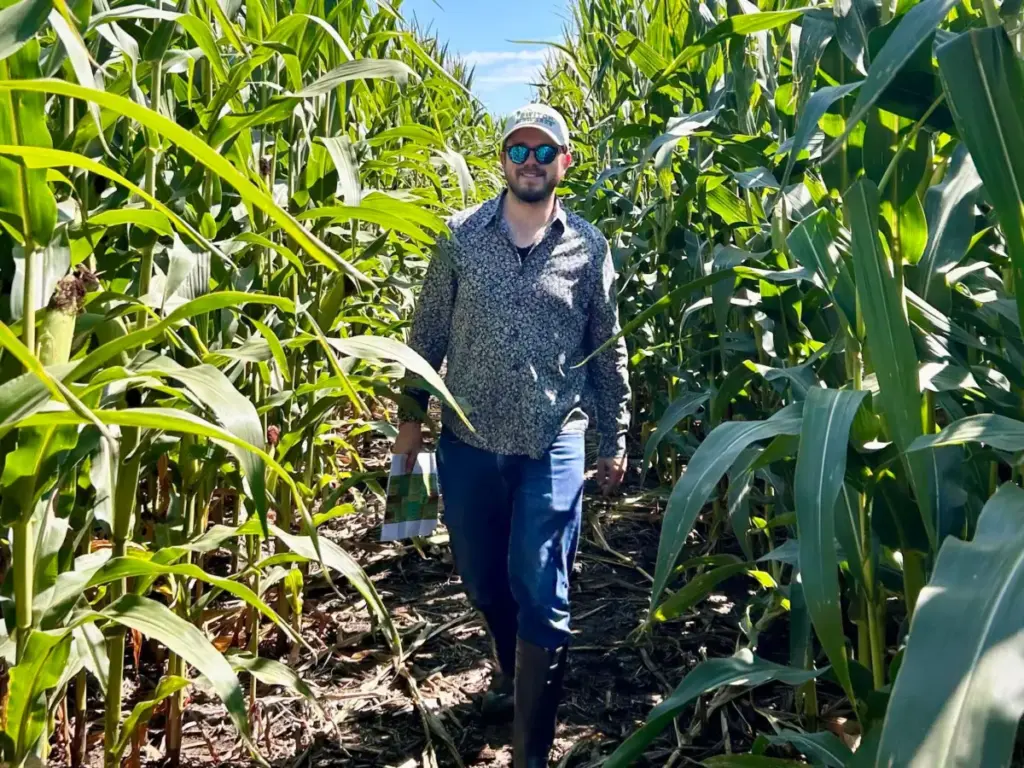
By designing microbes that monitor environmental cues, such as dropping nitrogen levels in the surrounding soil, Switch ensures that its bacterial colonies establish healthy, robust populations before shifting into high-yield, nitrogen-producing mode. As of late 2026, the company is conducting early-stage field trials across six U.S. states, focusing heavily on corn—the nation’s most heavily planted crop, spanning over 90 million acres. While commercial availability remains two to three years away, visual evidence from ongoing trials suggests that treated crops are already exhibiting healthier development compared to untreated control plots.
Supporting Context & Metrics: The Chemistry, Economics, and Environmental Toll
The Nitrogen Paradox
To understand the necessity of microbial fertilizers, one must examine the chemical reality of nitrogen. The air we breathe is approximately 80% nitrogen gas ($N_2$). However, this atmospheric nitrogen is biologically inert; its atoms are bound by a robust triple covalent bond that plants cannot break down and utilize directly.
For plants to grow, they require "fixed" nitrogen—reactive compounds like ammonia ($NH_3$) or nitrates ($NO_3^-$). In natural ecosystems, certain free-living soil microbes and symbiotic bacteria (such as Rhizobium in legumes) possess the enzyme nitrogenase, which allows them to break the triple bond and fix atmospheric nitrogen. Synthetic fertilizers mimic this process industrially via the Haber-Bosch process, consuming vast quantities of natural gas and generating massive carbon dioxide emissions in the process.
The Economic Squeeze on Growers
Farmers today are navigating what industry experts term a "double whammy" of adverse macroeconomic conditions. On one side of the ledger, input costs—particularly synthetic fertilizers and specialized seeds—have surged dramatically. Recent geopolitical conflicts, including the war involving Iran, have severely disrupted global energy markets, sending the price of natural gas and, by extension, synthetic nitrogen fertilizers soaring.
On the other side of the ledger, prices for major commodity crops like corn have experienced downward pressure. This margin compression has forced growers to re-evaluate their operational expenditures.
+-----------------------------------------------------------------+
|                    THE GROWER'S ECONOMIC PINCH                  |
+-----------------------------------------------------------------+
|  [ Rising Input Costs ]           [ Falling Commodity Prices ]  |
|  - Synthetic fertilizers          - Corn                        |
|  - High energy/natural gas prices - Wheat                       |
|  - Premium seed technologies      - Sorghum & Barley            |
+-----------------------------------------------------------------+
                                 │
                                 ▼
+-----------------------------------------------------------------+
|                 THE BIOLOGICAL SOLUTION                         |
|  - Microbial seed treatments (Pivot Bio, Switch Bioworks)       |
|  - 25% to 50% synthetic fertilizer offset                       |
|  - Reduced exposure to energy market volatility                 |
+-----------------------------------------------------------------+
Biological fertilizers offer a dual economic benefit: they provide a cheaper source of vital nutrients while insulating farmers from the erratic price swings of the fossil-fuel-dependent fertilizer market.
Replacement Ceilings and Environmental Realities
Despite the enthusiasm surrounding agricultural biotechnology, researchers and industry leaders emphasize that microbes are not a silver bullet capable of entirely eradicating synthetic fertilizers in the near term.
Current modeling and field data indicate clear biological ceilings:

- Initial Replacement Capacity: First-generation commercial microbial products typically offset roughly 25% of a farm’s total synthetic fertilizer requirement.
- Maximum Projected Capacity: Advanced modeling by companies like Switch Bioworks suggests that future iterations may cap out at replacing approximately 50% of synthetic inputs.
- The Long-Term Outlook: According to agricultural policy experts, there is no plausible technological roadmap to eliminate synthetic fertilizers entirely within the foreseeable future. Consequently, managing agricultural emissions will require a multifaceted approach combining microbial biologicals, precision agriculture, and enhanced land-management practices to mitigate nitrogen runoff and pollution.
Official Statements and Industry Perspectives
The transition from chemical dominance to biological integration has sparked intense discussion among agricultural scientists, biotech executives, and environmental policy analysts.
Tim Schnabel, Founder and CEO of Switch Bioworks:
Addressing the core philosophy of his company and the current stage of product development, Schnabel emphasizes the complexity of reinventing agricultural inputs:
"We have to reinvent fertilizer. You have this inherent biological reality, where it’s really expensive for microbes to fix nitrogen. It’s too early to tell exactly how well this works in the field. But as of August, some corn plants treated with Switch microbes already looked visibly healthier than those that hadn’t been."
Dan Blaustein-Rejto, Director of Food and Agriculture at the Breakthrough Institute:
Highlighting the dual challenge of microbial energetics and the broader environmental significance of the sector, Blaustein-Rejto notes:
"It takes a lot of energy, and if they do fix the nitrogen, they want to use it for themselves, to build proteins and survive. Adding genetic switches could help microbes grow and thrive and then help fertilize crops. There’s a lot of potential for these companies and products to help farmers reduce emissions. This could be a really important solution for a quite hard-to-abate sector."
Blaustein-Rejto also underscores the necessity of rigorous, independent scientific validation before commercial claims can be widely accepted:
"This is one of the final steps before they can go to market and make strong claims to farmers. Independent trials are important as well, since there can be a large gap between a company’s reported data and what independent researchers find."
Travis Frey, Chief Technology Officer at Pivot Bio:
Reflecting on the market dynamics and the maturation of the agricultural biologicals space, Frey points to a structural shift in grower adoption:
"Growers right now are experiencing a double whammy from the farm economics point of view. Fertilizer costs are going up, and the price of commodity crops like corn has dropped. This next decade is when biologicals on the farm are going to go mainstream."
John Havlin, Professor of Crop and Soil Sciences at North Carolina State University:
Offering an academic perspective on the integration of microbial solutions into traditional agronomy, Havlin states:
"I’m very excited about the future of the use of these products. They’ll eventually have a role to play to reduce the load of nitrogen that’s being applied. Fertilizer and seeds are two of the biggest costs for many growers, so reducing dependence on synthetic fertilizers could be a major help for agriculture."
Future Outlook: The Path to Mainstream Adoption
As agricultural biotechnology enters its next critical decade, the trajectory of microbial fertilizers will depend on a delicate interplay between laboratory innovation, rigorous field validation, and economic necessity.
1. Scaling Field Trials and Independent Validation
For startups like Switch Bioworks—currently navigating multi-state field trials leading up to a targeted commercial launch in two to three years—the immediate hurdle is consistency. Proving that genetically switched microbes can perform reliably across diverse soil types, weather patterns, and farming practices is paramount. The incorporation of independent academic and third-party field trials will serve as the definitive proving ground, establishing trust among risk-averse growers.
2. Broadening Crop Applications and Delivery Mechanisms
Following the path forged by pioneers like Pivot Bio, future microbial technologies will likely expand beyond primary row crops like corn, wheat, and cotton into specialty horticulture and orchards. Innovations in delivery mechanisms—shifting from liquid in-furrow applications to advanced seed coatings applied long before the seed reaches the farm—will further reduce logistical friction for farmers.
3. Navigating Regulatory and Public Acceptance Landscapes
As genetically engineered microbes move out of contained laboratory environments and into open agricultural ecosystems, regulatory oversight will intensify. Ensuring environmental safety, preventing unintended ecological disruption, and securing public trust in synthetic biology applications will be critical milestones for the industry.
4. A Hybrid Future for Global Agriculture
Ultimately, the future of farming will not be an absolute binary between synthetic chemistry and natural biology. Instead, the agricultural sector is moving toward an integrated hybrid model. While synthetic nitrogen fertilizers will remain necessary to sustain baseline global caloric production for the foreseeable future, biological fertilizers will carve out a substantial, indispensable niche. By clipping the wings of agricultural emissions, easing the financial burden on growers, and introducing biological resilience into the soil, microbes are quietly laying the groundwork for a more sustainable, economically viable agricultural renaissance.



