

By Bianca Crowley, Digital Collections Manager, Biodiversity Heritage Library
Special Contribution: Part of the "BHL at 20: Treasures from the Biodiversity Heritage Library" series celebrating two decades of open-access biodiversity literature.
Executive Overview
For the Biodiversity Heritage Library (BHL), the true treasures of our collection extend far beyond the physical pages of rare books, historical journals, and centuries-old archives. While the scientific significance of our digital repository cannot be overstated, the real marvel lies behind the scenes: the tireless, multi-year labor of global partners working across institutional and international boundaries to bring these fragile resources from dusty library shelves onto computer screens worldwide.
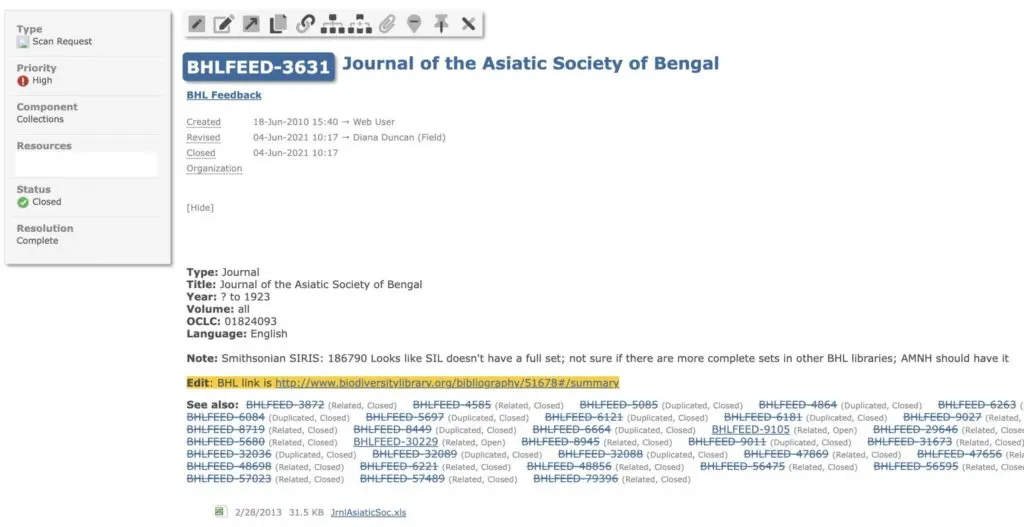
In celebration of BHL’s 20th anniversary, this retrospective examines one of our most ambitious collaborative milestones—the complete digitization of the historic Journal of The Asiatic Society and its legacy publications. Spanning an astonishing 11 years, nine institutions, 19 dedicated contributors, and countless cross-continental communications tracked through 40 issue tickets, this project encapsulates the resilience, grit, and cooperative spirit that defines BHL.
Operating without centralized funding, dedicated digitization staff, or permanent grants since the conclusion of our landmark MacArthur Foundation funding in 2013, BHL relies on a distributed labor model. The successful rescue and public archiving of the Asiatic Society legacy volumes—culminating in June 2021—serves as a case study in modern digital preservation, demonstrating how global networks can achieve monumental tasks through shared commitment and agile organization.
Detailed Chronology: 1 Journal, 9 Institutions, 11 Years
The genesis of this massive undertaking dates back to June 2010, when founding BHL institutions initiated a specialized digitization pipeline targeting the comprehensive series associated with the Journal of The Asiatic Society.
The roots of the publication stretch back much further. Founded in Kolkata in 1784 by Sir William Jones through British India’s highest court, the Asiatick Society was established to study the "History, Civil and Natural, the Antiquities, Arts, Sciences, and Literature of Asia." More than 240 years later, The Asiatic Society remains a cornerstone of global scholarship and holds the distinction of being India’s oldest surviving publishing house. Recognized by the Indian government as an Institution of National Importance, its historical publications span from 1788 to the present day, covering an extraordinarily broad interdisciplinary spectrum across the cultural and natural sciences, including pioneering work in medicine and literature.

To capture this vast legacy, BHL consortium members had to systematically track down, assess, scan, and curate public-domain volumes scattered across disparate collections worldwide. Because participating organizations contributed resources strictly as time and institutional capacity allowed, the project progressed in waves.
The work required continuous coordination among nine distinct partner organizations. Over the course of 11 years, 19 individuals actively touched the project, logging 40 discrete issue tickets and generating over 82 collaborative comments within BHL’s internal tracking systems. It was not until June 2021 that BHL was finally able to declare the digitization of all public-domain volumes of the Journal and its legacy titles "complete" to the best of its ability.
Today, BHL is proud to provide free, open-access digital availability to a rich suite of these historical titles, accommodating various name changes throughout the journal’s publication history, alongside complementary resources such as the Memoirs and diverse independent Asiatic Society publications.
Supporting Context & Metrics: Scanning Locally, Coordinating Globally
Managing a distributed, cross-border digitization initiative over more than a decade requires robust infrastructure. For BHL, that backbone has been our internal Gemini issue tracking system.
Deployed decades ago, Gemini functions as the definitive source of truth for internal projects, website maintenance, troubleshooting, and collection enhancement. While issue-tracking systems are traditionally built for software development or customer support, adapting Gemini to manage library cataloging gaps, physical book conditions, scanning priorities, and institutional workflows required years of structural refinement.
The metrics behind the Asiatic Society project reveal the sheer scale of operational overhead required:

- Duration: 11 years (June 2010 – June 2021)
- Participating Institutions: 9 founding and partner organizations
- Active Contributors: 19 individual catalogers, managers, and technicians
- Tracking Overhead: 40 formal tickets, 82+ collaborative comments, and continuous cross-checking
Without such a system, coordinating the nuanced back-and-forth among a globally dispersed workforce would have been impossible. It provided a transparent, centralized platform where partner institutions could bridge geographical divides, resolve metadata discrepancies, identify physical gaps in the literature, and execute complex curation tasks.
The Realities of a Distributed Labor Model
Why did a single journal series take 11 years to digitize? The answer lies in the unique operational model of the Biodiversity Heritage Library.
Despite operating as the world’s largest open-access digital library for biodiversity literature—housing tens of millions of pages—BHL does not maintain dedicated, centralized digitization or cataloging staff. Instead, our network of partner institutions voluntarily contributes what they can from their own local resources.
Following the conclusion of critical grant funding through the MacArthur Foundation in 2013, participating institutions have routinely navigated fluctuating budgets, shifting administrative priorities, and staffing constraints. Furthermore, technical hurdles frequently slowed progress:
- Inconsistencies and legacy errors in global catalog records
- The delicate physical condition of fragile, centuries-old paper volumes
- Variations in local digitization equipment and hardware capabilities
- Software bugs, platform transitions, and evolving documentation standards
This organic, decentralized framework allows institutions to participate autonomously, contributing when time and funding permit. However, it also means that long-term projects are inherently vulnerable to institutional ebbs and flows.
Official Statements & Perspective
Reflecting on the completion of the Asiatic Society project, Digital Collections Manager Bianca Crowley emphasizes that the success of BHL is fundamentally rooted in human persistence rather than automated scale.

"As the Digital Collections Manager for the Biodiversity Heritage Library, my take on the treasures of BHL’s collection is less about the content or significance of any particular title, and more about the work over many years behind the scenes by the people within BHL partner institutions to bring these treasures from the shelves to the screen and make them accessible and discoverable for anyone with an internet connection."
This sentiment forms the cornerstone of BHL’s identity as it celebrates its 20th anniversary. The organization’s guiding philosophy maintains that sustainability is not just about keeping servers online, but about continuously nurturing the human networks that expand and preserve the historical record of life on Earth.
Future Outlook: Modernizing for Efficiency and Sustainability
As BHL steps into a new chapter—marked by a transition toward a more autonomous, globally distributed shared-ownership model independent of any single host institution—leadership is actively evaluating how to streamline future digitization pipelines.
While the 11-year timeline for the Asiatic Society publications demonstrated extraordinary dedication, it also highlighted systemic inefficiencies that the library aims to resolve. Guided by BHL’s core collection development priorities—access, usability, discovery, and breadth—the organization is formulating a platform modernization plan designed to make cross-institutional collaboration faster, smarter, and more agile.
Key strategic goals for the road ahead include:
- Streamlining Workflows: Reducing administrative friction in tracking systems to shorten project lifecycles.
- Enhancing Metadata Interoperability: Upgrading cataloging standards to minimize friction when integrating multi-institutional contributions.
- Deepening Global Partnerships: Expanding collaborative networks into regions historically underrepresented in digital biodiversity archives.
- Securing Long-Term Financial Resilience: Transitioning away from purely volatile grant-dependent models toward sustained, recurring support structures.
While the exact mechanisms of future projects remain to be written, the completion of the Asiatic Society legacy volumes stands as an enduring proof-of-concept. It proves that when dedicated professionals share a common vision of open access, geographical and institutional barriers can be successfully overcome.

Support BHL’s Next Chapter
BHL’s treasures are not merely the books, journals, and illustrations housed within our database—they are the people whose collaboration, care, and persistence bring them to the world. For two decades, our global community has worked across borders to open biodiversity knowledge for everyone.
To help us sustain this vital long-term work, please consider supporting the Biodiversity Heritage Library through a recurring donation, membership, or planned gift. Together, we can ensure that the stories of our natural world remain open, free, and accessible for generations to come.



