

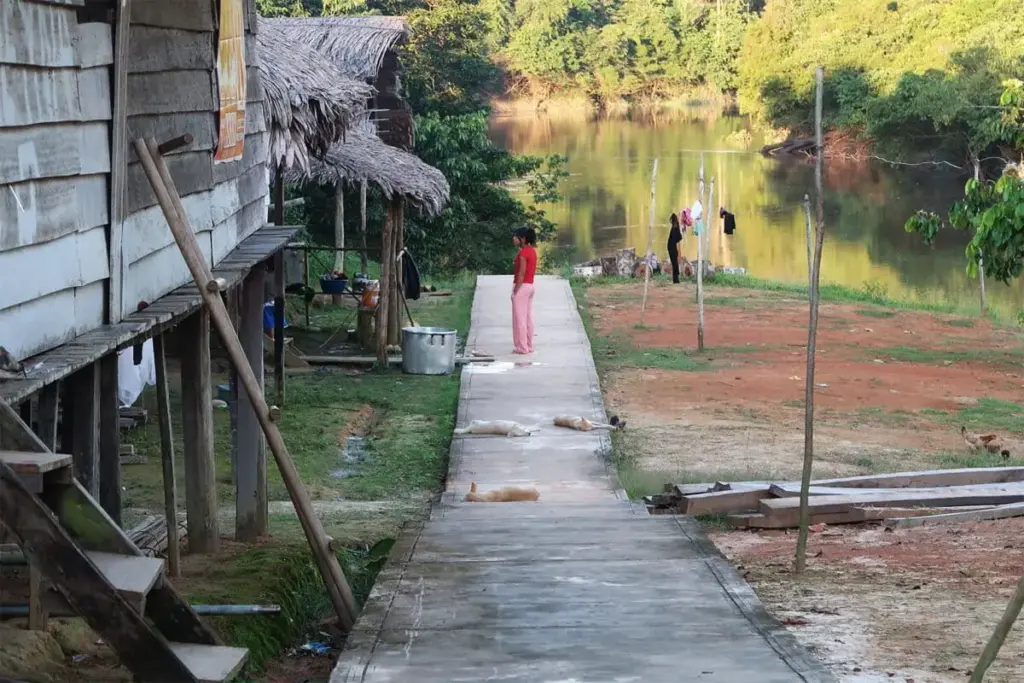
In the remote expanses of the Peruvian Amazon, an escalating confluence of environmental collapse, state neglect, and infectious disease has created a silent catastrophe for the Indigenous Matsés community. Originally setting out to document external environmental threats to Matsés territory as part of a broader investigation into the Yavari-Tapiche territorial corridor, Mongabay staff writer Aimee Gabay uncovered a starkly different and far more urgent reality. Instead of focusing solely on deforestation or illegal extraction, every conversation with community members quickly pivoted to an invisible, devastating invader: an epidemic of malaria and hepatitis B.
Decades after their historic, voluntary initial contact with the outside world in 1969—undertaken to escape violent encroachment by rubber tappers and government bombings—the Matsés remain critically vulnerable. Lacking the historical immunological defenses of populations constantly exposed to modern pathogens, they now face mounting mortality rates. This crisis is aggressively compounded by severe climate anomalies, including prolonged droughts that dry up the river arteries essential for regional transit. While the Peruvian government maintains formal health protocols and guidelines for isolated and recently contacted Indigenous populations on paper, systemic bureaucratic inertia, budget cuts, and a failure of implementation have left the community stranded. With a looming El Niño event threatening to deepen the dry season, the health crisis not only imperils the Matsés but also threatens neighboring groups living in voluntary isolation within the wider Amazonian basin, highlighting a critical flashpoint in planetary health.
Detailed Chronology: From First Contact to Present Crisis
The Historical Context of 1969 and the Decision to Reach Out
The contemporary vulnerabilities of the Matsés cannot be understood without examining their history. Until 1969, the community lived in voluntary isolation deep within the Peruvian Amazon. However, their lands were increasingly invaded by outsiders, most notably rubber tappers, leading to volatile conflicts. In a particularly brutal historical episode, when the Peruvian government attempted to clear Matsés territory for road construction, the community defended their ancestral lands. In response, the government called upon the U.S. Air Force, stationed in Panama, to drop bombs on Matsés communities, obliterating their traditional communal longhouses (malocas) and forcing them to flee into the forest.
Constant displacement disrupted their traditional nomadic hunting and gathering patterns, severely impacting food security. Exhausted by relentless violence and the constant threat of annihilation, a small group of Matsés made the brave and desperate decision in 1969 to initiate peaceful contact with evangelical missionaries. While they viewed this plunge as necessary to secure the survival of their people, it instantly exposed them to a barrage of novel diseases against which they possessed zero immunity.
Generations of Epidemics and the Modern Health Emergency
Elder Roberto Necca Tumi Unan, one of the last surviving members of the Matsés born before first contact, recalls a childhood spent hiding from outsiders under a canopy of leaves to evade lethal confrontation. He remembers an era before the introduction of foreign pathogens, when entire families did not succumb to sudden, mysterious illnesses.
Decades after that initial contact, the community continues to grapple with wave after wave of infectious outbreaks, including influenza, malaria, and hepatitis B. While malaria is directly tied to environmental parameters, hepatitis B—which is sexually transmitted—wreaks havoc through its compounding socio-economic and logistical effects. Chronic hepatitis B, left untreated, advances to severe conditions such as cirrhosis, resulting in agonizing degeneration and, ultimately, death.
Matsés Chief Leo Chuma Teca Beso has traveled thousands of miles from the jungle to the urban centers of Iquitos and Lima to plead for governmental assistance. According to Chief Leo, the situation has degraded to the point where community members who manage to secure transport to Iquitos frequently die destitute on the city streets because their illnesses have progressed far past the threshold of effective medical intervention.
Supporting Context & Metrics: Climate Change, Isolation, and the Yavari-Tapiche Corridor
The Mechanics of Climate-Driven Disease Proliferation
Climate change acts as a primary multiplier of the Matsés health crisis. The relationship between environmental degradation and disease is multifaceted:
- Malaria and the Forest Fringe Effect: Prolonged droughts, higher average temperatures, and localized forest degradation create ideal breeding grounds for malaria-bearing mosquitoes. As soils lose their water-retention capacity and small pools of stagnant water multiply, mosquito populations surge. Furthermore, altered weather patterns and drying riverbeds force changes in wildlife behavior and human movement, increasing vector exposure.
- Hepatitis B and Logistical Strangulation: Because the Matsés territory lacks highways or airstrips, the community is entirely dependent on river transit via the Gálvez River and its tributaries. During the dry season, receding water levels render waterways impassable. Communities located up to two days away by boat from the nearest healthcare post are entirely cut off. This isolation prevents sick individuals from reaching urban clinics and blocks mobile health brigades from entering the territory to deliver life-saving vaccinations and treatments.
The Yavari-Tapiche Territorial Corridor and Isolated Populations
The stakes extend far beyond the 29 recognized Matsés communities. The Matsés territory abuts the expansive Yavari-Tapiche Territorial Corridor, a massive 16-million-hectare expanse spanning Peru and Brazil. This corridor serves as a sanctuary for the largest concentration of Indigenous peoples living in voluntary isolation in the world.
These uncontacted and recently contacted groups are exceptionally vulnerable. If a member of the Matsés community, while hunting or patrolling, encounters an isolated group while carrying pathogens like malaria, the resulting transmission event could trigger a localized demographic collapse or outright genocide. Moreover, the corridor faces intense anthropogenic pressures from illegal mining, illegal logging, oil and gas projects, and narco-trafficking. As climate impacts and disease force isolated nomadic groups to relocate in search of water and uncontaminated food sources, their probability of colliding with these heavily armed resource extractors—and contracting fatal diseases—increases exponentially.
Official Statements and Institutional Failures
Ministry of Health (MINSA) Response and Policy Gaps
Despite the existence of sophisticated national guidelines and health protocols designed specifically to protect isolated and recently contacted Indigenous populations in Peru—frameworks that have been theoretically active for nearly two decades—their practical application remains woefully inadequate.
When questioned, representatives of Peru’s Ministry of Health (MINSA) acknowledged significant institutional limitations, including severe budget cuts, a lack of institutional agility, and the exorbitant logistical costs required to mount health campaigns in remote Amazonian outposts. Official government statistics record zero deaths from hepatitis B within the region—a figure fiercely contested by local leaders, independent tropical disease specialists, and human rights organizations.
This statistical anomaly exists because MINSA has historically failed to execute comprehensive, community-wide epidemiological screenings across 100% of the Indigenous population. In late December, following intense pressure from civil society organizations and Indigenous leadership, a preliminary health brigade managed to screen a mere 20% of the Matsés population, immediately detecting 17 positive cases of hepatitis B and vaccinating only 490 out of 1,500 eligible individuals. Chief Leo recounted how, when he personally petitioned the Ministry of Health in Lima, officials initially denied that the Matsés were suffering from these afflictions at all, claiming the native communities were entirely healthy.
The Necessity of Culturally Appropriate Healthcare
MINSA officials have emphasized that deploying health brigades requires more than financial resources; it demands deep cultural competency. Indigenous cosmologies, worldviews, and linguistic frameworks shape how communities perceive disease, medicine, and vaccination. Health interventions that ignore traditional systems often face deep suspicion or outright rejection. However, in the case of the Matsés, this barrier does not apply: the community is actively demanding immediate medical intervention, begging for vaccines, and traveling vast distances to secure them, rendering bureaucratic excuses about cultural friction entirely hollow in the face of ongoing fatalities.
Future Outlook: The Looming El Niño and Planetary Health
As the Peruvian Amazon transitions deeper into the dry season, community leaders and environmental observers are bracing for the worst. The impending intensity of the next El Niño cycle threatens to replicate or surpass the catastrophic hydrological droughts witnessed between 2023 and 2024.
Plans for a crucial follow-up vaccination campaign scheduled for October hang in the balance. The severe drop in river water levels threatens to strand health brigades just as it prevented Chief Leo from returning to his home village to celebrate the annual August 30th anniversary of first contact with his family.
Mongabay staff writer Aimee Gabay emphasizes that this crisis serves as a profound case study in planetary health—an emerging scientific field that asserts human health, environmental vitality, and ecological integrity cannot be viewed as separate silos. As Gabay notes:
"The moment there is an unhealthy environment, that automatically leads to more disease… Planetary health is something that’s super important, and I think there needs to be a lot more focus or emphasis on seeing all of these issues as intertwined rather than as separate things."
If the forests and rivers of the Peruvian Amazon degrade, and if the Indigenous guardians who monitor these ecosystems are incapacitated by preventable epidemics, the environmental stability of the region collapses alongside human well-being. For the Matsés, the path forward requires immediate, fully funded, and logistically prioritized state action that bridges the gap between written protocols and frontline reality—before the convergence of climate change and bureaucratic apathy erases a culture that fought for over half a century simply to survive.



