

Executive Overview
In an era where marine ecosystems face unprecedented strain from industrial overexploitation, climate change, and habitat destruction, a fundamental question continues to haunt conservationists worldwide: What is actually happening on commercial fishing vessels when no one is watching?
For decades, the high seas and coastal fisheries have operated largely as opaque realms, governed by self-reporting and a distinct lack of independent oversight. However, Aotearoa New Zealand has thrust itself onto the leading edge of a global regulatory shift. Following a sweeping 2016 scandal that exposed systematic, illegal fish discarding and the unreported deaths of endangered marine life—such as the rare Hector’s dolphin (Cephalorhynchus hectori)—the nation’s fisheries regulator embarked on an ambitious initiative. Today, a comprehensive network of government-installed onboard cameras and electronic monitoring systems blankets nearly the entire domestic inshore commercial fishing fleet.
While this digital transformation has dramatically enhanced bycatch accountability and data collection, it has also triggered fierce political pushback, privacy debates, and existential questions about public access versus corporate confidentiality. Led by contentious political dynamics under Fisheries Minister Shane Jones, New Zealand now finds itself at a crossroads. As the nation weighs whether to enshrine restrictions on public freedom of information or expand monitoring to cover lingering loopholes, the unfolding experiment serves as a critical case study for fisheries managers across the globe.
Detailed Chronology: From Scandal to State-Mandated Surveillance
The 2016 Disclosing Scandal
The impetus for New Zealand’s modern surveillance regime was born out of institutional failure and public revelation. In 2016, a series of leaked internal documents tore open a major scandal at the Ministry for Primary Industries (MPI). The files revealed that investigative operations conducted by the regulator in prior years had uncovered widespread, systematic illegal discarding of low-value commercial fish species across vessels operating off the South Island.

More alarmingly, the documents highlighted serious non-compliance infractions, including failures to report accidental catches of endangered marine mammals such as the Hector’s dolphin. Despite possessing concrete evidence of these violations, MPI leadership elected not to pursue prosecutions nor inform the general public of the findings. The subsequent public outcry exposed the vulnerabilities of an industry heavily reliant on voluntary compliance and eroded trust in state-managed conservation.
The Rollout and Legislative Turbulence
Spurred by the scandal, regulators moved to overhaul monitoring protocols, culminating in the nationwide deployment of onboard cameras across six different gear types within the inshore fleet. This infrastructure was completed by 2025, costing an initial NZ$45.6 million (approximately $26.8 million USD), with more than 80% funded directly by taxpayers and the remainder absorbed through industry levies. Ongoing annual maintenance is projected at NZ$8.7 million ($5.1 million USD), with commercial operators expected to assume a greater share of the financial burden over time.
Yet, the program’s political journey has been fraught with turbulence. Following the 2023 general election, Shane Jones of the conservative New Zealand First Party assumed oversight of Fisheries New Zealand (FNZ), a branch of MPI. An avowed advocate for the commercial fishing sector, Jones immediately targeted the initiative, dismissing the technology as "state surveillance of industry" and openly evaluating plans to halt the rollout entirely.
Although his administration ultimately permitted the existing program to reach completion in 2025, Jones has continued to clash with conservationists and transparency advocates. In March 2026, he introduced a contentious fisheries bill to parliament designed to exempt onboard camera footage from the country’s Official Information Act (OIA)—effectively dismantling the public’s legal right to request review logs. Furthermore, the legislation proposed severe penalties, including fines of up to NZ$50,000 ($30,000 USD), for any unauthorized leaks or releases of video footage.

Supporting Context & Metrics: How the System Operates on the Ground
To understand the mechanics of New Zealand’s electronic monitoring framework, one must look at vessels like the Chips. Owned and operated by Karl Warr, an 11-meter (36-foot) bottom trawler based out of the east coast North Island port city of Napier, the vessel represents the backbone of the country’s small-scale inshore fleet.
Technology and Daily Operations
The Chips is outfitted with three hardwired, government-installed cameras positioned strategically to record all deck operations, with a particular focus on the stern where fish are hauled aboard, sorted, and processed. The encrypted digital footage is saved locally on onboard storage devices and automatically uploaded via mobile telecommunications networks—utilizing infrastructure provided by major telecom firm Spark—whenever the vessel enters cellular range.
While Warr can observe a live feed of what the cameras are recording via a dedicated monitor in his wheelhouse, he possesses no administrative control over the system: he cannot pause, rewind, or directly access the stored, encrypted recordings.
Beyond optical surveillance, New Zealand’s commercial fishers operate within a deeply integrated digital reporting matrix:

- Digital Catch Reporting: Fishers utilize specialized applications like eCatch (utilized by small-scale operators) or Olrac (favored by larger fleet captains) to log granular data regarding every single deployment of fishing gear.
- Vessel Tracking: Every commercial vessel in the country, regardless of whether it carries onboard cameras, must carry a hardwired "black box" transponder on its bridge that continuously beams spatial location data back to FNZ.
Risk-Based Review and Compliance Escalations
Rather than reviewing 100% of all recorded footage—a logistical impossibility given the sheer volume of data—FNZ applies a risk-based filtering mechanism. Stewart Alderson, FNZ’s acting director of verification and operations, explains that footage is prioritized based on the perceived risk of protected species interactions.
During the first quarter of 2026, FNZ reported reviewing 25% of all recorded fishing events, translating to 3,476 distinct event reviews. Of those, 55 cases were formally escalated to compliance teams for deeper investigation. Depending on the severity of the infraction, outcomes range from formal regulatory education and written warnings to infringement notices carrying fines between NZ$250 and $500 ($147–$294 USD). In egregious cases, operators face full prosecution, massive financial penalties, and the potential seizure of commercial vessels and fishing gear.
Comparative Global Context
Globally, New Zealand’s approach occupies a unique niche. According to Bubba Cook, a New Zealand-based policy director for the conservation NGO Sharks Pacific, no other nation has instituted a mandatory onboard camera system spanning such a diverse range of inshore gear types.
International experts view different regional models with varying degrees of success:

- The United States: Widely considered a global leader in electronic monitoring by researchers like Edwin van Helmond of Wageningen Marine Research, the U.S. relies on decentralized, fishery-specific camera programs tailored to distinct regional councils rather than a single federal umbrella.
- Europe: Observers note that New Zealand’s unified national rollout places it significantly ahead of European Union fisheries management, which continues to grapple with fragmented implementation across member states.
- The Pacific Region: New Zealand’s policy choices exert considerable influence over neighboring Pacific Island nations as they design localized monitoring frameworks.
Official Statements and Competing Perspectives
The debate surrounding New Zealand’s camera mandate cuts a jagged line across industry stakeholders, commercial fishing associations, political leaders, and environmental NGOs.
The Industry Shift: From Resistance to Pragmatism
While initial resistance was fierce—with many fishers equating the cameras to an invasive surveillance state violating the sanctity of their floating homes—attitudes have steadily evolved.
"The boats are their home, and they were sort of quite concerned that someone was encroaching on the rights… But it’s good to be able to show people what’s going on, because there’s a lot of misinformation out there about bottom trawling."
— Mike Terry, President of the Napier Fisherman’s Association
Similarly, Tiff Bock, general manager of Seafood New Zealand—the primary commercial fishing trade association—acknowledges that while member companies expressed legitimate historical concerns regarding privacy, legal protections, implementation costs, and technical logistics, the industry recognizes the value of data validation. Bock argues, however, that the true utility of cameras lies in behavioral incentives rather than public voyeurism:

"The value of the cameras is that fisheries never know when someone is watching… The cameras verify fisher reporting, but it is the incentive shift and associated behaviour change that really changes the landscape."
The Conservationist Critique: A Toothless Tiger?
Conversely, environmental advocates and independent researchers argue that restricting public access to the footage neuters the core accountability mechanism of the program.
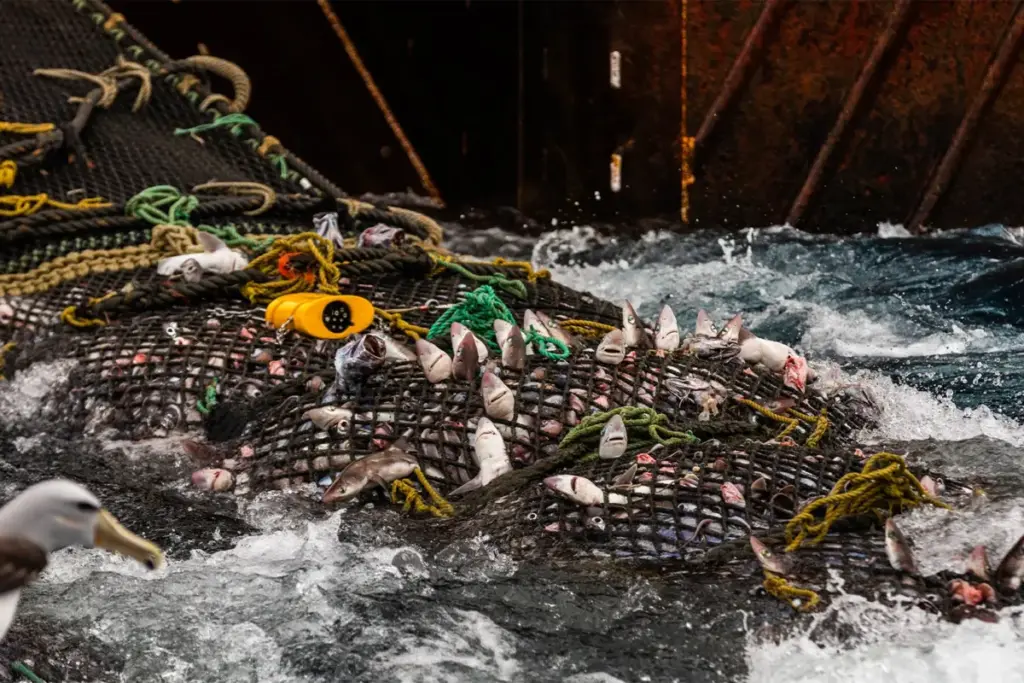
Data released by FNZ in 2024 revealed stark empirical realities: camera-equipped vessels reported drastically higher incidents of bycatch than historical pre-camera baselines. Specifically, monitored vessels recorded 3.5 times more seabird interactions, 6.8 times more dolphin captures, and roughly 1.5 times the volume of discarded fish.
While conservationists praise this as definitive proof that the cameras exposed widespread historical under-reporting, they fiercely decry the impenetrable wall of secrecy surrounding the visual evidence.

"No one gets to see it. Might as well not be there. The whole idea of it, it’s so that we know what’s going on… It’s had its testicles removed."
— Karl Warr, commercial fisher and transparency advocate
Ellie Hooper, an oceans campaigner with Greenpeace Aotearoa, emphasizes that reading dry statistical summaries of marine mammal deaths carries a vastly different psychological and political weight than witnessing raw photographic evidence of environmental degradation. This sentiment was echoed by New Zealand’s Chief Ombudsman, who formally condemned Minister Jones’s proposed legislation to block OIA requests as "unnecessary and excessive."
Future Outlook: Gaps, Observers, and the Road Ahead
As New Zealand looks toward the future of its marine management, critical structural debates remain unresolved.
Addressing Monitoring Gaps
Critics point out notable blind spots in the current regulatory architecture:

- The Small-Boat Loophole: Vessels measuring under 8 meters (26 feet) in length remain entirely exempt from the onboard camera mandate, creating what the Environmental Law Institute (ELI) terms a significant monitoring gap.
- The Deepwater Exemption: Deepwater industrial trawlers—such as the 64.5-meter Amaltal Atlantis, operated by Talley’s Group Ltd.—are not outfitted with cameras. Regulators defend this exclusion by pointing to high human observer coverage, noting that observers monitored 49% of all deepwater catch during the 2024–2025 fishing year.
Cameras Versus Human Observers
Environmental law groups strongly push back against viewing electronic monitoring and human observers as interchangeable substitutes. Data compiled by ELI indicates that human observer sea days aboard inshore vessels plummeted from 1,953 days in the 2020–2021 season down to a mere 277 days by the 2024–2025 season—representing a drop in inshore fishing effort coverage from 5.5% down to 1.1%.
Conservationists emphasize that machines cannot replicate human capabilities: cameras cannot physically tag specimens, take biological tissue samples, verify the precise deployment of complex bird-scaring mitigation devices, or exercise discretionary judgment in complex marine emergencies.
Conclusion
New Zealand’s electronic monitoring program stands as a landmark achievement in modern fisheries engineering, successfully proving that technical feasibility and industry-wide compliance are achievable goals on a national scale. Yet, the ongoing legislative battles over public transparency, freedom of information, and state oversight demonstrate that technological deployment is only half the battle.
For fishers like Karl Warr—whose lifelong connection to the ocean runs deeper than any policy paper or parliamentary bill—the ultimate success of New Zealand’s waters depends on genuine stewardship. Whether the state chooses to open the aperture of transparency or shroud its data in corporate and bureaucratic secrecy will determine whether the "genie in the bottle" fulfills its promise of ecological preservation or succumbs to political regression. All eyes remain fixed on the cameras.



