The European Union’s ambitious transition toward a zero-emission transport sector faces a high-stakes turning point. According to a comprehensive new market analysis by Transport & Environment (T&E), the continent’s legacy heavy-duty vehicle manufacturers are rapidly running out of time. If European truckmakers fail to accelerate their electrification strategies and continue lobbying to dilute current regulatory frameworks, they risk losing a staggering 25% of the burgeoning European electric truck (e-truck) market to aggressive new market entrants from China and the United States by 2030.
While zero-emission commercial vehicles (ZEVs) doubled their market share to reach 5.6% of total sales across the EU in 2025—bolstered by strict CO₂ standards that took effect in July of that year and plunging battery manufacturing costs—the competitive landscape is shifting beneath the feet of traditional European automotive giants. Pioneers in Northern and Western Europe, particularly Norway, Sweden, and the Netherlands, have already pushed e-truck adoption past the 15% mark for new sales.
However, as global competitors prepare to flood the European market with advanced, cost-effective models, the historic oligopoly that has long governed the EU’s 245,000-vehicle annual heavy truck market—dominated by Daimler Truck, Traton, IVECO, DAF, and the Volvo Group—finds itself vulnerable. In an industry where fleet operators survive on razor-thin profit margins, the superior Total Cost of Ownership (TCO) offered by foreign competitors could rapidly upend decades of market dominance.
Detailed Chronology: The Evolution of Europe’s Heavy-Duty Mandates
To understand the current crisis facing European truck manufacturers, one must examine the regulatory and industrial timeline that brought the continent to this juncture.
2019–2023: The Foundation of EU Decarbonization
For decades, the heavy-duty transport sector—accounting for a disproportionate share of transport-related greenhouse gas emissions—remained stubbornly resistant to decarbonization. While the passenger car market saw early investments in electrification, commercial freight logistics lagged due to high energy demands, infrastructure deficits, and payload constraints.
In response, the European Union began drafting tighter CO₂ emission performance standards for heavy-duty vehicles (HDVs). Recognizing that voluntary measures would fail to shift entrenched diesel-dependent supply chains, EU lawmakers established binding targets that required manufacturers to drastically cut fleet-wide emissions over the coming decades.
July 2025: Regulatory Enforcement Begins
The turning point for commercial fleet electrification arrived in July 2025, when the EU’s updated and enforceable truck CO₂ standards formally went into force. These regulations mandated a steep downward trajectory for average fleet emissions, compelling legacy manufacturers to pivot away from internal combustion engines (ICE).
Coinciding with this regulatory push, global battery cell and pack prices experienced accelerated declines, significantly improving the upfront price parity of commercial-grade energy storage systems. By the close of 2025, zero-emission trucks had doubled their market penetration year-over-year, capturing 5.6% of overall EU sales. Regional leaders such as Norway, Sweden, and the Netherlands surged ahead, proving that commercial electrification was technically and logistically viable for regional distribution and urban logistics.
2026 and Beyond: The Influx of Global Competitors
As the market entered 2026, the competitive dynamics shifted from regulatory compliance to pure market combat. Having watched European automakers hesitate and lobby against maintaining regulatory ambition, international competitors—particularly from China and the United States—began positioning their next-generation e-trucks for deployment across European transport corridors.
Rather than viewing the European market as an impenetrable fortress guarded by legacy brands, foreign new entrants identified the commercial transport sector’s primary vulnerability: cost. Armed with optimized supply chains, advanced vertical integration, and aggressive pricing strategies, these global players are now poised to capture up to a quarter of the European e-truck market by the end of the decade.
Supporting Context & Metrics: The Economics of Haulage and the TCO Factor
In the freight and logistics industry, emotional brand loyalty takes a backseat to hard financial arithmetic. Haulage operators and fleet managers navigate razor-thin net profit margins, historically hovering between 1.5% and 2%. In such a high-stakes, low-margin environment, even minor operational savings can determine a company’s survival. Consequently, vehicle investments are almost exclusively driven by Total Cost of Ownership (TCO) rather than upfront sticker prices alone.
Unlocking Savings Through Foreign Alternatives
T&E’s latest research reveals that cutting the TCO by more than 10% serves as an absolute game-changer for logistics firms. While European manufacturers have begun rolling out electric models, many of these legacy offerings carry premium price tags born from slower production scaling and higher overhead costs.
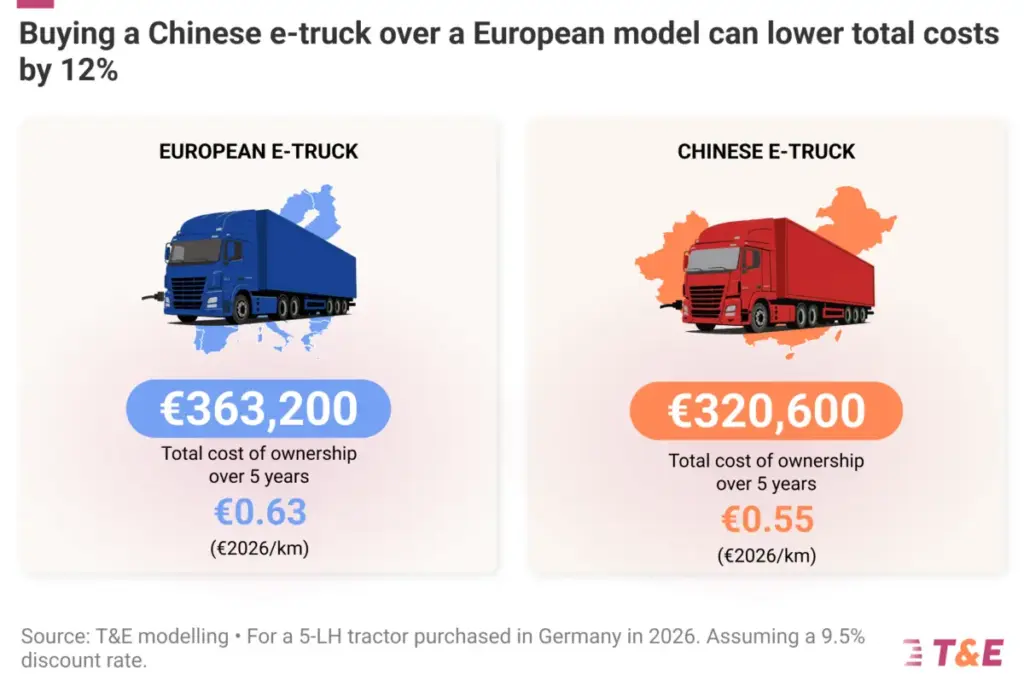
By contrast, incoming Chinese and US electric truck models have been engineered from the ground up to maximize economic efficiency. According to T&E’s comparative cost analysis, owning a Chinese electric truck can slash an operator’s Total Cost of Ownership by a remarkable 12%.
To contextualize this in real-world terms, consider a typical German transport operator deciding between a domestic European electric model and a competing new-entrant vehicle:
European Model TCO: Approximately €0.63 per kilometer (factoring in energy, maintenance, depreciation, and residual value).
New Entrant Model TCO: Approximately €0.55 per kilometer.
The Bottom Line: For a commercial vehicle operating under standard long-to-medium haul distances, this seemingly modest difference of €0.08 per kilometer compounds rapidly. Over a standard five-year operational ownership cycle, a single truck saves the operator €43,000.
When multiplied across fleets operating dozens or hundreds of heavy-duty trucks, the financial disparity becomes insurmountable for operators attempting to remain competitive while locked into higher-cost European machinery.
The Vulnerability of the Legacy Oligopoly
The European heavy truck market is characterized by high barriers to entry and a deeply entrenched oligopoly. Historically, a small cohort of heritage manufacturers—specifically Daimler Truck, Traton (the truck holding company of the Volkswagen Group encompassing Scania and MAN), IVECO, DAF, and the Volvo Group—has controlled approximately 245,000 annual vehicle registrations in the EU.
Because these legacy players spent years hedging their bets between diesel, natural gas, and nascent electric platforms, they left a wide operational opening. New market entrants recognized that by offering comparable—or superior—build quality, payload capacities, and software ecosystems at a significantly reduced price point, they could capture massive market share virtually overnight.
Official Statements and Industry Perspectives
The warnings issued by Transport & Environment underscore a profound structural anxiety within European industrial policy: the fear that the heavy-duty sector will repeat the painful missteps of the passenger electric vehicle (EV) market.
Stef Cornelis, Director of Freight and Fleets at T&E, did not mince words when assessing the current industrial landscape:
"Competitive Chinese and US truck models are already in the European market, and many more are poised to enter soon. This is a critical moment for Europe’s trucking industry, which should learn from what has happened to the car industry. Weakening the pace of electrification now would present an opportunity for US and Chinese competitors to gain a significant share of the market, in Europe and the rest of the world."
Cornelis highlighted the paradox of the legacy strategy, pointing out that while traditional automakers continue to lobby EU regulators to soften and delay upcoming fleet CO₂ reduction targets, foreign competitors are moving forward at full speed.
"Competition will be good for logistics companies and consumers, but the transition offers a limited window for European incumbents to maintain their lead," Cornelis added. "While they continue to sit on the fence between combustion and electric technologies, and seek to weaken the truck CO₂ targets, new players have fully embraced electrification."
Industry analysts note that lobbying efforts aimed at watering down European environmental standards are ultimately counterproductive. By fighting against regulatory predictability, legacy manufacturers divert crucial capital and engineering talent away from manufacturing optimization and battery supply chain security. This defensive posture creates the exact vacuum that foreign competitors are eager to fill.
Future Outlook: The Path to 2030 and Global Competitiveness
As the European Union looks toward its 2030 climate and industrial milestones, the stakes for the heavy-duty manufacturing sector could not be higher. The next four years will determine whether European industrial giants retain their historical crown or become regional players displaced by more agile, cost-effective international disruptors.
1. Re-Evaluating Manufacturing and Supply Chain Strategies
To fend off the incursion of US and Chinese e-trucks, European OEMs must radically accelerate their manufacturing efficiencies. This requires moving away from low-volume, highly customized assembly lines toward scalable, modular production platforms. Furthermore, European truckmakers must secure resilient, localized supply chains for battery cells, power electronics, and rare-earth-free electric motors to insulate themselves from geopolitical trade frictions and shipping volatility.
2. The Imperative of Regulatory Steadfastness
Policymakers in Brussels face immense pressure from industry trade groups to relax the 2030 and 2035 truck CO₂ standards. However, T&E’s analysis suggests that yielding to these demands would be catastrophic for long-term competitiveness. Maintaining stringent regulatory ambition forces legacy automakers to commit fully to the transition. Without the pressure of binding mandates, historical inertia tends to favor legacy combustion technologies, leaving companies unprepared for a global market that is rapidly and irreversibly electrifying.
3. Charging Infrastructure as a Co-Dependent Variable
While vehicle acquisition costs and total cost of ownership form the immediate battleground, the long-term success of e-trucks in Europe hinges on the rapid buildout of public and depot megawatt-charging infrastructure. Freight corridors must be equipped with high-power charging stations capable of turning around heavy commercial vehicles within mandatory driver rest periods (typically 45 minutes every 4.5 hours). Collaborative efforts between European governments, energy utilities, and transport operators will be essential to ensure that the infrastructure matches the rapid deployment of foreign and domestic zero-emission fleets.
Conclusion
The message from T&E’s market analysis serves as both a warning and a blueprint. The electric transition in commercial freight is no longer a distant theoretical exercise; it is an active, fiercely contested global race. For European truckmakers, the window to catch up, restructure, and compete on cost is closing rapidly. If legacy manufacturers choose to spend their energy fighting environmental regulations rather than innovating and scaling electric production, the European heavy-duty highway will belong to the world.