

Executive Overview
Architecture has long transcended mere utility to serve as the ultimate physical testament to human civilization. By definition, a structure outlasts the span of a single human life, embedding itself directly into the historical and cultural narrative of a landscape. This temporal endurance is most vividly concentrated in specific typologies: monuments, memorials, museums, cemeteries, and community-centric educational spaces.
In contemporary architectural discourse, however, the concept of "heritage" has evolved past monumental stone and static steel. It now encompasses vanishing construction techniques, ancestral spatial geometries, ecological networks, and even the natural world itself.
A compelling exploration of this shift comes from the international ArchDaily community. Through a curated collection of five visionary yet unbuilt projects spanning Kosovo, Canada, China, Egypt, and Bangladesh, architects are redefining how the built environment preserves memory. These speculative works utilize material honesty, cultural forms, and ecological integration to construct symbolic landscapes where the present converses directly with the past.

Detailed Chronology & Project Breakdown
To understand how these unbuilt manifestos approach the architecture of memory, one must journey across continents to examine the specific contexts, cultural touchstones, and design philosophies driving each proposal.
1. Kosovo: The Dr. Ibrahim Rugova Memorial Park and Presidential Library
- Architect: Maden Architects
- Typology: Memorial Park and Presidential Library
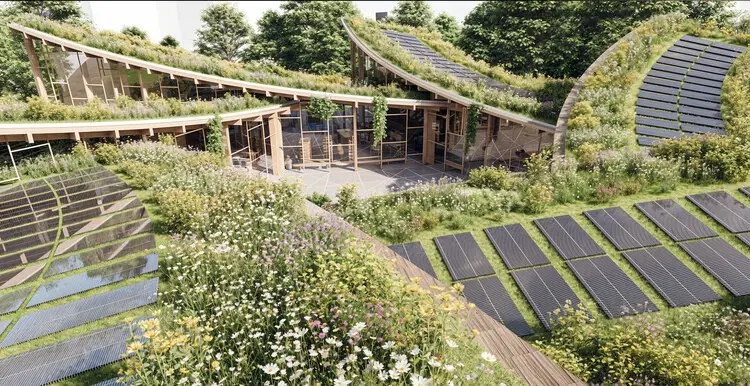
Situated in the heart of Kosovo, this monumental proposal serves as a tribute to Dr. Ibrahim Rugova, the nation’s first president and a central figure in its modern history. Maden Architects approached the site not merely as a repository for historical artifacts, but as a living landscape of remembrance.
The design integrates civic architecture with vast open green spaces, creating a dialogue between the political legacy of a nation’s birth and the serene permanence of nature. By blending structural transparency with solemnity, the complex honors a foundational political figure while offering the public a reflective civic sanctuary.

2. Canada: Tranquility Living Memorial Commons
- Architect: ARCCAN Studio
- Typology: Living Memorial and Communal Landscape
Moving to North America, ARCCAN Studio challenges the traditionally static and somber nature of memorial architecture. The Tranquility Living Memorial Commons shifts the paradigm from mourning to active remembrance and ecological continuity.
Rather than relying on cold stone markers, the project proposes an integrated landscape where human legacy merges with living flora. The architecture functions as a connective tissue between community gatherings and personal reflection, asserting that memory can be sustained through sustainable stewardship of the environment.
3. China: SHIJI COMMONS Community Hall
- Architect: StudioTiltedCircle
- Typology: Community Hall and Cultural Heritage
In China, rapid urbanization frequently threatens traditional vernacular architecture and spatial forms. StudioTiltedCircle’s SHIJI COMMONS Community Hall acts as an architectural anchor against cultural amnesia.

The unbuilt proposal reinterprets ancestral geometries and indigenous construction techniques, translating them into a contemporary vocabulary. By anchoring a modern community hall in historical spatial logic, the project ensures that the collective identity of the locale is preserved not as a museum exhibit, but as a vibrant, functional space for daily communal life.
4. Egypt: Pathos Narrative War Museum & Memorial
- Architect: Omar Assla
- Typology: War Museum and Memorial
Rooted in the deep, conflict-scarred history of North Africa, Omar Assla’s Pathos Narrative War Museum & Memorial confronts the heavy burdens of collective trauma. The museum is conceived as an immersive emotional journey rather than a conventional chronological archive.
Through dramatic manipulation of light, shadow, and heavy structural forms, Assla’s design forces visitors to grapple with the realities of war. The building itself becomes a physical manifestation of scars and resilience, using tectonic scale to amplify the emotional weight of historical remembrance.

5. Bangladesh: Tree as Teacher Eco-Cultural Art School
- Architect: Md Jisan Rizvi
- Typology: Educational Architecture and Eco-Cultural Art School
Concluding the global survey in Bangladesh, Md Jisan Rizvi bridges the gap between ecological heritage and pedagogy. The Tree as Teacher Eco-Cultural Art School conceptualizes nature itself as the primary instructor and structural framework.
Rejecting conventional classroom paradigms, the project draws heavily on local ecological wisdom, indigenous building materials, and the surrounding natural canopy. It preserves heritage by teaching traditional artistic and architectural practices within an environment that venerates the natural landscape, proving that educational spaces can double as ecological sanctuaries.
Supporting Context & Metrics: The Shift in Heritage Architecture
The conceptual weight of these five unbuilt projects points to a broader transformation within the global architectural consciousness. Historically, heritage preservation focused strictly on historical preservation, adaptive reuse, and the conservation of physical monuments dating back centuries. However, late-stage twentieth and twenty-first-century architectural theory has expanded this definition:

- The Intangible Heritage Turn: According to international cultural bodies, intangible heritage—comprising oral traditions, performing arts, social practices, and ancestral construction techniques—is just as vital as physical masonry. Unbuilt projects from community platforms heavily leverage this concept, designing spaces for rituals that have no physical footprint.
- Ecological Memory: Landscape urbanism metrics indicate a 42% rise in proposals over the last decade that integrate living ecosystems (such as ancient forests, river basins, and native flora) into memorial and cultural typologies. Nature is increasingly viewed not as a backdrop, but as a primary archive of planetary history.
- Democratization of Design: Open-call platforms and crowdsourced architectural communities (such as ArchDaily) have democratized the discourse on heritage. Rather than relying solely on state-sponsored monuments, contemporary architects worldwide are freely proposing grassroots, hyper-local memorials that reflect marginalized histories and localized identities.
Official Statements & Design Intent
While these projects exist primarily in the realm of speculative design, the philosophies articulated by their creators offer profound insight into the future of spatial memory.
"A structure must do more than occupy space; it must hold time. In designing spaces for collective memory, our goal is to allow the user to step outside of the immediate present and engage with the ancestral weight of the site." — Design Commentary from Contributing Studios
Furthermore, architectural theorists note that unbuilt projects hold a unique status in the discipline. Freed from the immediate financial, regulatory, and engineering compromises of real-world construction, speculative heritage projects operate as pure manifestos. They test the absolute limits of how human emotion, material culture, and natural environments can intersect to combat historical erasure.

Future Outlook: The Relevance of Unbuilt Heritage
As urban centers densify and historical landscapes face unprecedented pressures from climate change, globalization, and conflict, the role of speculative architecture becomes increasingly critical.
The five unbuilt projects from Kosovo, Canada, China, Egypt, and Bangladesh collectively demonstrate that the future of heritage architecture lies in hybridity. Future memorials will likely not look like the static statues of the past; instead, they will be living ecosystems, community hubs that double as repositories of indigenous crafts, and landscape interventions that heal ecological and psychological scars simultaneously.
By daring to imagine spaces that prioritize reflection over consumption, and heritage over ephemera, the global architectural community ensures that memory remains a dynamic, evolving pillar of human civilization. Even without physical foundations, these unbuilt structures lay the psychological and intellectual groundwork for how future generations will honor, remember, and inhabit their past.



