

By Willard Shoko
Independent Starlink Researcher and Network Consultant
Executive Overview
Zimbabwe stands at a critical juncture in its telecommunications evolution. As digital transformation sweeps across Southern Africa, the demand for high-speed, low-latency, and resilient internet connectivity has transitioned from a luxury to an absolute economic necessity. For decades, landlocked nations like Zimbabwe have grappled with the high costs, geographic vulnerabilities, and infrastructural bottlenecks associated with traditional terrestrial backhauls and legacy geostationary satellite systems.
However, the rapid commercialization of Low Earth Orbit (LEO) satellite constellations—exemplified by the market arrival of Starlink in September 2024—has fundamentally rewritten the rules of engagement. While LEO technology has democratized access, soaring regional adoption rates have inevitably introduced new engineering challenges. Bandwidth throttling during peak operational hours and variable latency metrics underscore an urgent requirement: the localization of physical ground infrastructure.
This comprehensive report conceptualizes a strategic, twelve-month roadmap designed to transition Zimbabwe from relying on indirect regional satellite feeds to establishing dedicated domestic gateway teleports, securing advanced Q/V band spectrum licensing, and commissioning a centralized Point of Presence (PoP) in Harare. By tightly integrating these localized satellite gateways with Zimbabwe’s robust and expanding national fiber backbones—including infrastructure from Liquid Intelligent Technologies, PowerTel, TelOne, DFA Zimbabwe, and international initiatives like the Google Umoja cable system—the nation can unlock unprecedented digital capacity.
Ultimately, this initiative aims to stabilize domestic speeds, guarantee sub-20 ms local latencies, and propel Zimbabwe into a new era of connectivity capable of supporting enterprise-grade cloud computing, advanced artificial intelligence workloads, and nationwide digital inclusion.
Detailed Chronology: From Mazowe to LEO Constellations
To understand the magnitude of the proposed infrastructure transformation, one must first trace the historical arc of Zimbabwe’s satellite telecommunications journey.
The Dawn of Satellite Comms: The Mazowe Earth Station (1985)
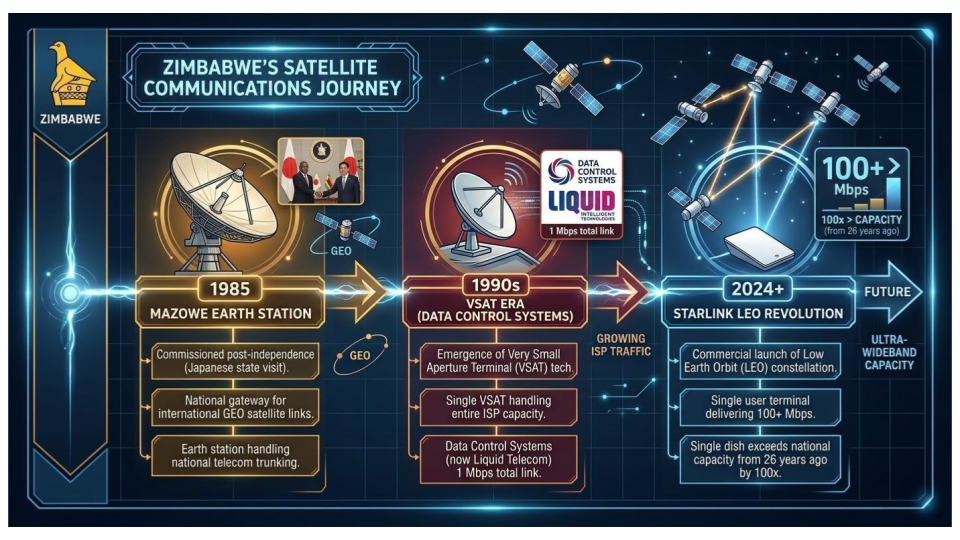
Zimbabwe’s foray into satellite telecommunications began in the mid-1980s. Following an official state visit to Japan, a strategic bilateral and national vision materialized into reality with the establishment of the country’s primary satellite hub at Mazowe in 1985. For a generation, the Mazowe Earth Station served as the nation’s sole gateway to international telecommunications networks, operating strictly via Geostationary Earth Orbit (GEO) satellite links.
While revolutionary for its time, GEO technology was severely constrained by physics. Positioned roughly 35,786 kilometers above the equator, GEO satellites imposed inherent round-trip propagation delays (latencies often exceeding 600 milliseconds), making real-time interactive applications, high-frequency financial trading, and seamless cloud synchronization exceptionally difficult.

The VSAT Milestone and Early Commercial Bandwidth
As the twentieth century drew to a close and corporate demands for enterprise and consumer bandwidth began to tick upward, Very Small Aperture Terminal (VSAT) technology emerged as the next operational milestone. Early commercial implementations in Zimbabwe relied on a single VSAT terminal to handle the entire international bandwidth load for Data Control Systems—the corporate entity that eventually evolved into Liquid Intelligent Technologies. At its inception, this setup delivered a modest, single-megabit (1 Mbps) aggregate trunk connection.
To put this in perspective, individual domestic households today routinely consume more data in a single hour than that entire foundational national capacity could support over days during the early commercial satellite era.
The LEO Paradigm Shift
The arrival of LEO constellations, spearheaded by Starlink’s official commercial launch in Zimbabwe on September 6, 2024, shattered historical bandwidth ceilings. Operating at altitudes ranging from 500 to 1,200 kilometers, LEO satellites reduce orbital propagation delays drastically.
The quantitative leap is staggering: a modern enterprise dish or consumer user terminal deployed today delivers throughput capacity that exceeds Zimbabwe’s total national bandwidth capacity from 1999 by a factor of 100. This quantum leap in data speeds has catalyzed exponential demand across education, health, agriculture, and private enterprise.

Supporting Context, Historical Performance Metrics, and Latency Trends
When Starlink made its official debut in Zimbabwe in September 2024, initial performance benchmarks were exceptionally favorable. Early adopters enjoyed high throughput and low latencies, largely driven by low regional network load and unconstrained feeder capacity routed through neighboring landing stations.
However, as subscriber adoption surged exponentially over the subsequent two years leading up to September 2026, the realities of shared network architecture began to manifest. Substantial regional subscriber density created noticeable bandwidth throttling during peak usage hours. Furthermore, reliance on cross-border signal routing yielded mixed latency performance, as data packets frequently traversed multiple international boundaries before reaching target servers or content delivery networks (CDNs).
The Solution: Domestic Teleports and the Harare PoP
The definitive engineering remedy for these regional bottlenecks is the deployment of local ground station teleports combined with a domestic Point of Presence (PoP) anchored in Harare.
- Eliminating Cross-Border Hops: By establishing local ground stations, user traffic is beamed directly from the LEO constellation to physical teleports located on Zimbabwean soil, bypassing unnecessary international transit legs.
- Securing Sub-20 ms Latency: Routing traffic through a centralized Harare PoP ensures that intra-national data exchanges never leave the country, consistently maintaining domestic latencies below 20 milliseconds.
- Mitigating Peak Throttling: Direct feeder links dedicated to Zimbabwean gateways offload traffic from congested regional beams, guaranteeing sustained, high-speed connectivity even during peak evening hours.
Technical Architecture & Spectrum Allocation
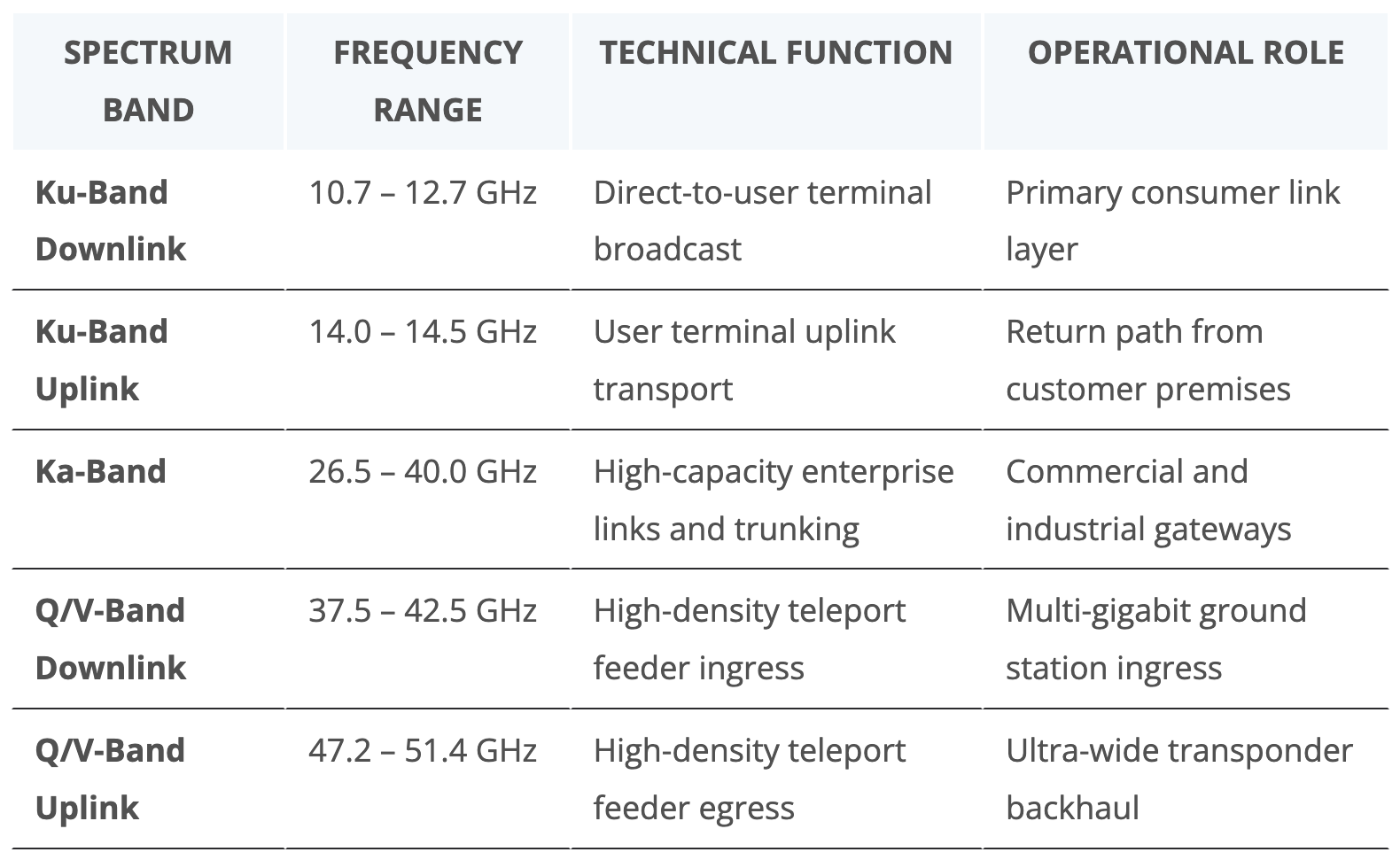
Establishing high-capacity feeder links capable of routing multi-gigabit traffic between high-speed LEO constellations and terrestrial fiber networks requires careful orchestration of radio frequency (RF) spectrum. While conventional Ku and Ka bands manage standard user terminal communications, high-capacity feeder links demand advanced frequency allocations, specifically within the Q/V band (33–50 GHz).
Q/V Band Engineering Advantages
The integration of Q/V band spectrum into Zimbabwe’s telecommunications regulatory framework offers profound engineering advantages:
- Massive Spectrum Availability: The Q/V bands offer significantly wider contiguous blocks of unassigned spectrum compared to legacy Ku and Ka bands, enabling multi-gigabit per second (Gbps) data transmission rates per gateway antenna.
- High Spatial Reuse: Due to the shorter wavelengths and highly focused beam characteristics of Q/V band transmissions, network operators can achieve superior spatial reuse without causing harmful interference to neighboring communication systems.
- Enhanced Spectral Efficiency: Utilizing these higher frequencies allows ground station teleports to handle the massive traffic aggregation generated by thousands of active LEO satellites passing overhead simultaneously.
Note on Mitigation: While Q/V band frequencies are susceptible to atmospheric attenuation caused by heavy rainfall—a notable factor during Zimbabwe’s rainy season—modern gateway designs incorporate site diversity, adaptive modulation, and advanced uplink power control (UPC) algorithms to ensure carrier-grade service availability of 99.99%.
National Fibre Infrastructure Synergy Matrix
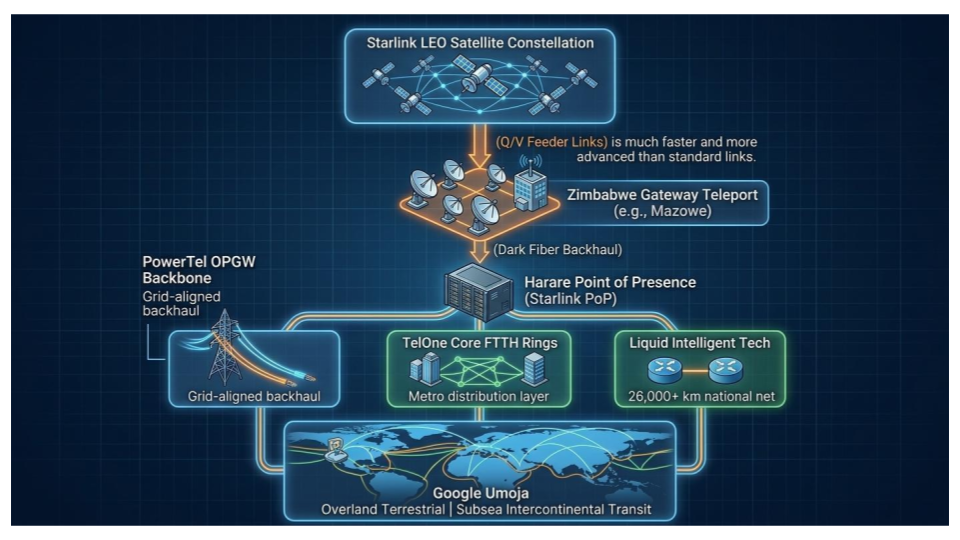
Building isolated satellite ground stations is insufficient; these teleports must be seamlessly integrated into Zimbabwe’s existing and expanding terrestrial fiber-optic backbones. The proposed Harare PoP will act as the nexus, bridging space-based assets with a robust matrix of domestic and international fiber networks:
- Liquid Intelligent Technologies Fibre Backbone: Operating an extensive network spanning over 26,000 kilometers of fiber across Zimbabwe, Liquid provides the core long-haul terrestrial routing layer. Connecting Starlink’s Harare PoP directly into Liquid’s regional cross-border network ensures resilient, high-speed transit across Southern Africa.
- PowerTel and Paratus Partnership: PowerTel and Paratus Zimbabwe formed an equal-investment Public-Private Partnership (PPP) to construct a high-capacity DWDM fiber backhaul network across Zimbabwe. Starting with an active 800 Gbps link between Plumtree and Bulawayo, the agreement leverages PowerTel’s powerline-based national fiber infrastructure and Paratus’s continental network to deliver up to 10 Tbps in cross-border bandwidth linking Zimbabwe, Botswana, and Zambia.
- TelOne Expansions: Ongoing backbone capacity expansions executed by TelOne along vital cross-border transit links—such as Kazungula to Zambia/Botswana and Beitbridge to South Africa—are driven by surging regional demand for 100G+ wavelengths, providing an ideal secondary transit layer.
- Dark Fibre Africa (DFA) Zimbabwe: DFA constructed a 1,500 km open-access optical fiber backbone running along national railway servitudes from Beitbridge through Bulawayo, Harare, and Mutare. Built via an $18 million-plus partnership with BCS Group and Dandemutande, the network uses DWDM technology to deliver multi-gigabit transit capacity. This infrastructure provides local ISPs and mobile operators with redundant, high-speed wholesale backhaul while improving cross-border links to South Africa, Botswana, Zambia, and Mozambique.
- Google Umoja Cable System: Providing an overland terrestrial path from East Africa down through Southern Africa and across to global subsea landings, the Umoja cable system represents a vital international conduit. Linking the local Starlink PoP to the Umoja network establishes direct, low-latency access to intercontinental cloud services and hyper-scale data centers.
Global Benchmarks: Insights from Brazil and the USA
To ensure that Zimbabwe’s deployment of LEO satellite ground infrastructure meets international best practices, regulators and network architects can look to successful precedents set by nations with vast geographic expanses, such as Brazil and the United States.
- Regulatory Streamlining: In Brazil, Anatel (the national telecommunications agency) fast-tracked regulatory approvals for gateway site acquisitions, recognizing that ground infrastructure is vital to ensuring rural connectivity mandates are met without overburdening terrestrial cellular networks.
- Co-Location and Power Redundancy: US deployments demonstrate the critical need for carrier-neutral co-location facilities equipped with robust, multi-megawatt backup power systems. Given Zimbabwe’s historical power generation and distribution challenges, local teleports must incorporate dedicated solar-hybrid microgrids and industrial diesel generators to maintain uninterrupted gateway operations.
- Spectrum Harmonization: International benchmarks emphasize the importance of preemptive spectrum coordination between satellite operators and national defense, meteorological, and aviation agencies to prevent interference in shared frequency bands.
Strategic Implementation Roadmap
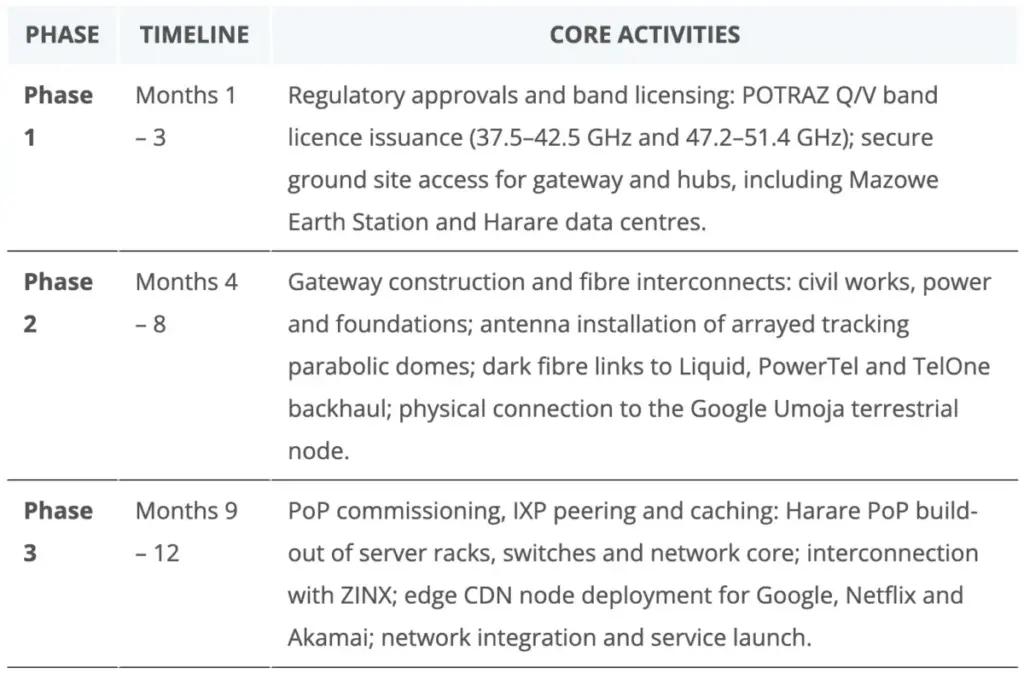
To transition this conceptual framework into operational reality, a rigorous, twelve-month phased roadmap has been structured across three distinct milestones:
[ Months 1 - 4 ]                      [ Months 5 - 8 ]                      [ Months 9 - 12 ]
----------------                      ----------------                      ----------------
Phase 1: Regulatory & Spectrum        Phase 2: Gateway Civil Works          Phase 3: PoP Integration
• Q/V Band Allocation                 • Antenna & Radome Installation       • Terrestrial Fibre Cross-Connects
• Site Survey & Environmental Approvals • Power & Redundancy Engineering    • Commercial Launch & Optimization
Phase 1: Regulatory Clearance and Spectrum Allocation (Months 1–4)
- Objective: Secure formal regulatory approvals from the Postal and Telecommunications Regulatory Authority of Zimbabwe (POTRAZ).
- Key Actions: Finalize Q/V band and Ka/Ku band spectrum licensing agreements; complete rigorous RF environmental impact assessments; select optimal geographic land parcels surrounding the Harare perimeter for low-interference ground station placement.
Phase 2: Physical Gateway Construction and Civil Works (Months 5–8)
- Objective: Construct the physical teleports and install high-frequency earth station antennas.
- Key Actions: Pour reinforced concrete pads for heavy gateway terminals; erect radomes to protect tracking antennas from environmental elements; deploy carrier-grade power infrastructure, including high-capacity uninterruptible power supplies (UPS) and localized solar-diesel hybrid microgrids to guarantee 99.99% uptime.
Phase 3: PoP Commissioning, Fibre Cross-Connects, and Service Launch (Months 9–12)
- Objective: Establish the central Harare Point of Presence and integrate it with national fiber backbones.
- Key Actions: Deploy core routing and switching hardware within a secure Harare data center facility; execute physical fiber cross-connects with Liquid Intelligent Technologies, DFA Zimbabwe, PowerTel, and TelOne; run end-to-end performance trials, optimize BGP routing tables, and officially transition traffic from regional uplinks to the new domestic gateway infrastructure.
Future Outlook
The implementation of domestic gateway teleports, Q/V band licensing, and a centralized Harare Point of Presence marks a watershed moment in Zimbabwe’s telecommunications history. By marrying the celestial reach of Low Earth Orbit satellite constellations with the deep, high-capacity roots of national terrestrial fiber networks, Zimbabwe is actively dismantling historical digital divides.
As this twelve-month roadmap unfolds, the nation will transition from a passive consumer of regional satellite capacity to an active, self-sustaining digital hub in Southern Africa. The resulting network—characterized by hyper-low sub-20 ms latencies, unthrottled peak throughput, and unbreakable enterprise resilience—will empower schools, hospitals, financial institutions, and tech entrepreneurs across the country. Zimbabwe’s digital sky is open, and the infrastructural foundation to conquer it is finally falling into place.
About the Author
Willard Shoko is an Independent Starlink Researcher and Network Consultant with over two decades of hands-on expertise in networking infrastructure and internet connectivity. Passionate about next-generation satellite technology, Willard is a key community contributor on X and Reddit, best known for his work mapping unofficial Starlink Ground Stations and Points of Presence (PoPs). His technical insights have earned recognition and reposts directly from Elon Musk and Starlink. Today, he leverages his deep network architecture expertise to design and specialized, tailored internet-based solutions across the educational and private sectors. (Independent consultant; not affiliated with Starlink.)



