

Executive Overview
Over the past decade, municipal waste management across North America has undergone a quiet structural revolution. Prompted by tightening climate targets and a clearer understanding of landfill dynamics, cities have rolled out curbside organic waste collection at an unprecedented scale. According to data from BioCycle’s national survey, access to household organic waste collection in the United States surged by 49% in just two years, climbing from 10 million households in 2021 to 14.9 million in 2023.
Yet, this rapid expansion of infrastructure has exposed a critical bottleneck: the gap between municipal access and actual household participation. While some progressive urban centers report near-universal compliance, others struggle with participation rates well below 30%.
This gap is not merely an administrative inefficiency; it is a major environmental liability. Food waste accounts for approximately 24% of municipal solid waste sent to landfills. Once buried, this organic matter decomposes anaerobically, generating methane—a potent greenhouse gas with a warming potential up to 80 times greater than carbon dioxide over a 20-year timescale. The Environmental Protection Agency (EPA) estimates that food waste is responsible for a staggering 58% of fugitive methane emissions released from municipal landfills.
Consequently, an unused green bin is not a neutral policy outcome. It represents a systemic failure of public policy to account for household behavior. Investigative analysis reveals that the primary barrier to long-term organic recycling is not a lack of environmental awareness, but rather the highly visceral "yuck factor": the odor, moisture, and pest issues associated with maintaining an organic waste cart.
To bridge this gap, municipal policy must move beyond simple public education campaigns. Solving the food waste crisis requires addressing the daily friction of bin maintenance. This article examines the mechanics of organic collection, the behavioral science behind household participation, and how simple physical innovations—such as the BagEZ suspended bag frame—are reshaping how cities and citizens manage organic waste.
Detailed Chronology: The Evolution of Curbside Organics
The modern three-bin system (trash, recycling, and organics) is the result of decades of policy evolution, marked by shifting environmental priorities and technological advancements in waste processing.
[1970s–1990s: Landfill Era] ──> [2000s: The Blue Bin Revolution] ──> [2010s: Rise of Organics] ──> [2020s: The Participation Barrier]
       |                                      |                                   |                                     |
- Unregulated dumping                 - Curbside recycling               - Mandatory composting              - Infrastructure exists
- Landfill gas unrecognized           - Public adopts "blue bin"          - Methane reduction goals           - Low household compliance
- High organic volumes                - High contamination rates          - Toronto & SF lead initiatives     - "Yuck factor" drives attrition
The Landfill Era and the Discovery of Landfill Gas (1970s–1990s)
For most of the 20th century, municipal solid waste management operated on a "bury and forget" model. Organic waste, yard trimmings, plastics, and metals were mixed into single-stream waste destined for regional dumps. By the late 1980s, regulatory bodies began recognizing the hazards of landfill gas (LFG) migration and groundwater contamination, prompting the EPA to enact stricter Resource Conservation and Recovery Act (RCRA) Subtitle D regulations in 1991. This initiated the closure of thousands of open dumps and the transition to highly engineered, lined landfills.
The Blue Bin Revolution and Source Separation (2000s)
The late 1990s and early 2000s saw the widespread adoption of curbside recycling. The introduction of the "blue bin" established the concept of source separation at the household level. While highly successful in diverting paper, glass, and metals, this era largely ignored food waste, which continued to make up the heaviest, wettest, and most environmentally destructive portion of the municipal waste stream.

The Rise of Municipal Organics Programs (2010s)
Recognizing that recycling dry goods was insufficient to meet aggressive carbon-reduction goals, pioneering cities began piloting source-separated organics (SSO) programs. San Francisco became the first major U.S. city to mandate composting in 2009. Other major metropolises followed suit:
- Toronto, Canada: Developed its highly visible "Green Bin" program, utilizing anaerobic digestion to process household organics.
- New York City, USA: Initiated voluntary pilot programs in select boroughs, eventually transitioning toward mandatory curbside composting using brown bins.
- Seattle, USA: Outlawed food waste in municipal trash bins in 2015, imposing fines on households and businesses that failed to comply.
The Participation Barrier and the "Yuck Factor" (2020s)
By 2023, municipal organics programs had expanded to cover nearly 15 million households in the U.S. alone. However, waste management officials hit a wall. While providing residents with green bins was relatively straightforward, keeping those bins in active, correct use proved incredibly difficult.
Behavioral studies and feedback from municipal haulers revealed a recurring pattern: households would enthusiastically start using their organic bins, only to abandon the practice within weeks due to the buildup of sludge, foul odors, maggots, and pest infestations. The physical unpleasantness of cleaning a large, deep plastic bin turned organic recycling into an unwelcome household chore, leading to high program attrition rates.
Supporting Context & Metrics: The Cost of Inaction
To understand why household compliance is so critical, one must look at the environmental and financial metrics that define the waste management sector.
Landfill Emissions and the Methane Problem
Landfills are the third-largest source of human-related methane emissions in the United States, accounting for approximately 14.4% of the national total. Because food waste has a high moisture content and decomposes rapidly compared to wood or paper, it acts as the primary driver of this process.
| Waste Stream Component | Share of Landfill Input (%) | Share of Fugitive Methane Emissions (%) |
|---|---|---|
| Food Waste | 24% | 58% |
| Paper & Cardboard | 26% | 23% |
| Wood & Yard Trimmings | 11% | 12% |
| Plastics, Metals, Glass, Other | 39% | 7% |
Source: U.S. Environmental Protection Agency (EPA) estimates.
The Behavioral Economics of Household Waste
The gap between access and participation is illustrated by a year-long Food Recycling Project conducted by the Essex County Council in the United Kingdom (2023–2024).
The council launched an intervention targeting more than 375,000 households. To lower the behavioral barriers to organic recycling, they delivered a simple package:

- An informational leaflet detailing what materials were accepted.
- A highly visible reminder sticker placed on the general waste bin.
- A free roll of compostable bin liners.
                          [ESSEX COUNTY COUNCIL STUDY]

      Control Group                 Intervention Group (Free Liners + Education)
┌──────────────────────┐              ┌──────────────────────────────────────┐
│  Baseline Organics   │              │     +21% Organic Tonnage Increase    │
│       Tonnage        │              │  (More than double the 10% target)   │
└──────────────────────┘              └──────────────────────────────────────┘
The results were immediate. In the first three months following the delivery, food recycling tonnage rose by an average of 21% compared to a control group that did not receive the package. This increase was more than double the council’s initial 10% target.
The Essex County trial confirmed a core principle of behavioral economics: reducing friction is far more effective than moral persuasion. By providing households with a free tool (liners) to keep their indoor and outdoor bins clean, the council successfully bypassed the "yuck factor" barrier.
However, the trial also highlighted a structural limitation. Continuous municipal distribution of free compostable liners is an expensive subsidy that most local governments cannot sustain long-term. This raises an important question: how can cities maintain high participation rates when residents must purchase their own bin-maintenance solutions?
The Engineering of Bin Hygiene: The BagEZ Solution
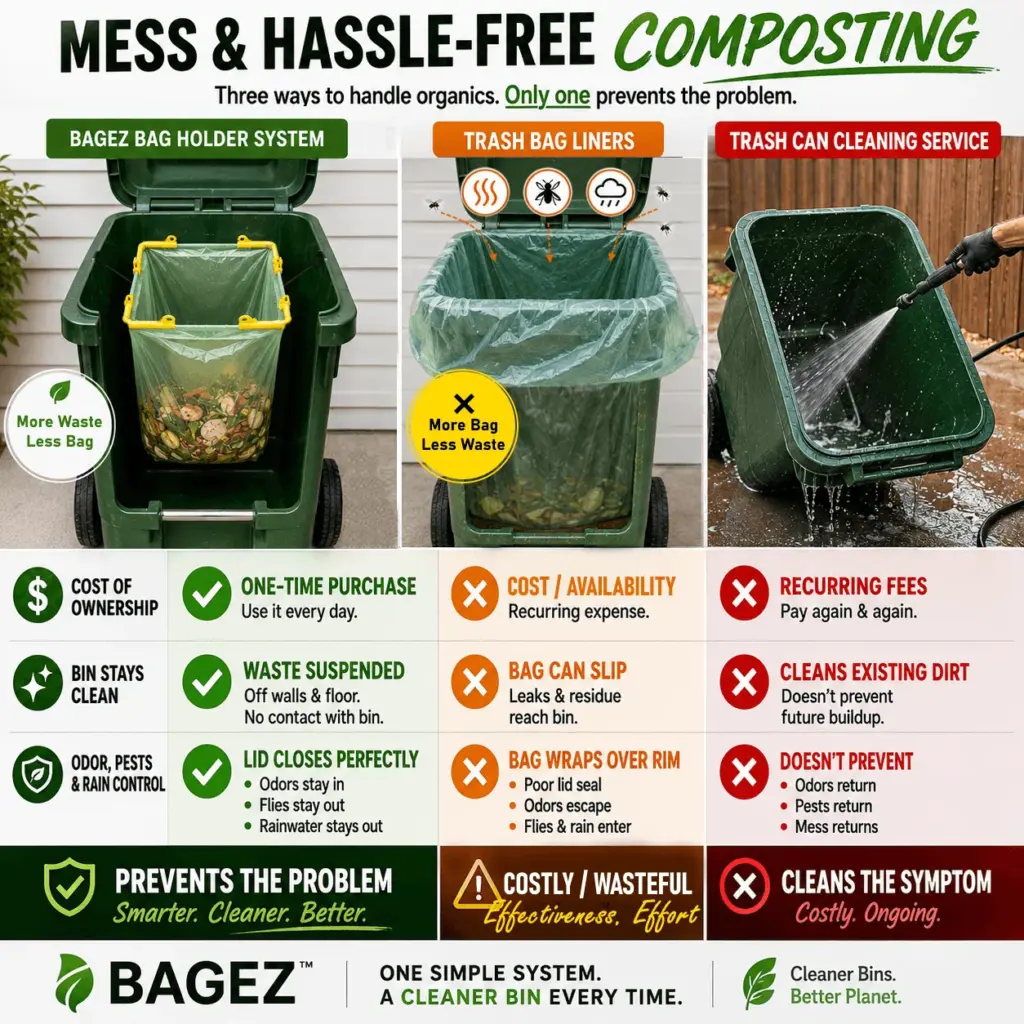
When households are left to manage their green bins without municipal subsidies, they typically face three imperfect choices:
- The Naked Bin Method: Dumping food scraps directly into the green cart. This quickly leads to a toxic sludge of decomposing organic liquids at the bottom of the bin, requiring regular, unpleasant hosing out.
- Full-Cart Liners: Purchasing large, expensive, 35-to-95-gallon compostable bags to line the entire cart. These bags are costly, prone to tearing under heavy loads, and are often unnecessarily large for the actual volume of food waste produced.
- The "BagEZ" Suspended Method: A mechanical approach that suspends a smaller, standard-sized bag within the larger bin, preventing contact between the waste and the bin walls.
The Physics of Condensation and Moisture Pooling
To understand why the third option is highly effective, it helps to examine the physics of organic decomposition.
Produce and household food scraps are composed of up to 80% to 90% water. As cellular walls break down during decomposition, this water is released. In a standard green bin, paper or compostable bags filled with scraps rest directly against the plastic walls and floor of the cart.
   TRADITIONAL METHOD (Surface Contact)           BAGEZ SUSPENDED METHOD (Air Gap)

        ┌────────────────────────┐                   ┌────────────────────────┐
        │                        │                   │  ======[BagEZ Frame]   │
        │  ┌──────────────────┐  │                   │  │ ┌────────────────┐ ││
        │  │  Wet Food Scraps │  │                   │  │ │  Dry/Contained │ ││
        │  │  Releasing Water │  │                   │  │ │   Food Scraps  │ ││
        │  └────────┬─────────┘  │                   │  │ └──────┬─────────┘ ││
        │  ▒▒▒▒▒▒▒▒▒│▒▒▒▒▒▒▒▒▒▒  │                   │  │        │           ││
        │  Condensation Pools    │                   │  │  ◄── Air Gap ──►   ││
        │  (Odor, Rot, Maggots)  │                   │  │                    ││
        └────────────────────────┘                   └────────────────────────┘
This direct contact creates a microclimate. Warm, moist air rising from the decaying food hits the cooler plastic walls of the bin, condensing into liquid. Because there is no airflow around the bag, this moisture cannot evaporate. It pools at the bottom of the bin, creating an anaerobic, foul-smelling environment that attracts flies and pests.
How the BagEZ Frame Alters the Microclimate
The BagEZ system, designed by Canadian entrepreneur Sean Rana, addresses this issue through simple mechanical suspension. The device consists of a folding steel rack equipped with specialized clips that secure a standard bag (from 13 gallons up to 49 liters) to the frame. The frame’s handles grip the rim of the curbside cart, suspending the bag in mid-air.

By hanging the bag, the system achieves several key benefits:
- The Air-Gap Insulation Effect: The bag never touches the bottom or sides of the bin. This allows air to circulate freely around the entire surface of the bag (underneath, on the sides, and behind).
- Passive Evaporation: Condensation that forms on the exterior of the bag evaporates into the moving air instead of pooling at the bottom of the bin. The interior walls of the green cart remain entirely dry.
- Optimized Sizing: According to the MITRE-Gallup survey—the largest study of U.S. household food waste to date—the average household generates roughly 6.2 cups of food waste per week (increasing to 8.8 cups when factoring in inedible scraps like peels, cores, and bones). This equates to just over half a gallon of waste weekly.
Because households do not generate enough food waste to fill a massive curbside cart, using a giant, expensive cart liner is highly inefficient. The BagEZ frame allows households to use a standard, cost-effective 13-gallon compostable or paper bag, aligning the liner size with actual household waste production.
Official Statements and Industry Perspectives
The challenge of managing organic waste has drawn the attention of circular economy experts, municipal waste directors, and product innovators alike.
Sean Rana, Founder of BagEZ, emphasizes the need for user-friendly design in environmental solutions:
"The infrastructure for organic waste collection is largely in place, but we are failing at the kitchen-to-curb connection. Expecting citizens to spend their weekends scrubbing rotting sludge out of a plastic cart is unrealistic. It’s a friction point that quietly kills program participation. We engineered BagEZ to eliminate that friction entirely. By keeping the bag suspended and the bin dry, we turn a gross, recurring chore into a simple, touch-free habit."
A municipal waste management director in the Pacific Northwest, speaking on the condition of anonymity, highlights the financial impact of low participation:
"Every ton of food waste that ends up in our landfills costs taxpayers double: first in landfill tipping fees, and second in the long-term environmental mitigation of methane emissions. We can pass all the municipal mandates we want, but if residents find the green bin disgusting, they will simply hide their food waste in black trash bags. Hardware innovations that make bin maintenance clean and cheap are essential for us to hit our diversion targets."
The EPA’s Office of Land and Emergency Management notes the critical role of source separation:

"To achieve our national goal of cutting food loss and waste in half by 2030, we must optimize our organic recovery pathways. Source-separated organics collection is highly effective, but its success depends entirely on sustained household participation. Minimizing contamination and managing vector issues [pests and odor] at the household level are primary hurdles to scaling these programs nationally."
Practical Troubleshooting: Managing the Green Bin Ecosystem
Even with a suspended bag system, managing organic waste requires a basic understanding of the biological processes at play. Below is an authoritative guide to maintaining an odor- and pest-free organic collection setup.
                  ┌────────────────────────────────────────┐
                  │   GREEN BIN BIOLOGICAL MANAGEMENT      │
                  └───────────────────┬────────────────────┘
                                      │
         ┌────────────────────────────┼────────────────────────────┐
         ▼                            ▼                            ▼
   [Moisture Control]           [Odor Mitigation]           [Pest Deterrence]
 - Use BagEZ for suspension   - Sprinkle baking soda       - Hang a peppermint sachet
 - Place newspaper at base      inside the suspended bag     on the bin exterior
 - Keep bin interior dry      - Keep pH neutral            - Use Diatomaceous Earth (DE)
1. Moisture and Leak Prevention
- The Newspaper Catch: Always place two or three sheets of folded newspaper at the very bottom of the curbside bin beneath the suspended bag. In the rare event of a bag failure or puncture, the newspaper acts as a highly absorbent barrier, preventing liquid from reaching the plastic floor.
- Program-Compliant Liners: Before choosing your liners, verify your municipality’s specific rules using directories like the Earth911 Recycling Search. Some programs accept certified compostable plastics (such as BPI-certified bags), while others strictly require paper liners or unlined yard waste.
2. Odor and Fly Control
- Targeted Baking Soda Application: Baking soda (sodium bicarbonate) is highly effective at neutralizing acidic odors. Rather than scattering it across the vast bottom of an empty cart, sprinkle a small amount directly inside the suspended bag.
- Diatomaceous Earth (DE): For households struggling with flies or maggots, food-grade diatomaceous earth is a highly effective, non-toxic pesticide. DE works by absorbing lipids from the waxy outer layer of insects’ exoskeletons, causing them to dehydrate. However, DE is only effective when dry. Utilizing a suspended bag frame like BagEZ to keep the bin interior dry is a prerequisite for DE to work.
3. Deterring Wildlife
- Olfactory Masking: Raccoons, rodents, and stray animals hunt almost exclusively by scent. To deter them, construct a small cloth sachet containing cotton balls soaked in peppermint essential oil and whole cloves. Secure this sachet to the handle or exterior hinge of the bin. The strong scent overpowers the smell of food, making the cart unappealing to foraging animals.
Future Outlook: The Next Phase of Organic Recycling
As North American municipalities face stricter climate targets, the policy landscape surrounding organic waste is shifting from voluntary participation to strict compliance.
Regulatory Mandates and Enforcement
States like California are leading this transition with landmark legislation such as Senate Bill 1383, which requires all jurisdictions to provide organic waste collection and reduce organic disposal by 75% by 2025. In New York City, curbside composting is transitioning to a mandatory service, with fines planned for non-compliant properties. As these mandates spread, the pressure on households to adopt clean, sustainable organic habits will only grow.
The Shift Away from Costly Municipal Subsidies
While pilot programs like the one in Essex County prove that giving away free bags boosts recycling rates, long-term fiscal realities are forcing municipalities to transition away from continuous subsidies. Local governments are instead focusing on education and encouraging residents to invest in durable, self-sustaining household tools.
Conclusion
The ultimate success of the multi-billion-dollar municipal composting grid does not depend on bigger trucks or more advanced anaerobic digesters. It depends on the everyday experience of the citizen standing in their kitchen or driveway. By removing the physical unpleasantness of bin maintenance, communities can turn organic recycling from a dreaded chore into a simple, automatic routine—ensuring that food waste is processed safely and sustainably.



