

Originally published by Capital B and reproduced here as part of the Climate Desk collaboration.
In a landmark and deeply controversial legal blow to environmental justice advocates, a federal appeals court has ruled that the U.S. Constitution does not guarantee American citizens a fundamental right to clean, safe drinking water.
The decision, handed down by the Fifth U.S. Circuit Court of Appeals, directly centers on the decades-long, catastrophic public health crisis in Jackson, Mississippi—a majority-Black capital city where residents have long struggled with contaminated taps, crumbling infrastructure, and systemic administrative failures. Furthermore, the appellate court ruled that the Constitution does not afford citizens a “right to truthful information from officials during a public health crisis,” effectively immunizing local and state authorities from civil rights liability over misleading statements regarding toxic hazards in municipal water supplies.
The ruling has sent shockwaves through legal, environmental, and civil rights communities. It signals that Black and low-income residents, who are disproportionately impacted by failing water systems nationwide, face severe structural barriers when attempting to seek constitutional remedies through the federal court system. Paired with previous determinations by the federal Environmental Protection Agency (EPA)—which ruled that the city could not secure support through Title VI of the Civil Rights Act of 1965—the appellate decision underscores a grim reality for Jackson’s residents: their suffering is real, but under the current interpretation of American jurisprudence, a legal remedy does not exist.
Executive Overview
The federal appeals court’s decision is the latest chapter in an agonizing saga for the residents of Jackson, more than 80% of whom are Black, and where the poverty rate is more than double the national average.
The underlying lawsuit, filed in 2022, alleged that city and state officials knowingly allowed lead-contaminated water to reach residential homes while deliberately misleading the public about its safety. Plaintiffs argued that these actions violated their Fourteenth Amendment right to bodily integrity. They also accused state authorities of discriminatory allocation, alleging that federal funds earmarked for drinking water safety were repeatedly diverted to neighboring white communities at Jackson’s expense.
However, writing for the majority, U.S. Circuit Judge Kurt Engelhardt affirmed a lower court’s dismissal of the case. While acknowledging that access to safe water is “important,” the court held that it is not a right “deeply rooted in our Nation’s history and tradition”—the strict originalist standard required to establish a substantive due process right under the Constitution.
The court’s refusal to recognize clean water as a constitutional right, combined with its dismissal of claims concerning deceptive public health communication, leaves vulnerable populations with virtually no constitutional shield against systemic environmental neglect. As community organizers and legal scholars point out, the ruling not only impacts Jackson, but potentially sets a perilous legal precedent for marginalized communities across the United States.
Detailed Chronology: Decades of Neglect and Legal Battles
To understand the weight of the Fifth Circuit’s ruling, one must examine the history of Jackson’s water crisis, which stretches back far beyond its emergence into the national spotlight in 2021.
Generations of Contaminated Infrastructure
For decades, generations of Jackson residents have grown up navigating systemic water failures. Brooke Floyd, a lifelong resident, recalls watching her grandmother complain about discolored, foul-smelling tap water decades ago. For families like Floyd’s, the contamination has been a persistent, multi-generational hazard.
The crisis is the culmination of decades of deferred maintenance, aging treatment facilities, leaking and breaking water mains, severe municipal staffing shortages, and a shrinking local tax base. As wealthier residents and businesses fled the city over the latter half of the 20th century—a demographic shift closely tied to racial integration—Jackson’s municipal revenue base cratered, leaving the city fundamentally unable to keep pace with necessary infrastructure upgrades.
The Breaking Points: 2020 to 2022
The infrastructure decay reached a crescendo in March 2020, when the EPA issued an emergency order warning that conditions in Jackson’s water system presented an “imminent and substantial endangerment” to residents due to severe treatment and distribution failures.
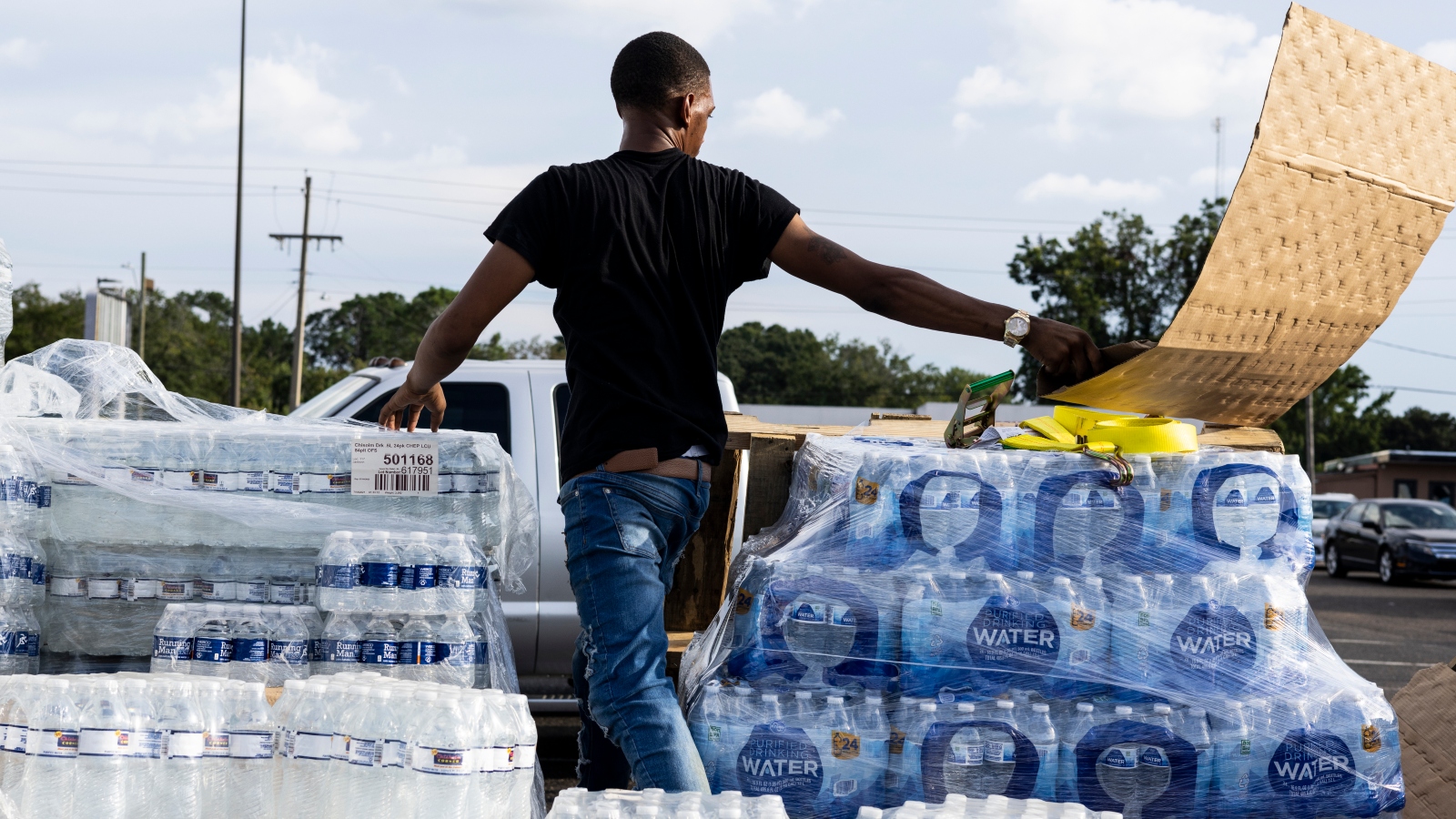
The situation exploded into a full-blown humanitarian crisis in February 2021, when a severe winter storm swept across the South. Freezing temperatures crippled the city’s already fragile treatment equipment and ruptured distribution lines, leaving tens of thousands of residents completely without running water for weeks. People were forced to melt snow or stand in long lines for bottled water just to flush toilets and cook.
Just over a year later, in late summer 2022, heavy flooding and catastrophic failures at the O.B. Curtis Water Treatment Plant triggered yet another citywide emergency. Water pressure plummeted across the capital, shutting down schools, businesses, and hospitals, and prompting direct federal intervention.
The Lawsuit and the Fifth Circuit Ruling
In the wake of the 2022 disaster, a coalition of Jackson residents filed a landmark federal lawsuit against the city and former Mayor Chokwe Antar Lumumba. The plaintiffs alleged that officials knowingly delivered lead-contaminated water, lied about its safety, and violated their constitutional rights under the Fourteenth Amendment.
On September 4, the Fifth U.S. Circuit Court of Appeals delivered its definitive blow. Judge Engelhardt wrote that “lying about the presence of lead in the water is a far cry from the state’s physically extracting evidence from a criminal suspect or conducting an invasive medical procedure without consent,” dismissing the argument that false safety assurances violated bodily integrity. The court concluded with the stark observation that “the Constitution does not provide redress for every governmental wrongdoing.”

Dissenting in part, U.S. Circuit Judge Catharina Haynes argued that the plaintiffs had indeed plausibly alleged that the city violated their right to bodily integrity by knowingly placing them in active danger. Her dissent, however, was not enough to sway the majority.
Supporting Context & Metrics: Environmental Racism and Public Health
The legal hurdles faced by Jackson are symptomatic of a broader, systemic crisis across the United States. Federal data consistently demonstrates that environmental burdens—particularly regarding clean water access—are distributed along stark racial lines.
Disproportionate Violations in Black Communities
According to federal data compiled by the EPA and independent researchers, Black communities are statistically more likely than white communities to be served by water systems that commit health-based Safe Drinking Water Act violations. Furthermore, comprehensive studies show that water systems operating in communities with larger Black populations take significantly longer to receive necessary federal fixes, upgrades, or regulatory interventions than those in predominantly white areas.
The primary driver of lead poisoning in the United States is not merely individual poverty, but systemic racial inequality. Decades of redlining, municipal disinvestment, and discriminatory infrastructure funding have concentrated communities of color around aging, highly vulnerable industrial and municipal water grids.
Devastating Human Toll
The health consequences of long-term exposure to contaminated water are irreversible. Gwendolyn Reed-Davis, a Jackson resident, has spent years driving long distances to family members’ homes simply to wash clothes and bathe her children. Reed-Davis directly attributes her school-age children’s chronic learning difficulties and her own severe kidney infections to decades of exposure to Jackson’s compromised water supply.
Extensive medical literature—including landmark studies published in JAMA and Science Advances—confirms that early childhood exposure to lead leads to permanent cognitive impairment, behavioral disorders, and developmental delays, the effects of which linger decades after initial exposure.
Official Statements and Community Reactions
The legal defeat has elicited profound outrage from grassroots organizers, contrasted with measured responses from municipal leadership.
“Jackson residents did everything this country tells poor people to do. They organized, they testified, they boiled their water, they filed suit, they trusted the courts. And at every step the answer has been no,” said Danyelle Holmes, a senior national organizer with Mississippi’s Poor People’s Campaign.
“What it signals is that the law has told a majority-Black capital city that its suffering is real but its remedy does not exist,” Holmes added, noting the cold calculus of the court’s opinion. “They did not say the water was safe. They said even if everything the residents alleged is true, the Constitution owes them nothing.”
Brooke Floyd echoed this sentiment, pointing out the inherent double standard in American jurisprudence. “I do think the ruling would’ve been different if the majority of our city looked different, was in a different tax bracket, and had a different ZIP code, but alas, we probably wouldn’t have had the problems to begin with,” Floyd said. “The problem the rest of America needs to worry about is, while they were making sure not to guarantee me my rights, they were quietly taking yours, too.”
Conversely, municipal leaders offered a different perspective on the litigation. In an official statement responding to the Fifth Circuit’s decision, Jackson Mayor John Horhn stated: “We are pleased that the Fifth Circuit upheld the dismissal of these claims. The City remains committed to the health, safety, and well-being of every Jackson resident.”
Future Outlook: Financial Strains and Ongoing Oversight
As the legal avenues close, the physical and financial realities of fixing Jackson’s water system continue to evolve on the ground.
Following the 2022 federal intervention, a court-appointed third-party manager, JXN Water, was established to oversee the massive rehabilitation of the city’s water and sewer infrastructure. While JXN Water reports operational improvements and stabilizing revenues, the utility remains heavily burdened and tightly bound to federal oversight.
However, the financial burden of these infrastructure repairs is increasingly falling back onto the shoulders of the city’s impoverished residents. In March, a court-approved 12% rate increase raised the average residential water-and-sewer bill by roughly $8.88 a month, bringing it to approximately $88. Compounding this, JXN Water’s long-term financial plan proposes an additional 10% rate hike in spring 2027, followed by further increases of 9% in 2028 and 8% in 2029. For a city where the poverty rate is double the national average, these compounding increases pose a severe economic threat.
Despite the structural obstacles and the federal appeals court’s refusal to codify clean water as a constitutional right, local activists maintain that their fight is far from over.
“We are organizing, we are marching to the polls, and we are not waiting on a court to tell us our lives are worth clean water,” Holmes emphasized. “As the Poor People’s Campaign teaches us, this is not about left and right. It is about right and wrong, and everybody knows which one Jackson has received.”



