

By Hans Nicholas Jong
Published by Mongabay Conservation News
DOI: https://doi.org/10.66709/news-330177
Executive Overview
Nearly a year after what scientists have classified as one of the most severe ecological shocks ever documented for the world’s rarest great ape species, the critically endangered Tapanuli orangutan (Pongo tapanuliensis) is facing an escalating crisis. Despite the catastrophic losses inflicted by late-2025 extreme weather events, Indonesia has yet to implement a coordinated, landscape-level recovery strategy for the species. Instead, industrial activity has resumed, high-impact expansion projects remain actively planned, and a potent El Niño weather cycle is introducing an unprecedented fire and drought threat to an already battered habitat.

Recent satellite imagery reveals fresh, jarring ground disturbances within the operational concession of the Martabe gold mine, situated squarely within the heart of the Batang Toru ecosystem in North Sumatra. These disturbances have ignited a contentious debate between environmental watchdogs and mining operators over slope stability, corporate responsibility, and the long-term viability of an isolated population numbering only about 716 individuals. Compounding these fears, government-mandated environmental audits remain unfinished even as mining operations recommence under out-of-court regulatory settlements. Conservation scientists warn that the cumulative pressures of past disasters, ongoing industrial footprints, and a blistering dry season have pushed the region to a state of absolute "red alert."
Detailed Chronology: From Cyclone Senyar to June’s Fresh Scars
The current ecological emergency in Batang Toru cannot be understood in isolation; it is deeply rooted in a catastrophic timeline that stretches back to late 2025.

The November–December 2025 Disaster
In late 2025, extreme rainfall driven by Cyclone Senyar slammed into North Sumatra, unleashing massive, destructive landslides across the western block of the Batang Toru ecosystem. A landmark satellite-based scientific study published in Current Biology estimated that the storm obliterated more than 8,300 hectares (20,500 acres) of intact rainforest. Because the western block serves as the epicenter for the largest subpopulation of Tapanuli orangutans, the localized landslides resulted in an estimated direct mortality of roughly 58 apes.
To put this in perspective, conservation biologists stress that the long-term demographic survival of the Tapanuli orangutan cannot sustain an annual mortality rate exceeding 1%. The losses from Cyclone Senyar alone spiked estimated mortality to more than seven times that critical threshold, leaving the remaining population fragmented into three vulnerable pockets and deeply compromised.

The June 2026 Satellite Findings
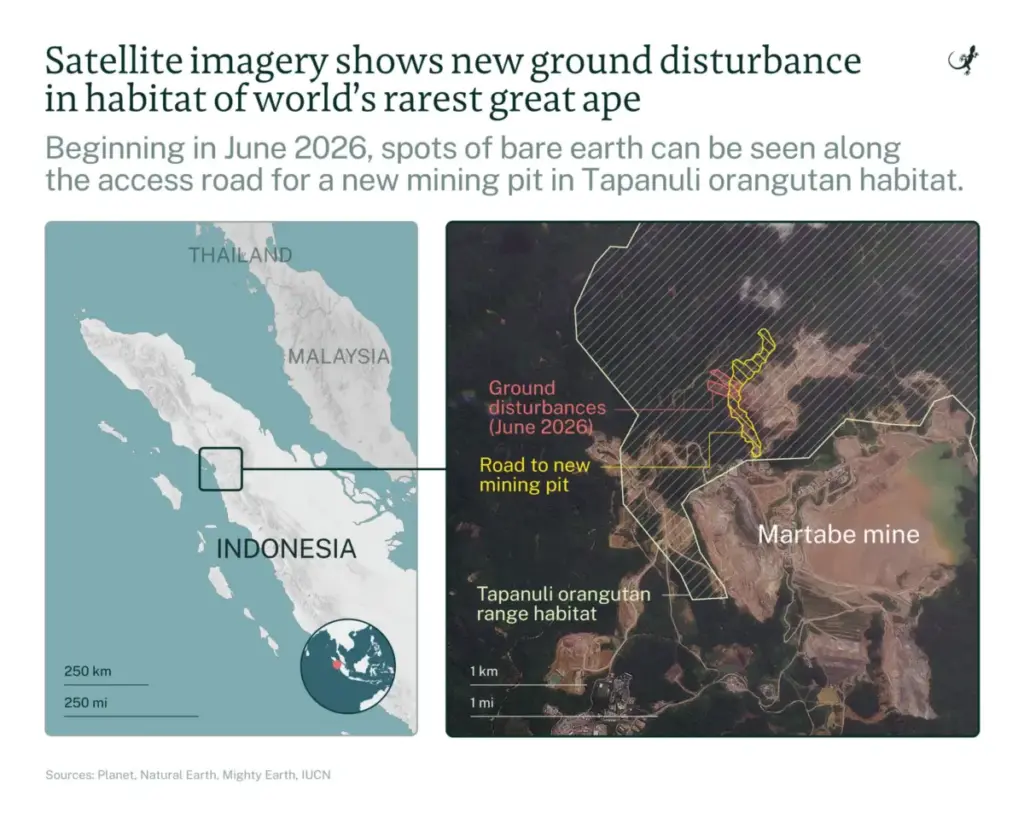
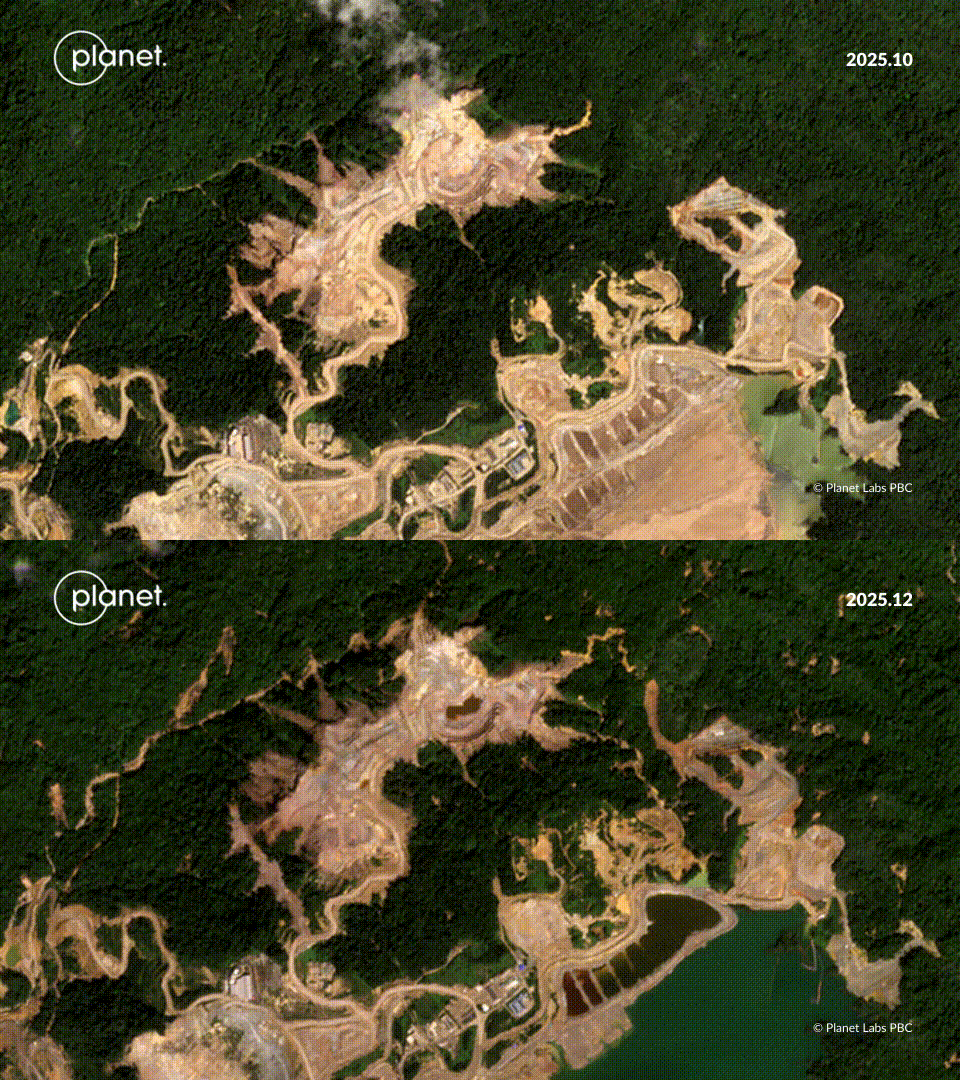
Fresh concerns arose between June 13 and June 23, 2026, when Planet satellite imagery analyzed by the U.S.-based environmental organization Mighty Earth revealed newly carved swaths of treeless earth and disrupted topography surrounding the Ramba Joring pit near the Martabe gold mine.
According to Mighty Earth, these scars point to active land movement and secondary landslides linked to mine development and infrastructure pressures. The disturbances sit alarmingly close to the access road designed for the proposed 50-hectare (124-acre) Tor Ulu Ala (TUA) open pit, located just north of the current mining footprint. Furthermore, spatial analysis by Mighty Earth indicated that specific segments of the June earthmoving activities fell outside the zones formally mapped for disturbance through the end of the decade under the mine’s 2030 Life of Mine (LOM) schedule.

Supporting Context & Metrics: A Habitat on the Brink
The fragility of the Batang Toru ecosystem is compounded by strict biological mathematics and compounding environmental stressors.
- Population Baseline: Comprehensive assessments place the entire global population of Pongo tapanuliensis at roughly 716 individuals remaining in the Batang Toru forest. Divided into increasingly isolated subpopulations, the species lacks any demographic buffer to absorb additional losses.
- The AZE Designation: The area targeted for the TUA pit expansion is not merely ordinary forest; it is recognized by the Alliance for Zero Extinction (AZE) as a globally significant Key Biodiversity Area (KBA). Conservationists have frequently questioned why industrial expansion continues to target this specific ecological hotspot when vast tracts of alternative land exist elsewhere within the broader 130,252-hectare (321,860-acre) concession.
- Secondary Landslide Vulnerability: Prominent conservation biologist Erik Meijaard, a co-author of the Current Biology study, notes that the June disturbances are likely secondary landslides. Slopes left inherently unstable, fractured, and denuded of mature tree root systems during the November 2025 cyclone remain intensely susceptible to progressive collapse during subsequent weather events or mechanical shocks.
Official Statements and Industry Disputations
The discovery of the June earth scars and the broader impacts of industrial activity inside an orangutan stronghold have drawn sharp contradictions between corporate stakeholders, independent scientists, and regulatory bodies.

Agincourt Resources’ Defense
Agincourt Resources, the operator of the Martabe gold mine, has strongly disputed Mighty Earth’s characterization of the June earthworks as landslides caused by unmanaged development. The company stated that the ground movement resulted from routine material displacement following controlled blasting operations conducted strictly within its planned operational boundaries. Agincourt maintained that these blasts were engineered with thorough consideration of local topography, geotechnical standards, and long-term slope stability metrics.
Furthermore, Agincourt rejects the scientific study’s mortality estimates. The company reported that its own post-disaster monitoring teams confirmed the survival of previously cataloged orangutans and even recorded three previously undocumented individuals. However, independent analysts point out a critical caveat: Agincourt’s post-cyclone surveys covered only about 63% of the Martabe Preservation Area. The remaining 37% was left unsurveyed due to extreme, hazardous terrain, meaning a substantial portion of the monitored ape population remains officially unaccounted for.

Agincourt maintains that its ongoing and future expansion projects—including both the open-pit TUA development and a newly registered underground mining exploration application filed in July 2026—will proceed in parallel. The company insists these projects are essential for extending the economic life of the mine by five to 10 years and generating closure funds, while remaining compatible with conservation targets via biodiversity offsets and habitat restoration plans.
Government and Regulatory Stance
The Indonesian Ministry of Environment has adopted a compartmentalized approach to the crisis. Following the November 2025 disaster, the government initiated civil lawsuits against six companies over alleged links to the catastrophic floods and landslides, initially contemplating the revocation of Agincourt’s mining permit. However, those legal actions were later resolved through out-of-court settlements, allowing Agincourt to resume commercial mining while subjected to a mandatory environmental audit.

Nety Widayati, the ministry’s director of impact prevention for business and activities, clarified that the administrative audit and the legal authority to mine are distinct processes. "The environmental approval wasn’t revoked," Widayati told Mongabay. "They were simply ordered to undergo an environmental audit."
According to the ministry, this audit—expected to conclude imminently—will yield management recommendations such as zoning restrictions, development limitations, or enhanced environmental safeguards. Crucially, the ministry views the November disaster not as the fault of a single entity, but as a cumulative consequence of multi-sector activities altering the Batang Toru landscape. Meanwhile, when pressed specifically on whether the ministry investigated the June ground disturbances, Deputy Minister Sigit Reliantoro declined to comment, directing inquiries to law enforcement channels.
Future Outlook: The El Niño Wildfire Threat and the Absence of a Recovery Plan
As if industrial encroachment and landscape scarring were not enough, a new and potentially devastating threat is looming over Batang Toru: a severe El Niño cycle.
When rainforests are fragmented and damaged by landslides, the immediate consequence is a massive accumulation of dead, drying biomass and woody debris exposed directly to intense sunlight through shattered canopies. On July 30, 2026, Indonesia’s meteorological agency (BMKG) officially declared the onset of a strong El Niño phase, warning of suppressed rainfall, prolonged drought, and heightened wildfire risks nationwide.

Data from FireWatch—a satellite monitoring platform developed by Nusantara Atlas—underscores the gravity of the national fire season, recording over 637,000 hotspots across Indonesia by mid-September, far outstripping historical records from volatile years like 2019.
Conservationists warn that if an unseasonable dry spell or escaped agricultural fire breaches the landslide-scarred slopes of Batang Toru, the accumulation of dry fuel could ignite catastrophic forest fires. Such an event would bypass the resilience of an ecosystem already reeling from the loss of 8,300 hectares of forest in late 2025.

Conclusion: A Call for Coordinated Action
Nearly a year after Cyclone Senyar ravaged their home, Tapanuli orangutans possess neither a dedicated government recovery plan nor a safe harbor from ongoing industrial expansion. With mining operations fully active, underground exploration applications progressing through regulatory channels, and the shadow of El Niño darkening the horizon, conservationists argue that time has run out for business-as-usual approaches.
"The west block was the epicenter of the Tapanuli orangutan population, and now we don’t actually really know what the population health is," said Mighty Earth campaign director Phil Aikman. For the world’s rarest great ape, the convergence of unchecked corporate ambition, fragile recovering soils, and climate extremes has elevated the crisis from an ecological warning to an irreversible emergency.



