

Executive Overview
For decades, the cornerstone of global climate policy has rested on a single, overarching imperative: reaching net-zero carbon dioxide ($CO_2$) emissions. While curtailing $CO_2$ remains essential to stabilizing long-term atmospheric temperatures, a groundbreaking study published in Communications Earth & Environment reveals a dangerous blind spot in international climate strategy. By treating all greenhouse gases as an aggregated lump sum—measured through simplified "$CO_2$ equivalent" ($CO_2e$) metrics—current climate models and national commitments severely underestimate the immediate, violent warming impact of methane ($CH_4$).
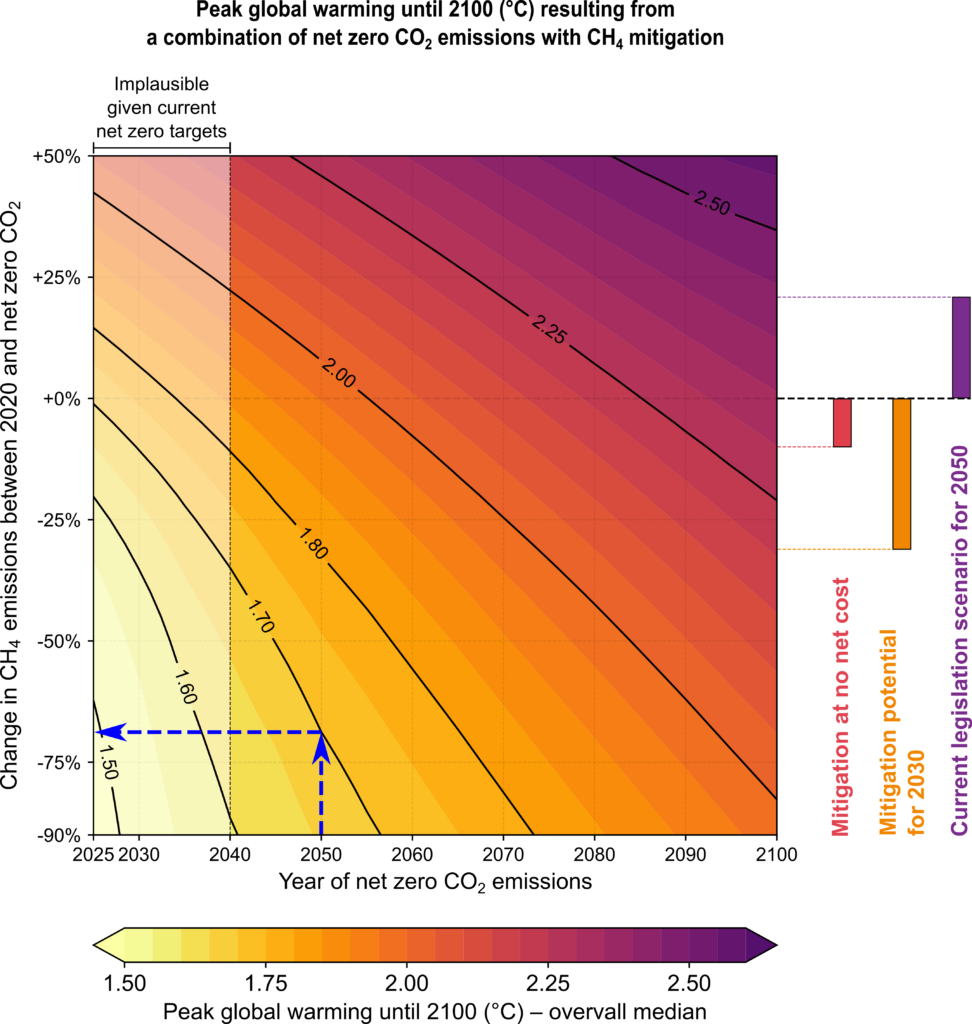
The study, authored by K. Weber et al., demonstrates that even under the most aggressive national net-zero $CO_2$ targets, failing to implement dedicated, stringent methane cuts guarantees peak global warming will breach crucial Paris Agreement thresholds. If global methane emissions are allowed to follow current policy projections—which forecast a 20% increase by 2050—peak warming will surpass 2.0°C above pre-industrial levels, even if the world successfully achieves net-zero $CO_2$ emissions by mid-century.
To prevent temperature overshoots that could trigger irreversible climate tipping points, the researchers advocate for a fundamental paradigm shift: decoupling methane targets from $CO_2$ targets. By starting with strict peak warming thresholds (such as 1.7°C or 1.8°C) and calculating backward, the study provides a realistic roadmap for independent methane reductions. The findings serve as a stark warning to policymakers preparing the next generation of Nationally Determined Contributions (NDCs): net-zero $CO_2$ is a necessary condition for climate stability, but without aggressive, standalone methane cuts, it is fundamentally insufficient.
+-----------------------------------------------------------------------------------+
|                            PEAK WARMING RISK MATRIX                               |
+------------------------------------+----------------------------------------------+
| 2050 Net-Zero CO2 + Current CH4    | Exceeds 2.0°C Peak Warming                   |
| Policy Trajectory (+20% CH4)       | (Violates Paris Agreement Limits)            |
+------------------------------------+----------------------------------------------+
| 2050 Net-Zero CO2 + Flat CH4       | Exceeds 1.85°C Peak Warming                  |
| (0% CH4 Change relative to 2020)   | (High Risk of Climate Instability)           |
+------------------------------------+----------------------------------------------+
| 2050 Net-Zero CO2 + Stringent CH4  | Limits Warming to ~1.7°C                     |
| Mitigation (-69% CH4 by 2050)      | (Aligns with "Well-Below 2°C" Goal)          |
+------------------------------------+----------------------------------------------+
Detailed Chronology & Scientific Methodology
The Evolution of Climate Scenario Modeling
Historically, Integrated Assessment Models (IAMs)—the computational tools utilized by the Intergovernmental Panel on Climate Change (IPCC) to evaluate mitigation pathways—have relied on cost-optimization algorithms. These models evaluate the financial cost of reducing various greenhouse gases and select the most economically efficient combination to reach a given target.
While theoretically sound, this approach introduces two major systemic flaws into real-world policymaking:
- Economic Assumption Bias: IAMs assume climate policy is executed with perfect market efficiency, ignoring the messy reality of political inertia, localized agricultural subsidies, geopolitical friction, and fragmented regulatory frameworks.
- Metric Distortion: By converting methane into $CO_2$ equivalents ($CO_2e$), models mask the critical temporal mismatch between the two gases. Methane possesses an atmospheric lifetime of roughly a decade, yet over a 20-year timescale, it traps more than 80 times as much heat as $CO_2$. Combining them into a single variable conceals the massive near-term cooling dividend offered by rapid methane suppression.
A Decoupled, Warming-First Methodology
To overcome these structural limitations, Weber et al. established a novel analytical framework that separates $CO_2$ and methane trajectories, treating them as independent variables across an expanded scenario space. Starting in 2025, the researchers modeled thousands of linear mitigation combinations for $CO_2$ (or total greenhouse gases) and $CH_4$ up to 2100, utilizing a simple, robust climate model to calculate peak warming probabilities.
Instead of asking, "What is the cheapest way to reach a combined $CO_2e$ target?" the study asks: "If a society commits to reaching net-zero $CO_2$ by a specific year, what is the absolute minimum level of independent methane reduction required to keep peak global warming below 1.7°C, 1.8°C, or 2.0°C?"
 traditional iam approach:
 [ CO2 + CH4 Emissions ] ---> [ Convert to CO2-Equivalent ] ---> [ Least-Cost Optimization ] ---> Masked Near-Term Warming

 NEW DECOUPLED APPROACH:
 [ Fixed Peak Target (e.g., 1.7°C) ] ---> [ Model CO2 Net-Zero Date ] ---> [ Calculate Mandatory CH4 Reduction ]
The results reveal an inescapable physics-based relationship: the later global $CO_2$ reaches net-zero, the more aggressive near-term methane reductions must be to avoid catastrophic warming peaks.
Supporting Context & Metrics: The $CO_2$-Equivalent Dilemma
The "Spaghetti vs. Chicken" False Equivalence
To explain the mathematical flaw in current policy frameworks, scientists frequently rely on an everyday analogy: asking how much methane corresponds to one tonne of $CO_2$ is akin to asking how many grams of spaghetti equal a whole chicken.
+-----------------------------------------------------------------------------------+
|                        THE CONVERSION METRIC PARADOX                              |
+---------------------+-------------------------------+-----------------------------+
| Conversion Metric   | Primary Comparison Focus      | Vulnerability / Weakness    |
+---------------------+-------------------------------+-----------------------------+
| GWP100              | Integrated heat absorption    | Understates methane's near- |
| (100-year horizon)  | over a century.               | term impact by ~3x.         |
+---------------------+-------------------------------+-----------------------------+
| GWP20               | Direct radiative forcing      | Overstates methane's long-  |
| (20-year horizon)   | over two decades.             | term warming persistence.   |
+---------------------+-------------------------------+-----------------------------+
| GWP*                | Dynamic rate of emission      | Can frame stable methane    |
| (Step-change metric)| changes over time.            | emissions as "no added      |
|                     |                               | warming," disincentivizing  |
|                     |                               | necessary deep cuts.        |
+---------------------+-------------------------------+-----------------------------+
While convenient for standardized market instruments—such as carbon offsets or aggregate corporate emissions reporting—these metrics obscure real-world thermal impacts. Because methane is a powerful short-lived climate pollutant (SLCP), cutting a tonne of methane today provides an immediate reduction in global radiative forcing. Conversely, cutting a tonne of $CO_2$ prevents heat accumulation that would otherwise persist for centuries. When policies allow companies or nations to trade methane reductions for $CO_2$ reductions under a unified $CO_2e$ umbrella, they risk masking ongoing long-term carbon accumulation while miscalculating the timing of peak temperatures.
Quantitative Breakdown: Minimum Methane Reductions Required
The study’s numerical modeling provides concrete benchmarks for future international negotiations. To maintain a 50% probability of limiting peak global warming to specific thermal ceilings, global methane emissions must achieve severe baseline cuts relative to 2020 levels.
+-----------------------------------------------------------------------------------+
|       MINIMUM METHANE CUTS REQUIRED FROM 2020 BASELINE TO CONTROL PEAK WARMING     |
+---------------+----------------------------------+--------------------------------+
| Peak Warming  | Net-Zero CO2 Target Year         | Net-Zero Total GHG Target Year |
| Threshold     | 2050     2060     2100           | 2050     2060     2100         |
+---------------+----------------------------------+--------------------------------+
| 1.7°C Peak    | -69%     N/A*     N/A*           | -63%     N/A*     N/A*         |
| 1.8°C Peak    | -32%     -56%     N/A*           | -11%     -47%     N/A*         |
| 2.0°C Peak    | +8%      -8%      -83%           | >+50%    +33%     -78%         |
+---------------+----------------------------------+--------------------------------+
*Note: "N/A" indicates that even with 100% methane elimination, the delayed net-zero target date
 guarantees peak warming will exceed that temperature limit.
The data highlights a severe constraint: if net-zero $CO_2$ is delayed until 2060, keeping peak warming below 1.7°C becomes physically impossible, regardless of how drastically methane emissions are slashed.
Evolving Constraints on the Remaining Carbon Budget
The concept of the "Remaining Carbon Budget" defines the total cumulative mass of $CO_2$ humanity can still emit while retaining a given probability of staying below a specific temperature threshold. Standard estimates from the IPCC Sixth Assessment Report (AR6) set the remaining 2.0°C carbon budget from 2025 onward at approximately 1,000 to 1,150 gigatons of $CO_2$ ($GtCO_2$).
However, the new research demonstrates that these baseline IPCC estimates depend entirely on the unstated assumption that global methane emissions will naturally drop by 27% to 35% by 2050.
- The Methane-Stagnation Penalty: If methane emissions remain flat at 2020 levels rather than decreasing, the available carbon budget to preserve a 2.0°C threshold shrinks by roughly 30%, dropping down to approximately $750,GtCO_2$.
- The No-Mitigation Reality: If global methane emissions grow in line with current baseline policies (+20% by 2050), the carbon budget for holding warming to 1.7°C is effectively exhausted immediately.
ESTIMATED REMAINING 2.0°C CARBON BUDGET (FROM 2025)
+-------------------------------------------------------------------+
| Baseline IPCC Assumption (-30% CH4 by 2050): 1,000 - 1,150 GtCO2  |
+-------------------------------------------------------------------+
| Zero Methane Progress (0% CH4 Change):       750 GtCO2 (-30%)     |
+-------------------------------------------------------------------+
| Policy Fail Trajectory (+20% CH4 Rise):      1.7°C Budget Exhausted|
+-------------------------------------------------------------------+
Sectoral Potential & Feasibility Analysis
Addressing methane requires targeted interventions across its three main anthropogenic source sectors: agriculture, fossil fuels, and waste management. Crucially, the mitigation potential across these sectors varies widely in cost and operational readiness.

       ANTHROPOGENIC METHANE EMISSIONS BY SECTOR & MITIGATION POTENTIAL

       [ Agriculture: ~40% ] ------------------> Low-Cost Potential: Limited
                                                Requires systemic dietary shifts,
                                                feed additives, livestock mgmt.

       [ Fossil Fuels: ~35% ] -----------------> Low-Cost Potential: EXTREMELY HIGH
                                                Leak detection/repair, vent capture,
                                                no-net-cost operational fixes.

       [ Waste Mgmt: ~20% ] -------------------> Low-Cost Potential: Moderate
                                                Landfill gas recovery, organic
                                                waste diversion, composting.
1. Fossil Fuel Infrastructure (The Low-Hanging Fruit)
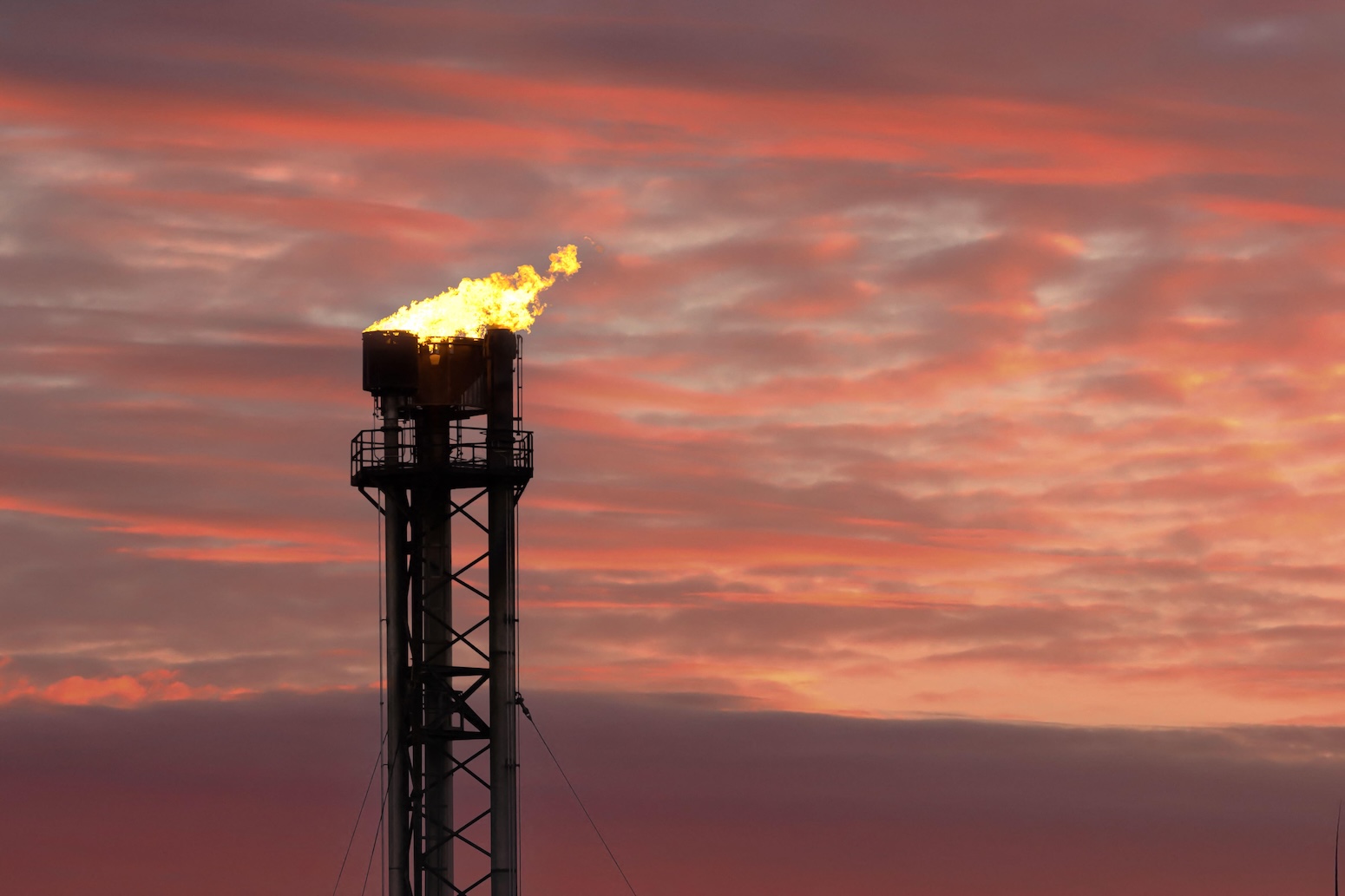
According to analysis from the International Energy Agency (IEA), the energy sector represents the most immediate, cost-effective opportunity for rapid methane abatement. Methane leaks during oil extraction, natural gas venting, and coal mining can frequently be eliminated using existing technologies—such as satellite-guided Leak Detection and Repair (LDAR) programs and vapor recovery units.
The study highlights that implementing all "no-net-cost" fossil fuel methane interventions would immediately shave 0.05°C off peak global temperatures. Because the captured gas can be monetized, these interventions pay for themselves.
2. The Global Methane Pledge Baseline
Full implementation of the Global Methane Pledge—a voluntary framework backed by over 150 countries targeting a 30% aggregate reduction in global methane emissions by 2030—would reduce peak global warming by 0.15°C. This reduction is equivalent to avoiding decades of industrial $CO_2$ emissions, proving that near-term methane action is the single most powerful lever for controlling climate extremes over the next 20 to 30 years.
Future Outlook & Policy Recommendations
The findings of Weber et al. carry profound implications for national governments, corporate sustainability boards, and international climate negotiators as they draft future mitigation roadmaps.
                       KEY POLICY IMPERATIVES FOR 2030/2050

    +-----------------------------------------------------------------+
    | 1. DECOUPLE NDC TARGETS                                         |
    | Establish standalone CH4 targets alongside net-zero CO2.        |
    +-----------------------------------------------------------------+
                                    |
                                    v
    +-----------------------------------------------------------------+
    | 2. MANDATE FOSSIL FUEL LEAK ELIMINATION                         |
    | Enforce zero-flaring and aggressive LDAR regulations globally.  |
    +-----------------------------------------------------------------+
                                    |
                                    v
    +-----------------------------------------------------------------+
    | 3. REWRITE CORPORATE REPORTING STANDARDS                        |
    | Disaggregate methane reporting in Scope 1, 2, and 3 footprinting|
    +-----------------------------------------------------------------+
1. Disaggregation of Nationally Determined Contributions (NDCs)
Current international climate protocols permit signatories to package their emissions pledges into a single $CO_2e$ figure. This structure allows states to claim progress while neglecting short-lived climate pollutants. Future climate summits must require nations to report distinct, binding targets for $CO_2$ and $CH_4$ independently. Currently, only a small minority of states—including Japan, Mexico, and South Korea—maintain explicit, standalone methane mitigation targets.

2. Recalibrating Integrated Assessment Models
The scientific community must reform the optimization algorithms within IAMs. By forcing models to evaluate methane mitigation through realistic political and sector-specific lenses, rather than pure least-cost mathematical shortcuts, researchers can provide policymakers with accurate evaluations of climate risks.
3. Immediate Sectoral Focus on Energy Leaks
Nations must enforce strict regulatory limits on routine flaring, venting, and fugitive leaks across oil and gas operations. Given that a substantial fraction of fossil fuel methane cuts can be achieved at net-zero or negative financial cost, failure to execute these interventions represents an avoidable failure of regulatory oversight.
Conclusions
The imperative to achieve net-zero $CO_2$ emissions remains an absolute, non-negotiable law of atmospheric physics; without it, global temperatures will continue to rise indefinitely. However, as the research by Weber et al. demonstrates, net-zero $CO_2$ is not a complete solution on its own.
Treating methane as a secondary concern under the blanket metric of "$CO_2$ equivalence" creates a dangerous illusion of security. If methane emissions continue their current upward trajectory, the world will experience severe temperature overshoots exceeding 2.0°C, regardless of how rapidly $CO_2$ infrastructure is decarbonized.
To preserve a stable climate, the global community must embrace a dual-track strategy: driving down long-term $CO_2$ emissions to zero while simultaneously executing aggressive, targeted, and independent reductions in methane. Decoupling these two gases in policy, finance, and international law is no longer just an academic preference—it is a physical requirement for keeping global warming well below dangerous thresholds.



