

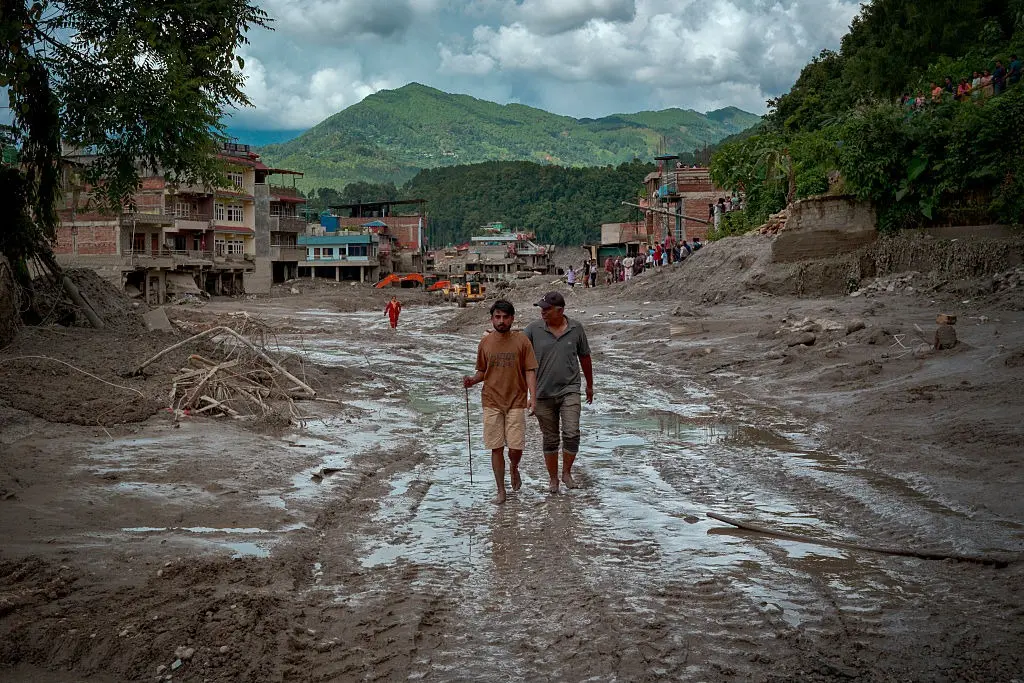
KATHMANDU / TRISHULI — Nearly a month after a compound disaster of ice, rock, and water tore through the high-altitude valleys of northern Nepal, the true scope of the tragedy continues to unfold across the country’s fragile river basins. What began on August 26, 2026, as a sudden hydro-meteorological surge in the northern stretches of Rasuwa district has evolved into one of the deadliest climate-induced catastrophes in Himalayan history.
With the official death toll climbing toward 1,500 and an estimated 5,800 individuals still missing, Nepal finds itself at the epicenter of an escalating global climate emergency. The destruction along the Bhote Koshi and Trishuli river systems underscores a stark, unjust paradigm: developing nations bearing the structural brunt of a planetary crisis to which they contributed virtually nothing.
Executive Overview
The disaster that struck the Bhote Koshi river corridor in late August 2026 was not merely a localized weather event; it was a compound ecological collapse driven by rapid thermal expansion in the high Himalayas. A colossal mass of glacial ice and high-altitude permafrost detached in the upper catchments, creating a high-velocity debris flow that swept through alpine settlements, critical road arteries, and vital energy infrastructure before surging downstream into the Trishuli valley.
                    +---------------------------------------+
                    |   HIGH-ALTITUDE THERMAL EXPANSION     |
                    | Glacial detachment & permafrost thaw  |
                    +-------------------+-------------------+
                                        |
                                        v
                    +---------------------------------------+
                    |     COMPOUND DEBRIS & FLASH FLOOD     |
                    | Ice, rock, and torrents enter basin   |
                    +-------------------+-------------------+
                                        |
                                        v
                    +---------------------------------------+
                    |      DOWNSTREAM CASCADE IMPACTS       |
                    |  - 1,500 Confirmed Fatalities         |
                    |  - 5,800 Missing Persons              |
                    |  - Hydropower Grid Paralysis          |
                    |  - Severe Cross-Border Trade Disrupt. |
                    +---------------------------------------+
As search and recovery operations transition into a grim phase of disaster management, the crisis has laid bare the extreme vulnerability of mountain communities. Nepal’s National Disaster Risk Reduction and Management Authority (NDRRMA) has classified the flood as a national catastrophe requiring sustained, multi-year international intervention.
The political and economic ramifications are profound. Beyond the human loss, the flood demolished major hydroelectric installations, severed crucial trade links with China, and decimated localized agricultural economies. The calamity has reignited intense debates surrounding the operationalization of global Loss and Damage funds, early-warning network limitations in complex topographies, and the urgent need for direct, non-debt climate financing for climate-vulnerable nations.
Detailed Chronology
The Prelude: Thermal Stress and Pre-Monsoon Saturation
Throughout the summer of 2026, the Hindu Kush Himalaya (HKH) region experienced unprecedented surface temperature anomalies, running up to 2.3°C above baseline averages. High-altitude weather monitoring stations in the Rasuwa and Langtang regions recorded sustained melting windows, weakening structural ice margins and destabilizing steep permafrost slopes along the Tibetan border.
By mid-August, intense, localized atmospheric rivers deposited concentrated rainfall over already saturated glacial moraines. This combination of thermal thawing from above and hydrological pressure from beneath created primed conditions for a massive structural failure in the upper catchment of the Bhote Koshi.
August 26, 2026: The Collapse and Flash Surge
- 14:15 NPT: A massive detachment of high-altitude ice and bedrock occurred at an elevation exceeding 5,000 meters in the high northern Rasuwa region. The falling mass impacted a proglacial lake, instantly displacement-volume surging hundreds of thousands of cubic meters of water and debris into the upper Bhote Koshi basin.
- 14:45 NPT: A wall of mud, boulders, and water—estimated at over 15 meters in height—slammed into border crossing points and mountain villages near Rasuwagadhi. Strategic bridges along the Pasang Lhamu Highway were severed instantly, isolating dozens of high-altitude settlements.
- 16:00 NPT: The flood peak hit downstream hydroelectric stations. The run-of-the-river power facilities along the Bhote Koshi were overtopped or swept away, forcing an automatic emergency shutdown of regional power corridors and plunging parts of central Nepal into dark conditions.
- 18:30 NPT: The surge reached the confluence of the Bhote Koshi and Trishuli rivers. Heavy sediment loads choked the river channels, destroying lower-lying markets, riverside homesteads, and vital civil infrastructure in Trishuli.
Timeline of the August 2026 Disaster
========================================================================================
[Aug 26, 14:15] Glacial ice/rock detachment occurs above 5,000m in Rasuwa.
[Aug 26, 14:45] 15-meter surge strikes Rasuwagadhi; Pasang Lhamu Highway bridges collapse.
[Aug 26, 16:00] Downstream hydropower infrastructure overtopped; regional grid trips.
[Aug 27, 06:00] First military helicopter reconnaissance reveals widespread valley collapse.
[Sep 05, 12:00] Official death toll surpasses 1,000 as search efforts hit impassable mudslides.
[Sep 23, 2026] NDRRMA reports ~1,500 confirmed dead, 5,800 missing; calls for aid renewal.
========================================================================================
August 27 – September 5, 2026: Emergency Response and Isolation
In the immediate aftermath, ground rescue operations were severely hampered by continuous landslides and the total destruction of access roads. The Nepalese Army, Armed Police Force, and local volunteer teams deployed search-and-rescue helicopters, but cloud cover and narrow river valleys restricted aerial lifts.
By early September, search efforts yielded heartbreaking discoveries as entire communities were found buried under meters of dense glacial slurry and river silt. Search crews utilized heavy machinery where accessible, but vast stretches of the river banks remained unreachable, converting large areas of the valley floor into mud-choked graves.
Supporting Context & Metrics
Human and Societal Toll
The human cost of the August 26 flood ranks among the most severe in the modern history of the Central Himalayas. The high number of missing persons highlights the violent speed of the flash flood, which caught communities during daytime activities without sufficient lead time for evacuation.
| Category | Metric / Quantity | Impact Assessment |
|---|---|---|
| Confirmed Fatalities | ~1,500 | Concentrated across Rasuwa and Nuwakot districts |
| Missing Persons | ~5,800 | Presumed buried under deep mudflows or swept downstream |
| Displaced Persons | 42,000+ | Housed in temporary shelters, schools, and tent cities |
| Destroyed Dwellings | 8,400+ | Entire riverside settlements completely leveled |
| Healthcare Facilities Affected | 18 clinics/posts | Severe disruption to regional emergency health services |
Infrastructure and Economic Destruction
The economic fallout threatens to stall Nepal’s macroeconomic stability for years. The Bhote Koshi and Trishuli basins host a critical concentration of Nepal’s energy generation and commercial trade arteries.
- Energy Sector Collapse: Preliminary estimates indicate that over 350 Megawatts (MW) of hydroelectric generation capacity were taken offline. Turbines were clogged by silt, penstock pipes ruptured, and control rooms inundated.
- Trade Corridor Paralysis: The Pasang Lhamu Highway, serving as a primary land trade route between Nepal and China, sustained catastrophic structural damage. Key bridges were completely destroyed, cutting off vital imports of goods, raw materials, and fuel.
- Agricultural Ruin: Flash flooding buried thousands of hectares of arable terraced farming land under toxic, nutrient-poor sediment, wiping out seasonal crops and destroying livestock populations.
Sectoral Distribution of Direct Financial Losses (Estimated Total: $1.85 Billion)
+-------------------------------------------------------------------+
| Hydropower Infrastructure      [35%] $$$$$$$$$$$$$$$              |
| Transport & Roads              [25%] $$$$$$$$$$$                  |
| Private Housing & Property     [20%] $$$$$$$$$                    |
| Agriculture & Livestock        [12%] $$$$$                        |
| Public Services & Telecoms     [ 8%] $$$                          |
+-------------------------------------------------------------------+
The Science of Mountain Hazards
The Himalayan cryosphere is warming at nearly twice the global average rate—a phenomenon known as Elevation-Dependent Warming (EDW). As glaciers retreat, they leave behind fragile moraine-dammed lakes susceptible to Glacial Lake Outburst Floods (GLOFs).
Concurrently, deep-seated permafrost that acts as geological glue for mountain faces is thawing. When high-intensity rainfall events interact with compromised permafrost structures, the resulting failure is not a simple flood, but a hyper-concentrated sediment flow capable of moving multi-ton boulders and destroying heavy concrete structures downstream.
Official Statements
The disaster has triggered profound grief and urgent appeals from authorities in Nepal and international observers, emphasizing the acute moral conflict embedded in the climate crisis.
Speaking from Kathmandu, Dharam R. Uprety, Head of Nepal’s National Disaster Risk Reduction and Management Authority (NDRRMA), framed the disaster in unequivocal terms:
"The climate crisis didn’t just knock at our doorstep. It has smashed through homes, demolished critical roads, and caused untold grief for millions of Nepali people. It has now been nearly a month since a wall of ice, rock, and water tore through the Bhote Koshi river system. The death toll has risen to nearly 1,500 people with 5,800 more still missing. Nepal needs sustained assistance from the international community."
Uprety emphasized that national disaster budgets are stretched beyond capacity, calling on global institutions to bypass bureaucratic delays and deliver immediate, non-repayable grants for reconstruction and community relief.
In a formal address to foreign diplomats, Nepal’s Ministry of Foreign Affairs stressed the systemic injustice of the tragedy:
"Nepal contributes less than 0.05% to global greenhouse gas emissions, yet our citizens are paying for planetary warming with their lives, their homes, and their futures. The tragedy in the Bhote Koshi basin is a stark reminder that the current framework for climate finance is profoundly inadequate to meet the scale of loss and damage occurring on the frontlines."
Unions of affected communities and regional leaders have joined in calling for global accountability, pointing out that local adaptation measures—such as reinforced retaining walls and local weather alerts—are easily overwhelmed by catastrophic atmospheric and glaciological events.
Future Outlook
The Reconstruction Imperative
Nepal faces a daunting recovery path that will require years of dedicated resources. Immediate priorities include:
- Locating the Missing: Resuming targeted excavation in downstream delta areas, though hopes of finding survivors have given way to recovering remains for grieving families.
- Restoring Transport Lines: Constructing temporary bailey bridges along the Pasang Lhamu Highway to reopen essential supply chains and allow aid convoys into remote districts.
- Preventing Secondary Crises: Providing clean water, sanitation, and medical support to tens of thousands of displaced residents in temporary camps to prevent waterborne disease outbreaks.
                                  RECOVERY PHASE MATRIX
+---------------------------------------------------------------------------------------+
| PHASE 1: Immediate Relief (Months 0-3)                                               |
| - Emergency shelter, water, sanitation, and disease control in camps.                |
| - Temporary bailey bridge installation across critical Pasang Lhamu trade points.     |
+---------------------------------------------------------------------------------------+
                                           |
                                           v
+---------------------------------------------------------------------------------------+
| PHASE 2: Reconstruction & Stabilization (Months 3-18)                                |
| - Resettlement of displaced populations outside high-risk flood channels.             |
| - Repair and de-silt affected hydroelectric power generators.                         |
+---------------------------------------------------------------------------------------+
                                           |
                                           v
+---------------------------------------------------------------------------------------+
| PHASE 3: Long-Term Climate Adaptation (Years 2-5)                                     |
| - Installation of multi-hazard early warning sensors across high-altitude catchments. |
| - Redesign of civil infrastructure using climate-resilient engineering standards.     |
+---------------------------------------------------------------------------------------+
Climate Finance and Global Accountability
As international climate summits approach, the catastrophe in northern Nepal serves as an urgent wake-up call for the global community. The Loss and Damage Fund, established under international climate negotiations to assist vulnerable nations, must evolve from a symbolic promise into an active financial mechanism.
Experts argue that disaster response must transition from reactive humanitarian aid to proactive climate justice. This shift requires:
- Direct Grant Allocations: Providing climate finance in the form of direct grants rather than loans, ensuring vulnerable nations do not accumulate debt while rebuilding from climate-induced events.
- High-Altitude Monitoring Networks: Expanding Doppler radar arrays, satellite monitoring, and real-time hydrological sensors deep within high-alpine zones to provide downstream communities with vital evacuation windows.
- Climate-Resilient Infrastructure Standards: Re-engineering bridges, highways, and hydropower installations to withstand compound disasters, extreme runoff surges, and massive sediment loads.
The tragic events along the Bhote Koshi and Trishuli rivers demonstrate that the physical limits of human adaptation are being tested in real time. Without rapid, scaled-up global climate action and direct support for nations on the ecological frontline, the cost of climate inaction will continue to be measured in destroyed lives, broken economies, and devastated mountain communities.



