As the amber canopy of autumn descends across Britain’s parks, woodlands, and nature reserves, a sprawling, subterranean kingdom is making its annual, dazzling ascent to the surface. From urban green spaces in the heart of Birmingham to the ancient stretches of the Wyre Forest, the arrival of cooler, wetter weather has catalyzed the explosion of the United Kingdom’s extraordinary fungal diversity. Over 15,000 distinct species of fungi call the UK home, and the autumn months provide a fleeting, vibrant window where these elusive organisms display their magnificent, bizarre, and sometimes terrifying fruiting bodies.
Yet, this seasonal spectacle is accompanied by a stern warning from conservationists and mycologists alike. While public fascination with wild mushrooms has reached an all-time high, driven by family-oriented foraging walks, social media photography, and a growing appreciation for local ecology, the hidden hazards of the forest floor demand profound respect. Experts stress that the golden rule of autumn exploration—encapsulated by conservation workers as "no licking, no picking, no kicking"—must be observed. Amidst the whimsical toadstools of folklore and fairy tales lurk silent, lethal lookalikes capable of causing catastrophic organ failure.
This comprehensive report examines the surging popularity of autumn fungi spotting across the West Midlands and wider Britain, details the rare biological specimens emerging from the leaf litter, and outlines the crucial balance between public engagement and ecological preservation.
Detailed Chronology: The Seasonal Awakening and Mycological Discoveries
The transition from late summer to autumn marks a critical biological shift across British ecosystems. As deciduous trees shed their leaves and temperatures drop, mycelial networks—the vast, interconnected underground webs of fungal threads that constitute the true body of the fungus—begin to concentrate their metabolic energy into producing above-ground reproductive structures: mushrooms and toadstools.
The Urban and Rural Tapestry of the West Midlands
In recent weeks, field naturalists and conservation workers have charted a remarkable variety of species springing up in unexpected locales. The Birmingham and Black Country Wildlife Trust has noted an uptick in public sightings, proving that one does not need to venture into remote wilderness to witness the fungal kingdom’s architectural marvels.
In the heart of Birmingham city centre, observant walkers have stumbled upon colonies of tiny bird’s nest fungi (family Nidulariaceae). True to their name, these minute, cup-shaped curiosities measure barely a centimetre across, yet they hold miniature, pebble-like egg structures containing spores. When autumn raindrops strike these cup-shaped nests, a specialized splash-cup mechanism propels the "eggs" outward into the surrounding environment, ensuring the dispersal of the next generation.
Meanwhile, in the wooded enclaves beneath birch trees across the region, the iconic fly agaric (Amanita muscaria) has erupted in brilliant crimson. Adorned with stark white flecks—the remnants of the universal veil that encases the young mushroom—this species serves as the quintessential archetype of the woodland toadstool.
Further urban surprises were logged when a rare red cage fungus (Clathrus ruber) was discovered in Cannon Hill Park. This bizarre organism breaks through the soil as a whitish egg before expanding into a striking, lattice-like crimson sphere. According to regional records, this sighting marked only the second time the species had been officially documented across Birmingham and the Black Country. Nationally, verified records of the red cage fungus number only in the hundreds, making it a prized discovery for seasoned mycologists.
Supporting Context & Metrics: The Hidden Architecture of British Woodlands
To understand the sudden appearance of these autumn phenomena, one must look beyond the caps and stems visible on the forest floor. Fungi occupy their own biological kingdom, distinct from plants and animals. They play an indispensable role as the primary recyclers of forest ecosystems, breaking down lignin and cellulose in dead wood and fallen leaves, thereby returning vital nutrients to the soil.
By the Numbers: The UK Fungal Landscape
15,000+: The estimated number of distinct fungal species recorded across the United Kingdom.
Millions: The invisible kilometers of mycelial networks underlying a single hectare of healthy woodland soil.
10+ Years: The extensive field experience required by many local naturalists to safely and accurately identify the rarer species inhabiting British habitats.
Second Sighting: The rarity of the red cage fungus occurrence in Birmingham’s Cannon Hill Park, underscoring how urban green spaces can occasionally harbor unexpected ecological anomalies.
Architectural Wonders of the Forest Floor
The sheer morphological diversity of autumn fungi defies easy categorization. Beyond the familiar umbrella-shaped toadstools, the British landscape hosts an astonishing array of geometric and organic forms:
The Fly Agaric (Amanita muscaria): Deeply embedded in European folklore, this species owes its widespread cultural recognition to its vibrant red coloration. Historically utilized as an insecticide (hence "fly-agaric"), it forms a mutualistic mycorrhizal relationship with the roots of birch, pine, and spruce trees, trading minerals and water for sugars.
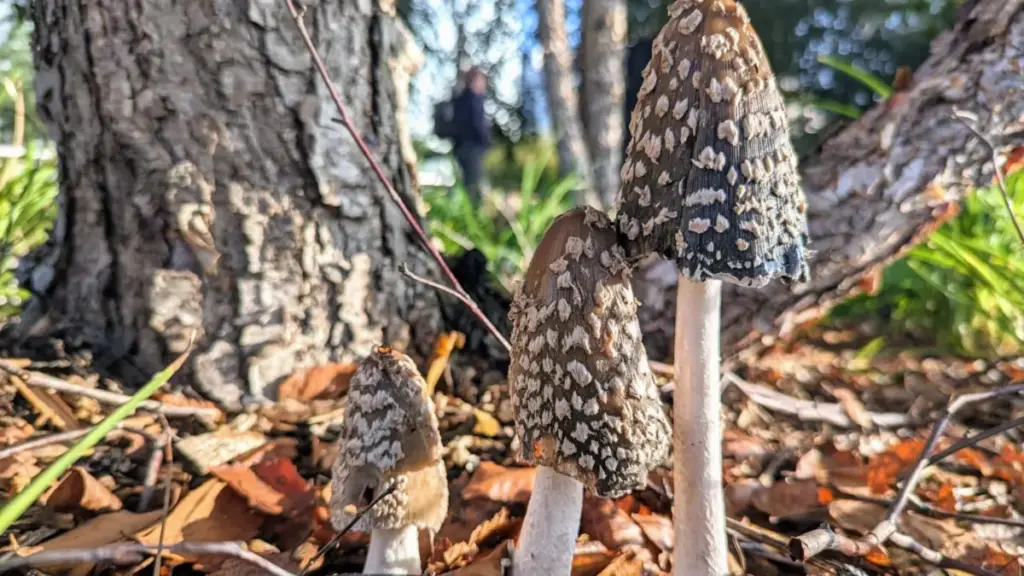
The Magpie Inkcap (Coprinopsis picacea): Named for its distinctive black-and-white scaly cap, this striking mushroom undergoes rapid autolysis as it matures, dissolving its own cap into an inky, black liquid laden with spores.
The Coral Tooth Fungus (Hericium coralloides): Described by regional experts as one of the rarest and most visually arresting sights in British woodlands, this species forms large, cascading, white coraloid fruiting bodies on decaying hardwood stumps, resembling frozen marine life suspended in timber.
Bird’s Nest Fungi: Miniature biological engineering feats that utilize kinetic rainfall energy to propagate their spores across the forest floor.
Official Statements and Expert Perspectives
As public interest in mycology surges, conservation professionals are stepping up efforts to educate the community on how to interact responsibly with nature.
James Benwell of the Birmingham and Black Country Wildlife Trust emphasizes that searching for fungi can fundamentally alter how families experience the outdoors. By encouraging participants to slow down and peer beneath the leaf litter, ordinary walks transform into high-stakes ecological expeditions.
"Every walk becomes interesting and exciting if you’re exploring and if you’re looking for new things," Benwell notes. "Sometimes you’ve just got to look through the leaf litter a bit, and you’d be amazed at the colours and different shapes and sizes of mushrooms you can find when you do look."
Reflecting on the cultural ubiquity of certain species, Benwell points to the fly agaric as a bridge between childhood imagination and natural reality.
"It’s the mushroom of fairy tales," he explains. "It’s in Alice in Wonderland, it’s in Super Mario Brothers… It’s everywhere as part of fairy tales and folklore. But there are still adults who’ve never seen it."
Lucas Large, chairman of the West Midlands Fungus Group, has witnessed firsthand the exponential growth in public enthusiasm over more than a decade of field study. The group’s organized forays and educational walks consistently draw newcomers eager to decode the mysteries of the undergrowth. However, Large issues a solemn caution regarding the hazards of wild mushroom consumption.
Unlike botanical foraging, where certain physical characteristics may offer safe guidance, mycology brooks no margin for error.
"The only way to do it is to know which one it is, or be sort of certain that you’ve got a particular species," Large states, emphasizing that amateur guesswork can prove fatal.
This sentiment is echoed strongly by Benwell, who warns that the UK woodland environment hosts species of profound toxicity. Chief among these is the death cap (Amanita phalloides), a nondescript green-capped mushroom responsible for the overwhelming majority of fatal mushroom poisonings worldwide. The toxins contained within the death cap—specifically amatoxins—are heat-stable and resistant to cooking, attacking liver and kidney cells with devastating efficiency days after ingestion.
"There are mushrooms that will harm you, that will make you sick or even kill you in this country," Benwell warns. "The best place to get your mushrooms if you want to eat them is the supermarket."
To reconcile the urge to explore with the imperative of safety, conservationists advocate a strict household protocol for families and nature enthusiasts alike: "No licking, no picking, no kicking." By substituting the basket with a camera or sketchbook, modern foragers can document biodiversity without disrupting the delicate ecological balance of the forest floor.
Future Outlook: Conservation, Climate, and the Next Generation
Looking toward the future, the management and preservation of Britain’s fungal habitats face complex challenges driven by shifting climatic patterns and urban development. Fungal fruiting bodies are exquisitely sensitive to atmospheric humidity, soil temperature, and rainfall distribution. Unpredictable weather patterns, characterized by prolonged summer droughts followed by sudden, intense autumn storms, have begun to alter the traditional fruiting calendars that mycologists have relied upon for generations.
Organizations such as the Birmingham and Black Country Wildlife Trust, alongside regional bodies like the West Midlands Fungus Group, are ramping up citizen science initiatives. By encouraging the public to photograph, log, and upload their fungal sightings to national databases, conservationists are building an invaluable, real-time map of species distribution and climate impacts. These crowdsourced metrics allow scientists to track the migration of warm-weather species northward and monitor the health of ancient woodland remnants across Cannock Chase, Sutton Park, and the Wyre Forest.
Ultimately, the burgeoning fascination with fungi represents a vital cultural shift. As urban populations become increasingly disconnected from natural rhythms, the humble mushroom serves as an accessible, awe-inspiring gateway back into the natural world. Whether parents and children are marveling at the bioluminescent glimmer of hidden mycelium, tracking the dramatic expansion of a red cage fungus, or simply pausing to inspect the intricate cups of a bird’s nest fungus, the autumn woods offer an enduring testament to the complex, interconnected beauty of life on earth.
By maintaining a posture of respectful observation—photographing rather than picking, and studying rather than disturbing—the public ensures that the kingdom of the underyard will continue to enchant, mystify, and sustain British ecosystems for generations to come.