

Executive Overview
The global automotive landscape is undergoing a structural transformation, propelled by the relentless expansion of China’s electric vehicle (EV) manufacturing sector. Far from showing signs of saturation, China’s EV export machine reached unprecedented heights, shattering previous financial and volume records. According to comprehensive new data released by energy think tank Ember, China shipped a staggering $9.2 billion worth of electric vehicles overseas in May, eclipsing the previous monthly high of $9.1 billion set just a month prior in April. This represents a monumental 49% surge year-over-year, underscoring a trajectory of growth that has fundamentally reshaped international trade dynamics.
While much of the Western discourse surrounding Chinese EV dominance has historically centered on European tariffs, North American protectionism, and domestic overcapacity, a parallel revolution is unfolding closer to home. Southeast Asia has rapidly crystallized into one of the most dynamic and crucial destination markets for Chinese automakers. In May alone, Chinese EV exports to the Association of Southeast Asian Nations (ASEAN) block breached a milestone of $1.2 billion.
This burgeoning demand is not accidental. It is the convergence of aggressive, proactive industrial policy from Southeast Asian governments, soaring fossil fuel prices driven by geopolitical instability in the Middle East, and the unmatched scale and speed at which Chinese manufacturers—led by giants like BYD—can supply affordable, high-tech electric mobility solutions. As traditional markets in the West erect trade barriers, Southeast Asia is aggressively plugging into China’s EV supply chain, accelerating an energy transition that promises to redefine transportation across the Global South.
Detailed Chronology: The Ascent of China’s EV Export Hegemony
To fully grasp the magnitude of China’s current export performance, one must examine the velocity of its ascent. Just five years ago, in 2020, China’s monthly EV exports were valued at less than $1 billion. The transformation from a domestic-focused manufacturing hub into an international exporting behemoth represents one of the fastest industrial pivots in modern economic history.
The numbers for May paint a vivid picture of this ongoing expansion. China exported approximately 448,000 electric passenger vehicles during the month. This total comprised roughly 279,000 Battery Electric Vehicles (BEVs) and 169,000 Plug-in Hybrid Electric Vehicles (PHEVs). This balanced distribution highlights the sophisticated adaptability of Chinese automakers, who are capable of catering to diverse regional infrastructure realities by offering both pure electric and hybrid options.
The growth curve has been exceptionally steep over the past twenty-four months, transitioning from sporadic international shipments to systematic, high-volume market penetration. By establishing localized distribution networks, securing strategic partnerships, and in many cases planning regional manufacturing hubs, Chinese original equipment manufacturers (OEMs) have embedded themselves permanently into the international automotive fabric.
The ASEAN Catalyst: Country-by-Country Momentum
Within the broader Asian export boom, the ASEAN region has emerged as a primary anchor. The record $1.2 billion in exports recorded in May reflects aggressive adoption rates across several key markets, each deploying distinct policy mechanisms to spur electrification:
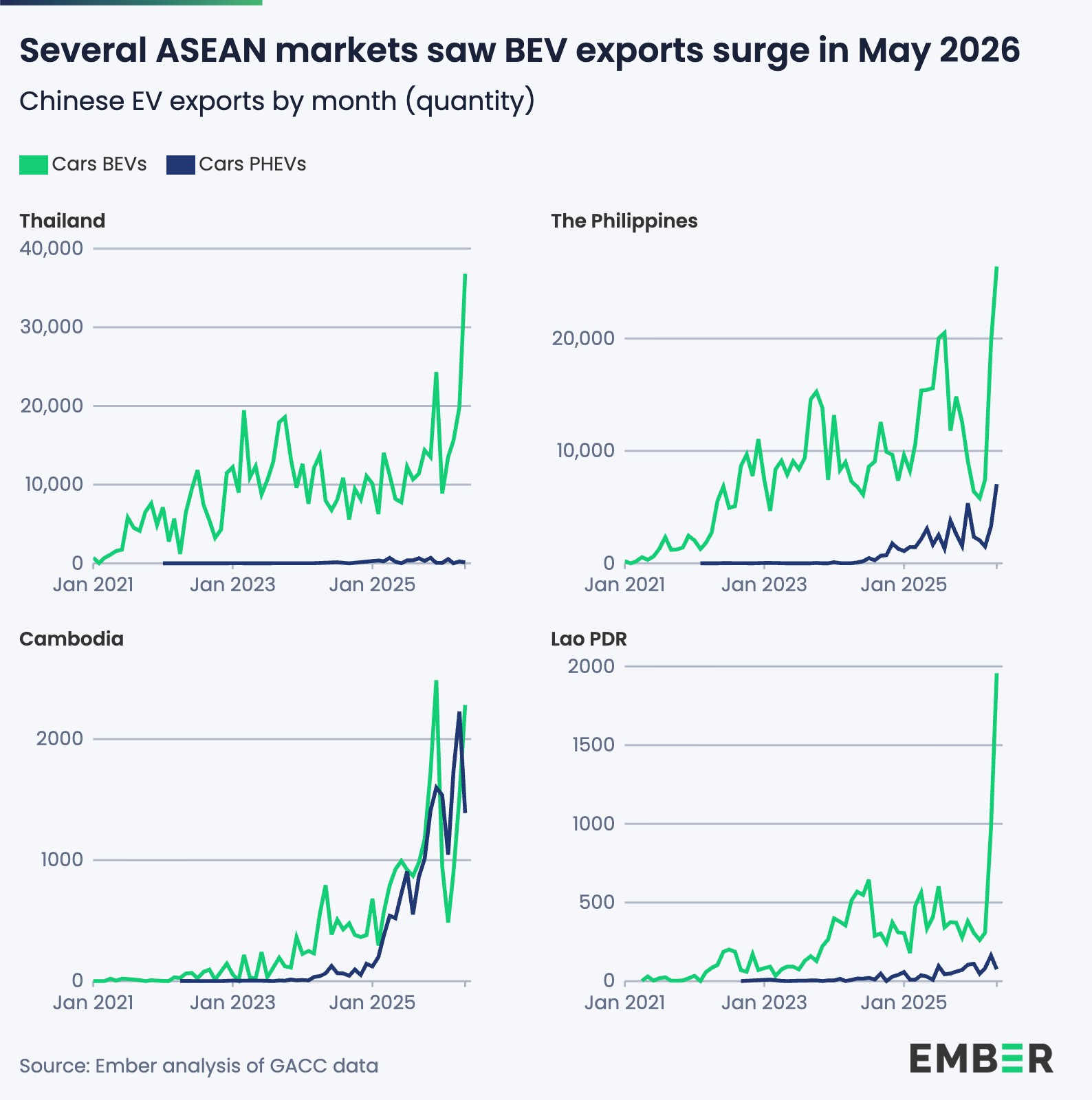
- Thailand: Long recognized as the "Detroit of Asia" due to its entrenched internal combustion engine (ICE) manufacturing base, Thailand has aggressively pivoted to become the epicenter of Southeast Asian EV adoption. In May alone, Thailand imported more than 36,000 Chinese EVs, buoyed by comprehensive government subsidies (such as the EV 3.5 package), tax cuts, and substantial inward investments from brands like BYD, GAC Aion, and Great Wall Motor.
- The Philippines: Surging close behind, shipments of Chinese EVs to the Philippines topped 33,000 vehicles in May. Urban centers facing severe air pollution and rising commuting costs are finding affordable Chinese BEVs and PHEVs to be an increasingly attractive alternative to traditional gasoline-powered vehicles.
- Cambodia: Proactive regulatory frameworks have transformed Cambodia into a rapidly growing EV market. In late March, the Cambodian government enacted sweeping tax reforms, cutting customs duties on BEVs to zero while slashing tariffs on PHEVs from a prohibitive 35% down to just 7%. This policy shock triggered a record monthly import volume in May, with BEVs commanding the lion’s share of the market while PHEVs steadily gain ground.
- Laos: Perhaps executing the most aggressive policy pivot in the sub-region, Laos has systematically reduced EV registration fees and service costs. More critically, the Laotian government mandated that transportation companies must ensure EVs make up at least 10% of their commercial fleets by the end of 2026. Demonstrating unprecedented commitment to shedding fossil fuel dependence, Laos implemented a temporary ban on the import of traditional ICE passenger cars through the end of the year. The downstream impacts of this policy on regional trade and domestic fleet electrification are anticipated to ripple through the market in the coming months.
Supporting Context & Metrics: The Macroeconomics of the Shift
The acceleration of EV adoption across Southeast Asia cannot be viewed in a vacuum. It is heavily catalyzed by external macroeconomic shocks, most notably the volatility of global energy markets.
According to Ember’s analysis, skyrocketing fuel prices—exacerbated heavily by ongoing geopolitical conflicts and instability in the Middle East—have exposed the profound vulnerabilities of nations dependent on imported fossil fuels. For Southeast Asian economies, which historically rely heavily on imported petroleum products to power their transportation networks, traditional internal combustion engine vehicles have transformed from an everyday utility into a volatile financial liability.
Key Metrics Defining the Shift:
- $9.2 Billion: Total value of China’s global EV exports in May, marking a 49% year-over-year increase.
- $1.2 Billion: Value of Chinese EV exports destined specifically for ASEAN nations in May.
- 448,000 Units: Total volume of electric passenger vehicles shipped internationally by China in May (279,000 BEVs; 169,000 PHEVs).
- 36,000+ / 33,000+: Monthly vehicle imports into Thailand and the Philippines, respectively, highlighting intense localized consumer demand.
- 10% Mandate: Laos’ regulatory requirement for commercial transport fleets to electrify by the close of 2026, paired with a concurrent temporary freeze on ICE vehicle imports.
These metrics illustrate a clear economic reality: the total cost of ownership (TCO) for electric vehicles in Southeast Asia has decisively tipped in favor of electrification. When combined with zero-tariff entry points, reduced maintenance overhead, and insulated electricity grids, the transition away from oil has become a matter of both national security and household economics.
Official Statements and Industry Insights
Energy analysts and market researchers tracking the region emphasize that the current surge is structural rather than cyclical. The convergence of industrial oversupply in China and acute energy insecurity in importing nations has created a frictionless trade corridor.
Lam Pham, Ember’s energy analyst for Asia, highlighted the direct correlation between geopolitical energy shocks and regional policy acceleration:

"The current energy crisis has reinforced the value of electrification as a pathway to greater energy security, reduced fuel import exposure, and long-term transport cost savings."
Echoing this sentiment, Euan Graham, Ember’s senior electricity and data analyst, pointed to the sheer velocity of the supply-and-demand mechanics at play:
"Southeast Asia is fast becoming one of the most dynamic destinations for electric vehicles, and China is supplying that demand at scale and speed."
Industry observers note that Chinese automakers have learned valuable lessons from their domestic market—specifically regarding hyper-competition, cost optimization, and software integration. By deploying vehicles tailored to emerging market price points without sacrificing modern infotainment and battery safety features, these brands are capturing market share long before legacy Western or Japanese automakers can pivot their regional product portfolios.

Future Outlook: Electrek’s Take and Strategic Implications
While Western media coverage of the global EV transition remains intensely focused on the geopolitical friction between Beijing, Brussels, and Washington, a blind spot has emerged regarding the Global South. Southeast Asia does not command the same daily headlines as the European Union or the United States, yet it is rapidly establishing itself as one of the most consequential, high-growth EV markets on the planet.
The strategic playbook deployed by Chinese automakers in ASEAN has been masterclass-level. Rather than simply exporting completed vehicles, companies are laying down deep roots through local manufacturing investments, joint ventures with regional conglomerates, and the establishment of robust charging infrastructure ecosystems. Concurrently, regional governments are acting as willing and eager partners, utilizing tax incentives, zero-duty thresholds, and bold regulatory bans on ICE imports to force the hand of modernization.
The infusion of Middle East-induced energy crises has essentially placed Southeast Asian EV adoption into turbo mode. Consumers and commercial fleet operators alike are waking up to the reality that gasoline-powered mobility is an expensive, vulnerable relic of the past.
As China’s EV export machine continues to shatter records month after month, Southeast Asia is no longer just a secondary market acting as a pressure valve for excess production. It has become a foundational pillar of the global electric vehicle revolution—proving that affordable, accessible electrification can scale at an unprecedented pace when manufacturing capability aligns perfectly with urgent regional demand.



