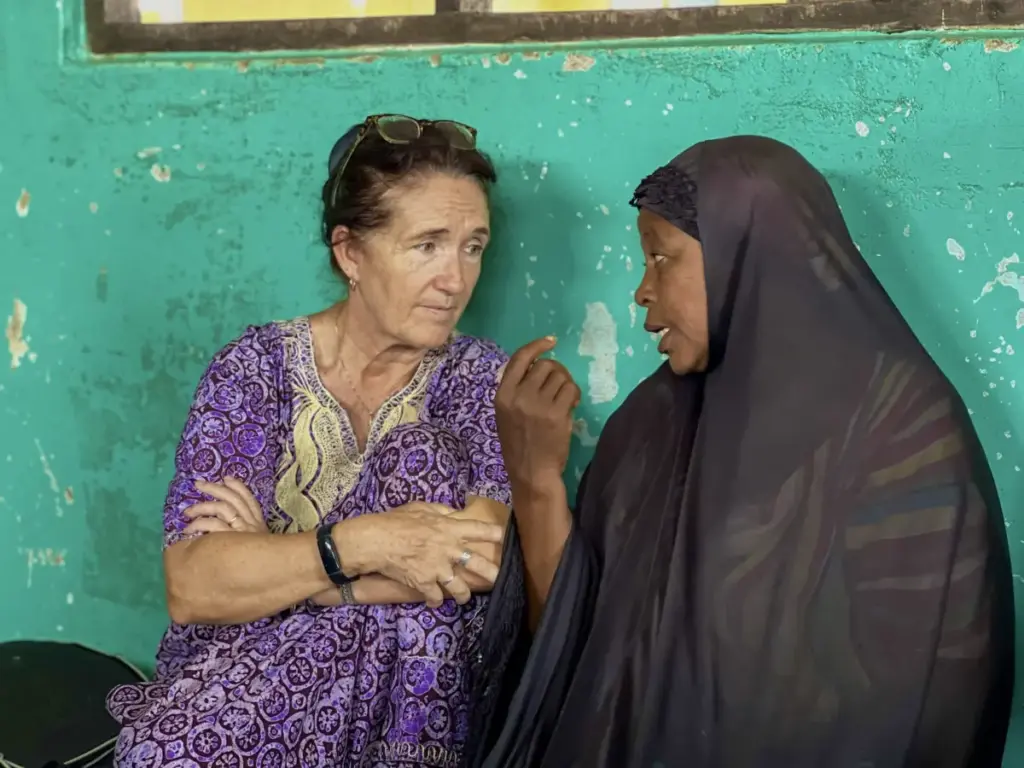
Decades before their paths would formally intertwine to establish one of East Africa’s most lauded marine conservation networks, Ali Thani and Lorna Slade were already walking parallel tracks along the coast of Zanzibar. Back then, Thani was stationed within the island’s Department of Forestry, while Slade worked alongside the Department of Environment. Little did they know that a convergence of personal history, academic research, and a catastrophic global financial crisis would thrust them into a partnership that would fundamentally alter the trajectory of coastal conservation in Tanzania.
What began in 2008 as a modest, orphaned experiment funded by a meager $25,000 severance check from a retreating U.S. foundation has transformed into the Mwambao Coastal Community Network. Today, Mwambao operates with a robust annual budget of approximately $3.5 million, driving locally rooted marine conservation, sustainable fisheries, and alternative livelihood programs across Zanzibar and mainland Tanzania.
Yet, as the global conservation community races toward the ambitious "30-by-30" mandate—the international goal to protect 30% of the world’s land and oceans by 2030—Mwambao finds itself at a critical crossroads. Independent evaluations obtained by Mongabay reveal a complex reality on the ground: while the network has pioneered participatory spatial planning and eco-credit schemes that bridge the gap between financial survival and ecological protection, it also grapples with mixed community reactions, localized disputes over fishing closures, and the perennial struggle of maintaining institutional quality amid rapid growth.
In an exclusive, wide-ranging interview during a reporting trip to Zanzibar, Mongabay’s David Akana sat down with Thani and Slade to unpack the triumphs, tensions, and existential strategic debates defining Mwambao’s present and future.
Detailed Chronology: The Genesis of Mwambao
To understand how a $25,000 grant blossomed into a multi-million-dollar organization, one must look back nearly three decades.
[1990s] Co-founders cross paths in Zanzibar's environmental and forestry departments.
   │
[Mid-2000s] Lorna Slade returns to Tanzania for master's tourism research.
   │
[2008] Global financial crash strikes; Sand County Foundation withdraws, leaving $25K.
   │
[2008–2010] Thani & Slade launch participatory media training, subsidizing costs from personal salaries.
   │
[2010s–Present] Mwambao scales up, introducing eco-credits, fisheries co-management, and reaching a $3.5M annual budget.
The Accidental Launchpad
"I will go back about 31 years," recalls Lorna Slade, reflecting on her early days in East Africa. After spending five and a half years working in Tanzania, Slade returned to the country years later to conduct master’s research focused on sustainable tourism. Her academic work caught the attention of the U.S.-based Sand County Foundation, an institution dedicated to championing the rights and knowledge of landowners and resource stewards.
The foundation commissioned Slade to evaluate whether a regional network could be established to empower local resource users. Following a comprehensive regional study, Slade advised the foundation to narrow its focus entirely to Tanzania, where the need for grassroots environmental stewardship was acute.
The 2008 Financial Meltdown
The foundation greenlit the proposal, but timing dealt a cruel blow. In 2008, as the global stock market crashed and the international financial crisis set in, the foundation abruptly pulled out of Tanzania entirely.
Rather than abandoning the project, the backers handed Slade and Thani a parting sum—a mere fraction of the promised funds. "They basically said, ‘OK, well, it’s a good idea. We have $25,000, so here you are,’" Slade remembers with a wry smile.
At the time, Thani was lending his expertise to international NGOs like CARE Tanzania and WWF, while Slade balanced a part-time job in the United Kingdom with periodic returns to East Africa. Armed with $25,000 and an unshakeable conviction, the duo decided to establish a knowledge and advocacy network designed to cross-pollinate best practices among vulnerable coastal communities.
From Participatory Film to Implementation
In its infancy, Mwambao focused heavily on participatory media. The founders ventured into remote villages, teaching residents how to operate cameras, capture their own stories, edit short films, and share them with neighboring settlements. They produced roughly a dozen films before confronting a harsh financial reality: donor funding for pure knowledge-sharing and advocacy was exceptionally difficult to secure.
"You need to be doing stuff," Slade notes. Transitioning from passive advocacy to active implementation, Mwambao began picking up small consultancy contracts. For the first two years, funding trickled in so slowly that Thani and Slade subsidized the organization’s operational costs out of their own pockets. It wasn’t until roughly 24 months later that the network generated enough revenue to place both founders on payroll, sparking an upward trajectory that has continued unabated.
Supporting Context & Metrics: Navigating Scale and Complexity
Scaling an organization from a two-person volunteer initiative to a complex enterprise with a $3.5 million operating budget brings profound structural growing pains.
Financial Compliance vs. Grassroots Ethos
Managing millions of dollars requires rigorous institutional frameworks. Ali Thani points out that while Mwambao has built a highly competent finance team, enforcing internal HR policies and financial compliance across all operational tiers remains an ongoing task.
Yet, for Slade, the most daunting challenge is philosophical and transitional: "At some point, Ali and I are going to move on. We feel an ownership because we’ve grown the whole thing ourselves… Bringing other people in who feel that same sense of ownership and keeping the same ethic going forward is a challenge for any growing organization."
Furthermore, Mwambao frequently functions as an unintentional talent incubator. Young, enthusiastic professionals join the network, receive top-tier training in community mobilization and conservation science, and are eventually lured away by larger entities offering higher salaries. While beneficial for individual career growth, this turnover places a heavy strain on Mwambao’s core capacity.
The Eco-Credit Innovation
One of Mwambao’s most celebrated interventions is its eco-credit program. Recognizing that marine conservation cannot succeed when local populations are struggling to put food on the table, the network designed a financing model that directly ties environmental stewardship to economic upliftment.
How it works: The program injects small amounts of seed capital into communities, enabling residents—particularly women—to launch small businesses. Alongside capital, participants receive rigorous training in business selection, financial budgeting, and household versus enterprise cash management.
The challenge of scale: While a typical cohort might start with 5 groups encompassing around 150 families, villages often consist of 2,000 to 3,000 residents, leaving countless others waiting for access.
Cultural alignment: Because the credit system is carefully tailored to local cultural norms, demand heavily outstrips Mwambao’s financial capacity. In some instances, communities have been so inspired by the model that they have initiated their own credit groups independently, utilizing only the knowledge imparted by Mwambao.
Official Statements & Founder Insights
The dialogue between Mongabay’s David Akana and Mwambao’s co-founders highlights the delicate synthesis of local cultural immersion and external technical expertise that underpins the organization’s philosophy.
The Power of Local Culture and Co-Management
Ali Thani emphasizes that conservation efforts are bound to fail if they are imported from the outside without accounting for local traditions.
"To understand conservation, you need to know people’s culture. You need to know how people perceive conservation and how you want to align with them,"Ali Thani explains. "If I came from somewhere else, I don’t think I would have been as successful. But as a coastal Tanzanian, I can work here. Even in Kenya, I can work because the culture of coastal communities is similar."
Lorna Slade echoes this sentiment, noting that while international organizations historically relied on top-down scientific mandates, Mwambao deliberately positioned itself as a bridge. Over time, however, the network realized it needed to bolster its own internal scientific rigor, blending community trust with empirical data collection and rigorous monitoring.
Rejecting Militarized Conservation
When discussing enforcement strategies, both founders draw a sharp line against heavy-handed or militarized conservation models.
"I’m not interested in militarized conservation," Thani asserts. "If there is a problem, whether it’s dynamite fishing, deforestation, or something else, you need first to understand why they did it and who did it… You shouldn’t assume that everybody in the community is doing it."
While Slade acknowledges that extreme infractions—such as illegal dynamite fishing—demand swift and uncompromising legal intervention, she underscores that enforcement must be paired with livelihood support and fair pricing mechanisms. "If people are paid a fair price, they don’t necessarily need to extract as much," she notes.
Future Outlook: Strategic Debates Ahead
As Mwambao looks toward the remainder of the decade, its founders are engaged in intense strategic soul-searching. Independent evaluations have brought to light notable friction points within some community fishing closures, including uneven enforcement, local mistrust, and concerns over whether grassroots institutions can survive without external scaffolding.
Re-Granting and Decentralization
The central strategic debate facing Mwambao is whether to continue expanding its geographic footprint and directly managing ever-larger teams, or to pivot toward a re-granting model.
Under a re-granting framework, Mwambao would transition into a lean, highly specialized oversight body that channels funds directly to mature community organizations, empowering them to run their own projects while Mwambao provides auditing, monitoring, and technical support.
With political leaders and local government offices across Tanzania frequently knocking on Mwambao’s door to replicate its successes in new districts, the pressure to expand is intense. Yet, the founders remain acutely aware of the dangers of overextension.
Hope for the Ocean’s Future
Despite mounting global pressures, climate anxiety, and the immense hurdles of safeguarding vast coastlines with limited budgets, both founders retain a cautious optimism rooted in human resilience.
"You have to have hope in people," Slade reflects. "You have to have hope in the environment and in the resilient nature of the environment. But you can’t just leave it. You have to be as active as you can to try and build the resilience of both people and the environment."
Thani shares a similarly grounded outlook: "I don’t have 100% certainty about the future of the oceans. But I hope there will be increasing social and ecosystem resilience through the community. That is where the future has to be."