

Executive Overview
In the modern digital landscape, few scientific resources are as vital, yet as quietly foundational, as the Biodiversity Heritage Library (BHL). Operating as the world’s largest open-access digital library for biodiversity literature and archives, BHL has spent nearly two decades democratizing centuries of scientific inquiry. It has unlocked natural history texts, rare field notes, and exquisitely illustrated taxonomic volumes, making them freely accessible to researchers, educators, artists, and conservationists across the globe.
Yet, beneath its vast digital facade, the library faced an existential threat that nearly wiped it from the internet entirely. Following the sudden withdrawal of long-standing institutional support—specifically, its nearly twenty-year foundational partnership with the Smithsonian Institution—BHL was thrust into a state of severe vulnerability. With no immediate guarantees of continuity, the library was forced into a high-stakes race against time to restructure its governance, relocate its core technical infrastructure, and secure independent funding.
What followed was a remarkable testament to the power of the global scientific and conservation community. Through the #GiveBHLWings campaign and broader philanthropic efforts, supporters from 46 countries stepped forward to raise over $113,000, successfully bridging the library into a newly decentralized, globally governed future. Today, with its servers permanently migrated to the Field Museum in Chicago and its administrative framework firmly established, BHL has survived its greatest trial.
However, survival is not self-sustaining. As the formal transition period concludes, the leadership of BHL has launched a critical new initiative: the BHL Sustainers program. Designed to cultivate a reliable base of monthly contributors, this campaign seeks to replace emergency rescue funding with predictable, long-term operational support. This report examines the timeline of BHL’s harrowing transition, the metrics of its community-led rescue, the architectural evolution of its new operating model, and why ongoing financial resilience remains non-negotiable for the future of global biodiversity knowledge.
Detailed Chronology: From Institutional Crisis to Decentralized Independence
The modern history of the Biodiversity Heritage Library is divided cleanly into two eras: the foundational Smithsonian-backed epoch and the newly minted, globally distributed era. Understanding the magnitude of BHL’s recent survival requires tracing the precise sequence of events that threatened to dismantle a 64-million-page digital archive.
The Anatomy of an Institutional Departure
For nearly twenty years, the BHL operated under the secure umbrella of the Smithsonian Institution. This partnership provided not only financial backing and administrative stability, but also deep technical integration, server hosting, and institutional credibility. However, shifting institutional priorities and budgetary pressures culminated in a sudden reality: the Smithsonian support that BHL had long depended upon was coming to an end.
The announcement sent shockwaves through the international taxonomic and ecological communities. BHL was not merely a website; it was an intricate, highly specialized digital ecosystem. Its operations relied on complex technical systems, continuous server hosting, sophisticated OCR (optical character recognition) pipelines, web services, and a dedicated staff capable of managing millions of digitized pages of fragile, historical text. Losing Smithsonian sponsorship meant that staff, services, technical systems, partnerships, governance, and funding all evaporated overnight from a centralized institutional balance sheet.
The Launch of #GiveBHLWings
Facing closure or severe paywall restriction—an outcome antithetical to its core mission—BHL leadership made a bold decision: they would take the library independent. On October 17, 2025, BHL officially launched public fundraising for its historic transition, framing the campaign under the banner #GiveBHLWings.
The campaign operated under a strict and unforgiving countdown. BHL had until January 1, 2026—the official date of its separation from the Smithsonian—to secure the financial runway necessary to keep the lights on, retain essential personnel, and maintain uninterrupted access to its massive digital holdings.
During the final seven weeks leading up to the transition deadline, the global community mobilized at an unprecedented scale. Supporters from every corner of the earth contributed to a burst of emergency philanthropy. When the clock struck midnight on January 1, 2026, the immediate emergency threshold had been met, keeping the servers online and the staff at their posts.
The Technical Migration: Moving to the Field Museum
While securing operational funding kept the library alive through its initial independence milestone, a massive logistical hurdle remained: the physical and digital migration of BHL’s core infrastructure.
For months following the January transition, BHL operated under a provisional framework while engineering teams mapped out a permanent home for the library’s vast digital assets. The final major piece of this complex architectural puzzle fell into place in July 2026, following the formal conclusion of the transition period at the end of June.
In a massive technological undertaking, BHL successfully migrated its servers and core technical infrastructure from the Smithsonian Institution to the Field Museum in Chicago. This relocation marked more than a mere change of physical server racks; it signaled the birth of a new operational model. BHL transitioned permanently into a distributed, partner-supported framework, spreading its governance, technical hosting, and administrative duties across a resilient network of international institutions rather than relying on a single point of failure.
Supporting Context & Metrics: By the Numbers
To truly appreciate the scope of BHL’s survival and its ongoing operational needs, one must examine the quantitative reality of the library. BHL is not a boutique archive; it is a heavyweight engine of global scientific discovery.
- 64,000,000+: The number of pages of biodiversity literature, field notes, taxonomic descriptions, and historical archives freely accessible online.
- 46: The number of countries from which donors contributed during the emergency transition fundraising window.
- $113,000+: The total amount of independent funding raised since the public fundraising initiative began on October 17, 2025.
- $51,000: The remarkable sum raised specifically during the final seven-week #GiveBHLWings sprint leading up to the January 1, 2026 independence date.
- 135+: The number of different global currencies accepted by BHL’s current donation platform, reflecting the truly international nature of its user base.
These metrics illustrate a profound truth: BHL is a global commons. Its users are not concentrated in a single nation or academic discipline. They include evolutionary biologists tracking historical species distributions, systematic botanists parsing 18th-century Latin descriptions, wildlife artists studying classical ornithological plates, and amateur naturalists exploring the wonders of the natural world.

Official Statements & Community Perspectives
The transition from a centralized institutional ward to an independent, globally governed entity required unwavering alignment between BHL staff, institutional partners, and the broader user community.
In reflections published by BHL leadership and project coordinators, the narrative has consistently centered on collective stewardship. When the institutional rug was pulled out from under the library, the administration faced a stark choice: scale back operations or trust that the global community valued open-access science enough to foot the bill.
"In 2025, the Biodiversity Heritage Library faced a real threat to its existence," project communications noted during the height of the campaign. "After nearly two decades of support from the Smithsonian Institution, BHL needed to establish a new independent and globally governed future. Staff, services, technical systems, partnerships, governance, and funding all had to be secured so that the world’s largest open-access digital library for biodiversity literature and archives could remain free and available to everyone."
The response from the community was overwhelming. Donors did not just provide a temporary band-aid; they validated the philosophical premise of open-access digital libraries. Because the community rallied around BHL, operational continuity was preserved: staff were retained, service interruptions were minimized, and tens of millions of pages of irreplaceable scientific heritage remained untouched by paywalls or subscription models.
Yet, leadership is quick to emphasize that emergency philanthropy is only the first chapter of independence. "Together, we saved BHL," organizers reflect. "Now we need to sustain it."
Future Outlook: The Shift to Sustainable Support
With its servers securely housed at the Field Museum and its administrative independence codified, BHL has entered a new phase of maturity. However, the financial realities of running a digital archive of this scale remain demanding. Modernizing technical infrastructure, improving search discoverability, repairing degraded OCR scans, expanding digital collections, and integrating cutting-edge data tools require consistent, predictable capital.
This realization underpins BHL’s current strategic initiative: the cultivation of BHL Sustainers.
Why Monthly Support Matters
Emergency fundraising campaigns, while effective in moments of crisis, are inherently volatile. They require high-intensity marketing, community anxiety, and unpredictable inflows of cash. For an organization managing millions of digital objects and serving millions of global users, stability is paramount.
Monthly gifts provide that stability. By establishing a predictable, recurring stream of revenue, BHL can budget for long-term technical improvements, secure talented engineering and archival staff, and plan collection expansions without the constant fear of sudden shortfalls.
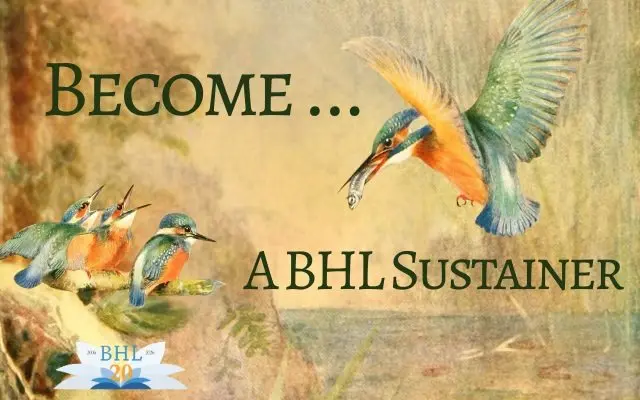
BHL’s leadership has deliberately structured the Sustainer program to be accessible to all income levels, utilizing imagery from its historic collections—such as delicate illustrations of kingfishers and rare natural history plates containing diverse clutches of eggs—to symbolize how small, individual contributions accumulate into a resilient whole. Just as a clutch contains diverse elements working together to create life, individual monthly gifts of varying sizes combine to form an unbreakable foundation for the library.
How to Support the Future of BHL
Donations to the BHL Sustainer program are processed securely through BHL’s fiscal sponsor, the Council on Library and Information Resources (CLIR). Depending on the donor’s country of residence and individual tax circumstances, contributions may be tax-deductible.
Beyond monthly sustaining gifts, BHL continues to welcome larger philanthropic investments, including:
- Major one-time gifts and philanthropic grants.
- Wire transfers and institutional donations.
- Bequests, planned giving, and other legacy gifts designed to secure the library’s permanence for generations to come.
As climate change accelerates, biodiversity loss reaches critical thresholds, and the scientific community races to document and protect the natural world, access to historical baseline data has never been more urgent. The literature preserved within BHL contains the foundational records of species descriptions, ecological baselines, and historical distributions that inform modern conservation strategies.
Last year, a passionate global community gave BHL wings, lifting it safely across an existential chasm. Now, the challenge is ensuring those wings never tire. For anyone whose work, research, art, teaching, or personal passion relies on the boundless wealth of the natural world, the call to action is clear: the digital ark is afloat, and it is time to help it keep flying.



