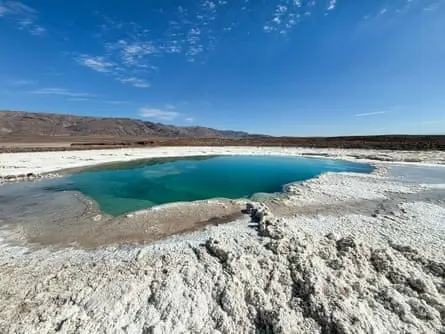
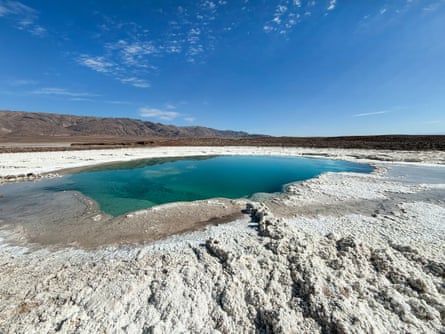
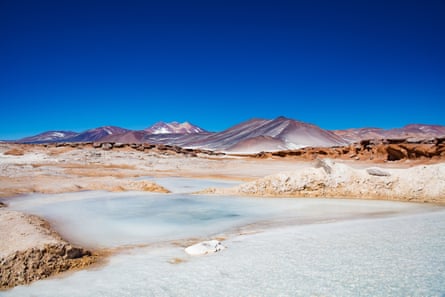
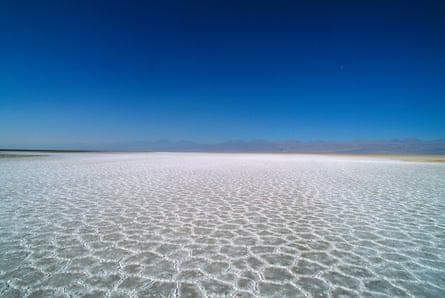
High atop the Andean plateau, where the borders of Argentina, Bolivia, and Chile converge, sits one of the most sublime and deceptive landscapes on Earth: the Salar de Atacama. To the casual observer, the vast, brilliant white expanse of the salt flat looks like a frozen ocean, its blinding crust framed by the jagged silhouettes of towering volcanoes like Licancabur and the reddish hues of the Domeyko mountain range. Beneath this pristine, sun-bleached surface, however, lies an environmental and geopolitical battleground.
Nearly a quarter of the world’s known lithium reserves are suspended here in subterranean brine, locked away in a concentration so dense that it has turned the Atacama into one of the most profitable and economical lithium-mining regions on the planet. This silvery-white alkali metal is the indispensable lifeblood of the global green energy transition. As governments, automakers, and technology conglomerates race to phase out internal combustion engines and transition toward renewable power storage, demand for lithium-ion rechargeable batteries has skyrocketed.
Yet, this urgent global imperative to save the planet from catastrophic climate change has created a profound and heartbreaking paradox. The large-scale extraction of "white gold" in the Atacama desert threatens to permanently destabilize a fragile, hyper-arid ecosystem, deplete scarce water resources, disrupt indigenous ways of life, and imperil endemic species such as the Andean flamingo.
The struggle playing out in the high-altitude deserts of South America is not an isolated environmental dispute; it is a microcosm of a much larger planetary dilemma. As green capitalism expands its extractive frontiers to secure the raw materials necessary for a post-carbon economy, global climate action is increasingly coming into direct conflict with local environmental protection and indigenous sovereignty.
Detailed Chronology: How the Atacama Formed and How It Is Being Mined
Geological Genesis: The "Endorheic" Trap
To understand the immense wealth of the Salar de Atacama, one must understand its radical geological history. Scientists classify the region as an "endorheic" basin—derived from Greek roots meaning "inside" and "flow." Water can enter the basin through rare precipitation events or mountain runoff, but it cannot escape via rivers or streams to the ocean. It can only leave through evaporation.
When heavy weather systems—such as the invierno boliviano (Bolivian winter), a paradoxical meteorological phenomenon occurring during the southern hemisphere’s summer—sweep moisture across the Amazon basin, they are driven up the steep eastern slopes of the Andes. Pushed by high-altitude winds over the high mountain ridges, these massive storm fronts dump torrential rains onto the Chilean high plateau.
When the rains subside, water trickles down rocky ravines from precious mountain springs, slowly dissolving lithium out of surrounding volcanic rocks and carrying wind-scoured lithium dust down to the center of the salar. As the relentless, piercing desert sun evaporates this pooled surface water, the concentration of lithium in the remaining brine grows exponentially.
Beneath the crust, complex hydrothermal systems driven by subterranean magma and active fault lines circulate the brine through porous geological strata, leaching even more lithium from the earth. The result is a series of lithium-rich brine deposits resting anywhere from four to 200 feet below the surface.
The Extraction Process: "Mining Water"
The modern extraction method utilized by mining corporations in the Atacama is deceptively simple, low-tech, and heavily dependent on natural evaporation.
Pumping: Companies sink deep wells into the salt crust to pump the underground lithium-rich brine to the surface.
Evaporation Ponds: The pumped brine is channeled into massive, shallow evaporation ponds sprawling across the stark white landscape.
Concentration: Over a lengthy cycle lasting anywhere from 10 to 24 months—dictated by weather conditions and brine quality—natural solar evaporation concentrates the lithium levels by roughly 40-fold, raising concentrations from an initial 0.15% to a harvestable 6%.
Processing: Once concentrated, the liquid is transported to processing plants to be refined into lithium carbonate or lithium hydroxide, ready for export to global battery supply chains.
Despite its low-tech appearance, this process is colloquially known as "mining water." In the world’s oldest and driest desert, pumping millions of liters of hypersaline brine daily disrupts the delicate hydrostatic balance of the entire basin, lowering underground water tables and triggering a slow-motion ecological crisis.
Supporting Context & Metrics: Ecology, Indigenous Rights, and Climate Pressures
A "Polyextreme" Web of Life
Ecologists often characterize the Atacama Desert as a "polyextreme" environment. It combines extreme altitude, intense solar radiation, hyper-aridity, massive daily temperature fluctuations, and densely saline lakes. To the untrained eye, the region appears barren and lifeless. In reality, it hosts a specialized, highly adapted network of biodiversity.
Microorganisms and Phytoplankton: Microscopic blue-green algae and bacteria thrive in the hyper-saline waters, driving the foundational energy production of the ecosystem.
Artemia (Brine Shrimp): These tiny crustaceans feed on the phytoplankton, tolerating salinity levels that would prove fatal to almost all other aquatic species.
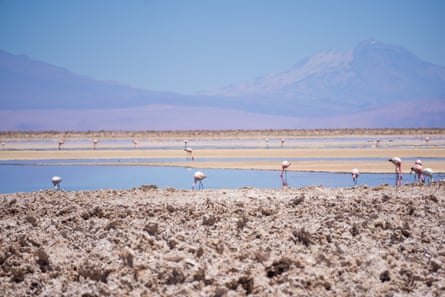
Chilean Flamingos: Serving as the ultimate barometer of wetland health, three distinct species of flamingos inhabit the Atacama salt flats. Using specialized filter membranes in their bills—akin to the lamellar structures found in whales—they strain brine shrimp and algae from the shallows. Their complex migratory patterns and synchronized courtship dances link the isolated saline lagoons into a cohesive ecological web.
Compounding Pressures on Wildlife and Communities
Today, these delicate webs of life are fracturing under the weight of compounding pressures:
Climate Change: Rising global temperatures accelerate surface water evaporation across the Atacama, shrinking the shallow lagoons and starving the blue-green algae that sustain both brine shrimp and flamingos. Consequently, endemic flamingo populations are in structural decline.
Industrial Disturbance: The heavy industrial traffic, drilling machinery, and persistent mechanical noise associated with lithium extraction operations encroach directly upon flamingo breeding grounds.
Water Scarcity: Indigenous Colla and Atacameño (Lickanantay) communities, who have inhabited these high-altitude plateaus for millennia, rely on local freshwater springs for agriculture, livestock, and survival. As industrial mining draws down subsurface aquifers, local communities face acute water scarcity, threatening traditional livelihoods and cultural survival.
Official Statements and Stakeholder Perspectives
The tension between global climate objectives and local environmental protection has drawn intense scrutiny from international watchdogs, corporate entities, and local leadership.
"The source of all life is here. Water is not merely a resource to be optimized on a corporate spreadsheet; it is our ancestor, our sustenance, and the foundation of our continuity in this extreme land."
— Representative of local Indigenous Colla communities
Environmental researchers studying the Atacama emphasize that modern science is struggling to keep pace with the velocity of environmental degradation.
"Science is perpetually playing catch-up, documenting ecological impacts long after the irreversible damage has occurred. Lithium extraction’s threat to the underlying hydrology of this desert is a slow-motion disaster—one driven by planetary demands yet absorbed entirely by local ecosystems."
— Dr. Elena Vasquez, Andean Hydro-Ecologist
On the corporate and governmental side, state regulators and mining executives argue that technological modernization and stricter environmental quotas can mitigate these impacts.
"Chile recognizes its vital role in supplying the critical minerals necessary for global decarbonization. Our mandate is to balance this historic responsibility with robust environmental safeguards, ensuring that public-private partnerships respect local governance and incorporate advanced direct lithium extraction (DLE) technologies to minimize water consumption."
— Statement from the Chilean Ministry of Mining
Future Outlook: Reimagining the Green Transition
As the world looks toward a net-zero carbon future by mid-century, the Salar de Atacama serves as a stark warning and a portal into our collective planetary future. It demonstrates how global supply chains intersect with vulnerable local food webs, how economic production models can undermine foundational biological systems, and how postcolonial state-building continues to marginalize ancient indigenous histories.
However, the path forward is not fundamentally blocked; it can be redirected. Achieving a globally just energy transition requires a paradigm shift:
Inverting Supply Chains: Rather than beginning our environmental accounting at the point of consumption, policymakers must trace supply chains backward to their raw material inputs, interrogating the socio-ecological cost of every extraction site.
Demand-Side Policies: Governments must enact structural policies that curb hyper-reliance on private automobile ownership. Promoting robust public transit, urban designs that reduce sprawl, smaller and more efficient battery designs, and mandatory battery-recycling frameworks will drastically reduce the sheer volume of raw mining required for clean transportation.
Just Supply Chains: Global capital must be held to account, ensuring that the transition to green energy does not replicate the extractive exploitation of fossil fuel eras under a different banner.
Just as any industrial workplace is simultaneously a site of corporate exploitation and a locus of worker solidarity, the supply chains of green technologies represent both a tool of ecological domination and fertile ground for grassroots resistance. By centering indigenous sovereignty, demanding rigorous environmental accountability, and rethinking how we power our societies, humanity can build a genuinely sustainable world—one that heals the climate without sacrificing the fragile, extraordinary corners of the earth that make life worth sustaining.