Executive Overview
As the European Union intensifies its legislative push to meet aggressive climate neutrality goals, the transportation sector remains a glaring anomaly. Unlike other economic sectors that have successfully curtailed greenhouse gas emissions since 1990, European transport emissions have stubbornly continued to climb, driven largely by skyrocketing aviation growth and heavy road transit.
To reverse this trajectory, European policymakers have pinned immense hope on shifting passengers away from carbon-intensive flights and cars toward rail—Europe’s greenest mass-market transport mode. The newly proposed EU Passenger Package represents a monumental stride toward modernizing European rail ticketing, dragging an archaic, fragmented system out of the stone age, and strengthening passenger rights.
Yet, according to a recent position paper and analysis by Transport & Environment (T&E), the current iteration of the EU Passenger Package falls critically short. While it introduces much-needed reforms, its geographic scope is overly restricted, its booking mechanics fail to accommodate the messy reality of multi-operator schedules, and its missed-connection protections remain handcuffed to single-railway silos.
If the European Union is serious about meeting its overarching climate targets and making its flagship High-Speed Rail Plan a success, the Passenger Package must be significantly enriched, harmonized, and expanded. Without aggressive revisions, Europe risks locking in a fractured rail network that cannot effectively compete with cheap, highly convenient international flights.

Detailed Chronology & Policy Evolution
The journey toward a unified European rail network has been painfully slow, marked by decades of protectionist national rail monopolies, incompatible signaling systems, and a complete absence of unified digital infrastructure.
From Fragmented Monopolies to Digital Awakening
Historically, booking an international train journey across multiple European borders required navigating a maze of distinct national railway websites. A traveler trying to map a route from Lisbon to Berlin or Madrid to Warsaw faced disparate booking horizons, non-communicating databases, and terrifyingly fragile connections. If a train run by a national incumbent suffered a delay, causing a passenger to miss a leg operated by a different company, travelers were frequently left stranded with zero legal protections or financial recourse.
Recognizing this as a major structural barrier to modal shift, the European Commission began drafting regulatory frameworks to mandate cross-border ticketing cooperation. The introduction of the EU Passenger Package was heralded as a breakthrough—a legislative tool designed to force major booking platforms to sell competitor tickets and streamline passenger rights across borders.
The Limits of the Current Proposal
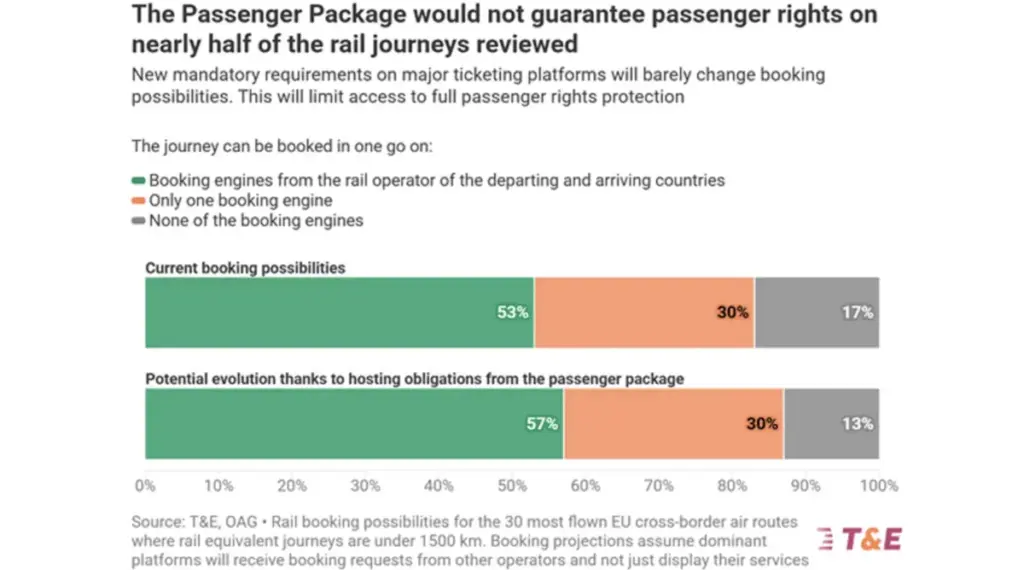
Despite its ambitious branding, the current draft of the EU Passenger Package contains loopholes that undermine its core intent. Most notably, the proposed "hosting obligation"—which forces major rail operator booking platforms to sell tickets for other operators—is geographically constrained. Rather than covering comprehensive pan-European corridors, the obligation limits its effect primarily to neighboring countries.

This narrow focus ignores the realities of modern long-distance travel. For example, major aviation routes spanning distances up to 1,500 kilometers have viable rail equivalents (such as Brussels to Madrid). Yet, under current rules, these routes often fall into regulatory blind spots, leaving passengers unprotected and unable to book a seamless single ticket.
To bridge this gap, T&E and other sustainable transport advocates are urging the EU to extend hosting obligations to all capital cities under 1,500 kilometers apart that feature a maximum of two changes and an existing rail route.
Supporting Context & Metrics: The Crisis in European Transport
To understand why the EU Passenger Package matters so deeply, one must examine the grim statistics defining Europe’s transportation landscape.
The Emissions Dilemma
According to data from the European Environment Agency (EEA), transport remains the single largest source of greenhouse gas emissions in the European Union. While sectors like energy production, manufacturing, and heating have aggressively decarbonized over the past three decades, transport emissions have trended upward.

- Aviation: Recognized as the fastest-growing source of transport emissions in Europe, international and domestic flights continue to soar despite growing climate awareness.
- Road Transport: Passenger cars and commercial freight still account for the overwhelming majority of total transport emissions across the EU.
The Consumer Friction Point
The resistance to train travel is not merely a matter of ticket pricing or travel duration; it is fundamentally an issue of user experience. T&E commissioned polling revealed a staggering statistic: 61% of European respondents were deterred from taking long-distance rail journeys at least once simply because the booking process was too complicated.
In a modern digital economy where consumers can book complex multi-airline itineraries with a few clicks on a smartphone, European rail ticketing remains painfully antiquated. Furthermore, market concentration exacerbates the problem. Incumbent national operators maintain iron grips on domestic ticket sales. For instance, in France, an astonishing 9 out of 10 rail tickets are sold via SNCF Connect. Newer market entrants, open-access operators, and international competitors remain virtually invisible on these dominant platforms, stifling competition and keeping consumers locked into high-carbon alternatives.
Core Policy Shortcomings & Key Recommendations
The T&E position paper outlines three fundamental flaws in the current EU Passenger Package, accompanied by actionable recommendations to salvage the legislation.
1. Expanding the Hosting Obligation Beyond Immediate Neighbors
Major rail operator booking platforms must be legally compelled to sell tickets for other operators across a much wider geographic footprint. Restricting this obligation to immediate neighbors protects less than half of major international routes, rendering the policy ineffective against high-polluting aviation routes.

- Key Recommendation: Harmonize the EU Passenger Package with the EU High Speed Rail Plan. Extend the hosting obligation to encompass all capital city routes under 1,500km with a maximum of two changes where a rail route exists (e.g., Brussels to Madrid).
2. Enabling Cumulative Platform Booking, Not Just Single Transactions
Rail operators do not release their tickets simultaneously. While one national operator might open its booking horizon six months in advance, another might release tickets only three to four months prior due to scheduling or engineering works.
Under the current narrow definition of a "single ticket," passengers who buy legs sequentially run the risk of losing their integrated rights.
- Key Recommendation: Revise the regulation to protect passengers who buy segments on the same platform over time, rather than strictly requiring a single, simultaneous transaction. A traveler booking a trip from Paris to Madrid should be able to secure their SNCF leg months in advance, add the subsequent Renfe leg to the exact same platform itinerary when it becomes available, and retain full, continuous single-ticket passenger rights.
3. Granting Universal Journey Continuation Rights
If a passenger misses a connection due to a delayed train, the current regulatory framework often forces them to wait hours—or overnight—for the next available service operated by the same railway undertaking, even if a competitor’s train to the same destination is leaving immediately.
- Key Recommendation: Implement universal journey continuation rights. If a connection is missed, passengers must be permitted to board the very next suitable train to finish their journey, regardless of which railway undertaking operates it. For example, if a Brussels-to-Paris train is delayed, causing a missed connection to Milan, the traveler should be allowed to board an available Trenitalia France service rather than waiting hours for the next SNCF option. This not only enhances consumer convenience but also shields operators from costly hotel and accommodation liabilities resulting from missed last-train connections.
Future Outlook
The European Union stands at a critical crossroads. The decisions made regarding the EU Passenger Package will reverberate across the continent for decades, dictating whether rail can genuinely emerge as the backbone of European mobility.

If lawmakers cave to industry lobbying or leave loopholes that protect legacy national monopolies at the expense of consumer convenience, the legislation will fail. Travelers will continue to book budget airlines out of sheer frustration, and Europe will miss its vital climate milestones.
Conversely, if the EU seizes this golden opportunity to enforce true cross-border ticketing integration, mandate universal platform compatibility, and guarantee seamless journey continuation rights, rail travel could experience a renaissance. By making green travel the easiest, most seamless, and most reliable option available, Europe can finally put its transport emissions on a permanent downward slope.
To dive deeper into the technical details, read the full T&E Position Paper on the EU Passenger Package.