

Executive Overview
The intersection of agriculture and renewable energy has transitioned from an experimental niche to a major industrial and economic force. Known as agrivoltaics, this emerging movement integrates photovoltaic solar arrays with working farmland, offering a dual-yield model that harvests both food and electricity from the same acreage. At a time when rural communities face skyrocketing fuel costs, unpredictable weather patterns, and shifting commodity markets, agrivoltaics presents a vital financial lifeline.
Yet, even as commercial-scale projects demonstrate unprecedented construction velocity and ecological benefits, the sector finds itself navigating turbulent political waters. While state-level economic developers and academic institutions champion agrivoltaics for its speed-to-power capabilities and land-preservation merits, federal agricultural policies have taken a hostile turn. Recent regulatory shifts at the U.S. Department of Agriculture (USDA) threaten to stifle rural clean energy adoption, prompting high-stakes legal battles. This report examines the evolution of the agrivoltaic movement, the breakthrough projects reshaping the rural landscape, the academic partnerships driving future innovation, and the policy clashes threatening to impede progress.
Detailed Chronology: From Academic Curiosity to Industrial Scale
The Early Years (2017–2021): Laying the Groundwork
The modern agrivoltaic movement began gaining traction around 2017, when agricultural researchers and renewable energy advocates started compiling empirical evidence regarding land dual-use. Early pilot projects established that solar panel arrays could be engineered with elevated racking systems and optimized spacing to accommodate agricultural operations. Researchers demonstrated that partial shade from solar panels could reduce heat stress on certain crops and livestock while mitigating moisture loss in arid soils. Despite these promising findings, initial market adoption was slow, hindered by regulatory red tape, unfamiliarity among traditional farming communities, and a lack of standardized engineering templates.
The Breakthrough (2022–2025): Scale and Speed
The narrative shifted dramatically in 2022 when renewable energy developer Doral Renewables broke ground on the Mammoth Solar project. Spanning Starke and Pulaski counties in northwest Indiana, this massive 1.3-gigawatt initiative was developed on land leased from more than 65 local farming families.
Mammoth Solar was constructed in deliberate phases, showcasing the "speed-to-power" capability required by a modern electrical grid grappling with surging demand from data centers, electrification, and manufacturing. By October 2026, the final 900-megawatt phase achieved commercial operation, having been built in a remarkable 18-month window. Indiana energy officials lauded the milestone, noting that large-scale solar deployment can happen rapidly when supported by regional landowners and streamlined development frameworks.
Simultaneously, Doral integrated agricultural activity directly into the installation footprint. Before the first 400 megawatts were even fully commissioned, Mammoth hosted thousands of head of grazing livestock—including sheep, donkeys, alpacas, and kunekunes (small pigs). These animals function as living landscaping crews, managing vegetation naturally beneath the panels and drastically reducing the need for diesel-powered mowing equipment.
The Present Era (2026 and Beyond): Institutionalization and Legal Friction
By 2026, the agrivoltaic model expanded beyond simple livestock grazing into advanced specialty crop trials, native grassland restoration, and formal academic research partnerships. However, this industrial maturation coincided with an adversarial federal policy landscape. While initiatives like the National Science Foundation-backed Midwest Agrivoltaics for Resilient Communities (MARC) initiative push the technological envelope, new regulatory roadblocks implemented by the USDA have triggered a direct confrontation between renewable energy advocates and federal agricultural authorities.
Supporting Context & Metrics
The economic and ecological metrics surrounding contemporary agrivoltaic installations highlight why this model is rapidly gaining institutional backing across the American Midwest.
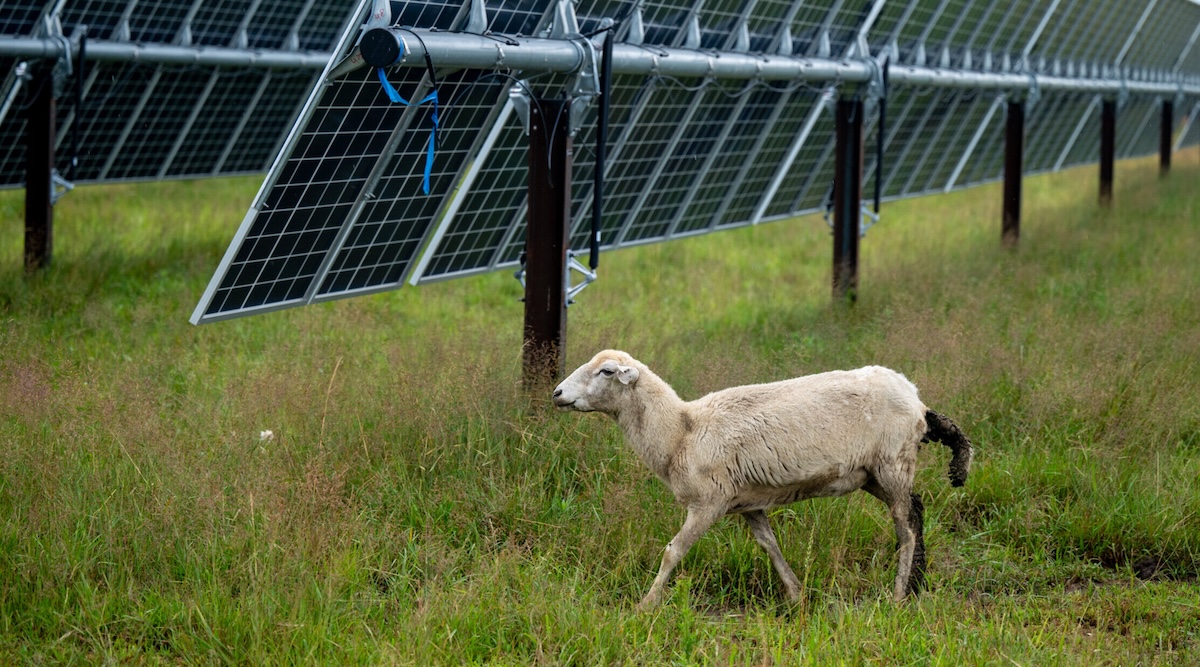
- Massive Generation Capacity: Projects like Indiana’s Mammoth Solar (1.3 gigawatts) and Wisconsin’s planned Vista Sands solar facility demonstrate that clean energy infrastructure can scale to gigawatt levels on private agricultural land without permanently removing that acreage from rural economies.
- Rapid Deployment Velocity: The final 900-megawatt phase of Mammoth Solar was constructed in just 18 months, proving that solar projects can deliver critical grid capacity far faster than traditional fossil-fuel or nuclear generation plants.
- Industrial Synergy: Agrivoltaics creates localized industrial demand. For instance, the Mammoth project sourced roughly 20,000 tons of structural steel exclusively from the Indiana manufacturing sector to build the solar panel racking systems and hardware.
- Ecosystem and Public Health Valuations: Rigorous engineering and ecological reports for projects like Vista Sands indicate massive co-benefits. In Wisconsin, the project’s design facilitates native plant restoration, allows numerous high-draw agricultural wells to shut down to conserve stressed water tables, and minimizes chemical leaching from fertilizers and insecticides. Initial engineering estimates calculated public health and ecosystem dividends at $630 million during the facility’s first year of operation alone.
- Diversified Landowner Revenue: By leasing segments of their land for solar generation while maintaining grazing or specialized crop operations beneath the panels, farmers secure a dependable, inflation-resistant income stream that insulates them from commodity price shocks and volatile fuel expenses.
Official Statements and Institutional Perspectives
The expansion of agrivoltaics has generated distinct viewpoints from state officials, academic leaders, and federal regulators, illuminating a stark philosophical divide over the future of rural American land use.
State-Level Enthusiasm and Grid Realities
State officials operating on the front lines of economic development emphasize the necessity of rapid energy deployment paired with land stewardship. Suzanne Jaworowski, Indiana’s Secretary of Energy, encapsulated this sentiment during the commercialization of Mammoth Solar’s final phase:
"In the world of economic development right now, every project is looking for speed to electrons. With demand for electricity skyrocketing, we need every electron we can get on the grid… We want to create an energy infrastructure that will draw economic development and do it in a way that preserves our way of life and our agricultural environment. This project is a great example of that."
Jaworowski further emphasized that solar energy plants require minimal permanent surface disruption compared to suburban sprawl or commercial real estate development. Once a solar lease expires, the underlying farmland can be completely restored to traditional crop production if desired.
Academic Innovation: The MARC Partnership
To scientifically validate and optimize these dual-use systems, institutions like Purdue University have stepped in. Through the newly formed Midwest Agrivoltaics for Resilient Communities (MARC) incubator—funded by the National Science Foundation—researchers are actively studying how agrivoltaics can bolster rural power security.
Dr. Dan Chavas of Purdue University, serving as principal investigator on the project, explained the core motivation behind the initiative:
"When hail ruins a harvest, heat strains livestock, or windstorms cut electricity, farmers and their communities are hit hard. Our goal is to understand how agrivoltaics can make our nation’s rural communities more resilient and prosperous… Producing both food and energy locally can help diversify and stabilize landowner income, reduce power outages, and ultimately create a more prosperous rural Midwest."
As part of the MARC collaboration, Mammoth Solar has established a dedicated research zone for robotics testing, advanced microclimate monitoring, and specialty crop trials, working alongside utility partners like NiSource and tracker manufacturers such as Nextpower.

Federal Friction and Regulatory Backlash
In sharp contrast to state and academic enthusiasm, federal leadership within agricultural departments has expressed deep skepticism toward solar development on farmland. U.S. Secretary of Agriculture Brooke L. Rollins has repeatedly advanced the narrative that utility-scale solar installations represent an existential threat to American farmland, drawing sharp criticism from clean energy advocates who argue federal officials are failing to distinguish between destructive urban real estate development and non-destructive, dual-use agrivoltaic arrays.
This ideological friction materialized into concrete policy changes when the USDA altered the eligibility criteria for the long-standing Rural Energy for America Program (REAP). Historically designed to provide low-cost loans and federal grants to help farmers and rural small businesses invest in energy independence, the newly revised rules have effectively blocked agricultural producers from accessing these crucial financial vehicles. Furthermore, the policy changes have retroactively penalized existing grant and loan recipients, leaving individual farmers on the hook for tens of thousands of dollars in unexpected expenses.
Future Outlook: Legal Battles and the Path Ahead
The trajectory of American agrivoltaics now hangs in a delicate balance between grassroots agricultural innovation and top-down federal obstructionism.
On the ground, the momentum is undeniable. Developers, ecologists, and agricultural scientists are continuing to refine best practices—testing everything from shade-tolerant specialty crops and automated robotic maintenance to advanced hydrological conservation techniques. Rural landowners, squeezed by high input costs and diesel fuel prices, increasingly view solar leasing as an essential mechanism for debt reduction and generational farm preservation.
However, the immediate regulatory environment remains hostile. Recognizing the existential threat posed by the USDA’s updated REAP guidelines, environmental and legal advocacy groups—specifically the Environmental Law & Policy Center and Earthjustice—filed a joint federal lawsuit against Secretary Rollins and the Department of Agriculture. The legal challenge targets what plaintiffs describe as unlawful, anti-solar eligibility barriers that penalize rural entrepreneurs and dismantle the pipeline for rural clean energy deployment.
Whether the federal government will recalibrate its stance in the face of these legal challenges and undeniable economic data remains an open question. What is clear, however, is that agrivoltaics has moved past the point of being a temporary trend. By demonstrating that food and energy security can peacefully and profitably coexist on the exact same acreage, the agrivoltaic movement has established a formidable blueprint for the future of rural America—one that will press forward regardless of political headwinds.



