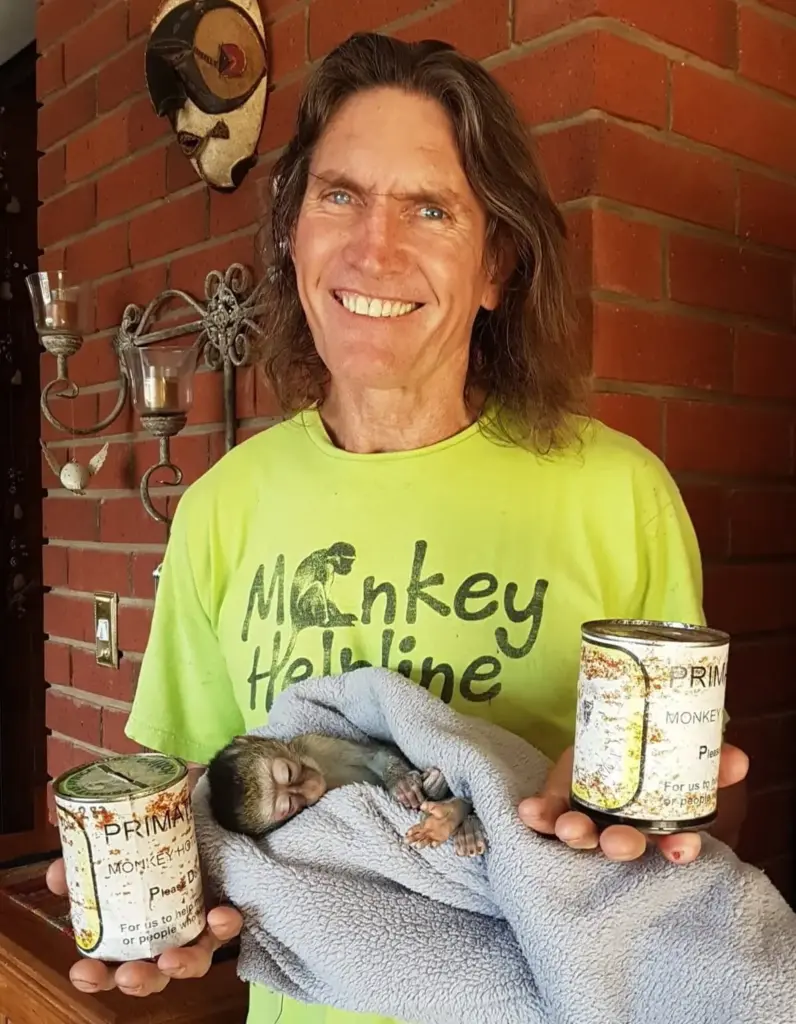
For three decades, the sprawling urban and suburban landscapes of KwaZulu-Natal, South Africa, operated under a unique unspoken pact. When a vervet monkey was found bleeding on a suburban roof, trapped in illegal wire snares, electrocuted by exposed power lines, or hit by oncoming traffic, residents knew precisely who to call.
Steve Smit—universally known as the “Monkey Man”—was more than an animal rescuer; he was a living fixture of Durban’s environmental and ethical conscience. With his trademark rugged resolve, an unwavering moral compass forged during decades within the apparatus of the state, and, in his later years, a signature eye patch, Smit spent thirty years climbing trees, crawling through tight subterranean spaces, and negotiating with panicked homeowners. He answered thousands of distress calls, treating every individual creature not as an anonymous statistic of an abundant species, but as a sentient being possessing an absolute right to life.
Smit passed away on August 12th at the age of 70, following a courageous and characteristically uncomplaining battle with cancer. His death marks the end of an extraordinary era for South African conservation and animal rights activism. Co-founder of Monkey Helpline and a relentless, sometimes abrasive thorn in the side of institutional wildlife management, Smit challenged the nation to rethink how it interacted with its indigenous fauna. His legacy is one of uncompromising empathy—a lifelong testament to the belief that human expansion does not grant us dominion over the lives of wild animals, but rather a profound obligation to protect them.
Detailed Chronology: From State Intelligence to the Frontlines of Animal Liberation
The trajectory of Steve Smit’s life reads like a complex study in moral evolution. Long before he was scaling suburban rooftops to rescue infant vervets, Smit was enmeshed in the inner workings of South Africa’s security apparatus during one of the nation’s most turbulent periods.
The Reluctant State Operative
Smit’s path into government service began not out of zealotry, but out of ideological objection. As a young man, rather than submitting to compulsory military conscription—a cornerstone of the apartheid-era state’s enforcement mechanisms—he opted instead to join the police force. This initial pivot led him deeper into the labyrinth of state intelligence, where he spent roughly 25 years moving through the ranks of the Bureau of State Security (BSS) and later the National Intelligence Service (NIS).
Yet, working within the high-stakes, opaque world of state intelligence left deep psychic marks. In a rare 2007 oral-history interview, Smit reflected candidly on this period, admitting that he was profoundly troubled by the conduct, institutional culture, and moral compromises demanded by the organizations he served. This internal friction served as a catalyst, steering his life toward an entirely different kind of service—one rooted not in the protection of state regimes, but in the defense of the voiceless.
Founding FALCON and the Birth of Radical Advocacy
Smit’s transition from state operative to animal rights pioneer materialized in 1985 when he founded FALCON (the Front for Animal Liberation and Conservation of Nature), widely recognized as South Africa’s inaugural animal rights organization. FALCON—which later evolved into Justice for Animals—introduced a radically new vocabulary to the South African conservation landscape.
During an era when mainstream conservation was dominated by game-farming economics, trophy hunting, and macro-level population management, Smit and FALCON targeted the systemic exploitation of individual animals. They campaigned vociferously against vivisection, recreational hunting, the cruel conditions of traveling circuses, and the commercial wildlife trade.
In 1995, FALCON achieved a watershed moment by catalyzing a fierce public debate over the controversial practice of elephant culling in Kruger National Park. The pressure exerted by Smit and his allies forced the National Parks Board to formally review its policies and temporarily suspend the cull. It was a clear demonstration that an outsider with a loud voice and moral clarity could rattle the pillars of institutional bureaucracy.
The Rise of Monkey Helpline
While his early activism operated on a macro-political scale, Smit’s daily life became overwhelmingly consumed by urban wildlife rescue following the establishment of Monkey Helpline in 1995, an organization he co-founded and ran alongside his dedicated partner, Carol Booth.
What began as an informal response to localized wildlife distress rapidly ballooned into a 24/7, unpaid vocation. By the 2000s, Smit and Booth were responding to anywhere from a handful to upwards of ten harrowing call-outs a day. Whether extracting a troop from a hostile industrial park or nursing a maimed infant back to health, Smit’s life was entirely subsumed by the rhythm of urban rescue.
Even severe physical trauma could not slow him down. In 2015, while rounding up rescued chickens in his Westville garden, a sharp tree branch struck Smit directly in his right eye, nearly blinding him. Doctors ordered strict, prolonged rest. Within weeks, however, Smit was back on the road handling wildlife emergencies, sporting a stark black eye patch that only added to his mythic status in the community.
Supporting Context & Metrics: The Philosophy of the Individual Animal
To truly understand Steve Smit’s impact, one must examine the ideological chasm that often separated him from traditional conservationists.
Species Abundance vs. Sentient Value
Mainstream conservation biology traditionally operates on the principle of population-level management. Species viability, ecosystem health, and biodiversity indices dictate policy decisions. If a population of vervet monkeys (Chlorocebus pygerythrus) is abundant and thriving across human-altered landscapes, traditional managers may view occasional mortality, culling, or lethal control as ecologically negligible.
Smit fiercely rejected this calculus. To him, ecological metrics were dangerously sterile when used to justify the suffering of individual sentient creatures. In a landmark 2003 parliamentary submission, Smit argued passionately that animals deserved moral protection regardless of their conservation status. A vervet monkey did not warrant less empathy, less medical care, or less protection simply because thousands of its conspecifics lived in nearby forests.
"A vervet monkey in distress is not a data point in a management ledger; it is an individual life experiencing pain, fear, and confusion," Smit frequently maintained.
The Human-Wildlife Interface
The ecological reality of KwaZulu-Natal is one of rapid urban encroachment. As human developments swallowed indigenous coastal forests and bushveld, vervet monkeys adapted with remarkable resilience. They learned to exploit suburban environments—raiding kitchens, harvesting backyard fruit trees, and navigating electrical grids.
This adaptability set the stage for relentless human-wildlife conflict. Homeowners, often uneducated about the behavior of urban primates, panicked, viewing the monkeys as aggressive pests, disease vectors, or destructive nuisances.
Smit’s intervention strategy was twofold:
Direct Rescue: Physically retrieving injured, poisoned, or orphaned animals and providing emergency medical stabilization.
Public Education: Spending countless hours counseling terrified or hostile residents.
Smit patiently explained that vervets were neither rabid nor predatory toward humans, and that the animals were merely trying to survive in a habitat that humans had dismantled. He possessed an extraordinary patience for frightened animals—often learning their behavioral nuances, troop dynamics, and maternal responses through hours of quiet observation—paired with an equally formidable intolerance for human cruelty.
Official Statements and Public Tributes
The news of Steve Smit’s passing on August 12th elicited an outpouring of grief, reverence, and gratitude from across South Africa and the global animal welfare community.
Environmental organizations, municipal leaders, and ordinary citizens took to social media and news outlets to honor the man who had defined urban wildlife rescue for a generation.
Carol Booth, Partner and Co-founder of Monkey Helpline: Reflecting on decades of shared sacrifice, Booth noted that Smit’s devotion to the cause was absolute, consuming his finances, his physical health, and every waking hour of his life. "Steve never stopped fighting," Booth stated. "Even when his own body was failing him, his mind and heart remained entirely with the animals."
The Greater Durban Community: Municipal figures and neighbourhood associations across Durban and Westville released statements acknowledging Smit’s irreplaceable role as a bridge between urban residents and wild nature. For thirty years, he had acted as an emergency responder for creatures left behind by municipal planning and environmental indifference.
Animal Welfare Advocates Worldwide: Tributes poured in from international organizations that had watched Smit clash with bureaucratic orthodoxy on platforms like the BBC World Service. Colleagues remembered him as a man who refused to soften his rhetoric or compromise on the moral standing of non-human animals, even when facing hostile institutional panels.
Future Outlook: Sustaining the Legacy of the "Monkey Man"
The death of Steve Smit leaves an immense, structural void in KwaZulu-Natal’s animal welfare network. Monkey Helpline, built largely on the indefatigable physical energy, personal charisma, and relentless self-sacrifice of Smit and Carol Booth, faces the formidable task of institutionalizing its operations to survive his loss.
The Financial and Operational Strain
Smit’s life of uncompromising activism was marked by profound personal financial precarity. Drawing no salary from Monkey Helpline, he faced severe medical crises—including a major health scare in 2021—without the safety net of medical aid, relying instead on public solidarity and crowdfunding to cover life-saving surgeries. His unwavering dedication meant that resources were funneled directly into rescues, veterinary bills, and equipment rather than organizational endowment.
As Monkey Helpline transitions into a post-Smit era, supporters and younger conservationists recognize that preserving his legacy requires more than emotional tributes; it demands sustainable financial structures, institutional partnerships, and expanded volunteer networks.
Mentorship and the Next Generation
One of Smit’s most enduring, if unheralded, contributions was his role as a mentor to younger wildlife rescuers. He trained a new generation of activists to look beyond the generalized panic of suburban homeowners and to respect the complex emotional and social lives of primates. These protégés carry forward his insistence on direct observation, field diplomacy, and uncompromising advocacy.
A Permanent Monument in the Suburban Landscape
Long after the physical structures of urban Durban shift, the ethos championed by Steve Smit will remain woven into the fabric of the region. He taught thousands of citizens to look up at the electrical wires, to look twice before speeding down suburban lanes, and to see a neighbor rather than a nuisance in the face of a vervet monkey.
In 2015, following his near-blinding eye injury, a British supporter sent Smit an unexpected parcel containing a stuffed toy monkey wearing an eye patch identical to his own. Named Stephanus, the toy became Monkey Helpline’s official mascot—a whimsical yet poignant symbol of resilience.
Today, Stephanus and the legacy of Steve Smit stand as enduring reminders of what one person can achieve through unyielding moral clarity. For thirty years, when an animal was bleeding in a garden or stranded on a roof anywhere around Durban, people knew whom to call. The challenge for South Africa’s conservation community now is to ensure that the phone keeps ringing, and that the voice for the voiceless is never silenced.