Executive Overview
France has been struck by a ferocious convergence of extreme weather events, culminating in a rare and destructive tornado and severe hailstorms that have devastated parts of the country’s south-west. The catastrophic atmospheric disturbance has left approximately 2,800 residential properties across 10 distinct rural villages entirely stripped of electrical power, while simultaneously throwing the nation’s transport infrastructure into disarray. Major international hubs, including airports in Bordeaux, Marseille, Nice, Toulouse, and northern Paris, have faced severe flight delays and sweeping cancellations.
The meteorological violence reached its dramatic peak in the Aude department, where terrifying weather conditions forced sports authorities to take the unprecedented step of cancelling the third stage of the prestigious Vuelta a España cycling race. Riders were left scrambling for cover as monstrous hailstorms and swirling vortexes swept through the French Pyrenees.
This latest disaster arrives hard on the heels of one of the most punishing summers in European history, characterised by unrelenting heatwaves and historic wildfires. Having barely begun the arduous process of ecological and infrastructural recovery from blazes that scorched 42,000 hectares of forest in the south-west alone—the largest such disaster since the Second World War—local communities, emergency services, and national authorities now find themselves grappling with a compound climate crisis. This comprehensive report examines the chronology of the disaster, the extensive infrastructural and economic damage, official responses, and the mounting concerns regarding climate volatility in Western Europe.
Detailed Chronology of the Event
Atmospheric Instability and the Buildup
The meteorological setup for the disaster began forming days in advance, as an unusually intense clash of warm, moisture-laden air originating from the Mediterranean collided head-on with a sharp, cold upper-level trough pushing down from the Atlantic across the Pyrenean mountain barrier. Météo-France, the nation’s official meteorological service, had issued amber weather warnings for several departments in the south-west, but the sheer velocity and localized intensity of the convective cells caught many residents and emergency coordinators off guard.
By early afternoon, supercell thunderstorms had rapidly matured over the rugged terrain of the French Pyrenees. These massive storm clouds, characterized by powerful internal updrafts, began producing torrential downpours, localized flash flooding, and massive hailstones measuring up to several centimeters in diameter.
The Vuelta a España Interruption
As the tempest rolled eastward into the Aude department, it directly intercepted the route of the Vuelta a España, one of professional cycling’s Grand Tours. Stage 3 of the race was actively underway when the sky darkened abruptly to an ominous, bruised purple.
Eyewitnesses on the ground, including race officials, support staff, and stranded spectators, watched in disbelief as the temperature plummeted and golf-ball-sized hailstorms hammered the peloton. Cyclists, traveling at high speeds, were forced to make split-second decisions to abandon their machines and seek immediate shelter beneath concrete overhangs, team vehicles, and roadside architecture. With roads rapidly becoming impassable rivers of ice and debris, race organizers, in consultation with local gendarmerie and civil protection units, made the definitive call to cancel the remainder of the stage. The safety of the athletes, support personnel, and spectators was prioritized over the continuation of the sporting spectacle, marking a rare and disruptive halt to the international racing calendar.
The Tornado Strikes Pomas
While the peloton sought shelter from the hail, an even more violent atmospheric phenomenon was taking shape just kilometers away. Eyewitness footage captured from various vantage points across the region documented a terrifying, swirling vortex descending from the cloud base. The tornado loomed ominously on the horizon, its dark funnel silhouetted against the sky before making destructive landfall over residential areas and dense woodland.
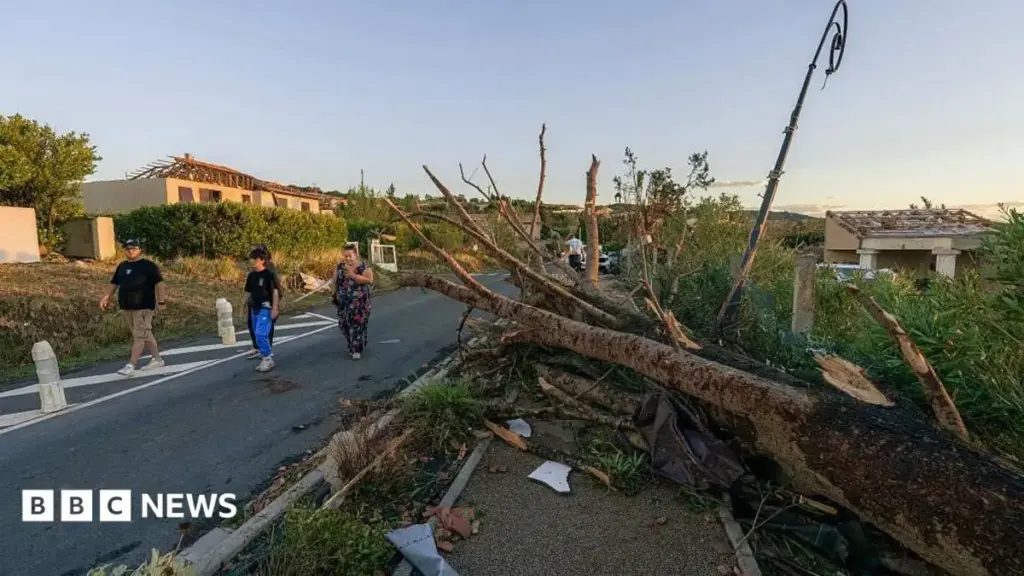
The small, picturesque village of Pomas, nestled within the Aude department, bore the absolute brunt of the tornado’s fury. Within minutes, the community was transformed into a disaster zone. The ferocious winds tore roofs off residential dwellings, snapped mature trees like toothpicks, and tossed automobiles aside as if they were toys. Piles of brick, shattered timber, and personal belongings littered the streets, cutting off access routes and trapping residents inside compromised structures. Emergency services reported that the vortex moved quickly, leaving a narrow but intensely destructive path of devastation in its wake.
Supporting Context & Metrics: Infrastructure, Transport, and Climate History
Power Outages and Localized Impact
The combination of tornadic winds, flying debris, and lightning strikes wreaked havoc on the region’s electrical grid. Grid operators Enedis mobilized emergency repair crews immediately following the storm, but access was severely hampered by blocked roadways and downed high-voltage transmission lines.
- Total Homes Affected: Approximately 2,800 residential properties.
- Villages Impacted: 10 distinct rural communities across the Aude department, with Pomas sustaining the most critical damage.
- Infrastructure Damage: Dozens of downed utility poles, transformer explosions, and widespread telecommunication disruptions accompanying the power grid failure.
Aviation Chaos
The instability was not confined to the Aude department; the sprawling front of severe weather created hazardous flying conditions across vast swaths of French airspace. Transport Minister Philippe Tabarot provided updates confirming that cascading delays and flight cancellations rippled through several of France’s most vital aviation hubs.
- Bordeaux-Mérignac Airport: Experienced severe ground stops as low-visibility and wind shear affected arrivals and departures.
- Marseille Provence Airport & Nice Côte d’Azur Airport: Forced to implement air traffic flow management restrictions due to severe convective activity sweeping across southern transit corridors.
- Toulouse-Blagnac Airport: Situated near the primary impact zone, Toulouse faced immediate disruptions as incoming flights were placed in holding patterns or diverted to alternative European airports.
- Northern Paris Hubs (Charles de Gaulle and Orly): Caught in the northern trajectory of the storm system, experiencing cascading delays that affected international flight schedules.
The Broader Climatic Backdrop
To fully understand the severity of public anxiety surrounding these events, the storm must be viewed through the lens of France’s recent environmental history. The summer months preceding this disaster were characterized by unprecedented, record-shattering heatwaves that turned vast regions of France into tinderboxes.
The south-west region was particularly devastated by monumental forest fires. Most notably, a catastrophic wildfire consumed an astonishing 42,000 hectares of pristine woodland—the largest single forest fire recorded in France since the end of the Second World War. Ecosystems were severely degraded, topsoils were scorched of organic matter, and local watersheds were left highly vulnerable.
When torrential rains and hail strike terrain that has been recently stripped of vegetation by mega-fires, the risk of secondary disasters—such as flash floods, mudslides, and severe erosion—multiplies exponentially. Experts point out that while France experiences several dozen tornadoes annually (typically weak, short-lived waterspouts or landspouts), the intensity, unpredictability, and compounding nature of these extreme weather events are shifting in alignment with broader global climate trends.
Official Statements and Emergency Responses
Government and Ministerial Briefings
In the immediate aftermath of the disaster, the French government swung into crisis-management mode. Interior Minister and regional prefects established an inter-ministerial crisis cell to coordinate search-and-rescue operations, clear blocked roadways, and restore critical infrastructure.
Transport Minister Philippe Tabarot addressed the media regarding the aviation paralysis, emphasizing safety as the paramount concern. "Our priority is the immediate safety of all travelers and the rapid stabilization of our transport corridors," Minister Tabarot stated during a press briefing in Paris. "The weather systems we are witnessing display an aggressiveness that demands absolute vigilance from our civil aviation authorities and national operators. We are working around the clock to clear the skies and assist stranded passengers."
Local authorities in the Aude department praised the rapid response of local volunteers, firefighters (sapeurs-pompiers), and the National Gendarmerie. Prefectural spokespeople confirmed that search-and-rescue teams equipped with specialized canine units and heavy lifting gear were deployed directly to Pomas and surrounding hamlets to search for any trapped or injured individuals beneath the rubble.
Meteorological Assessments
Météo-France released technical bulletins analyzing the tornadic event. Climatologists and meteorologists noted that while tornadoes are relatively rare in mainland Europe compared to North America, they do occur with regularity—averaging between 40 and 50 per year across France, most of which go unnoticed in sparsely populated agricultural or forest areas. However, the occurrence of a visible, highly destructive tornado directly impacting residential zones and interfering with a major international sporting event highlights a worrying trend toward more volatile atmospheric dynamics driven by rising sea and land surface temperatures.
Future Outlook: Mitigation, Adaptation, and Resilience
Infrastructure Hardening and Grid Modernization
As climate projections indicate an increase in the frequency and intensity of extreme weather events across Western Europe, French authorities are facing mounting pressure to future-proof the nation’s infrastructure. The vulnerability of the electrical grid in rural departments like Aude has underscored the urgent need for modernization.
Energy experts are calling for increased investments in underground power cabling in high-risk rural areas, smart-grid technology capable of autonomously isolating storm damage, and reinforced construction standards for residential and municipal buildings located in designated wind-corridors.
Rethinking Major Outdoor Events
The cancellation of Stage 3 of the Vuelta a España serves as a stark wake-up call for sports federations, event promoters, and municipal governments across Europe. Outdoor sporting events—traditionally scheduled during transitional seasons when weather is notoriously volatile—must now incorporate dynamic, climate-adaptive safety protocols.
Organizers are expected to invest more heavily in real-time meteorological monitoring partnerships, advanced radar tracking systems, and flexible scheduling frameworks that allow for rapid course deviations or temporary suspensions without compromising public safety or the integrity of the competition.
Ecological Restoration in the Wake of Wildfires
The compounding impact of summer wildfires followed by autumn storms has provided a grim preview of the challenges facing land-management agencies. Ecological restoration programs in the south-west must now prioritize multi-hazard resilience. Reforestation efforts will need to carefully select resilient tree species capable of withstanding both prolonged drought and sudden, violent windstorms, while engineering works to stabilize fire-scarred slopes against flash flooding must be accelerated before the winter rainy season sets in.
Conclusion
The violent convergence of hailstorms, transport paralysis, and a destructive tornado in south-west France is far more than a localized meteorological anomaly; it is a vivid manifestation of an escalating environmental reality. From the stranded residents of the 10 dark villages in the Aude department and the shattered homes of Pomas, to the grounded flights at major international airports and the abruptly halted cyclists of the Vuelta a España, the systemic reach of this disaster has exposed critical vulnerabilities in modern infrastructure.
As France looks toward the future, the lessons learned from this dual crisis of post-wildfire vulnerability and sudden convective storms will require a paradigm shift in emergency preparedness, infrastructural investment, and climate adaptation strategies. Only through decisive, forward-looking action can communities hope to weather the intensifying storms of a changing climate.