Executive Overview
By now, it has become abundantly clear that Prime Minister Mark Carney’s administration is determined to chart an entirely new trajectory for climate-change policy in Canada. Distancing his government from the legacy of his predecessor, Justin Trudeau, Carney has signaled a pragmatic yet profound pivot in environmental governance.
Reflecting on the inherited frameworks, Prime Minister Carney remarked: "The climate plan we inherited from the previous government was well-intentioned and well-suited for the times in which it was designed . . . but as times have changed, we must change our plan to get there."
While the initial contours of this redefined climate architecture were slow to materialize during the administration’s first year and a half in office, a clearer picture has finally emerged. As Parliament prepares to resume session, public and political attention is shifting from comparative critiques of the Trudeau era to a rigorous evaluation of whether the Carney government can successfully execute its own explicit environmental commitments.
Against the backdrop of yet another devastating wildfire season sweeping across the nation—a stark reminder of the accelerating costs of global heating—the urgency for credible, effective policy implementation has never been higher. This analysis examines the five core pillars of Carney’s climate strategy, evaluating their policy mechanics, current trajectory, and the immense challenges that lie ahead.
Detailed Chronology: The Evolution of Carney’s Climate Framework
To understand where Canadian climate policy stands today, it is essential to trace the legislative and executive milestones that have defined Mark Carney’s first eighteen months in office. The transition from legacy strategies to the current administration’s blueprint has been marked by strategic partnerships, phased rollouts, and legislative shifts.
Phase 1: The Inaugural Months and the Trudeau Break (Late 2024 – Early 2025)
Upon taking office, the Carney administration faced immediate pressure to define its environmental identity. Rather than abandoning climate action altogether, the government opted to rebrand and restructure. Early statements emphasized economic pragmatism, framing environmental protection not merely as a regulatory burden, but as a historic industrial and financial opportunity. This period was characterized by the systematic review of legacy mandates, particularly concerning industrial emissions caps and the federal electric vehicle (EV) mandates established under the Trudeau administration.
Phase 2: The Alberta Partnership and Industrial Pricing (Late 2025)
A critical turning point occurred in November 2025, when Prime Minister Carney announced a landmark partnership and memorandum of understanding (MOU) with the province of Alberta. Designed to bridge the historical gap between federal environmental ambitions and provincial resource economies, the MOU introduced new frameworks for industrial carbon markets and resource export diversification. However, this partnership immediately sparked intense debate among policy analysts regarding whether the compromises made would dilute national emissions reductions.
Phase 3: Budget 2025 and Sustainable Finance (December 2025 – July 2026)
As the government rolled out Budget 2025, the focus pivoted toward sustainable finance and market-driven incentives. In December 2025, the administration announced the next steps toward establishing "Made-in-Canada sustainable investment guidelines," partnering with organizations like the Canadian Climate Institute and Business Future Pathways. By July 2026, the first public draft reports for a domestic sustainable finance taxonomy were published, laying the groundwork for a green bond framework set to be finalized by 2027.
Phase 4: Energy Superpower Declarations and Regional Pacts (Summer 2026)
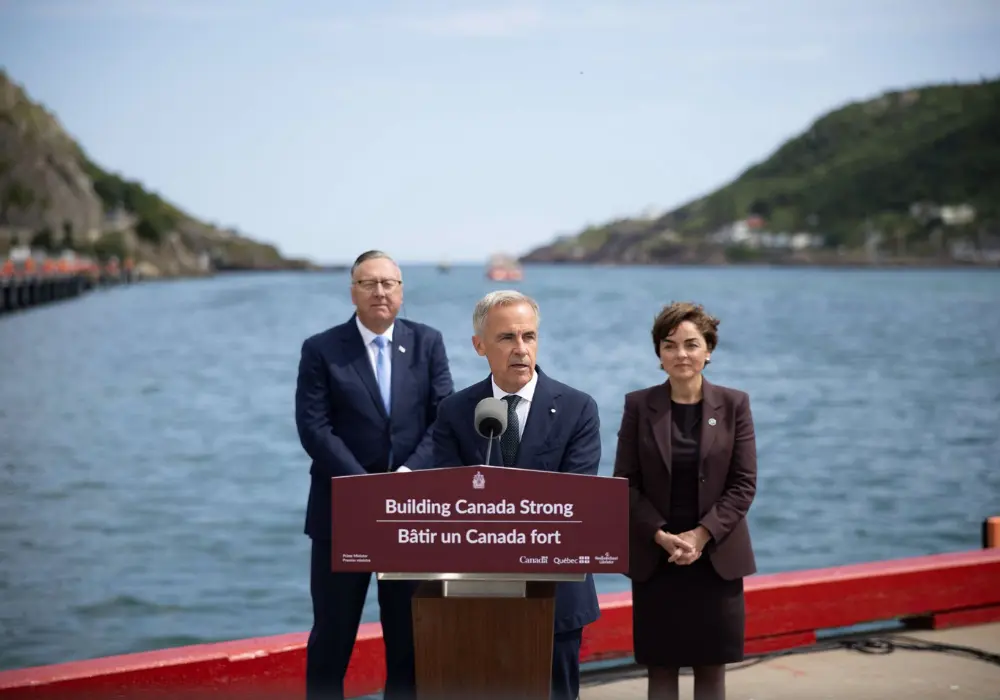
During the First Ministers’ Meeting in July 2026, Carney articulated his vision for Canada as a "clean and conventional" energy superpower. This was reinforced by major regional announcements, notably a historic clean-energy agreement forged between the federal government, Quebec, and Newfoundland and Labrador regarding the Churchill Falls expansion. As Parliament prepares to return, the administration finds itself at a crossroads: balancing ambitious long-term targets against lagging interim policy enforcement.
The Five Pillars of the Carney Climate Agenda
The architecture of the Carney government’s environmental strategy rests upon five explicit commitments. Each pillar represents a distinct effort to modernize Canada’s approach to emissions reduction, industrial growth, and sustainable finance.
1. Establishing "A Carbon Market That Actually Works"
Industrial carbon pricing remains one of the most cost-effective mechanisms for curbing large-scale greenhouse gas emissions. As economic research from platforms like the 440 Megatonnes project demonstrates, well-designed industrial pricing can drive substantial emissions reductions at minimal economic cost—often calculated at fractions of a dollar per barrel in the oil and gas sector.
However, operationalizing this philosophy has proved challenging. Reforming the industrial carbon market was a central component of the MOU signed between the federal government and Alberta. Unfortunately, subsequent analyses by the Canadian Climate Institute indicate that the adjustments made to Alberta’s industrial carbon market thus far are insufficient to establish a firm, reliable foundation nationally. Most concerningly, the market price of carbon credits in Alberta has actually trended downward since the MOU was finalized.
Industrial carbon pricing needed substantive structural reform when Prime Minister Carney assumed office, and independent policy experts agree that it continues to require urgent legislative strengthening today.
2. Targeting a 75% Electric Vehicle Adoption Rate by 2030 (and 90% by 2040)
Transportation remains one of Canada’s fastest-growing sources of emissions. To address this, the Carney administration introduced a specific and ambitious automotive strategy during a high-profile press conference, pledging to strengthen vehicle emissions standards to achieve the equivalent emissions reductions of a 75% electric vehicle (EV) adoption rate by 2030, scaling up to 90% by 2040.
Yet, the execution of this policy has encountered significant headwinds. In its efforts to restructure the automotive transition, the federal government moved to repeal pre-existing EV adoption mandates while experiencing delays in rolling out its replacement framework. Independent policy evaluations suggest that the details revealed thus far regarding the new federal standard lack the regulatory teeth required to guarantee compliance. By disrupting the established policy timeline without an immediate, equally rigorous successor in place, the administration has inadvertently complicated an already difficult transition for consumers and automakers alike.
3. Transforming Canada into a "Clean and Conventional" Energy Superpower
Throughout government communications, the phrase "clean and conventional energy superpower" has become a defining mantra of the Carney era. In his "Forward Guidance" video address, the prime minister articulated an ambition to build clean energy infrastructure on a scale that "would astound even Sir Adam Beck"—invoking the legacy of the visionary Ontario politician and hydroelectric pioneer.
While the "conventional" component of this strategy has been articulated with striking clarity and reinforced by billions of dollars in public capital and loan guarantees, the "clean" component remains less defined in practical terms.
There are, however, glimmers of substantial progress. The recent tripartite clean-energy agreement announced between the federal government, Quebec, and Newfoundland and Labrador regarding massive hydroelectric assets represents a major step forward. Nevertheless, policymakers emphasize that replicating this scale of inter-provincial cooperation will be necessary across every region of the country if Canada is to successfully meet its expansive clean-power generation goals.
4. Implementing "Made-in-Canada Sustainable Investment Guidelines"
Recognizing that public capital alone cannot fund the green transition, Budget 2025 introduced a pivotal commitment: the creation of indigenous, "Made-in-Canada sustainable investment guidelines" scheduled for full publication in 2027, alongside a compatible sustainable bond framework.
To ensure credibility and alignment with financial markets, the federal government engaged the Canadian Climate Institute and Business Future Pathways to lead the development of these taxonomies collaboratively. In mid-2026, the initiative reached a milestone with the release of the first public draft report, which outlines a structured framework for defining sustainable economic activities. If implemented effectively, this taxonomy will help channel billions of dollars in private institutional capital toward genuine decarbonization projects while actively mitigating the risks of greenwashing.
5. Achieving Net-Zero Emissions by 2050
Anchoring the entirety of Carney’s environmental platform is the legally enshrined and politically vital commitment to achieve net-zero greenhouse gas emissions by 2050. This overarching objective has been woven directly into the text of bilateral agreements—including the final text of the federal-provincial MOU with Alberta—and serves as the benchmark against which all federal climate policies will ultimately be judged.
Yet, a persistent gap remains between long-term aspiration and short-term reality. As independent tracking and modeling consistently demonstrate, current policy actions—when aggregated across federal and provincial jurisdictions—are not yet sufficient to put Canada securely on the trajectory required to meet its 2050 targets. For the net-zero pledge to retain its credibility, it must be matched by immediate, enforceable regulatory measures that accelerate emissions reductions across all heavy-emitting sectors.
Supporting Context and Metrics: The Economic and Environmental Reality
To properly evaluate the efficacy of the Carney government’s environmental strategy, it is necessary to examine the broader empirical landscape. Canada’s economic profile—historically tied to natural resource extraction, heavy industry, and vast geographical expanses—presents unique challenges for decarbonization.
- The Cost of Inaction: According to data compiled during recent parliamentary and scientific briefings, the economic toll of climate-driven natural disasters in Canada has escalated dramatically. The 2025 and 2026 wildfire seasons alone resulted in billions of dollars in insured losses, infrastructure damage, and emergency management expenditures, directly impacting the GDP and national productivity.
- Emissions Trajectory: While carbon pricing regimes have successfully stabilized emissions in specific industrial sectors, Canada’s overall reduction curve continues to trail behind G7 counterparts. The tension between expanding conventional energy exports and meeting domestic emissions caps remains the central policy dilemma for the current administration.
- Capital Mobilization: Financial sector analyses indicate that Canada requires upwards of $125 billion annually in low-carbon investments to meet its mid-century targets. The success of the forthcoming sustainable finance taxonomy (led by the Canadian Climate Institute and Business Future Pathways) will serve as a litmus test for whether domestic institutional investors can be mobilized at this unprecedented scale.
Official Statements and Stakeholder Perspectives
The strategic shift under Prime Minister Carney has elicited varied responses from political leaders, environmental economists, and civil society organizations.
Supporters of the administration argue that a pragmatic, market-friendly approach is the only political viable path forward in a federation as regionally diverse as Canada. By aligning environmental goals with industrial development—particularly through partnerships with resource-rich provinces like Alberta—the government aims to prevent the bitter regional polarization that characterized past climate battles.
Conversely, environmental watchdogs and climate policy institutes have urged caution, warning against the dilution of hard-fought regulatory gains. In recent briefings, the Canadian Climate Institute emphasized that flexibility must not become a euphemism for inaction. As Rick Smith, president of the Canadian Climate Institute, notes:
"Add it all up and you get a list of policy promises that have the potential to improve people’s lives, electrify the economy and reduce national emissions. As much of the country continues to feel the impacts of yet another dangerous wildfire season driven by climate change, the urgency to act is clear."
Future Outlook: The Road Ahead for Parliament and Policy
As Parliament prepares to reconvene, the political dynamics surrounding Canadian climate policy are entering a decisive new phase. The initial grace period—during which the Carney administration could successfully define itself primarily in contrast to Trudeau-era policies—has drawn to a close.
Moving forward, public debate will no longer center on theoretical strategies or comparative rhetoric. Instead, legislators, industry leaders, and citizens will focus relentlessly on execution:
- Legislative Rigor: Can the government strengthen industrial carbon pricing mechanisms to ensure credit prices recover and drive genuine emissions cuts?
- Regulatory Enforcement: Will the forthcoming vehicle emissions standards prove robust enough to drive the structural shift toward the 75% EV adoption target?
- Intergovernmental Cooperation: Can the federal government successfully replicate agreements like the Churchill Falls clean-power pact across other provinces?
- Financial Accountability: Will the 2027 Made-in-Canada sustainable investment guidelines establish a global standard for transparent green finance?
The policy promises assembled by Prime Minister Mark Carney possess the theoretical potential to transform Canada’s economic landscape, electrify core industrial sectors, and secure meaningful emissions reductions. However, in the realm of environmental governance, intent must ultimately be validated by execution. As the physical and economic impacts of climate change continue to mount across the country, the Carney administration faces a narrow window to prove that its new course can deliver where past plans have fallen short.