

Executive Overview
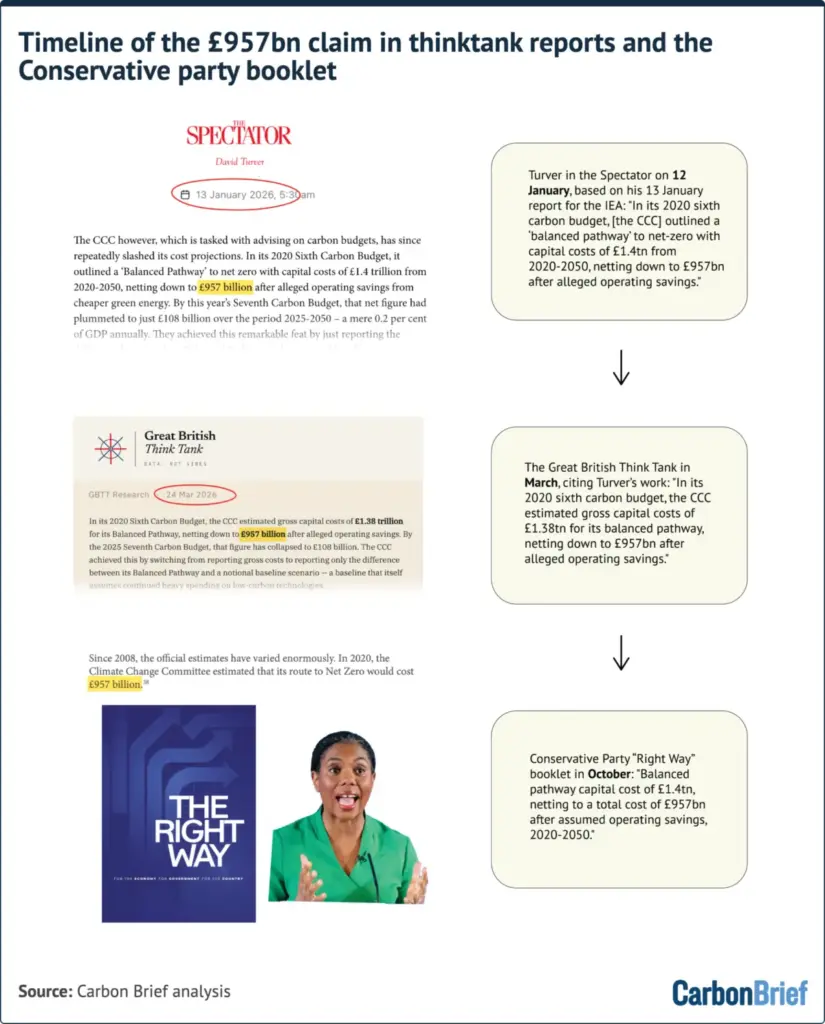
A high-profile policy document published by the UK’s opposition Conservative Party has come under intense scrutiny after incorporating a critical mathematical error that effectively doubled the projected cost of the nation’s transition to net-zero carbon emissions. The booklet, titled "The Right Way" and released in October 2026, claims that the government’s independent advisory body, the Climate Change Committee (CCC), placed the price tag of achieving net-zero emissions at nearly £1 trillion—specifically £957 billion.
However, an analysis of the underlying data reveals that this figure is the result of an elementary spreadsheet double-counting error. The CCC’s actual net cost estimate published in 2020 was £478 billion—exactly half the amount claimed by the Conservative Party. Furthermore, updated modeling released by the CCC in 2025 drastically lowered that projection to £108 billion over the 2025–2050 period, driven predominantly by rapid cost reductions in renewable technology, energy storage, and electric vehicles (EVs).
The inclusion of this inflated statistic highlights a glaring paradox within the opposition party’s publication. "The Right Way" frames itself as a manifesto for "common sense" governance, asserting that British voters demand a administration "competent enough to solve the problems for which it takes responsibility." In a section warning against over-reliance on "sophisticated modeling" at the expense of "political judgement," the document disparages existing climate finance models while relying on a flawed, miscalculated figure.
An investigation into the paper trail behind the £957 billion stat reveals how a simple technical error—adding a summary row to the individual rows it already summarized—passed through commentary outlets, free-market think tanks, and social media echoing chambers before ultimately being codified into official party policy material.
Detailed Chronology: From Spreadsheet Cell to Party Policy
The trajectory of the erroneous £957 billion figure demonstrates how technical accounting mistakes can migrate from raw data files into the mainstream political discourse.
+-----------------------------------------------------------------------------------+
| CHRONOLOGY OF THE SPREADSHEET ERROR                                              |
+-----------------------------------------------------------------------------------+
| Dec 2020    | Climate Change Committee publishes Sixth Carbon Budget dataset.    |
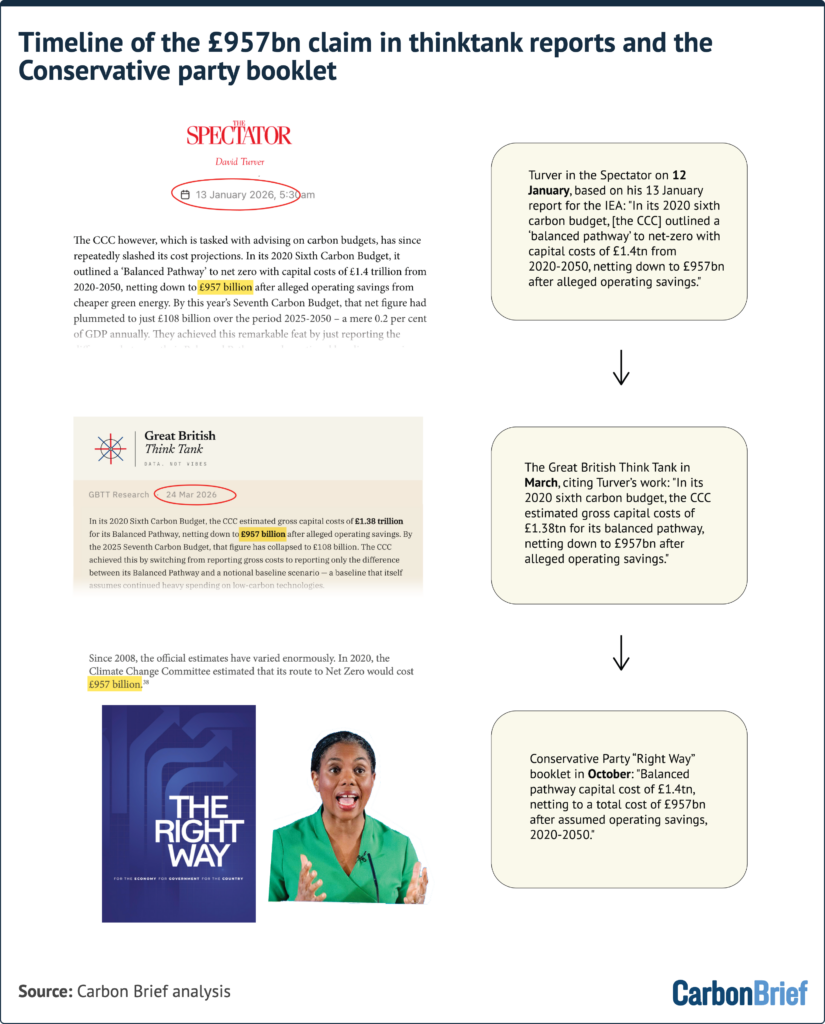
| Jan 12, 2026| David Turver publishes article in The Spectator citing £957bn.     |
| Jan 13, 2026| IEA publishes Turver's paper repeating the double-counted total.   |
| Mar 2026    | "Great British Think Tank" replicates the erroneous figure online. |
| Oct 2026    | Conservative Party publishes "The Right Way" incorporating figure.|
+-----------------------------------------------------------------------------------+
Phase 1: The CCC’s Original 2020 Sixth Carbon Budget Data
In December 2020, the Climate Change Committee published its recommendations for the UK’s Sixth Carbon Budget, setting out the path to net-zero emissions by 2050. Accompanying the report was a complex data spreadsheet detailing annual capital expenditures (CAPEX) and operational cost savings (OPEX) across major sectors of the UK economy, including energy generation, domestic heating, transportation, and agriculture.
In this original 2020 model, the CCC calculated:
- Total additional capital investments (CAPEX) needed between 2020 and 2050: £1.38 trillion.
- Total operational savings (OPEX) achieved over the same period: £0.90 trillion.
- Net total cost over 30 years: £478 billion.
Phase 2: The January 2026 Accounting Misstep
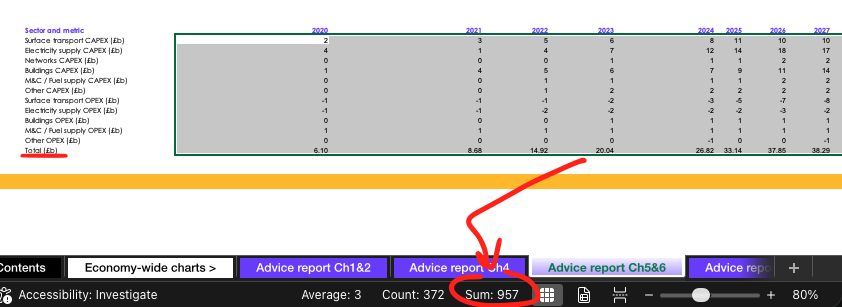
The £957 billion figure first appeared publicly on January 12, 2026, in an article written for The Spectator by David Turver, a retired engineer and commentator operating as an independent energy analyst.
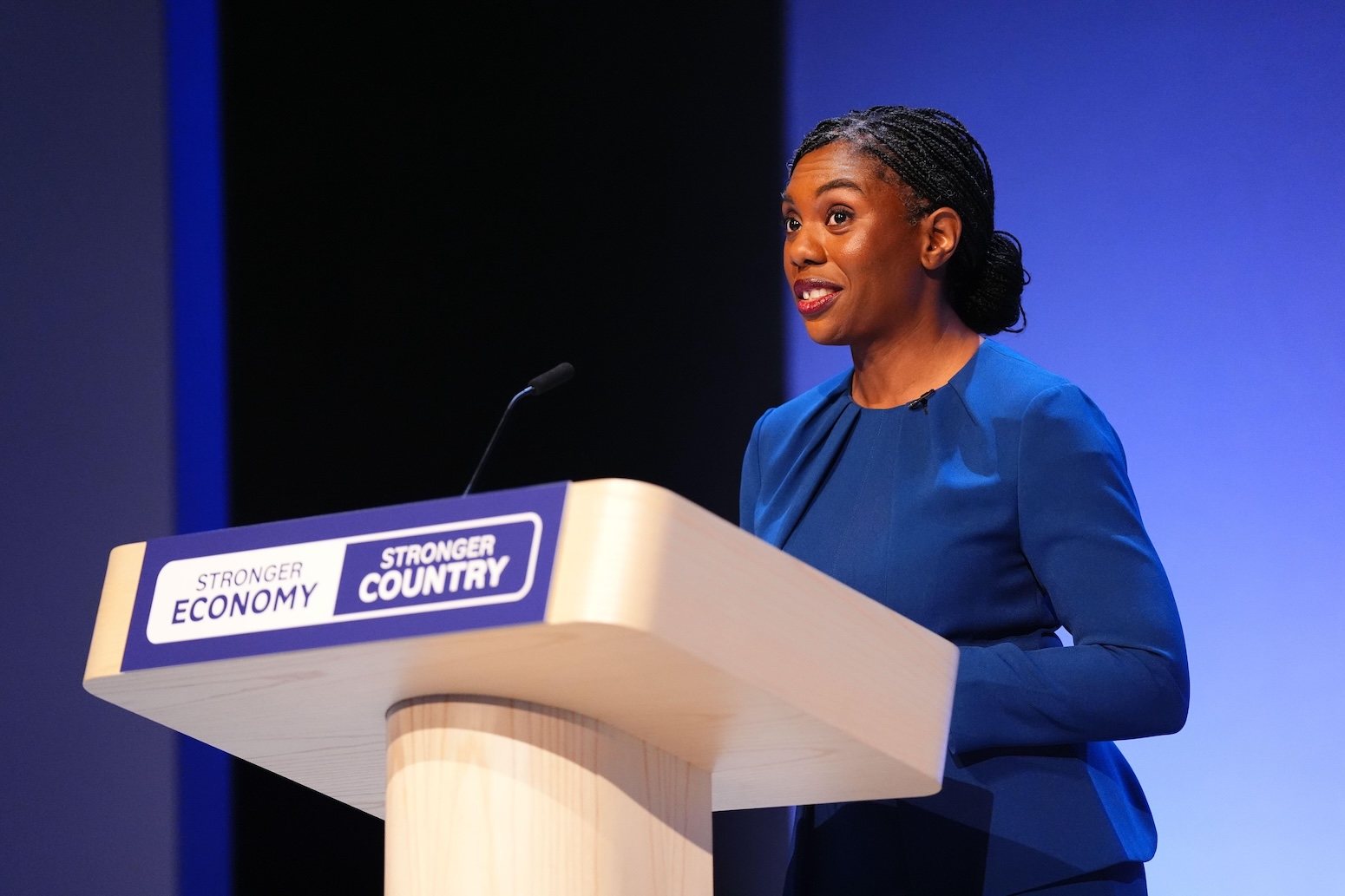
A day later, on January 13, 2026, the free-market Institute of Economic Affairs (IEA) published a report authored by Turver. In this paper, Turver cited Figure 5.3 of the CCC’s 2020 Sixth Carbon Budget publication. When attempting to recreate the CCC’s figures using the released raw Excel spreadsheet, an arithmetic error occurred: the column summing sectoral costs included both the individual sectoral rows and the predefined annual summary row.
Because the summary row already represented the sum of the sectoral rows, highlighting the entire range in Excel resulted in every input cost and saving being added twice.
$$ textTrue Net Cost = £478text billion $$
$$ textDouble-Counted Calculation = £478text billion times 2 = £957text billion $$
Turver’s IEA paper also featured secondary estimates suggesting that net-zero could cost the nation £7.6 trillion or even £9 trillion. These extreme assertions were grounded in assumptions that conventional fossil fuels, petrol vehicles, gas boilers, and legacy power infrastructure carry zero baseline cost over a 30-year operational lifecycle.
Phase 3: Re-publication Across the Think-Tank Network
Despite the mathematical discrepancy, the £957 billion figure gained traction across online commentary platforms. In March 2026, an organization calling itself the "Great British Think Tank"—which operates under the tagline "data, not vibes" and claims that "every figure is sourced from official public bodies"—re-published the £957 billion statistic in an online briefing on net-zero policy.
Phase 4: Institutional Adoption in "The Right Way"
By October 2026, the figure completed its journey into mainstream political strategy. The Conservative Party released its formal policy document, "The Right Way," presenting its stance on energy security and climate goals.
Directly referencing the Climate Change Committee’s 2020 analysis, the document asserted:
"In 2020, the CCC estimated that its route to net-zero would cost £957bn."
The claim passed through internal political vetting without verification against the original CCC publications or consultation with independent statistical authorities.
Supporting Context & Metrics: Deconstructing the Math
To understand how the arithmetic mistake occurred, it is necessary to examine the structure of the Climate Change Committee’s original 2020 Sixth Carbon Budget dataset.
The Double-Counting Mechanism
The CCC’s public Excel workbook (`The-Sixth-Carbon-Budget-Charts-and-data-
in-the-report.xlsb`) presents annual financial requirements across specific economic sectors:
+-----------------------------------------------------------------------------------+
| STRUCTURAL BREAKDOWN OF CCC NET-ZERO ESTIMATES (2020 DATASET)                     |
+-----------------------------------------------------------------------------------+
| Metric / Category            | Original CCC Figure (2020) | Double-Counted Figure|
+------------------------------+----------------------------+-----------------------+
| Capital Expenditure (CAPEX)  | £1.38 Trillion             | £2.76 Trillion        |
| Operational Savings (OPEX)   | (£0.90 Trillion)           | (£1.80 Trillion)      |
| Net Total Cost (2020–2050)   | £478 Billion               | £957 Billion          |
+------------------------------+----------------------------+-----------------------+
The worksheet contains rows dedicated to individual sectors:
- Low-carbon electricity supply
- Surface transport (EV charging and infrastructure)
- Residential and commercial buildings (heat pumps and insulation)
- Industry and manufacturing
- Agriculture and land use
At the bottom of these sectoral line items, the CCC included a aggregated line item labeled "Combined Net Total" for each calendar year from 2020 through 2050.
When conducting an automated summation across the entire column range (e.g., using =SUM(C4:C12) where C12 contains the subtotal of C4:C11), the resulting formula calculates (Subtotal) + (Subtotal). Summing the combined annual totals alongside the individual constituent line items yields exactly £957 billion instead of the actual £478 billion.
    [ Sector 1: Power Generation ]  --> £X
    [ Sector 2: Surface Transport]  --> £Y
    [ Sector 3: Buildings/Heating]  --> £Z
    --------------------------------------
    [ Subtotal Row: Net Annual   ]  --> £(X + Y + Z)  <-- Subtotal included in sheet
    ======================================
    INCORRECT TOTAL (Summing all)   --> £2 * (X + Y + Z) = £957 Billion
    CORRECT TOTAL (Summing sectors) --> £1 * (X + Y + Z) = £478 Billion
Revised 2025 Baseline vs. Historical Projections
Beyond the initial doubling of the 2020 figure, the political document overlooked the most recent official data published by the Climate Change Committee.
In 2025, the CCC updated its comprehensive economic models to account for real-world market developments over the preceding five years. The updated figures showed a substantial reduction in projected net transition costs:
+-----------------------------------------------------------------------------------+
| EVOLUTION OF CCC NET-ZERO COST ESTIMATES OVER TIME                                |
+-----------------------------------------------------------------------------------+
| Metric                       | 2020 CCC Assessment        | 2025 CCC Assessment   |
+------------------------------+----------------------------+-----------------------+
| Projected CAPEX              | £1.38 Trillion             | £670 Billion          |
| Projected OPEX Savings       | £0.90 Trillion             | £562 Billion          |
| Net Cost to UK Economy       | £478 Billion               | £108 Billion          |
| Percentage of 30-Year GDP    | ~0.9% of GDP               | < 0.2% of GDP         |
+------------------------------+----------------------------+-----------------------+
The dramatic downward revision from £478 billion to £108 billion was driven primarily by three technological and market shifts:
- EV Parity: Electric vehicle battery prices fell faster than anticipated, bringing initial purchase costs closer to internal combustion engine vehicles while delivering operating fuel savings.
- Renewable Deployment Costs: The levelized cost of offshore wind and solar power generation stabilized at lower thresholds than projected in 2019–2020 models.
- Fossil Fuel Price Volatility: Sustained high import prices for international natural gas expanded the relative financial savings achieved by replacing gas-fired heating and generation with electrification.
Macroeconomic Trade-Offs and Energy Security
The economic framing used by official advisory bodies differs fundamentally from the cost models advanced by critics.
When the CCC published its £478 billion estimate in 2020, it noted that this net investment represented less than 1% of UK gross domestic product (GDP) over a three-decade horizon. The committee’s macroeconomic modeling indicated that domestic capital investment in green technologies would displace energy imports, yielding a net long-term GDP boost of roughly 2%.
+-----------------------------------------------------------------------------------+
| MACROECONOMIC IMPACT COMPARISON (CCC ESTIMATES)                                   |
+-----------------------------------------------------------------------------------+
| Economic Metric                     | Projected Magnitude / Value                 |
+-------------------------------------+---------------------------------------------+
| Net Annual Co-Benefits of Net-Zero   | ~£110 Billion per year                      |
| Projected Net GDP Impact            | + 2.0% expansion vs. baseline               |
| Single Fossil Fuel Price Shock Cost | Greater than full 30-year net-zero cost     |
+-------------------------------------+---------------------------------------------+
In a early 2026 economic update, the CCC highlighted that achieving net-zero emissions would cost the UK economy less than enduring a single major international fossil-fuel price shock. The committee estimated that systemic benefits—ranging from enhanced national energy security to reduced health costs from air pollution—would yield gross societal benefits worth approximately £110 billion per year.
Official Statements and Critical Reactions
The Conservative Party’s Framing
In "The Right Way," the Conservative Party framed its critique of climate policy around financial prudence and executive capability. The text argues that public policy should prioritize political accountability over complex statistical frameworks:

"What people ultimately want is a government competent enough to solve the problems for which it takes responsibility… sophisticated modeling should not be a substitute for political judgement."
When confronted with the spreadsheet error, political representatives from the party maintained that regardless of specific line-item metrics, the overarching financial burden of net-zero mandates on working households demands re-evaluation. Critics within the party argued that capital requirements remain high even after accounting for long-term operational offsets.
Climate Change Committee and Independent Analysts
The Climate Change Committee has consistently warned against misrepresenting technical economic data in public debates. While the CCC refrained from direct political commentary regarding "The Right Way," its analysts have repeatedly issued public clarifications regarding the structure of their datasets.
In response to similar miscalculations circulating in the press earlier in 2026, a CCC spokesperson emphasized:
"Net-zero requires significant upfront capital investment in low-carbon infrastructure, but this investment generates substantial operational savings over time by eliminating the need to purchase expensive, volatile imported fossil fuels. Evaluating capital expenditure without accounting for operational savings—or double-counting those totals—leads to fundamentally misleading conclusions."
Energy policy analysts and independent fact-checkers noted the structural risks posed by unchecked claims entering official political platforms. Independent data analysts observed that while complex spreadsheet models can be confusing, political organizations have a responsibility to verify statistics cited in public documents.

Future Outlook: Policy Integrity in the Net-Zero Debate
The inclusion of an arithmetic mistake in a major policy publication highlights broader challenges in how technical data is integrated into public debates surrounding climate policy.
Impact on the Political Landscape
As the UK approaches future legislative debates over energy policy, the debate around net-zero costs remains central to political strategy:
+-----------------------------------------------------------------------------------+
| KEY ELECTORAL & POLICY FOCUS AREAS                                                |
+-----------------------------------------------------------------------------------+
| Area                       | Key Issue / Debate Point                             |
+----------------------------+------------------------------------------------------+
| Public Policy Framing      | Capital expenditure vs. long-term fuel savings.      |
| Verification Standards     | Reliance on unverified secondary think-tank sources. |
| Infrastructure Mandates    | Funding for grid upgrades, heat pumps, and EVs.     |
| Energy Security Policy     | Vulnerability to global fuel price volatility.       |
+----------------------------+------------------------------------------------------+- Information Verification in Policy Formations: The reliance on secondary sources like independent blog posts and unverified think-tank reports highlights vulnerabilities in party research pipelines.
- Polarization of Energy Economics: Distinguishing between gross capital expenditure (£1.38tn in 2020) and net cost (£108bn in 2025) remains a central challenge in public communication. Opponents often focus exclusively on upfront CAPEX, while proponents emphasize long-term OPEX savings.
- Regulatory and Sectoral Deadlines: Disagreements over fiscal projections directly affect specific regulatory policies, such as phase-out dates for new petrol and diesel cars, heat pump installation targets, and grid decarbonization timelines.
The Broader Challenge of Climate Accounting
The debate surrounding "The Right Way" illustrates the growing role of data integrity in national politics. As energy systems shift away from fossil fuels toward capital-intensive, low-operational-cost renewables, traditional financial metrics are frequently interpreted in conflicting ways.
For policymakers, the incident serves as a clear case study in the risks of confirmation bias when handling complex economic datasets. As the UK navigates its transition toward carbon neutrality by 2050, maintaining rigorous, verified accounting standards will be essential to ensuring public trust, political accountability, and sound economic management.



