

Executive Overview
For nearly as long as modern electric vehicles (EVs) have occupied showroom floors, prospective buyers and skeptics alike have fixated on two core anxieties: driving range and battery degradation. These psychological barriers—colloquially termed "range anxiety" and "battery longevity panic"—have persisted despite generations of engineering advancements. Critics often question how a high-voltage lithium-ion pack will perform after years of exposure to extreme weather, rapid DC fast-charging sessions, and standard daily commuting cycles.
To separate reality from lingering misconceptions, Aviloo, an industry-leading EV battery diagnostics firm, conducted a massive, multi-year empirical investigation. Analyzing more than 500,000 individual battery health tests performed between 2022 and 2026 across North America, South America, Europe, Asia, and Australia, the study offers an unprecedented global snapshot of medium- and long-term EV battery durability.
Examining 20 popular EV models at key odometer milestones—50,000 kilometers (approx. 31,068 miles), 100,000 kilometers (approx. 62,137 miles), and 150,000 kilometers (approx. 93,205 miles)—the findings provide definitive proof that modern EV chemistry is remarkably resilient. While a handful of configurations experienced notable capacity loss, the overwhelming majority of tested vehicles retain an exceptionally high percentage of their original energy storage capacity. Even at 150,000 kilometers, most cars hover safely in the lower-to-mid 90% range, proving that contemporary battery management systems (BMS) and thermal architectures have successfully mitigated severe degradation.

Detailed Chronology of the Aviloo Diagnostic Study
The journey toward understanding long-term EV battery health has historically been hampered by a lack of standardized testing. Early consumer reports relied heavily on anecdotal evidence, self-reported odometer logs, or proprietary manufacturer dashboards that did not always disclose internal cell resistance or true usable capacity.
The Genesis of the Project (2022)
Recognizing a massive information gap in the secondary and primary EV markets, Aviloo set out to establish a transparent, data-driven baseline. Beginning in 2022, the diagnostics firm leveraged its specialized hardware and software platforms—capable of assessing battery health under real-world driving and charging conditions—to aggregate data from hundreds of thousands of customer vehicles worldwide. The goal was simple: map out how 20 of the most popular EV models on the market actually degraded over time rather than how they performed under idealized laboratory conditions.
Global Expansion and Scaling (2023–2025)
As global EV adoption accelerated, so did the volume of Aviloo’s dataset. By scaling operations across five continents, the diagnostic platform captured variations in climate, infrastructure availability, and driving habits. Vehicles operating in the blistering heat of the American Southwest were evaluated alongside those navigating sub-zero Scandinavian winters. Throughout this multi-year collection phase, the research team monitored specific mileage thresholds to track linear versus non-linear degradation curves.
Final Data Synthesis and Publication (2026)
Culminating in 2026, the final dataset surpassed half a million tests. This milestone allowed researchers to publish comparative health metrics across distinct lifecycle intervals:
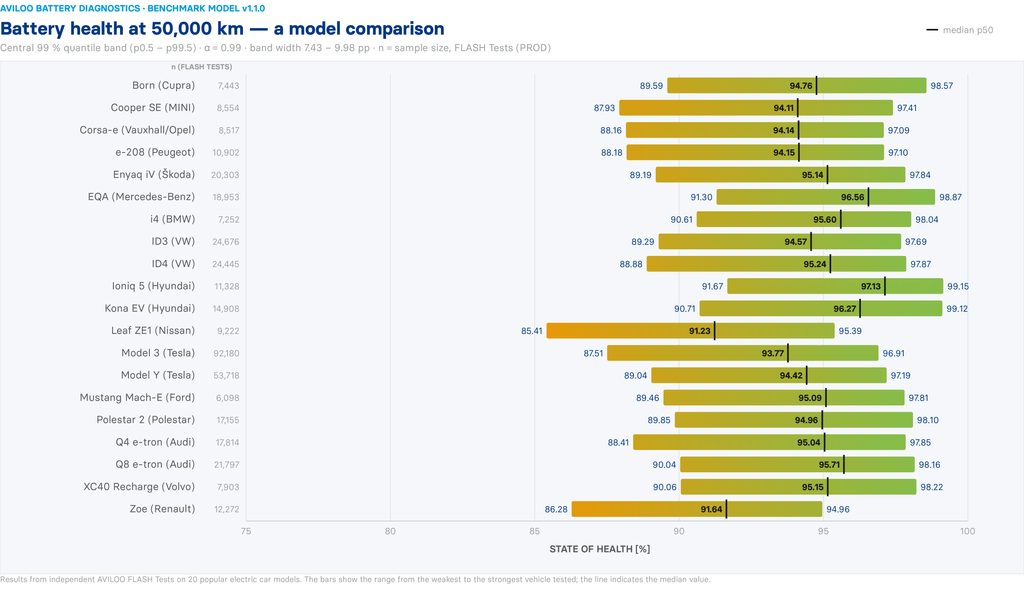
- 50,000 km (31,068 miles): The early-life check, highlighting initial manufacturing tolerances and the immediate impact of early driving styles.
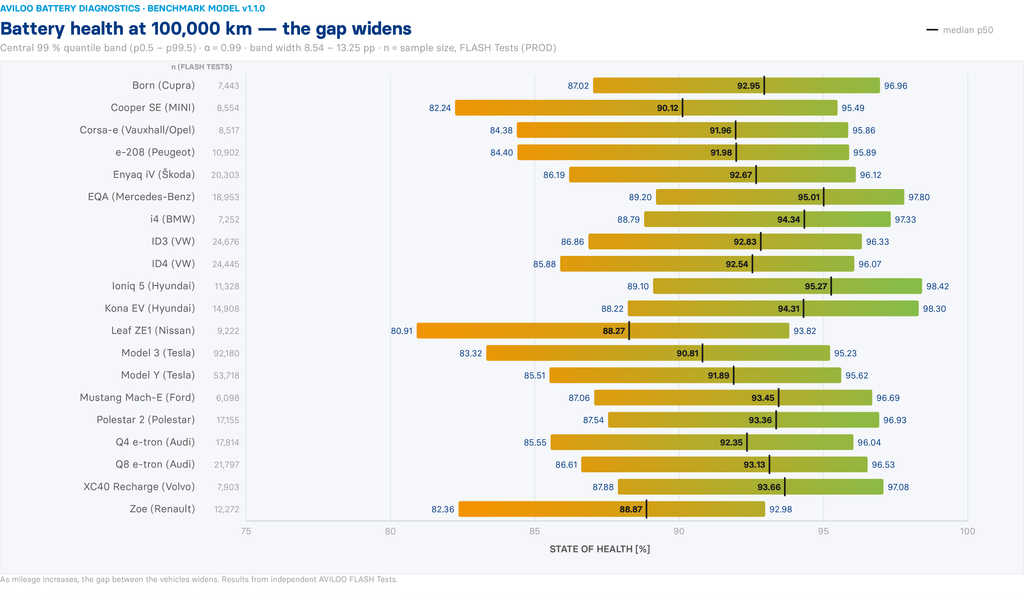
- 100,000 km (62,137 miles): The mid-life milestone, where chemical stabilization typically occurs and any latent thermal management flaws begin to surface.
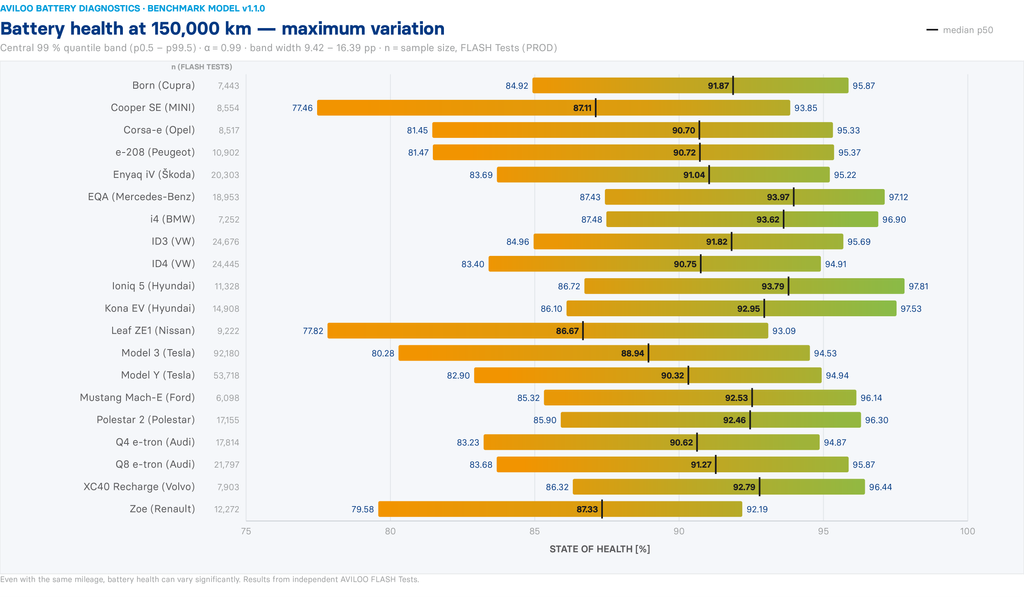
- 150,000 km (93,205 miles): The long-term durability test, representing the typical threshold where traditional internal combustion engine vehicles begin experiencing significant mechanical wear.
Supporting Context & Metrics: What the Data Reveals
To understand the weight of Aviloo’s findings, one must contextualize modern EV engineering against historical expectations. A decade ago, commercial EVs frequently featured packs with limited capacities—often hovering between 80 and 150 kilometers of real-world range. Under those circumstances, a 20% capacity loss was debilitating, reducing a daily commuter car into a vehicle with severely restricted utility.
Fast-forward to the current automotive landscape. Modern EVs regularly launch with base ranges exceeding 400 to 500 kilometers (250 to 300+ miles). Consequently, even if a battery experiences a 10% or 15% reduction in capacity over its lifespan, the remaining energy reserve still outmatches the total capacity of many vehicles manufactured ten years ago.
Key Findings by Mileage Milestone
- At 50,000 Kilometers (Early Life):
The vast majority of the 20 examined models maintained approximately 95% or more of their original battery capacity. This indicates that initial factory calibration, active liquid-cooling loops, and conservative buffer zones engineered into the BMS successfully protect cells during their most volatile chemical phase. - At 100,000 Kilometers (Mid Life):
While a slight acceleration in degradation can be observed as the chemistry settles, most top-tier vehicles remained well above 90% health. The data demonstrated that linear degradation is the norm rather than the exception, contradicting fears of sudden, catastrophic cliff-edge failures. - At 150,000 Kilometers (Long-Term Durability):
Performance at this stage varied more noticeably depending on the manufacturer’s thermal management philosophy and chemistry selection (e.g., Nickel Manganese Cobalt [NMC] vs. Lithium Iron Phosphate [LFP]). However, typical high-performing models still retained health figures in the lower 90% bracket. While select outliers exhibited up to a 20% loss, these instances were largely localized to vehicles subjected to intensive, unmitigated rapid-charging routines or extreme ambient climates without proper thermal conditioning.
The Real-World Practicality of Minor Degradation
From a consumer perspective, minor capacity reduction has a negligible impact on daily lifestyle routines. For everyday drivers—such as those utilizing home-charging setups to top off overnight once or twice a week—a slight drop in total kilowatt-hours translates to little more than plugging in slightly more often. As noted by long-term EV owners, managing a vehicle with a slightly depleted battery requires minimal active engagement; it rarely alters overall trip planning or commuting feasibility.
Official Insights & Industry Perspectives
Industry analysts and technical experts have increasingly emphasized that battery longevity is no longer the unknown variable it was perceived to be a decade ago.
- The Evolution of Thermal Management: Modern EV platforms utilize sophisticated liquid-cooling and heating systems that actively regulate cell temperatures, preventing the localized overheating that accelerated degradation in early-generation electric cars.
- Software-Defined Buffers: Manufacturers increasingly employ dynamic state-of-charge (SoC) buffers. By preventing users from charging cells to a true 100% or discharging them to absolute 0%, these software parameters drastically extend chemical longevity without requiring drivers to manually alter their charging habits.
- Chemistry Diversification: The widespread adoption of LFP chemistry in standard-range models has fundamentally shifted expectations. LFP cells are inherently more chemically stable, tolerate 100% daily charging with minimal degradation, and boast significantly higher cycle lives compared to traditional nickel-based chemistries.
Future Outlook: The Path Ahead for EV Durability
As the automotive industry looks toward the latter half of the 2020s and beyond, the implications of studies like Aviloo’s are profound.
1. Restoring Secondary Market Confidence
One of the most immediate benefits of comprehensive, crowdsourced diagnostic data is the stabilization of the used EV market. Historically, used car buyers hesitated to purchase electric vehicles due to opaque battery health metrics. Standardized diagnostics and empirical evidence proving that packs easily survive 150,000+ kilometers with minimal loss provide secondhand buyers with the peace of mind necessary to embrace pre-owned EVs.
2. Informing Next-Gen Engineering
Data gathered from millions of real-world kilometers driven across diverse global climates directly informs research and development labs. Engineers can analyze precisely how real-world abuse profiles—such as frequent highway-speed DC fast charging in hot climates—impact specific cell geometries and chemistries. This feedback loop ensures that upcoming solid-state batteries and advanced silicon-anode cells will debut with even more robust durability profiles.
3. Redefining Vehicle Lifespans
Ultimately, the longevity demonstrated in Aviloo’s half-million tests suggests that modern EVs are poised to outlast their internal combustion engine predecessors in structural and mechanical reliability. With fewer moving parts, no oil changes, and battery packs capable of retaining over 80% to 90% of their utility well past the 150,000-kilometer mark, the electric vehicle transition is transitioning from an ideological shift to an unassailable economic and practical reality.



