


Executive Overview
The modern electrical grid is standing at a historic crossroads. Built generations ago for a predictable, unidirectional flow of electricity—from centralized fossil-fuel or hydroelectric power plants down to passive consumers—the contemporary grid is now buckling under an unprecedented convergence of decentralized demands. Today’s grid operators must simultaneously manage the explosive adoption of electric vehicles (EVs), an influx of residential and utility-scale renewables, a proliferation of smart-home ecosystems, and the gargantuan, continuous power appetites of artificial intelligence (AI) data centers. Layered on top of these structural shifts is the escalating frequency of extreme weather events driven by climate change, making power reliability more precarious—and more vital—than ever before.
Enter Texture, an innovative grid software startup tackling this structural bottleneck head-on. The company announced today that it has successfully closed a $12.5 million Series A funding round, bringing its cumulative venture backing to approximately $23 million. The financing was co-led by VoLo Earth Ventures and Equal Ventures, with additional strategic participation from Lerer Hippeau and Abstract Ventures. Texture plans to deploy this fresh capital aggressively, scaling its engineering and deployment teams and expanding its real-time operating platform across a rapidly growing utility landscape.
Rather than forcing utilities to adopt yet another siloed, disconnected software legacy product, Texture’s core value proposition is consolidation and visibility. By synthesizing data feeds from smart meters, EV chargers, rooftop solar arrays, supervisory control and data acquisition (SCADA) systems, advanced metering infrastructure (AMI), and smart thermostats into a single, unified operating layer, Texture gives grid operators an unprecedented real-time window into the health and status of their distribution networks. Crucially, the platform is designed for rapid deployment—plugging seamlessly into existing infrastructure within days rather than years—and has found early, enthusiastic champions among America’s rural utility cooperatives.
Detailed Chronology: From Concept to Cooperative Adoption
The genesis of Texture lies in a fundamental frustration observed by its co-founder and CEO, Sanjiv Sanghavi. While visiting rural and regional utility providers, Sanghavi repeatedly encountered organizations eager to embrace the clean energy transition, deploy virtual power plants (VPPs), and leverage distributed energy resources (DERs), but completely stymied by the tools available to them.

Legacy grid software has historically been built for massive, investor-owned utilities (IOUs) boasting multi-million-dollar technology budgets and armies of specialized systems engineers. For smaller entities, such software is prohibitively expensive, agonizingly slow to deploy, and overly complex.
"Co-ops kept telling me the same thing," recalled Sanghavi. "They wanted to run modern grid programs, but didn’t have software built for their scale or budget."
Recognizing this market failure, Texture set out to build a lightweight, high-performance platform capable of bridging the gap. By focusing initially on utility cooperatives—which collectively serve approximately 42 million Americans, predominantly in rural and semi-rural regions—Texture carved out an essential niche. These co-ops face the exact same reliability and load-growth pressures as their larger metropolitan counterparts, yet operate with lean teams and tight financial constraints.
Texture’s software bypasses the traditional multi-year deployment cycles plaguing the utility sector. By integrating via open APIs and direct original equipment manufacturer (OEM) connections, utilities can fire up the platform in days. This agile deployment model paved the way for strategic expansions, such as Texture’s recent landmark partnership with the National Rural Telecommunications Cooperative (NRTC). Through this alliance, Texture’s cutting-edge Distributed Energy Resource Management System (DERMS) software is being extended to an expansive network of 850 utility co-ops across the United States.
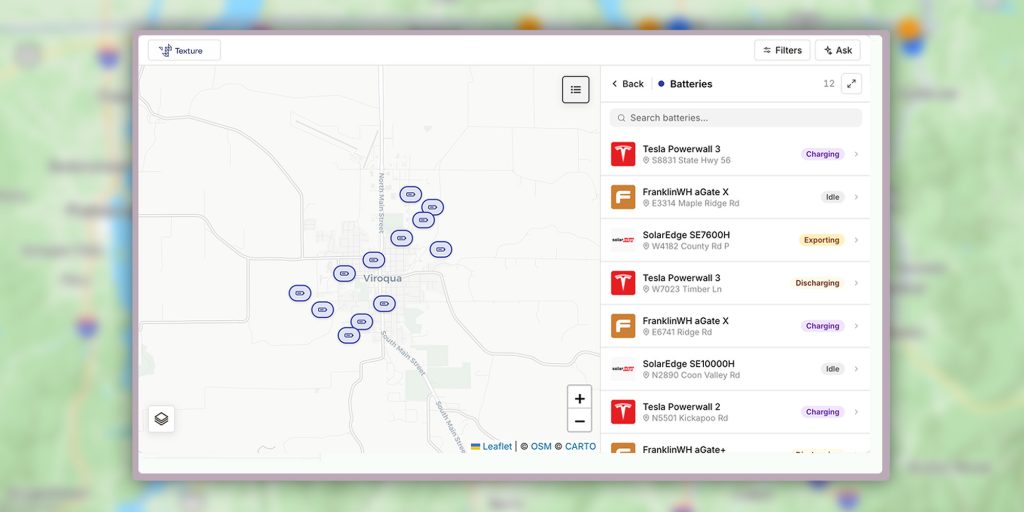
Furthermore, Texture has focused heavily on hardware-agnostic integrations, successfully establishing direct data pipelines with more than 50 OEMs and energy management companies. These include household names and industry giants such as Tesla, FranklinWH, Honeywell, Ecobee, SolarEdge, Leap Energy, and WattTime. This broad compatibility was dramatically showcased earlier this year when Ann Arbor’s Sustainable Energy Utility leveraged Texture’s infrastructure to launch a pioneering community battery program utilizing FranklinWH residential storage systems across 100 homes.
Supporting Context & Metrics: The Anatomy of Modern Grid Stress
To understand why investors are pouring millions into grid-edge software startups like Texture, one must examine the staggering macro-level pressures transforming the North American power sector.
The EV Load Spike and Transformer Crisis
One of the most immediate and localized threats to grid stability is the rapid proliferation of electric vehicles. While EV adoption is vital for decarbonizing the transportation sector, unmanaged level-2 and DC fast-charging creates violent localized demand spikes. When multiple homeowners on a single residential transformer plug in their EVs simultaneously after work, local infrastructure can quickly exceed thermal limits.
Texture’s software combats this by detecting sudden surges in electricity demand directly at the meter level. The platform traces how these localized loads cascade upward, affecting shared neighborhood transformers and distribution feeders. By offering predictive analytics and real-time alerts, Texture gives operators the critical window needed to intervene—via managed charging protocols or automated dispatch—before critical hardware fails.

This capability carries immense financial implications. According to market intelligence firm Wood Mackenzie, global supply chain disruptions and surging material costs have caused transformer prices to skyrocket by as much as 95% since 2019. Furthermore, supply chain bottlenecks mean that lead times for procuring large utility-grade transformers can stretch beyond two years. Protecting existing grid hardware from premature burnout is no longer just an operational preference; it is a financial survival metric for utilities.
The Virtual Power Plant (VPP) Blind Spot
As millions of homes install rooftop solar panels, behind-the-meter battery storage systems, and smart thermostats, the potential to aggregate these assets into Virtual Power Plants (VPPs) has never been higher. VPPs allow utilities to draw upon decentralized resources during peak demand events, reducing the need to fire up expensive, carbon-intensive peaking power plants.
However, a systemic flaw has hindered many existing VPP and demand-response platforms: a lack of real-time meter data access. Without instantaneous visibility into actual grid conditions at the edge, dispatch decisions are often made blindly or based on lagging indicators. Texture solves this by feeding real-time meter and device telemetry straight into the management layer, ensuring that VPP dispatch commands align perfectly with real-time local network constraints.
Official Statements & Industry Perspectives
The rapid validation of Texture’s business model is underscored by strong backing from institutional investors who recognize the urgent secular tailwinds facing the energy transition.

VoLo Earth Ventures and Equal Ventures, who co-led the $12.5 million Series A round, pointed to the critical need for software that modernizes grid operations without requiring a complete infrastructural overhaul. By enabling utilities to maximize the lifespan of existing physical assets while simultaneously integrating millions of new distributed energy resources, Texture hits the sweet spot between decarbonization and grid reliability.
Early utility adopters are equally vocal about the transformative impact of the platform. The Vermont Electric Cooperative (VEC)—widely recognized as one of the United States’ few carbon-neutral utilities—relies extensively on Texture to maintain grid stability and orchestrate hundreds of distributed residential and commercial batteries spread across its rugged territory.
By bridging the gap between legacy SCADA architectures and modern, internet-connected edge devices, Texture provides a master class in how software can outpace hardware deployment timelines. As CEO Sanjiv Sanghavi emphasizes, the objective is not to reinvent how electricity is generated, but to fundamentally streamline how it is managed, distributed, and consumed at the grid edge.
Future Outlook: Scaling the Intelligent Grid
Looking ahead, the road forward for Texture—and the broader grid-edge software ecosystem—is defined by immense opportunity tempered by urgent systemic challenges. With $23 million in total capital now secured, Texture is uniquely positioned to accelerate its product roadmap, deepen its OEM integrations, and scale its footprint across both rural co-ops and larger municipal utilities.

The macro trends driving the company’s growth show no signs of slowing down. As state and federal mandates push for accelerated electrification, the number of connected EVs, residential batteries, and commercial microgrids will multiply exponentially over the next decade. Simultaneously, extreme weather events—such as the severe grid stresses witnessed during extreme winter storms—prove that modern distribution networks require unprecedented flexibility and real-time responsiveness.
Texture’s vision of a unified, plug-and-play operating layer represents a paradigm shift for utility operators. By replacing fragmented legacy tools with a single, intelligent pane of glass, the startup is empowering utilities of all sizes to navigate the clean energy transition safely, efficiently, and affordably. As America’s electrical grid continues its historic transformation, software platforms like Texture will serve as the invisible connective tissue ensuring that the lights stay on, cleanly and reliably, for decades to come.



