Every evening, millions of urban dwellers perform a quiet, unspoken ritual. They approach a door, turn a key, cross a threshold, and step into a domestic sanctuary that belongs to them in a way no other space does. This choreography is so relentlessly mundane that its structural weight is easily overlooked. Yet, philosophers, cultural anthropologists, and spatial theorists have spent centuries unpacking the psychological scaffolding behind the simple act of coming home.
In an era defined by constant connectivity, hybrid work environments, and the spatial compression of open-plan living, the boundary between the frantic public world and the private interior has eroded. Modern housing often mirrors what philosopher Gaston Bachelard lamented as "superimposed boxes"—monospaces lacking the architectural depth necessary to anchor a genuine psychological transition.
Amidst this contemporary architectural crisis, visual culture offers a profound refuge. Specifically, the animated masterpieces of Studio Ghibli—helmed by Hayao Miyazaki and his contemporaries—construct spaces that elevate the ordinary to the sacred. By tapping into archetypal memories through meticulous, hand-drawn environments, Ghibli’s films do more than provide visual escapism. They visualize the psychological rites of passage tied to thresholds, homes, and liminal spaces. This article investigates the intersection of architectural theory, anthropological ritual, and cinematic world-building, examining how Studio Ghibli exposes our collective yearning for "felicitous space" in an increasingly accelerated world.
Detailed Chronology: The Evolution of Domesticity, Architectural Philosophy, and Cinematic Space
To understand how Studio Ghibli captures the psychological resonance of the home, one must first trace the philosophical lineage connecting physical shelter to internal emotional architecture.
Phase 1: The Foundations of Topoanalysis (Mid-20th Century)
In 1958, French philosopher Gaston Bachelard published The Poetics of Space, introducing the discipline of topoanalysis: the systematic psychological study of the sites of our intimate lives. Bachelard argued that the corners we cowered in, the staircases we climbed, and the attics of our childhood homes are not passive backdrops. Instead, they are physically inscribed into our neurological and bodily memory.
Bachelard coined the term "felicitous space" to describe a domain that protects, shelters, and fosters daydreams. He observed that every subsequent house we inhabit is an attempt to recover that first, primordial home—a paradise lost to memory.
Around the same period, anthropologist Arnold van Gennep was mapping out the mechanics of transition. His landmark work on rites of passage established that human transformation occurs in three distinct stages:
Separation: Detaching from a previous state or environment.
Liminality: The in-between, threshold phase where the old identity dissolves.
Incorporation: Re-emergence and stabilization within a new status or space.
Although van Gennep applied this framework to cultural milestones like birth, marriage, and death, the framework maps with startling precision onto the daily commute and the act of coming home. Standing at a front door is a micro-separation from the professional world; crossing the threshold is the liminal passage; settling into an armchair and removing one’s shoes is incorporation.
Phase 2: The Phenomenology of Lived Space (Late 20th Century)
Expanding upon Bachelard, Finnish architect and theorist Juhani Pallasmaa argued that architectural constructions cannot be reduced to cold Euclidean geometry. In his phenomenological critiques, Pallasmaa asserted that lived space transcends physical rules because human perception is multisensory, emotional, and deeply historical.
"Architectural constructions are built in the world of matter and Euclidean geometry, but lived space always transcends the rules of physics and geometry." — Juhani Pallasmaa
By the time Studio Ghibli was founded in 1985, these philosophical currents had begun to manifest in alternative visual mediums. Miyazaki’s cinematic worlds did not merely display buildings; they treated architecture as an emotional participant in the narrative.
Phase 3: The Ghibli Cinematic Universe and Spatial Metaphor (1988–Present)
Studio Ghibli’s cinematic output operationalized Bachelard’s topoanalysis and van Gennep’s rites of passage on screen:
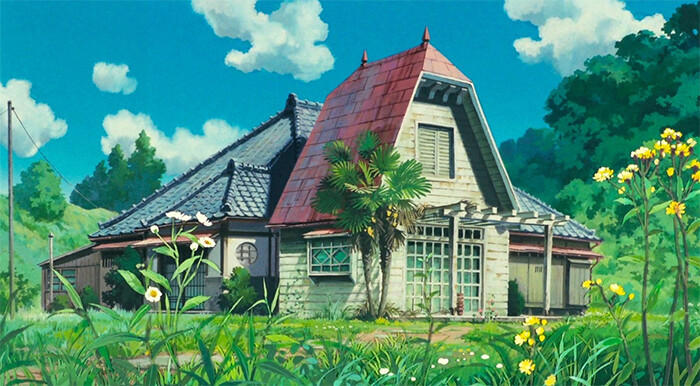
1988 (My Neighbor Totoro): The Kusakabe family moves into a dilapidated rural Japanese farmhouse. Before any furniture or human memories accumulate, the sisters are told the rooms are inhabited by susuwatari (soot sprites)—manifestations of the untamed, expectant nature of an empty house. The home arrives pre-inhabited by imagination.
2001 (Spirited Away): Chihiro crosses a literal bridge over a dry riverbed, marking her separation from the human world. She enters a liminal bathhouse realm where architectural spaces expand and contract in tandem with her psychological maturity.
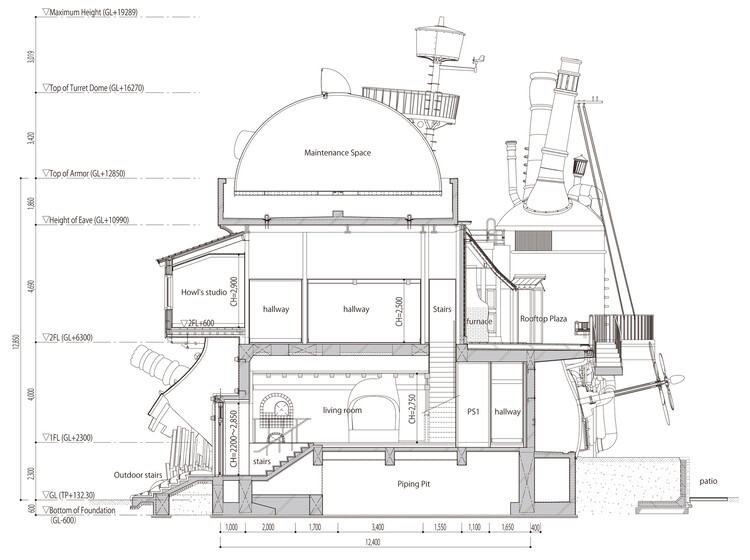
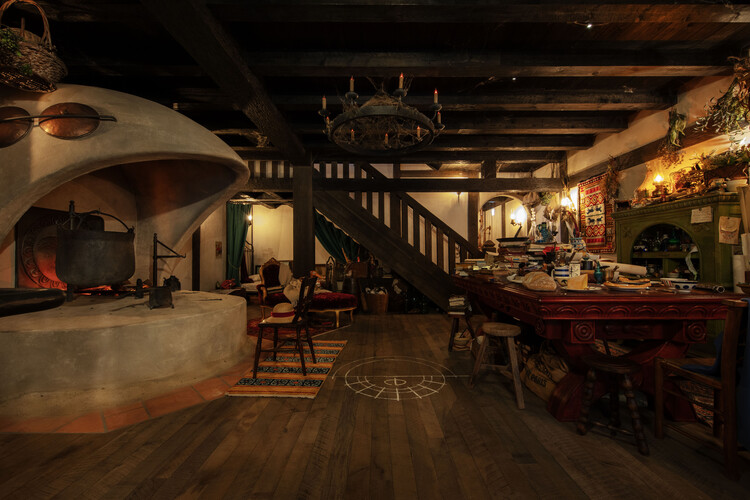
2004 (Howl’s Moving Castle): Sophie steps through a magical multi-destination door into an eccentric, cluttered castle that serves as an externalization of Wizard Howl’s turbulent inner psyche. Her physical cleaning of the castle parallels her psychological healing and incorporation into a new family unit.
Supporting Context & Metrics: The Architectural Crisis of Contemporary Living
The enduring cultural obsession with Studio Ghibli’s architectural landscapes is not merely nostalgic; it is a symptom of modern spatial alienation. Contemporary urban design and real estate markets have systematically dismantled the traditional spatial buffers that once safeguarded human psychology.
The Erosion of the Threshold
Historically, architectural planning utilized clear spatial hierarchies to facilitate psychological transitions. The traditional foyer, genkan (in Japanese architecture), or mudroom served as physical compressors—buffers where exterior stress could be shed before encountering the inner sanctum.
In contemporary real estate development, economic pressures and open-plan design trends have flattened these nuances:
The Monospace Epidemic: Urban apartments frequently merge the entry hall directly into the living, dining, and sleeping quarters. This lack of zoning forces work emails, digital stress, and public performance directly into the domestic core.
The Hybrid Work Blur: According to global workplace mobility studies, over 40% of knowledge workers operate in hybrid arrangements, blurring the psychological line between the workplace and the home. The home office has colonized the bedroom, disrupting the evening ritual of separation and incorporation.
Curated Domesticity: Social media aesthetics have turned homes into stages optimized for external legibility rather than internal sanctuary. When a home is designed to be photographed for strangers, its capacity to hold messy, accumulated personal memory—Bachelard’s "felicitous space"—is compromised.
Spatial Metrics: Ghibli’s Masterclass in Pacing
Miyazaki’s films actively rebel against the hyper-accelerated pacing of modern digital consumption by dedicating screen time to pure architectural stillness:
+-----------------------------------+-----------------------------------+
| Cinematic Scene                   | Duration of Stillness / Focus     |
+-----------------------------------+-----------------------------------+
| Chihiro on the Train (Spirited    | ~4 minutes of uninterrupted,      |
| Away)                             | dialogue-free spatial contemplation|
+-----------------------------------+-----------------------------------+
| Sophie by the Hearth (Howl's      | ~1 full minute emphasizing        |
| Moving Castle)                    | hearth masonry and warm firelight |
+-----------------------------------+-----------------------------------+
This deliberate use of temporal suspension invokes the Japanese aesthetic concept of mono no aware (物の哀れ)—a poignant, gentle awareness of the impermanence of things. By forcing audiences to sit quietly with characters inside detailed, handcrafted rooms, Ghibli films re-train the viewer’s appreciation for ordinary spaces.
Official Perspectives and Cultural Commentary
Architectural historians, cultural critics, and designers have increasingly turned to animation to critique contemporary urban design failures and re-evaluate human-centric planning.
Dr. Susan Napier, author of Miyazakiworld: A Life in Art, notes that Miyazaki’s detailed focus on domestic chores—cooking, cleaning, scrubbing floors—is not mere filler. It is a vital ritual of spatial appropriation:
"When Sophie cleans Howl’s messy, chaotic castle, she isn’t just performing domestic labor; she is claiming the space, domesticating the wild magic of the architecture, and anchoring her own identity within a foreign structure. Architecture in Ghibli films responds directly to human care."
Architectural critics writing for platforms like ArchDaily and Harvard Design Magazine emphasize that Ghibli Park in Aichi Prefecture, Japan—which physically constructs spaces like Howl’s bedroom and the Totoro house—proves that audiences hunger for tactile environments. The physical recreation of these animated spaces demonstrates that people do not just want to look at alternative worlds; they want to inhabit environments that honor human scale, craftsmanship, and emotional resonance.
Future Outlook: Reclaiming Sanctuary in Modern Architecture
As we look toward the future of architecture and urbanism, the lessons embedded in Studio Ghibli’s animated worlds offer a roadmap for healing the spatial fragmentation of modern life. Architects, interior designers, and urban planners are beginning to re-integrate ritualistic design principles into residential projects:
The Revival of the Threshold: Forward-thinking multi-family and single-family residential designs are bringing back dedicated entry transition zones—foyers, acoustic buffers, and transitional corridors that allow residents to mentally shed the outside world before entering the living space.
Tactile Materiality: Moving away from sterile, hyper-minimalist white-box aesthetics, contemporary interior design is seeing a resurgence in patinated woods, textured plaster, and handcrafted elements that invite physical touch and accumulate memory over time.
Micro-Sanctuaries in Compact Living: As urban densities increase and living footprints shrink, architects are designing multi-functional furniture and partitioned nooks that recreate Bachelard’s "corners of solitude." These micro-spaces provide psychological safety within compact footprints.
Conclusion: Building Worlds Worth Returning To
Studio Ghibli’s enduring magic lies in its insistence that the ordinary is sacred. By framing everyday acts—opening a door, crossing a bridge, boiling water over an old hearth—as monumental rites of passage, these films remind us of what architecture has often forgotten: a house cannot give us more hours in a day, but it can be designed and inhabited deliberately to hold stillness, memory, and peace. For modern architects, the challenge of the 21st century is clear: to build spaces that are not merely functional machines for living, but sanctuaries worthy of returning to every evening.