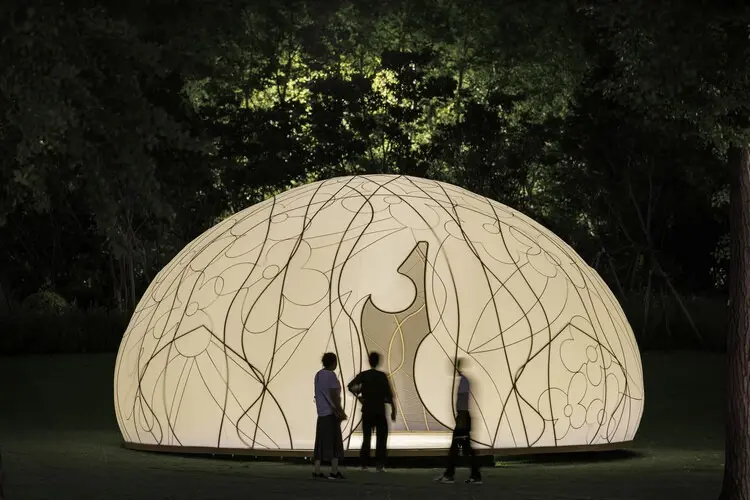
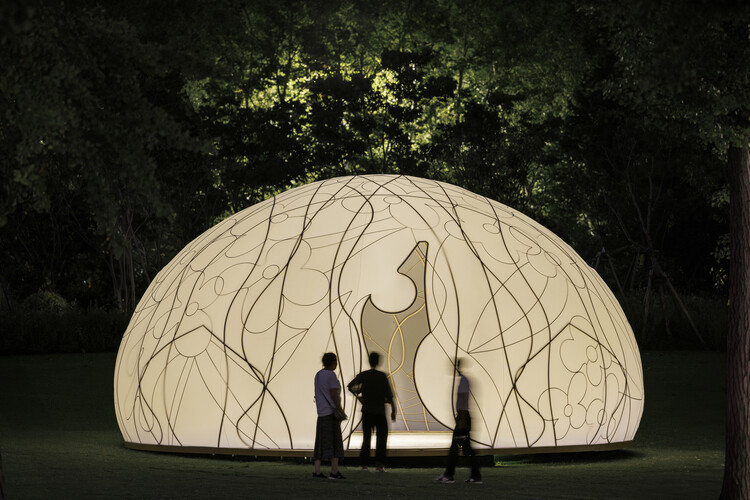
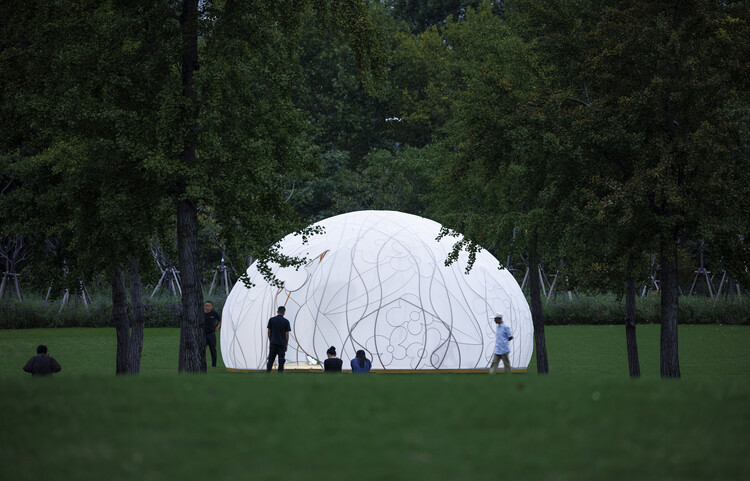
In the contemporary landscape where public architecture frequently prioritizes monolithic permanence, transient pavilions offer a compelling counter-narrative. They operate as spatial interventions that challenge our relationship with time, memory, and cultural geography. "Osmanthus Moon," a striking short-term public art and architectural installation designed by HCCH Studio and curated by Han Shuang, stands at the vanguard of this ephemeral movement. Unveiled to coincide with the traditional Chinese Mid-Autumn Festival, the project occupies a fascinating intersection between modern architectural theory, intangible cultural heritage, and ecological poetics.
At its core, Osmanthus Moon is both a physical structure and a metaphorical projection. It draws deeply from the cultural resonance of the osmanthus flower—an enduring symbol of autumn, olfactory nostalgia, and lunar mythology in East Asia—and weaves it together with the dynamic, expressive action paintings of a folk "Zao Hua" (stove flower) artist. Through this synthesis, HCCH Studio has crafted a temporary urban landmark that transcends its physical footprint, inviting visitors into a multisensory dialogue regarding heritage preservation, contemporary design methodologies, and the fleeting beauty of seasonal transition.
This comprehensive architectural report investigates the genesis, conceptual framework, material execution, and cultural significance of Osmanthus Moon. By examining the collaborative processes between the designers and folk artisans, as well as the project’s broader implications for public art installations, this piece explores how temporary structures can leave permanent impressions on urban consciousness.
Detailed Chronology: From Concept to Ephemeral Realization
The genesis of Osmanthus Moon follows a meticulous trajectory typical of high-concept pavilion architecture, though compressed into the accelerated timelines demanded by seasonal cultural celebrations. Understanding the project requires a close examination of its phased development, from initial ideological sketches to its eventual dismantling.
Phase I: Ideation and Cultural Research (Early Planning Stages)
The conceptual foundation of Osmanthus Moon was laid months before its physical assembly. HCCH Studio initiated the project by engaging in deep ethnographic and historical research centered on the Mid-Autumn Festival. The team recognized that contemporary interpretations of ancient festivals often risk falling into superficial commercialism or overly literal thematic mimicry. To avoid this, the architects sought a deeply layered narrative vehicle.
The osmanthus flower (Osmanthus fragrans) emerged as the primary conceptual anchor. Beyond its autumnal bloom and ubiquitous presence in regional landscapes, the osmanthus is mythologically tied to the moon—specifically the legendary osmanthus tree that grows on the lunar surface, endlessly chopped down and regenerated by the immortal Wu Gang. HCCH Studio aimed to translate this lunar-floral myth into spatial syntax. Concurrently, the studio sought to incorporate the vanishing craft of "Zao Hua" (stove flower painting), a traditional folk art characterized by spontaneous, energetic pigment applications onto kitchen stoves or ritual structures, symbolizing warmth, prosperity, and cyclical renewal.
Phase II: Design Iteration and Materiality Selection
With the conceptual pillars established, HCCH Studio moved into iterative spatial modeling. The challenge lay in creating an installation that could effectively merge the organic, delicate geometry of floral petals with the explosive, performative brushwork of the Zao Hua tradition, all while maintaining structural integrity for a public setting.
Architectural scale models and digital simulations were tested to evaluate how natural light would interact with the structure throughout the day and how artificial lighting could transform its facade by night, mimicking the luminosity of a harvest moon. The material palette was chosen deliberately to reflect both transience and sustainability, ensuring that the temporary intervention would leave minimal ecological impact upon its removal.
Phase III: Fabrication, Artisan Collaboration, and Assembly
The construction phase marked a unique cross-disciplinary collaboration between contemporary architectural fabricators and traditional folk artists. The Zao Hua artist was brought into the design process not merely as a decorator, but as a co-creator whose improvisational action paintings directly informed the spatial flow and textural finishes of the installation.
The assembly on-site was executed under tight temporal constraints, characteristic of festival architecture. Prefabricated modular components allowed for rapid deployment, minimizing disruption to the surrounding public square or cultural park. As the structure took shape, it immediately began drawing public curiosity, functioning as a semi-transparent lantern that bridged the gap between closed construction zones and open civic engagement.
Phase IV: Public Activation, Festival Peak, and Decommissioning
During the peak of the Mid-Autumn Festival, Osmanthus Moon served as a dynamic focal point for community gatherings, cultural performances, and contemplative spatial experiences. Visitors moved through and around the installation, engaging with its tactile surfaces and spatial enclosures.
True to its ephemeral nature, the installation’s lifecycle was designed to be short. Following the conclusion of the festival period, the structure entered its decommissioning phase. The materials were systematically cataloged for recycling or repurposing, ensuring that Osmanthus Moon lived up to the sustainable ethos of modern temporary architecture—vanishing from the physical landscape while remaining etched in the collective memory of its participants.
Supporting Context & Metrics: Architecture of the Ephemeral
To fully appreciate the significance of Osmanthus Moon, one must contextualize it within the broader ecosystem of public art installations and HCCH Studio’s overarching design philosophy.
Architectural Metrics and Specifications
Project Name: Osmanthus Moon
Design Studio: HCCH Studio
Curator: HAN Shuang
Photography: Guowei Liu
Typology: Public Art Installation / Pavilion Architecture
Primary Themes: Ephemeral Architecture, Intangible Cultural Heritage, Seasonal Phenomenology, Folk Art Integration
Primary Cultural References: Traditional Chinese Mid-Autumn Festival, Osmanthus Mythology, Zao Hua (Stove Flower) Action Painting
In architectural discourse, permanence has traditionally been viewed as the ultimate measure of success. From Vitruvius’s foundational tenets—firmness, commodity, and delight—to the monumental stone and steel structures of the 20th century, buildings have been conceived to resist the ravages of time. However, the 21st century has witnessed a profound paradigm shift. Temporary pavilions, pioneered by institutions like the Serpentine Gallery in London and expanded globally through festivals and biennales, offer a radical alternative.
Osmanthus Moon leverages this ephemerality as a core design tool. By acknowledging its own eventual disappearance, the installation frees itself from the burden of long-term weathering, structural aging, and programmatic rigidity. This liberation allows the architects to experiment wildly with lightweight structures, translucent skins, and expressive forms that would be impractical or unviable in permanent civic buildings. The physical structure acts as a temporal lens: because visitors know the pavilion will soon vanish, their psychological engagement is heightened, transforming casual observers into mindful participants.
Bridging the Digital and the Craft
HCCH Studio’s approach in Osmanthus Moon bridges two seemingly contradictory worlds: computational architectural design and raw, unscripted folk art. While modern pavilions often rely heavily on algorithmic precision, parametric modeling, and industrial fabrication, Osmanthus Moon deliberately subverts this cold technocracy by embedding the chaotic, human-centric energy of Zao Hua painting.
The Zao Hua tradition is rooted in improvisation and physical engagement with materials. By translating these energetic action paintings into architectural surfaces, HCCH Studio challenges the dominance of digital flatness. The installation becomes a physical manifestation of brushstrokes—three-dimensionalizing gesture and movement. This integration of intangible cultural heritage into spatial design offers a blueprint for how modern architects can honor local traditions without resorting to pastiche or historical mimicry.
Official Statements and Curatorial Vision
The theoretical framework underpinning Osmanthus Moon is articulated clearly through its creators and curatorial team, highlighting the deliberate choices that shaped its physical manifestation.
Curatorial Intent by HAN Shuang
Curator HAN Shuang emphasized the project’s role as a cultural bridge between ancient myth and modern spatial experience. In framing the installation, Shuang noted that the Mid-Autumn Festival has always been a time of profound emotional resonance regarding familial reunion, distance, and cosmic reflection.
"Traditional festivals require spatial vessels that can capture their emotional and symbolic weight without feeling archaic," the curatorial notes suggest. "Osmanthus Moon was conceived not merely as a decorative backdrop for holiday festivities, but as an active spatial instrument. It projects the cultural memory of the osmanthus—its scent, its color, its lunar associations—into the physical domain, allowing contemporary citizens to physically inhabit a myth."
Design Philosophy from HCCH Studio
The architects at HCCH Studio elaborate on the technical and metaphorical duality of the project, focusing particularly on the dialogue established with the folk Zao Hua artist. Architecture, in their view, is frequently too rigid to capture the spontaneous joy and spiritual warmth of traditional folk celebrations.
By inviting an action painter rooted in intangible cultural heritage to collaborate, HCCH Studio sought to inject a vital, anarchic creative energy into the precision of architectural design.
"We wanted to escape the clean, sterile geometry that often characterizes contemporary installations," HCCH Studio stated in their design narrative. "The collaboration with the Zao Hua artist allowed the building’s skin and spatial rhythm to be dictated by gesture, intuition, and cultural memory. The resulting structure is a projection—both literal and metaphorical—of the osmanthus pattern and the folk artist’s visceral brushwork, creating a dialogue where architecture learns from folk art, and folk art is elevated into spatial experience."
Future Outlook: The Legacy of Temporary Interventions
As cities densify and public spaces become increasingly commodified and sanitized, the role of temporary art installations and pavilions takes on heightened urgency. Projects like Osmanthus Moon point toward several key trajectories for the future of urban design and architectural practice.
Reclaiming Civic Imagination through Ephemerality
Permanent urban infrastructure often moves at a glacial pace, bound by bureaucratic red tape, zoning laws, and massive capital investments. Consequently, cities can struggle to reflect the fluid, evolving identities of their inhabitants. Short-term installations provide a vital release valve for urban creativity. They allow architects, artists, and communities to test radical ideas, question conventional spatial typologies, and temporarily transform underutilized civic spaces into vibrant nodes of cultural exchange.
The success of Osmanthus Moon demonstrates that a project does not need to endure for decades to make a lasting impact. By concentrating intense cultural narratives, artisanal collaboration, and innovative spatial design into a brief window of time, ephemeral architecture can catalyze civic imagination and foster a deeper sense of place.
The Evolution of Intangible Heritage in Architecture
One of the most promising takeaways from HCCH Studio’s work is the sophisticated integration of intangible cultural heritage (ICH) into contemporary design. Too often, efforts to preserve folk traditions result in museological isolation—trapping living arts behind glass or reducing them to commercial tourist spectacles.
Osmanthus Moon offers an alternative paradigm: integration through spatial activation. By translating the performative energy of Zao Hua painting into architectural form, the project validates folk art as a living, evolving discipline capable of conversing with cutting-edge spatial design. Future architects working within culturally rich regions may look to this methodology as a model for preserving heritage not by preserving objects, but by perpetuating creative processes.
Sustainability and Circularity in Temporary Design
As the architectural profession grapples with its massive carbon footprint, the ethics of temporary installations are increasingly scrutinized. Constructing a pavilion only to demolish it weeks later can easily veer into wasteful consumerism unless underpinned by rigorous circular economy principles.
The legacy of Osmanthus Moon and similar vanguard installations highlights the necessity of designing for disassembly from the outset. Future iterations of short-term public art will likely place even greater emphasis on bio-based materials, upcycled components, and zero-waste construction techniques. By proving that ephemeral structures can be culturally profound while maintaining a commitment to ecological sensitivity, HCCH Studio’s project sets a high benchmark for the future of sustainable temporary architecture.
Conclusion
Osmanthus Moon ultimately proves that the most resonant architecture is not always defined by its permanence. By fusing the delicate mythology of the autumn osmanthus with the raw, expressive power of folk action painting, HCCH Studio and curator Han Shuang created a fleeting sanctuary that captured the collective imagination of the public. As cities continue to search for ways to humanize urban space and honor cultural roots in an increasingly homogenized world, the lessons of Osmanthus Moon—collaboration, ephemerality, and poetic cultural projection—will undoubtedly continue to resonate across the architectural landscape.