

Published: September 3, 2026
Author: Moises Carrasco (Adapted and Expanded)
Source: ArchDaily
Executive Overview
Over the past several decades, the relentless expansion of Mexico’s metropolitan areas has triggered profound spatial, social, and environmental transformations. As cities such as Mexico City, Monterrey, Guadalajara, and sprawling peripheral industrial hubs grew exponentially, urban development often outpaced strategic municipal planning. The resulting footprint is characterized by fragmented neighborhoods, pronounced socioeconomic segregation, elevated crime rates in marginalized sectors, and a severe deficit of quality public spaces.
In many low-income urban environments, informal settlements expanded organically alongside raw, heavy infrastructure—such as open drainage canals, active rail lines, and treacherous natural ravines. These infrastructural elements historically functioned as physical and social barriers, isolating communities from one another while creating hazardous, neglected, and crime-prone vacant zones.
In response to this spatial injustice, public agencies, municipal governments, and forward-thinking architectural practices across Mexico have pioneered a paradigm shift. Rather than allowing these abandoned buffer zones to remain scars upon the urban landscape, they are being aggressively reclaimed and converted into vibrant public parks and pedestrian corridors. By transforming physical barriers into accessible, green communal spaces, these architectural interventions successfully rejoin separated neighborhoods, re-establish safe visual sightlines, heal the fragmented urban fabric, and provide essential spaces for daily recreation, ecological mitigation, and community gathering.
Detailed Chronology: The Evolution of Mexico’s Urban Redevelopment Strategy
To understand how Mexico arrived at this contemporary golden age of public space design, it is vital to trace the historical progression of its urban landscapes and the policy shifts that made these park transformations possible.
Phase 1: The Era of Unchecked Expansion (1970s–1990s)
During the late 20th century, rapid industrialization and rural-to-urban migration drove millions of citizens toward Mexico’s major economic centers. Cities swelled outward without the infrastructural backbone required to support sustainable communities. Municipalities prioritized vehicular transit, industrial zoning, and macro-infrastructure (like massive stormwater canals and highways), inadvertently slicing through existing communities. Low-income populations, priced out of formal housing markets, settled on marginal lands adjacent to these industrial corridors, ravines, and infrastructural easements.
Phase 2: The Recognition of Spatial Segregation (2000s–2010s)
By the turn of the millennium, the social costs of unmitigated urban sprawl became painfully clear. Urban theorists, sociologists, and architects began documenting the direct correlation between physical isolation, lack of civic amenities, and rising rates of urban violence. Areas cut off by infrastructure suffered from acute neglect. Municipalities realized that traditional policing and top-down security measures were insufficient without addressing the root cause: the physical degradation and inaccessibility of the built environment.
Phase 3: The Rise of Tactical Urbanism and Social Architecture (2015–2020)
A new wave of Mexican architects began experimenting with low-cost, high-impact interventions. Rather than proposing multi-billion-dollar master plans that could take decades to fund, design firms started working directly with municipal budgets and community stakeholders. They identified "residual land"—leftover slivers of land beneath overpasses, beside drainage easements, and along abandoned railway spurs—and reimagined them as pocket parks, sports courts, and linear pedestrian paths. This era laid the groundwork for institutionalizing public space as a fundamental human right rather than an urban luxury.
Phase 4: Institutionalized Transformation and Macro-Corridors (2020–Present)
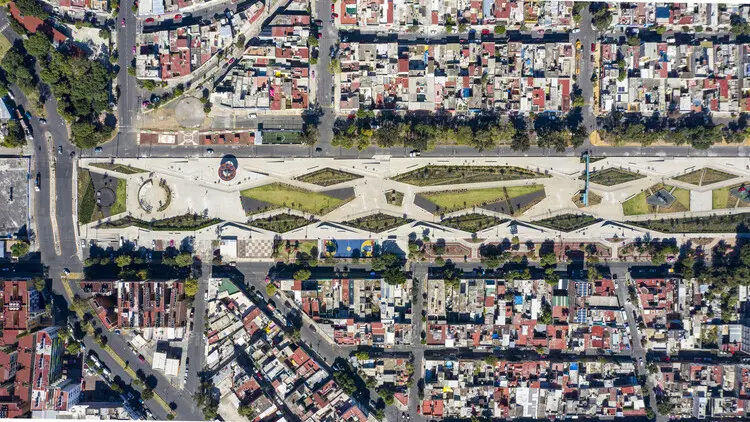
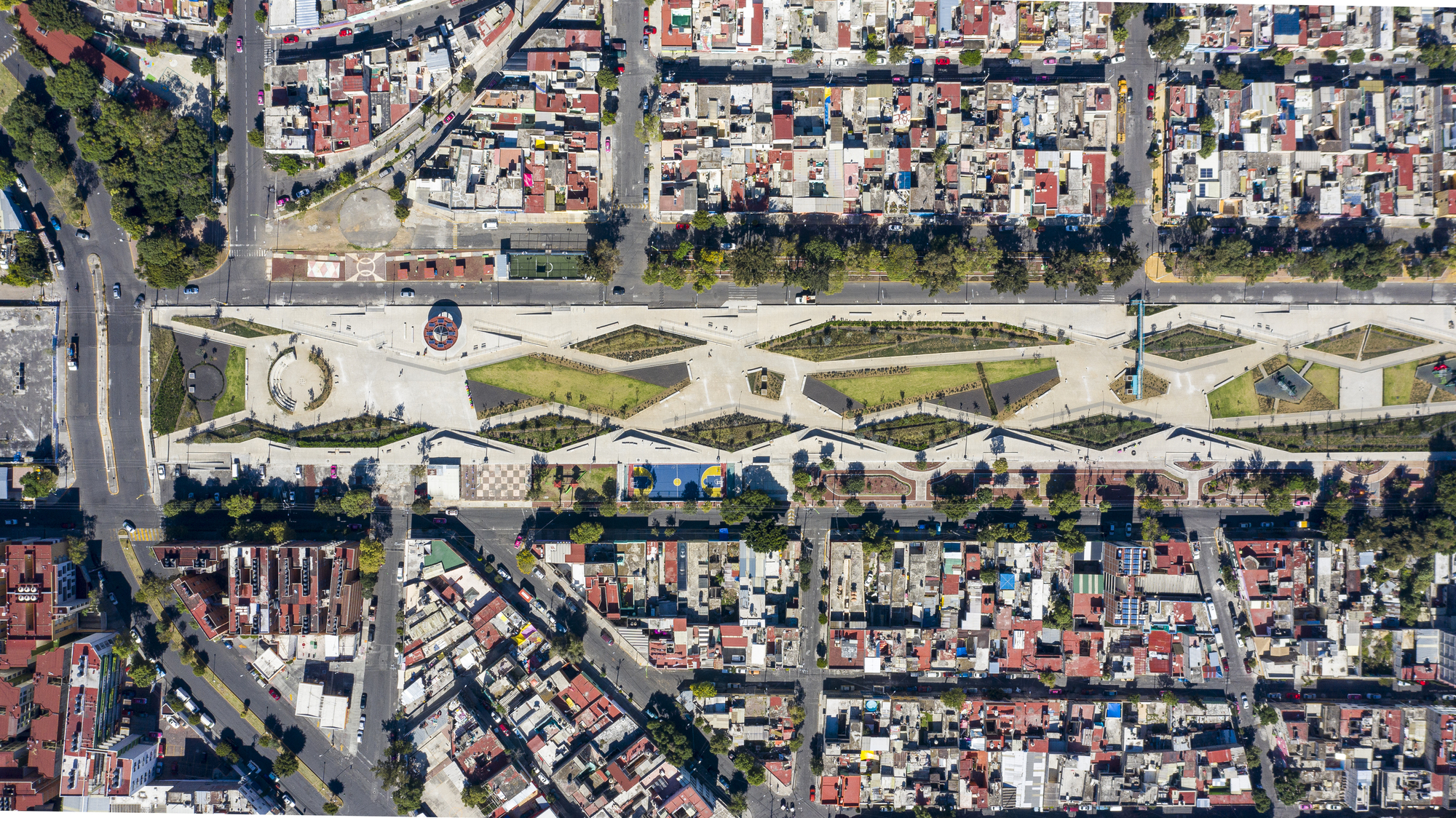
Entering the mid-2020s, these localized experiments matured into large-scale municipal strategies. Projects like the Gran Canal Linear Park and various interventions across the State of Mexico demonstrate how residual land can be systematically woven back into the urban matrix. Architects, landscape designers, and urban planners are now operating under cohesive frameworks that merge ecological restoration, social equity, and climate resilience into singular, long-lasting civic monuments.
Supporting Context & Metrics: Architecture, Materials, and Resilience
Designing public parks in marginalized Mexican neighborhoods presents a unique set of challenges. Beyond securing initial funding, architects must contend with harsh climatic conditions, heavy daily wear, and the chronic risk of municipal maintenance neglect. To ensure that these public investments survive and thrive over decades, designers have perfected a vocabulary of durable, low-cost construction strategies centered on integrally colored concrete, locally sourced aggregates, and robust hardscaping.
The Materiality of Endurance: Integrally Colored Concrete
Poured-in-place concrete has emerged as the definitive material for these urban reclamation projects. Utilized for retaining walls, bleachers, amphitheaters, skate parks, climbing structures, and custom site furniture, concrete provides unmatched structural stability and wear resistance.
Crucially, architects avoid standard gray industrial finishes—which can feel sterile or degrading—in favor of integrally colored concrete tinted with rich earth tones (ochres, deep reds, warm grays, and terracotta hues). This pigmentation is mixed directly into the batch, ensuring that scratches, weathering, and minor impacts do not reveal an underlying contrasting layer. Furthermore, this approach eliminates the need for periodic repainting, dramatically reducing long-term maintenance burdens for cash-strapped local governments.
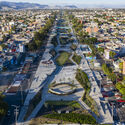
[Residual Infrastructure / Drainage Canal]
       │
       ▼ (Architectural Intervention)
[Integrally Colored Concrete Retainers & Walkways]
       │
       ▼ (Eco-Hydrological Integration)
[Porous Local Gravels & Recycled Tire Walls]
       │
       ▼ (Long-Term Community Impact)
[Safe Civic Corridor & Unified Urban Fabric]
Water Management and Ecological Healing
Many of these residual spaces originated as drainage canals or erosion-prone ravines. Consequently, modern Mexican park designs integrate advanced landscape engineering to manage stormwater runoff and control soil erosion.
- Porous Gravels: Large swaths of impermeable asphalt are replaced with compacted, porous local gravels that allow rainwater to infiltrate the local water table rather than overwhelming aging municipal drainage systems.
- Recycled Elements: Innovative structural systems, such as retaining walls constructed from recycled automobile tires packed with compacted earth, offer low-cost seismic resilience while repurposing waste that would otherwise clog local landfills or waterways.
- Native Flora: Botanical selections emphasize native, drought-resistant xeriscaping that requires minimal irrigation, surviving both severe dry seasons and torrential seasonal downpours.
Universal Accessibility and Passive Surveillance
Safety in these reclaimed zones is achieved through architectural transparency and inclusive design. By eliminating step-free barriers, wide ramps, and open, un-obscured sightlines, these parks facilitate "passive surveillance"—eyes on the street from surrounding homes and passing pedestrians. Well-lit pathways, open plazas, and activated recreational zones naturally deter illicit activities, transforming formerly feared dead-ends into lively neighborhood living rooms.
Official Statements and Design Perspectives
The paradigm shift from neglected residual land to celebrated civic infrastructure has been driven by close collaboration between municipal authorities, urban planning agencies, and Mexico’s vanguard architectural practices.
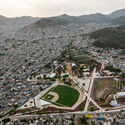
Speaking on the philosophy behind converting industrial buffers into public amenities, prominent urban designers emphasize that public space is the ultimate equalizer in contemporary Latin American cities.
"When a city leaves thousands of square meters of land abandoned beside a drainage canal or rail line, it is signaling to the residents of that neighborhood that their environment holds no value," notes a lead architect from a prominent Mexican urban design collective. "Our intervention is an inversion of that message. By introducing high-quality materials, durable concrete structures, and lush native landscaping, we declare that these communities deserve enduring, beautiful, and dignified civic spaces."
Municipal officials have also echoed the socioeconomic impact of these infrastructural stitches. In metropolitan areas where socioeconomic divides have historically been calcified by physical barriers, linear parks act as social bridges.
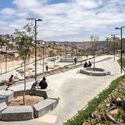
"We are no longer just building parks; we are repairing the torn fabric of our metropolis," states a municipal urban planning director. "These linear corridors allow a child from a previously isolated neighborhood to walk safely to school, allow families to gather on weekends in green surroundings, and provide structural integrity to land that was once hazardous waste."
Furthermore, structural engineers underscore the importance of material honesty and resilience. "In public architecture, if you design something that requires constant maintenance, you are designing its eventual abandonment," explains a structural consultant specializing in municipal civic projects. "By relying on heavy-duty, integrally colored concrete and geotextile stabilization, we build parks that can withstand heavy community use and extreme weather events with grace and minimal upkeep."
Future Outlook: The Next Generation of Mexican Urbanism
As Mexico looks toward the future of its urban centers, the methodology of reclaiming residual land is transitioning from an innovative exception to a standard urban planning blueprint.

Looking ahead, several vital trends are poised to shape the next generation of Mexican public parks:
- Climate-Adaptive Infrastructure: As climate change intensifies weather patterns, future parks will increasingly double as urban retention basins and sponge-city infrastructure, mitigating flood risks while providing recreational utility during dry months.
- Data-Driven Community Co-Design: Municipalities are increasingly utilizing participatory design workshops, leveraging digital mapping and local community engagement to ensure that every reclaimed plot directly serves the specific cultural, recreational, and generational needs of its immediate neighbors.
- Metropolitan Green Networks: Rather than operating as isolated pocket parks, current and future projects are being linked into extensive metropolitan green corridors—connecting peripheral neighborhoods directly to major urban centers via continuous, non-motorized pedestrian and bicycle networks.
Ultimately, the transformation of Mexico’s residual lands into thriving civic places proves that urban constraints can become spatial opportunities. Through rigorous material choices, empathetic design, and a steadfast commitment to social equity, Mexican architects and urban planners are redefining what a modern city can be—proving that even the most neglected remnants of industrial growth can blossom into the beating hearts of vibrant, united communities.



