The global automotive landscape is undergoing its most radical transformation in over a century, and a quiet yet seismic shift is currently rewriting the rules of international trade and energy security. While Western media headlines often fixate on the adoption battles playing out across Europe and North America, a different, highly accelerated electric vehicle (EV) revolution is taking root in Southeast Asia.
Fueled by a combination of aggressive Chinese manufacturing dominance, supportive regional government policies, and an acute energy crisis sparked by geopolitical instability in the Middle East, Southeast Asia has rapidly emerged as one of the most dynamic and vital EV growth markets on the planet.
According to groundbreaking new data released by energy think tank Ember, China’s electric vehicle export engine is operating at an unprecedented scale, shattering previous financial and volume records. In May, China shipped a staggering $9.2 billion worth of electric vehicles overseas—surpassing the previous record of $9.1 billion set just a month prior in April, and marking a monumental 49% surge year-over-year. To put this explosive trajectory into perspective, China’s monthly EV exports were valued at less than $1 billion as recently as 2020.
At the heart of this export tsunami is the Association of Southeast Asian Nations (ASEAN) bloc. In May alone, Chinese EV exports to ASEAN member states touched a historic high of $1.2 billion. Countries like Thailand, the Philippines, Cambodia, and Laos are no longer just passive observers of the global green transition; they are active, eager consumers of affordable, mass-produced electric mobility.
This in-depth report examines the convergence of factors driving this phenomenon, analyzing trade data, localized policy shifts, geopolitical catalysts, and what this accelerating paradigm means for the future of global transportation.
Detailed Chronology: From Niche Market to Export Hegemony
To fully grasp the magnitude of China’s current EV export dominance, one must trace the timeline of how its domestic manufacturing powerhouse transformed into an unstoppable global juggernaut.
The Foundation Years (2018–2020)
For years, China’s massive investments in the EV supply chain—spanning raw material processing, battery cell production, and vehicle assembly—were primarily designed to feed its voracious domestic market. Subsidies, aggressive infrastructure rollouts, and fierce local competition forged domestic champions like BYD, NIO, and XPeng. During this phase, export volumes were marginal. In 2020, total monthly EV exports from China hovered consistently below the $1-billion mark. Chinese brands were largely viewed by Western legacy automakers as localized curiosities rather than international threats.
The Post-Pandemic Breakout (2021–2023)
As global supply chains began to untangle following the COVID-19 pandemic, Chinese automakers found themselves sitting on overcapacity and possessing a distinct technological and cost advantage, particularly in lithium-iron-phosphate (LFP) batteries.
Recognizing that domestic growth would eventually plateau, companies pivoted aggressively toward foreign expansion. European markets were targeted first, followed swiftly by Latin America and Southeast Asia. By late 2023, monthly export values had climbed past $5 billion, establishing a clear upward trajectory that caught legacy western automakers flat-footed.
The Record-Breaking Surge of 2026
The opening months of 2026 have marked an inflection point. In April, China’s monthly EV exports breached a historic psychological barrier, hitting $9.1 billion. Yet, that record stood for barely 30 days. May data revealed an even higher watermark: $9.2 billion in total EV shipments.
During May alone, China exported approximately 448,000 electric passenger vehicles. This total breakdown illustrates a sophisticated product mix tailored to various global markets, comprising roughly 279,000 Battery Electric Vehicles (BEVs) and 169,000 Plug-in Hybrid Electric Vehicles (PHEVs).
Within this broader global surge, Southeast Asia transitioned from a secondary destination to a primary focal point. By May, regional imports of Chinese EVs skyrocketed, with individual nations enacting historic policy measures to clear the runway for electric mobility.
Supporting Context & Metrics: The Numbers Behind the ASEAN Boom
The sheer scale of the Southeast Asian EV transition is best understood through hard metrics. The regional appetite for electric cars is no longer theoretical; it is being measured in hundreds of thousands of units crossing borders every month.
Key Export Metrics at a Glance:
Total May EV Export Value (Global): $9.2 billion (up 49% year-over-year).
Previous Record: $9.1 billion (set in April).
Total May Export Volume: ~448,000 electric passenger vehicles.
BEV vs. PHEV Split: ~279,000 BEVs and ~169,000 PHEVs.
ASEAN Import Value (May): $1.2 billion.
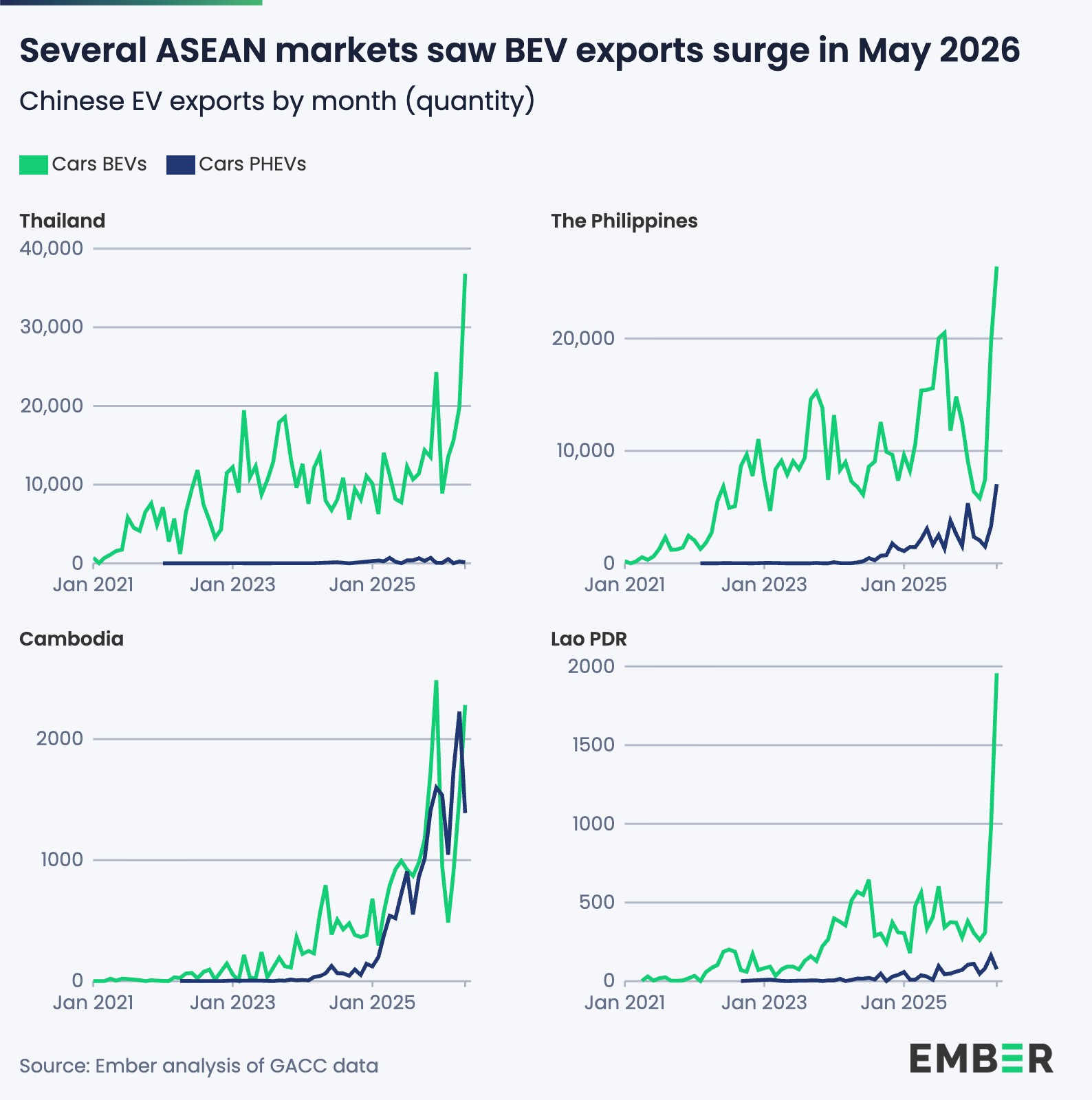
Thailand Lead Volume: Over 36,000 Chinese EVs imported in May alone.
Philippines Volume: Over 33,000 units imported.
Country-Specific Policy and Market Catalysts
1. Thailand: The Regional Manufacturing and Import Hub
Thailand has long been dubbed the "Detroit of Asia" due to its robust internal combustion engine (ICE) vehicle manufacturing base supported by Japanese automakers. However, Bangkok has aggressively pivoted to embrace electrification. In May, Thailand imported more than 36,000 Chinese EVs, serving as the crown jewel of ASEAN’s adoption curve. Through a mix of consumer subsidies (known as the EV 3.5 package) and demands for local manufacturing commitments, Thailand is successfully enticing Chinese giants like BYD, GAC Aion, and Changan to set up massive local assembly plants.
2. The Philippines: A Rapidly Scaling Archipelago
Trailing closely behind Thailand, the Philippines imported more than 33,000 Chinese electric vehicles in May. Driven by soaring urban congestion, high fuel costs, and progressive government executive orders mandating government fleet electrification, Filipino consumers are increasingly turning to affordable Chinese BEVs and compact city EVs.
3. Cambodia: Zero-Tariff Incentives
Cambodia has taken some of the most aggressive legislative steps in the region to attract clean transportation. In late March, the Cambodian government enacted a policy cutting customs duties on BEVs entirely to zero, while slashing tariffs on PHEVs from 35% down to just 7%. While BEVs continue to dominate the influx of Chinese vehicles entering Phnom Penh and other urban centers, the lowered PHEV tariffs have successfully spurred secondary market growth. Furthermore, the government is actively courting foreign direct investment to establish local component assembly lines.
4. Laos: Fleet Mandates and Fossil Fuel Bans
Laos represents one of the most fascinating case studies in rapid state-mandated energy transition. Vientiane has slashed EV registration and service fees to stimulate private adoption. More importantly, the Laotian government introduced a stringent mandate requiring all commercial transportation companies to ensure that EVs comprise at least 10% of their operational fleets by the end of 2026.
In a radical move in May, Laos went a step further by temporarily banning the import of traditional internal combustion engine (ICE) cars through the remainder of the year. The explicit goal is to curb the nation’s heavy economic dependence on imported fossil fuels. Analysts expect the compounding effects of these policies to dramatically reshape the country’s vehicular landscape over the next 24 months.
Official Statements & Industry Analysis
The confluence of trade data and grassroots policy changes has drawn intense scrutiny from energy analysts worldwide. Experts point out that the current transition is being supercharged by external macroeconomic shocks, chief among them being energy market volatility.
According to Ember, soaring global fuel prices—exacerbated significantly by ongoing conflicts and instability in the Middle East—have acted as an unexpected accelerator for Southeast Asia’s electric vehicle adoption. Consumers and governments alike are realizing that relying on imported petroleum leaves national economies dangerously exposed to global supply chain shocks.
"The current energy crisis has reinforced the value of electrification as a pathway to greater energy security, reduced fuel import exposure, and long-term transport cost savings," noted Lam Pham, Ember’s energy analyst for Asia.
Pham’s insights underscore a fundamental shift in mindset: electric mobility in developing Asian economies is no longer viewed merely as an environmental luxury or a carbon-reduction tool, but as a fundamental pillar of national economic defense and energy independence.
Echoing this sentiment, Euan Graham, Ember’s senior electricity and data analyst, emphasized the speed and scale of the transformation currently underway:
"Southeast Asia is fast becoming one of the most dynamic destinations for electric vehicles, and China is supplying that demand at scale and speed."
Industry observers note that Chinese automakers have successfully deployed a playbook combining extreme affordability with localized market adaptation. Unlike Western automakers, who initially focused on high-margin, premium electric SUVs for affluent European and American buyers, Chinese manufacturers engineered low-cost, right-hand-drive city cars, affordable hatchbacks, and versatile crossovers that fit the urban and economic realities of Southeast Asian cities.
Future Outlook: The Road Ahead for Global and Regional EV Markets
As we look toward the remainder of 2026 and beyond, the trajectory of Southeast Asia’s EV market points toward even greater integration with Chinese industrial supply chains.
1. Localization and Manufacturing Hubs
The phase of purely exporting built-up vehicles (CBU) from Chinese ports to ASEAN destinations is gradually evolving. To circumvent potential trade friction, tariffs, and to secure long-term market access, Chinese original equipment manufacturers (OEMs) are pouring billions of dollars into local factories across Thailand, Indonesia, and Malaysia. By 2027 and 2028, a significant percentage of "Chinese EVs" sold in Southeast Asia will actually bear "Made in Thailand" or "Made in Indonesia" badges.
2. Infrastructure Expansion and Grid Readiness
The explosive influx of hundreds of thousands of new EVs into nations like Thailand, the Philippines, and Laos places immense pressure on local power grids. The future outlook will depend heavily on how quickly these governments can scale up charging infrastructure—particularly DC fast-charging networks along major economic corridors—and integrate renewable energy generation to ensure that the electricity powering these vehicles is as green as the tailpipe emissions are absent.
3. Geopolitical Ripple Effects
While Western nations continue to construct protectionist walls—such as steep tariff barriers and trade investigations implemented by the United States and the European Union—Southeast Asia is charting an opposite course by keeping its doors open to affordable green technology. This divergence is creating a two-speed global EV economy: a protectionist West grappling with affordability hurdles, and a hyper-dynamic, rapidly electrifying Global South powered by Chinese industrial prowess.
Electrek’s Take
Southeast Asia often receives a fraction of the media and analytical attention dedicated to Europe, the United States, or China when global EV growth milestones are discussed. However, this oversight ignores reality. Southeast Asia is rapidly evolving into one of the most critical and fast-moving EV growth markets on Earth.
Chinese automakers have seized this opportunity by deploying aggressive pricing strategies, forming strategic local manufacturing partnerships, and aligning perfectly with regional government incentives. When paired with the severe energy crises sparked by Middle East instability, Southeast Asian EV adoption has been pushed into overdrive.
The record-breaking export numbers out of China are not a temporary anomaly; they are the new baseline. And as Southeast Asia races to electrify its roadways, it is cementing its place as an indispensable engine of the global green transition.