In what is rapidly unfolding as one of the deadliest climate-induced humanitarian disasters in recent Himalayan history, rescue operations are desperately racing against time to locate nearly 1,400 people still unaccounted for following a cataclysmic flash flood. The disaster struck the rugged border region between Nepal and the Tibet Autonomous Region of China with terrifying velocity, obliterating entire mountain communities, reducing critical infrastructure to rubble, and leaving at least 270 people dead.
The disaster was triggered when a massive landslide of ice and rock collapsed into the Lhende River, roughly 12 miles northeast of the crucial Rasuwagadhi border crossing. The resulting debris-laden torrent—a towering wall of mud, boulders, and churning water—thundered down remote valleys with little to no warning. Entire villages, hydroelectric infrastructure, and crucial mountain passages were swept away within minutes.
Compounding the crisis is the staggering international footprint of the victims. Among the missing are hundreds of foreign nationals—including tourists, trekkers, and pilgrims undertaking the revered high-altitude journey to Kailash Mansarovar—hailing from India, the United States, the United Kingdom, Australia, Canada, Singapore, and Russia. With nearly 40 kilometers (25 miles) of mountain roads obliterated and dozens of vital bridges destroyed, rescue missions have been severely bottlenecked, leaving international governments scrambling to coordinate relief efforts and families desperate for news from the blackout zones.
Detailed Chronology: The Anatomy of a Mountain Catastrophe
The Strike: Wednesday’s Sudden Deluge
The disaster began unspooling without warning on Wednesday. Initial reports from regional officials suggested that a moderate earthquake might have destabilized the landscape, but the US Geological Survey (USGS) later clarified that no tectonic seismic event had occurred. Instead, what seismographs recorded as a 4.4-magnitude shockwave was entirely generated by the catastrophic mechanical failure of a glacial wall—a massive collapse of ice, rock, and moraine into the Lhende River watershed.
The impact was instantaneous. Satellite analysis from Planet Labs confirmed that the resulting debris flow functioned as a geological battering ram. As the torrent rushed downstream toward the Rasuwa, Nuwakot, and Dhading districts of Nepal, it gathered massive momentum.
Eyewitness accounts paint a picture of sudden, apocalyptic terror. Bibek Kumal, a laborer working downstream in the hard-hit Rasuwa district, recounted the moments before the flood hit:
"I started running. Then a wall of water came thundering down as if it was an earthquake."
Swept into the churning mix of mud and debris, Kumal survived only by a stroke of extraordinary fortune, managing to leap and cling to a towering mango tree as the floodwaters surged past him. "Had there been no mango tree, I would have been washed away to death," he said from his hospital bed.
In Tibet, the devastation was similarly absolute. Chinese state media reported that a massive mudslide obliterated a major border crossing, burying vehicle convoys and sparking immediate fears of major casualties in high-altitude outposts.
The Immediate Aftermath and Rescue Operations
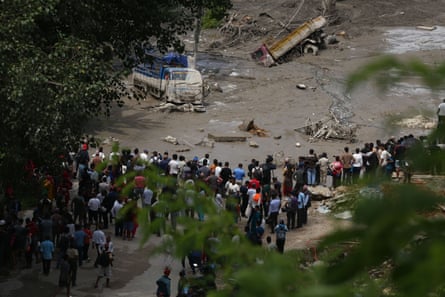
By Thursday morning, the physical scale of the devastation became apparent. Entire villages, such as Soley in Nuwakot—which once comprised approximately 25 homes—were wiped entirely off the map, reduced to barren tracts of grey silt and upturned timber.
Because the hydroelectric grid supplying the region was completely destroyed, the disaster zone was plunged into total darkness. In Nuwakot and Dhading, desperate crowds gathered outside a heavily guarded Nepali army training center, which had been converted into the central staging ground for helicopter rescue operations. Operating by the meager illumination of mobile phone torches, police officers logged the names of the missing in ledger books as families clamored for updates that rarely came.
Nirajan Paudyal, a Kathmandu-based journalist whose parents and relatives lived in the obliterated village of Soley, traveled to the disaster zone on Thursday morning in a desperate search for answers. Standing outside the military barracks, his voice heavy with dread, he told reporters:
"There is no update till now. I fear there won’t be any update."
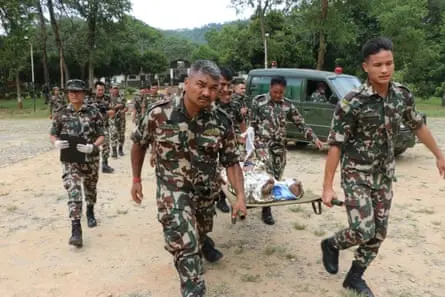
Rescue operations have faced immense hurdles. Because ground access is virtually non-existent due to washed-out highways and collapsed bridges, the Nepali army and international teams have relied almost exclusively on a fleet of helicopters. By Thursday afternoon, more than 100 survivors had been airlifted from isolated pockets, while dozens of critically injured individuals were flown directly to Kathmandu for advanced trauma care. Shockingly, search teams reported finding bodies hundreds of miles downstream in Nepal’s flat Chitwan district, carried far from the high-altitude peaks by the unrelenting currents.
Supporting Context & Metrics
The human and logistical toll of the disaster is staggering. Below is a breakdown of the available data regarding casualties, missing persons, and infrastructure damage as of the latest official tallies:
Casualty and Missing Persons Breakdown
Confirmed Fatalities: At least 270 bodies recovered on the Nepal side; 3 confirmed dead in Tibet.
Total Missing (Combined): Nearly 1,400 people.
Missing in Nepal: 826 individuals, of whom nearly 600 are foreign nationals.
India: 177 missing
United States: 63 missing
Australia: 34 missing
United Kingdom: 33 missing
Canada: 25 missing
Missing in Tibet (China): At least 558 individuals reported missing by state media, including at least 260 foreign nationals.
Commercial Tour Impact: Prominent tour operator Himalayan Glacier reported that 47 people—including two children—from a single expedition group remain unaccounted for, comprising tourists from Australia, Canada, Nepal, the US, Britain, Singapore, and Russia.
Infrastructure and Environmental Metrics
Road Infrastructure: Approximately 40 kilometers (25 miles) of vital mountain highways severely damaged or entirely washed away.
Bridges: Dozens of suspension and concrete bridges destroyed, cutting off remote valleys and trekking routes.
Emergency Deployment (Tibet): Approximately 800 emergency personnel, 150 vehicles, sniffer dogs, and specialized speedboats deployed by Chinese authorities.
Geographic Origin: The Lhende River valley, approximately 12 miles (20 km) northeast of the Rasuwagadhi border crossing.
Official Statements and Global Response
As the scale of the tragedy transcended national borders, world leaders and international humanitarian organizations mobilized rapidly to offer aid, financial assistance, and logistical support.
United Nations Secretary-General António Guterres issued a formal statement expressing deep sorrow over the loss of life and confirming that UN agencies and humanitarian partners are actively mobilizing emergency supplies, medical personnel, and shelter kits to support impacted communities.
The United States government announced an initial emergency assistance package of $500,000 to aid rescue and relief operations in Nepal. Meanwhile, Chinese Premier Li Qiang traveled personally to the China-Nepal border region on Thursday to oversee the search-and-rescue efforts being conducted by the Tibet Autonomous Region government.
Australian Prime Minister Anthony Albanese addressed the nation regarding the dozens of Australian citizens missing in the flood zones. He expressed profound solidarity with families awaiting news, noting that the sheer destruction of communication lines and transport links continues to make the verification of survivors extraordinarily difficult.
David Fisher, head of the Nepal delegation for the International Federation of the Red Cross (IFRC), painted a grim picture of the operational reality on the ground:
"Entire villages and market areas have been wiped out. The power, volume, and speed of the surging waters gave little time for anyone to flee."
Future Outlook: Vulnerability in a Changing Climate
While immediate efforts remain intensely focused on search, rescue, and the identification of the dead, the disaster has ignited urgent conversations among geologists, climate scientists, and regional policymakers about the long-term safety of human habitation and tourism in the greater Himalayas.
The region is increasingly recognized as a climate-change hotspot. As global temperatures rise, high-altitude glacial systems—historically stable reservoirs of ice and rock—are becoming dangerously destabilized. The sudden collapse of glacial walls, lakes, and moraines can trigger catastrophic Glacial Lake Outburst Floods (GLOFs) or massive debris flows with virtually no advance warning.
Furthermore, the economic and social fallout for Nepal and Tibet will be long-lasting. Mountain tourism, trekking expeditions, and spiritual pilgrimages—such as the sacred journey to Mount Kailash—form the lifeblood of the local economy. With vital highways fractured, hydroelectric plants destroyed, and confidence shaken, regional tourism is facing an unprecedented crisis.
For the families of the missing, the immediate future is defined by agonizing uncertainty. As rescue workers continue to comb through thick layers of mud, debris, and downstream riverbanks, the international community watches and waits, mourning a disaster that underscores both the majestic beauty and the unforgiving power of the world’s highest mountain range.