Executive Overview
In a decision of historical proportion for environmental jurisprudence and indigenous rights across the Global South, the Constitutional Court of South Africa—the nation’s highest judicial authority—has formally revoked the offshore oil and gas exploration rights granted to energy giant Shell and its local partner, Impact Africa (a subsidiary of Impact Oil & Gas). The landmark ruling brings a definitive conclusion to a fierce, five-year legal struggle waged by coastal indigenous communities, artisanal fishers, and a coalition of non-governmental organizations.
The court ruled that the initial granting and subsequent renewals of Exploration Right 12/3/252—which encompassed a vast 6,000-square-kilometer swath of South Africa’s pristine East Coast, known as the Wild Coast—were unlawful and unconstitutional. Central to the judiciary’s decision was the finding that the energy consortium and South Africa’s Department of Mineral Resources and Energy (DMRE) systematically failed to execute meaningful public consultation with affected coastal communities. Furthermore, the court emphasized that the state and corporate entities overlooked critical duties under environmental management legislation, neglecting to properly evaluate potential harm to local livelihoods, marine ecosystems, cultural and spiritual rights, and global climate stability.
Crucially, the Constitutional Court explicitly cited the recent landmark advisory opinion from the International Court of Justice (ICJ), reinforcing the principle that sovereign states possess an unequivocal duty under international law to prevent climate degradation and protect marine biodiversity. By declaring climate change a transboundary threat that supersedes national commercial interests, the judgment establishes a powerful legal precedent: corporate investments in fossil fuel extraction can no longer bypass rigorous community consent and comprehensive environmental risk assessments.
Detailed Chronology: The Five-Year Legal Battle
+-----------------------------------------------------------------------------------+
| CHRONOLOGY OF THE WILD COAST LEGAL STRUGGLE                                      |
+-----------------------------------------------------------------------------------+
| 2014–2021 | Exploration Right 12/3/252 secretly awarded and renewed by DMRE.      |
| Nov 2021  | Shell announces imminent start of 3D seismic surveys off the Wild Coast. |
| Dec 2021  | High Court in Makhanda issues urgent interdict, halting airgun blasts. |
| Sep 2022  | Eastern Cape High Court strikes down exploration right as unlawful.     |
| 2023–2024 | Shell & DMRE exhaust appeals; case elevates to Constitutional Court.  |
| Present   | Constitutional Court delivers final verdict, stripping exploration permit.|
+-----------------------------------------------------------------------------------+
The Origins and Secretive Grants (2014–2021)
The origin of the conflict traces back to 2014, when the Department of Mineral Resources and Energy quietly granted Exploration Right 12/3/252 to Impact Africa. Over the subsequent seven years, the exploration permit was renewed twice without substantive public notification or consultation with the indigenous communities residing along the Eastern Cape coastline. Shell later acquired a 50 percent operating interest in the permit, intending to tap into what fossil fuel analysts speculated could be vast deepwater hydrocarbon reserves off the South African continent.
Public Awakening and Massive Mobilization (Late 2021)
The dispute broke into public visibility in November 2021, when Shell announced its intention to commence a major 3D seismic survey along the Wild Coast. The operation involved a specialized vessel dragging arrays of high-decibel airguns through the ocean, firing pressurized acoustic blasts toward the seabed every ten seconds, 24 hours a day, for months.
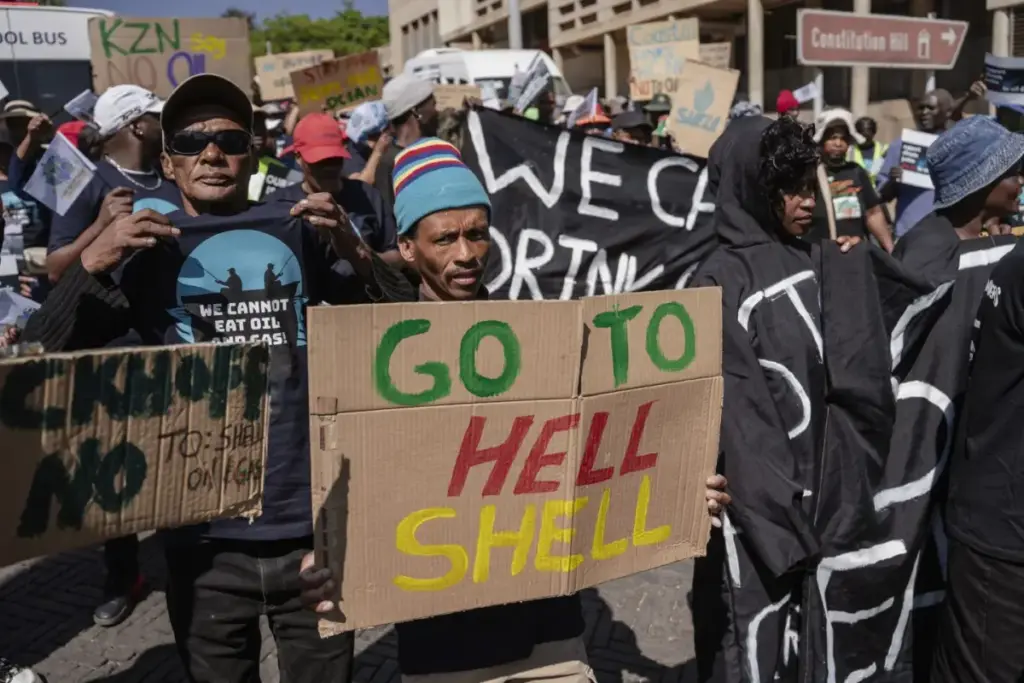
The announcement triggered unprecedented nationwide outrage. Thousands of South Africans gathered on beaches, while civil society groups—led by Sustaining the Wild Coast (SWC), Natural Justice, Greenpeace Africa, and the Dwesa-Cwebe Communal Property Association—joined forces with local traditional leaders and artisanal fishers to challenge the energy major in court.
The Makhanda High Court Interdict (December 2021)
In December 2021, the legal team representing the communities secured a dramatic victory in the Makhanda High Court. Judge Richard Bloem granted an urgent interdict ordering Shell to immediately cease all seismic testing operations. The court found that Shell had failed to adequately inform and consult the communities who held deep ancestral and economic ties to the sea, and recognized the threat of "irreparable harm" to marine life.
The Full Bench Ruling and Appeals (2022–2024)
In September 2022, a full bench of the Eastern Cape High Court went further, setting aside the exploration right in its entirety. Judge President Selby Mbenenge ruled that the decision-making process by Minister of Mineral Resources and Energy Gwede Mantashe was tainted by procedural unfairness, as affected communities were never given a voice.
Refusing to concede, Shell, Impact Africa, and the DMRE launched a series of appeals, seeking to preserve the exploration permit or obtain judicial permission to retroactively "cure" the consultation defects through a refreshed public participation process. The legal battle escalated to the Supreme Court of Appeal and ultimately reached the bench of the Constitutional Court in Johannesburg.
The Final Verdict
The Constitutional Court dismissed the arguments presented by Shell and the state. The justices affirmed that procedural defects of this magnitude could not be retroactively patched up without undermining the fundamental principles of administrative justice and administrative law. The court officially declared the initial exploration permit null and void, permanently barring Shell from conducting seismic surveys under the disputed right.
Supporting Context & Metrics
The Biological and Socio-Cultural Value of the Wild Coast
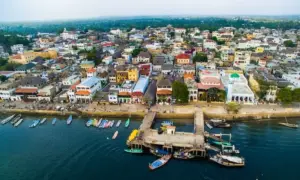
The Wild Coast is recognized globally as an ecological treasure and an area of high marine endemism. Stretching over 300 kilometers, its coastal waters contain several Marine Protected Areas (MPAs), including the Pondoland MPA, and serve as vital biological corridors for marine megafauna.
+----------------------------------------------------------------------------------+
| WILD COAST ECOLOGICAL & SOCIO-ECONOMIC METRICS                                  |
+----------------------------------------------------------------------------------+
| Coastline Span Covered by Permit | ~6,000 km²                                    |
| Marine Protected Areas Impacted  | Pondoland MPA, Dwesa-Cwebe Marine Reserve     |
| Vulnerable Species Affected      | Humpback whales, Southern Right whales,       |
|                                  | Loggerhead & Leatherback turtles, Coelacanths|
| Acoustic Intensity of Airguns    | Exceeding 220 decibels at source              |
| Livelihoods Directly Dependent   | >100,000 artisanal fishers & eco-tourism staff |
+----------------------------------------------------------------------------------+- Acoustic Disturbance: 3D seismic surveys generate low-frequency acoustic pulses that can travel hundreds of kilometers underwater. Marine biologists provided evidence demonstrating that these blasts cause severe physical trauma to marine mammals, disrupt whale communication and navigation, cause mass strandings, and destroy zooplankton populations—the foundation of the marine food web.
- Indigenous Heritage (Lwandle): For the indigenous AmaMpondo and Xhosa communities along the Wild Coast, the ocean—referred to locally as Lwandle—is not merely an economic resource; it is a sacred cultural realm inhabited by ancestors. The court recognized that failing to consult these communities violated their constitutional rights to cultural practice and spiritual heritage under Section 30 and 31 of the South African Constitution.
- Socio-Economic Dependence: More than 100,000 households along the Wild Coast rely on sustainable artisanal fishing, harvesting, and community-led eco-tourism. Industrial hydrocarbon exploration presented an existential threat to these local micro-economies.
International Legal Framework and Climate Precedents
A decisive aspect of the Constitutional Court’s ruling was its explicit integration of international climate law into South African constitutional interpretation. The court drew directly from the International Court of Justice’s 2024 landmark advisory opinion on state responsibilities regarding climate change.
                  +----------------------------------------------+
                  |    Constitutional Court Framework for        |
                  |     Offshore Resource Governance             |
                  +----------------------------------------------+
                                         |
         +-------------------------------+-------------------------------+
         |                               |                               |
         v                               v                               v
+------------------+           +-------------------+           +-------------------+
|  Procedural      |           |  Socio-Cultural   |           | International     |
|  Justice         |           |  Rights           |           | Climate Duties    |
|                  |           |                   |           |                   |
| Mandatory FPIC   |           | Protection of     |           | Compliance with   |
| (Free, Prior &   |           | indigenous custom |           | ICJ Advisory      |
| Informed Consent)|           | and livelihoods   |           | Opinions on GHG   |
+------------------+           +-------------------+           +-------------------+
The judges observed that climate change is inherently transboundary. Consequently, national regulators are legally obligated under Section 24 of the South African Constitution (the right to an environment that is not harmful to health or well-being) to evaluate the cumulative greenhouse gas emissions that would result from commercializing deepwater oil and gas fields before granting initial exploration rights.
Official Statements
Voice of the Communities
Siyabonga Ndovela, an East Coast community member, environmental activist, and co-applicant in the suit, expressed deep emotion following the delivery of the judgment:
"Today’s judgment makes me feel very happy and proud that the ocean is not for profit for mining companies. For years, big corporations thought they could walk over us because we live in rural coastal villages. This judgment proves that our ocean, our culture, and our livelihoods are sacred and cannot be bought or destroyed by oil companies."
Youth and local leaders across Pondoland celebrated the verdict as an affirmation of their right to self-determination and local stewardship over their ancestral waters.
Legal Representatives and Civil Society Campaigners
Non-profit environmental law organization Natural Justice, which co-represented the communities alongside the Legal Resources Centre (LRC), hailed the decision as a decisive moment for environmental accountability across the African continent.
A senior legal practitioner representing the applicants noted:
"The Constitutional Court has sent an unequivocal signal to energy majors worldwide: the era of top-down, opaque extraction in Africa is over. Corporate entities can no longer view public consultation as a mere tick-box exercise. True consultation requires respecting the right of local communities to give or withhold their Free, Prior, and Informed Consent."
Greenpeace Africa, whose activists mobilized thousands of signatures and organized global protests targeting Shell’s corporate headquarters, framed the victory in the context of the broader global energy transition:
"This is a extraordinary triumph for people power and climate justice. At a moment when the world must aggressively transition away from fossil fuels, Shell’s attempt to open up new hydrocarbon frontiers in pristine ocean waters was climate madness. South Africa’s courts have shown that environmental protection and human rights must prevail over corporate profits."
Corporate and Government Responses
Responding to the final ruling, a spokesperson for Shell stated that the company respects the decision of South Africa’s Constitutional Court, adding:
"Shell respects the judgment of the Constitutional Court. We will carefully study the full text of the ruling to determine our future strategy and options regarding our offshore interests in South Africa."
The Department of Mineral Resources and Energy, led by Minister Gwede Mantashe—who had previously characterized anti-fossil fuel litigation as "apartheid of a special type" hindering economic development—acknowledged the court’s final directive, stating that government departments would adjust administrative procedures to comply with the judicial standards set for public engagement and environmental impact evaluations.
Future Outlook
Redefining African Resource Governance
The Constitutional Court’s decision sets a monumental precedent for resource governance across the African continent. As western energy firms actively seek new frontier oil and gas deepwater plays off the coastlines of West, Southern, and East Africa, the Wild Coast legal victory provides a repeatable legal playbook for frontline communities challenging non-consensual extractive projects.
+----------------------------------------------------------------------------------+
| STRATEGIC IMPLICATIONS OF THE RULING FOR FUTURE PROJECT DEVELOPMENTS             |
+----------------------------------------------------------------------------------+
| 1. High Legal Risk for Non-Consensual Exploration                                |
|    Fossil fuel developers face invalidation of permits if consultation falls short.|
|                                                                                  |
| 2. Mandatory Scope 3 Emissions Assessments                                       |
|    EIAs must incorporate full lifecycle climate impacts before drilling begins.  |
|                                                                                  |
| 3. Strengthening Indigenous Veto Power                                           |
|    Adherence to Free, Prior, and Informed Consent (FPIC) becomes a binding norm.  |
|                                                                                  |
| 4. Acceleration of Renewable Energy Capital                                      |
|    Regulatory risk may redirect foreign investment toward solar, wind, and storage. |
+----------------------------------------------------------------------------------+
Institutionalization of FPIC and Climate Litigation
Moving forward, project developers across Africa will face far higher legal barriers. Environmental Impact Assessments (EIAs) will no longer be able to isolate exploration activities from downstream exploitation and global combustion impacts. Environmental lawyers anticipate that future regulatory applications in South Africa will be vulnerable to legal challenge unless they comprehensively incorporate:
- Scope 1, Scope 2, and Scope 3 greenhouse gas assessments.
- Multi-generational impact analyses on indigenous heritage and coastal economies.
- Broad-based, culturally appropriate public participation conducted in local languages.
Economic and Energy Policy Alignment
The decision lands in the middle of South Africa’s ongoing national debate surrounding energy security and the "Just Energy Transition." While the government has argued that developing domestic natural gas reserves is necessary to stabilize the national grid and offset coal plant retirements, environmental economists argue that locking capital into deepwater fossil fuel infrastructure poses financial stranding risks.
By legally constraining offshore oil and gas developments, the ruling creates strong incentives for the South African government and international investors to pivot focus toward the nation’s exceptional renewable energy potential. South Africa’s abundant solar and wind resources, paired with green hydrogen initiatives, offer a path toward energy security that aligns with both domestic constitutional obligations and global climate commitments.
Ultimately, the Wild Coast judgment cements a transformative reality: the sustainable protection of ocean ecosystems, indigenous heritage, and global climate balance are now legally recognized as non-negotiable foundations of economic development.