
Executive Overview
When modern society contemplates the concept of stress, the imagination typically gravitates toward monumental, life-altering catalysts—relocating across the country, navigating a profound professional transition, managing a tumultuous relationship, or enduring a traumatic loss. These are the "Capital-S" stress events that captivate popular culture, literature, and clinical psychology alike. However, this narrow definition of stress overlooks a more insidious, pervasive modern phenomenon: the daily accumulation of micro-stressors.
Our autonomic nervous systems do not reserve their acute survival responses—such as the rapid release of cortisol and adrenaline—solely for monumental crises. Instead, the human body reacts identically to the relentless, low-grade friction of ordinary existence: a rapidly overflowing email inbox, a grueling sequence of back-to-back virtual meetings without a moment for biological recovery, unexpected gridlock traffic when racing against a rigid schedule, and the ceaseless, vibrating cadence of smartphone notifications.
According to insights compiled by registered dietitian nutritionist and supplements editor Molly Knudsen, M.S., RDN, these micro-moments of friction repeatedly trigger the body’s acute stress pathways throughout the day. Left unchecked, the cumulative toll of these unmitigated micro-stressors leads to chronic physical tension, mental fatigue, emotional depletion, and cognitive fog.
Fortunately, breaking this cycle does not necessitate abandoning daily responsibilities for a weeklong wellness retreat or attempting a grueling, hour-long meditation session. Rather, emerging clinical protocols emphasize the profound efficacy of immediate, micro-dose interventions. By deploying a streamlined, three-step reset protocol—incorporating breathwork, targeted functional hydration, and evidence-based adaptogens such as Sensoril® ashwagandha and L-theanine—individuals can successfully interrupt the physiological stress cascade in real-time, preserving both cognitive performance and long-term well-being.
Detailed Chronology: The Evolution of Stress in the Digital Age
To understand why contemporary populations feel perpetually overwhelmed, one must examine how the human stress response evolved alongside our modern technological and professional landscapes.
The Evolutionary Imperative of Stress
Historically, the human stress response functioned as an exquisite, highly sophisticated survival mechanism. When our ancestral populations perceived an immediate physical threat—such as a predatory animal or a hostile rival tribe—the amygdala signaled the hypothalamus, triggering the sympathetic nervous system and the hypothalamic-pituitary-adrenal (HPA) axis. This cascade released crucial survival hormones, primarily cortisol and epinephrine, within milliseconds.
The physiological consequences were precise: heart rate accelerated, airways dilated, glucose flooded the bloodstream, and non-essential functions like digestion temporarily paused. This acute mobilization rendered the individual faster, stronger, and hyper-vigilant. Crucially, this response was designed to be transient. Once the physical threat was neutralized or escaped, the parasympathetic nervous system—the "rest and digest" branch—activated, returning the body to baseline homeostasis.
The Shift to Chronic, Inescapable Micro-Friction
In the twenty-first century, however, the fundamental nature of the threat landscape has inverted. Physical predators have been replaced by digital demands. The human brain interprets an urgent ping from a corporate messaging platform or an aggressive deadline from a supervisor through the exact same evolutionary circuitry that once anticipated a life-or-death encounter.

The critical pathology of modern stress is not the intensity of the reaction, but its chronicity. Unlike ancestral stressors, which demanded physical exertion and were followed by periods of relative safety, modern micro-stressors are continuous and inescapable.
- Phase 1: Morning Activation. The individual wakes up, immediately checks notifications, and encounters a backlog of messages, setting off an early morning cortisol spike before feet even touch the floor.
- Phase 2: Midday Accumulation. As the morning progresses, back-to-back meetings, shifting project parameters, and minor logistical obstacles sustain an elevated HPA axis output. The body is denied the physiological pause required to clear circulating cortisol.
- Phase 3: Evening Depletion. By the time the workday concludes, the cumulative friction of hundreds of micro-stressors leaves the central nervous system exhausted, yet strangely wired—making restorative sleep difficult to achieve and cementing a continuous cycle of physiological wear and tear.
Supporting Context & Metrics: The Science of the HPA Axis and Cortisol
To combat micro-stress effectively, health practitioners look closely at the biochemical markers governing our mood, energy, and resilience. Chief among these is cortisol, often termed the body’s primary stress hormone.
The Biochemical Reality of Cortisol
While cortisol has been unfairly villainized in wellness spaces, it is an indispensable chemical messenger required for metabolic regulation, immune function, and inflammatory control. Under normal physiological conditions, cortisol follows a distinct diurnal rhythm: levels surge sharply shortly after waking (known as the Cortisol Awakening Response, or CAR) and gradually taper off throughout the day, reaching their lowest point around midnight to facilitate deep sleep.
However, chronic exposure to micro-stressors flattens or dysregulates this natural curve. Instead of cleanly cresting and falling, circulating cortisol remains tonically elevated or experiences erratic spikes. Over time, this state places immense strain on the adrenal glands, impairs cognitive flexibility, degrades immune surveillance, and accelerates cellular aging.
The Role of Integrative Nutrition and Hydration
Clinical research continually highlights the intricate relationship between physical nourishment and stress resilience. Hydration status, for instance, plays a surprisingly direct role in modulating the HPA axis. A foundational study referenced by nutrition experts demonstrated that individuals experiencing even mild underhydration exhibited significantly less favorable cortisol responses during acute psychological stressors compared to their well-hydrated counterparts.
Furthermore, specific bioactive nutrients have been isolated and clinically validated for their capacity to buffer the nervous system against these biochemical disruptions without inducing heavy sedation or daytime sluggishness.
Official Statements & Expert Analysis
Industry leaders and clinical experts emphasize that managing modern stress requires actionable, practical tools tailored to the realities of a desk-bound, fast-paced workforce.
Molly Knudsen, M.S., RDN, a registered dietitian nutritionist and supplements editor, points out that the most successful health habits are those requiring minimal friction to implement.

"Stress management requires a holistic routine that helps your body stay adaptable to all that life throws at you," Knudsen explains. "That means you’re prioritizing healthy sleep hygiene, exercising regularly, and eating a nutrient-dense diet that fuels your body with the fuel it needs to stay resilient. But those big-picture habits don’t necessarily help during the exact moment when you realize you’ve been sitting at your desk for four hours straight dealing with a work project that’s gone haywire."
Addressing the physiological mechanisms of targeted stress support, Knudsen highlights several key evidence-based ingredients integrated into modern daily formulations:
- Sensoril® Ashwagandha Extract: "Ashwagandha is one of the most researched adaptogenic herbs," Knudsen notes. "Clinical studies show it may help maintain healthy cortisol levels and ease perceived stress. I tend to recommend standardized extracts like Sensoril® because they’re manufactured to deliver consistent amounts of active compounds and have been evaluated in human clinical trials."
- L-Theanine: Originating primarily from green tea leaves, this unique amino acid is celebrated for its ability to cross the blood-brain barrier. "L-theanine is a calming ingredient that can help take the edge off when you need it most," says Knudsen. "Taking the right dose can provide stress relief in 30 to 60 minutes." Crucially, it promotes alpha brain wave activity—associated with a relaxed yet alert state—without causing daytime drowsiness.
- Magnesium Bisglycinate: Often dubbed the "anti-stress mineral," magnesium is a cofactor in over 300 enzymatic reactions. "It doesn’t prevent stress, but it supports how your body manages it by working with your nervous system to help both your mind and muscles relax," Knudsen explains, noting that the bisglycinate form is chosen specifically for its superior bioavailability and gentle digestive profile.
The 3-Step Micro-Reset Protocol
Recognizing that professionals cannot simply abandon their desks for a yoga class every time an irritating email arrives, wellness experts advocate for a rapid, three-step tactical reset that can be executed anywhere in under five minutes.
Step 1: Reset Your Breathing
The most immediate backdoor to the autonomic nervous system is respiration. Under stress, humans instinctively shift to rapid, shallow thoracic breathing, which communicates a state of panic to the brain.
To short-circuit this loop, practitioners recommend Box Breathing (or tactical breathing):
- Inhale slowly through the nose for a count of 4 seconds, filling the diaphragm.
- Hold the breath comfortably at the top for 4 seconds.
- Exhale completely through the mouth for 4 seconds, releasing all tension.
- Hold at the bottom of the exhale for 4 seconds before repeating.
This rhythmic cadence immediately stimulates the vagus nerve, activating parasympathetic tone, reducing heart rate, and signaling to the brain that the acute threat has subsided.
Step 2: Make Yourself a Calming Functional Drink
Once the acute physiological panic has been interrupted via breathwork, the next step is to introduce biochemical support that buffers the nervous system and fosters sustained calm.
Formulations such as Integrative Therapeutics Cortisol Manager® Calm offer an ideal delivery mechanism for this phase. Utilizing a refreshing cherry medley flavor profile, this science-backed drink mix combines fast-acting L-theanine (which begins working within 30 to 60 minutes) with clinically studied Sensoril® ashwagandha, bioavailable magnesium bisglycinate (delivering 300 mg per serving to support muscle and nervous system relaxation), and active B-vitamins (B6 and B12) for cellular energy metabolism.
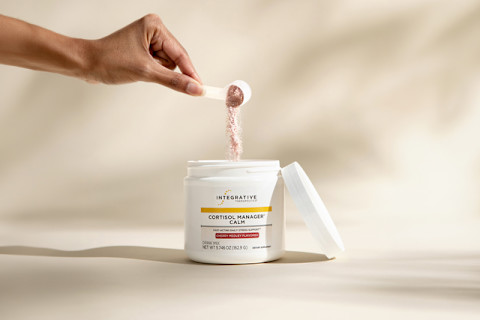
The act of preparing a warm or cool beverage serves a dual psychological purpose. As Knudsen observes: "Drink mixes offer a refreshing option. They’re easy to incorporate into your day, and the act of preparing and slowly sipping a calming beverage can become part of the stress-relief ritual itself." Furthermore, it directly addresses the critical hydration requirements necessary for optimal HPA-axis function.
Step 3: Savor the Micro-Moment
The final step is perhaps the most neglected: creating an intentional buffer of time before re-entering the stream of demands.
Before diving back into spreadsheets or communication channels, dedicate two to three minutes to completely detach. Step outside for a breath of fresh air, gaze out a window to engage panoramic vision (which naturally lowers autonomic arousal), stretch tight postural muscles, listen to a favorite musical track, or simply sit quietly while finishing your beverage.
These micro-moments teach the nervous system that recovery is accessible, safe, and woven into the fabric of everyday life.
Future Outlook: Building Long-Term Neural Resilience
As the pace of technological advancement and professional demands continues to accelerate, the prevalence of micro-stressors is unlikely to decline. Society must therefore shift its wellness paradigm away from the pursuit of a stress-free existence—an impossibility in the modern world—and toward the cultivation of neural resilience.
Future trajectories in integrative medicine and corporate wellness point toward personalized stress management protocols. We are witnessing an increased emphasis on wearable biometric tracking (monitoring heart rate variability and real-time stress markers), functional adaptogenic supplementation tailored to individual cortisol curves, and systemic organizational changes that respect biological recovery windows.
Ultimately, mastering micro-stress does not require grand gestures. By implementing accessible, science-backed protocols—such as intentional breathwork, targeted adaptogenic support via formulations like Cortisol Manager® Calm, and structured moments of daily pause—individuals can reclaim agency over their nervous systems. In doing so, we transform our daily routines from an accumulation of silent burdens into an ongoing practice of profound physical and mental renewal.