
Executive Overview
For decades, the global tourism industry has operated on a diet of linguistic shorthand. Terms like “green,” “eco-friendly,” “sustainable,” and “responsible” have served as default vocabulary for hotels, tour operators, and cruise lines eager to capture the growing demographic of conscious travelers. Yet, beneath the veneer of lush green leaf logos and idyllic nature imagery lies a pervasive systemic issue: the proliferation of unsubstantiated environmental claims. In an industry where intent frequently masquerades as impact, travelers have been left swimming in a sea of ambiguity, struggling to separate genuine environmental stewardship from sophisticated greenwashing.
That era of unaccountable marketing is drawing to a definitive close.
Set to take full effect on September 27, 2026, the European Union’s Empowering Consumers for the Green Transition (EmpCo) Directive represents a seismic regulatory shift. This legislation overhauls existing consumer protection laws, introducing stringent, enforceable rules governing how businesses market their environmental footprints. For the tourism sector—an economic engine deeply reliant on consumer trust—the directive is far more than a bureaucratic hurdle. It demands a fundamental operational and communicative pivot: moving away from empty marketing buzzwords and toward demonstrable, verifiable environmental impact.
While the regulation originates in Brussels, its gravitational pull is global. Any travel business, regardless of whether it is headquartered in New York, Nairobi, Tokyo, or Buenos Aires, must comply if it markets its products or services to consumers within the European Union. As the countdown to enforcement begins, the message to the tourism sector is unambiguous: substantiate your claims, discard unverified labels, or face severe regulatory and reputational fallout.
Detailed Chronology: The Regulatory Path to EmpCo
The journey toward the EmpCo Directive did not happen overnight; it is the culmination of years of rising consumer disillusionment, regulatory scrutiny, and legislative negotiation. Understanding this timeline is essential for travel brands seeking to contextualize why these rules are tightening now.

- March 2020: The European Commission publishes a landmark study evaluating green claims across various consumer markets. The findings are startling: 53% of environmental claims are found to be vague, misleading, or completely unfounded, revealing a marketplace riddled with deceptive marketing.
- March 2022: Responding to mounting pressure to protect consumers from deceptive environmental practices, the European Commission tables the initial proposal for the Empowering Consumers for the Green Transition (EmpCo) Directive, framing it as an amendment to existing Unfair Commercial Practices and Consumer Rights directives.
- January 2023: Global consumer research firm YouGov releases data showing that over half of global consumers are fundamentally skeptical of brand sustainability claims, underlining an urgent need for standardization and transparency to restore market confidence.
- March 2024: Following intensive negotiations between the European Parliament and the Council of the European Union, the EmpCo Directive is formally adopted. The text is published in the Official Journal of the European Union, setting a rigid implementation timeline for member states.
- March–September 2026 (Transposition Window): EU member states are given a designated window to transpose the directive into their national laws. During this period, businesses are urged to audit their marketing ecosystems.
- September 27, 2026 (Enforcement Day): The rules become fully applicable across the EU. From this date forward, non-compliant green marketing constitutes a direct violation of consumer protection laws, exposing offending businesses to substantial penalties, mandatory retractions, and public reprimands.
Supporting Context & Metrics: The Crisis of Consumer Trust
The urgency behind the EmpCo Directive is rooted in empirical reality. Modern travelers are increasingly aware of tourism’s complex footprint, encompassing carbon emissions, overtourism, resource depletion, and community displacement. However, the commercial response to this awareness has frequently exacerbated confusion rather than clarifying choices.
According to research insights from Booking.com’s 2025 impact reports, traveler awareness of tourism’s direct effects on local and global communities is at an all-time high. Consumers actively seek out sustainable options, yet their enthusiasm is continually undercut by corporate skepticism. When European Commission investigations reveal that half of all green claims lack adequate backing, and YouGov tracks a majority population of skeptical buyers, the economic imperative for regulatory intervention becomes undeniable.
Furthermore, the industry must navigate the distinction between the EmpCo Directive and the broader, highly anticipated Green Claims Directive.
- The EmpCo Directive is already adopted and focuses primarily on business-to-consumer (B2C) commercial practices, banning generic claims, unverified labels, and misleading offset language.
- The Green Claims Directive, while closely related and complementary, is a separate legislative proposal that remains under discussion. It aims to introduce even more rigorous, pre-approval substantiation requirements for environmental claims.
For tourism enterprises, treating EmpCo as an immediate operational priority while keeping an eye on the evolving Green Claims framework is the most prudent risk-mitigation strategy.
Official Statements and Industry Implications
The enforcement of the EmpCo Directive has prompted widespread reaction across environmental organizations, consumer watchdog groups, and travel industry leaders.

Regulatory bodies within the European Commission have repeatedly emphasized that the directive is designed not to stifle environmental marketing, but to reward genuine corporate accountability. In official briefings accompanying the rollout, EU consumer protection officials noted that businesses investing real capital into operational sustainability should not have to compete on a level playing field with marketers who rely on cheap, unfounded buzzwords.
Leading sustainable travel advocates have echoed this sentiment, framing the directive as an equalizer. For years, boutique eco-lodges and tour operators investing heavily in third-party certifications and measurable carbon reductions have suffered from the "noise" created by larger competitors engaging in greenwashing with impunity. Under EmpCo, vague declarations like "eco-friendly" or "conscious travel" will be scrubbed unless backed by recognized certifications—such as the EU Ecolabel for Tourist Accommodation, the Nordic Swan Ecolabel, or the Austrian Ecolabel.
Who Do the Rules Apply To?
A common misconception among international travel brands is that European Union directives only apply to companies physically located within the EU. The reality of the EmpCo Directive is far-reaching.
The Geographic Scope
Location is secondary to market reach. If your travel business sells products, tours, accommodations, or services to consumers residing within the European Union, the EmpCo Directive applies to you. Whether your headquarters are situated in London, New York, Singapore, Costa Rica, or Sydney, any consumer-facing communication that targets or reaches EU travelers falls under the jurisdiction of these rules.
The Operational Scope
The directive applies broadly across the entire tourism value chain:
- Tour Operators & Travel Agents: Anyone curating and marketing itineraries directly to the public.
- Hotels & Accommodations: Properties advertising environmental efficiency, energy-saving initiatives, or waste-reduction milestones.
- Destination Marketing Organizations (DMOs): Regional and national tourist boards promoting their areas as sustainable destinations.
- B2B Partners: Even if your primary communications are directed at other businesses rather than end-consumers, your messaging must be compliant. If a B2B partner incorporates your unverified environmental claims into their own consumer-facing marketing, liability cascades down the chain.
What Does the EmpCo Directive Require?
The statutory text of the directive is detailed, but its practical implications for travel marketers can be broken down into five core pillars:
1. Ban on Vague, Generic Claims
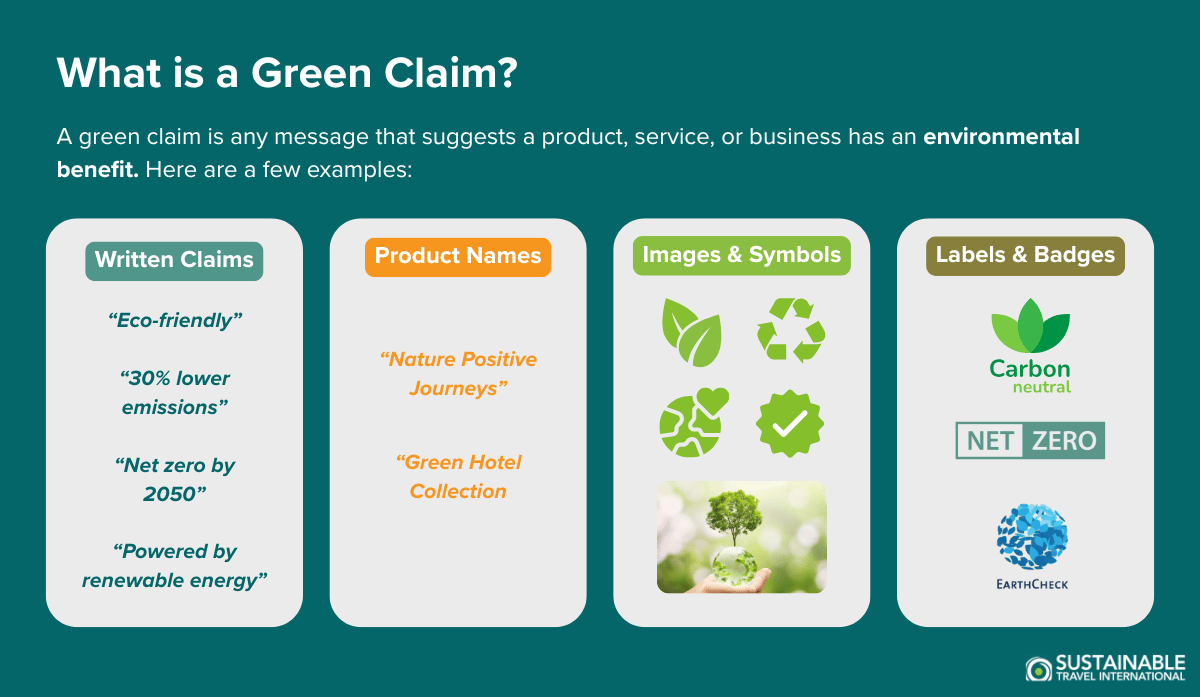
Generic environmental statements—such as “green,” “eco-friendly,” “sustainable,” “nature-positive,” or “climate-friendly”—are strictly prohibited unless they are accompanied by clear, prominent proof or supported by a recognized, rigorous certification scheme.
- What to avoid: Marketing a tour catalog as "Climate-Friendly Journeys" without any data to support the claim.
- What to do instead: Use specific, measurable language. For instance: "We have transitioned 90% of our regional tour transport to electrified rail networks, cutting associated transit emissions by 34%."
2. Elimination of Misleading Scope
Businesses must not overstate the environmental achievements of their operations. If only the administrative office runs on renewable energy, you cannot market the entire hotel or tour line as "powered by green energy." Similarly, businesses cannot market mandatory legal compliances (such as local bans on single-use plastics) as unique corporate sustainability achievements.
3. Redefining Carbon Offsets and Climate Funding
This is perhaps the most radical shift for the adventure and eco-tourism sectors. Under EmpCo, businesses can no longer label a trip, hotel stay, or flight as “carbon neutral,” “climate compensated,” or “net-zero” based on the purchase of carbon offsets or external climate credits.
The directive draws a sharp, unyielding line between internal operational emissions reductions and external climate investments. While investing in global reforestation or renewable energy projects is highly encouraged, these actions do not neutralize the carbon footprint of an active travel product.
- Prohibited phrasing: "Enjoy a carbon-neutral holiday by offsetting your flights with us."
- Compliant phrasing: "While we continue to aggressively reduce our direct operational emissions, we also invest in verified ecosystem protection projects that deliver global climate benefits equivalent to our trip footprints."
4. Mandatory Substantiation and Evidence
If you make a claim, you must prove it. Whether claiming a reduction in water consumption, waste generation, or carbon output, businesses must have empirical data and measurement tools in place. Furthermore, forward-looking commitments—such as pledging to achieve net-zero emissions by a future date—must be backed by a transparent, publicly available implementation plan featuring time-bound milestones and independent expert reviews.
5. Strict Regulation of Sustainability Labels
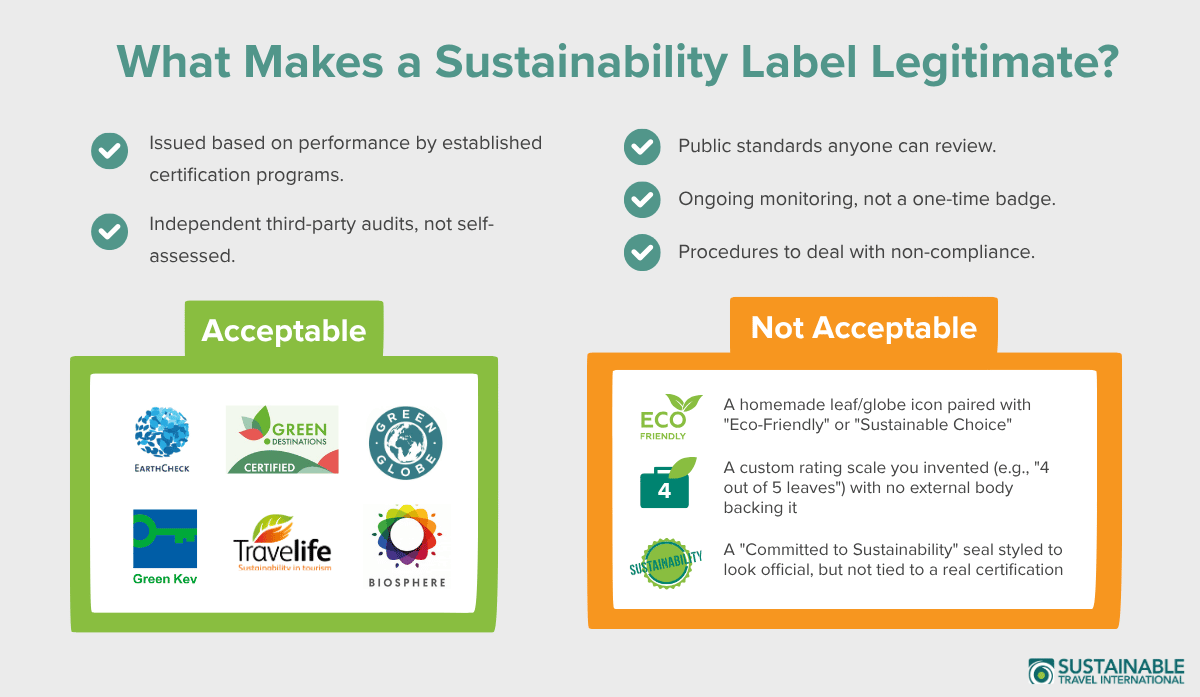
The marketplace has long suffered from a proliferation of self-created badges, seals, and trust marks. EmpCo outlaws home-baked labels like a self-designed "Committed to Sustainability" stamp. Any seal, badge, or logo displayed on a booking platform or website must originate from a public authority or an accredited certification program featuring independent, ongoing third-party monitoring—such as Travelife, Green Key, Green Globe, EarthCheck, or Green Destinations.
Future Outlook: Embracing Authenticity as a Competitive Advantage
As the September 2026 enforcement date approaches, travel enterprises face a choice: view the EmpCo Directive as an administrative burden or seize it as an opportunity to build unbreakable trust with modern consumers.
The tourism sector is entering a maturity phase. The days of exploiting traveler goodwill through poetic, unsubstantiated marketing copy are over. By proactively auditing marketing collateral, discarding vague eco-labels, separating carbon accounting from offset investments, and adopting verified measurement protocols, travel brands can insulate themselves against regulatory penalties while standing out in a crowded marketplace.
Authenticity is no longer just a moral choice or a nice-to-have marketing angle; under EU law, it is now the baseline for survival.