

Executive Overview
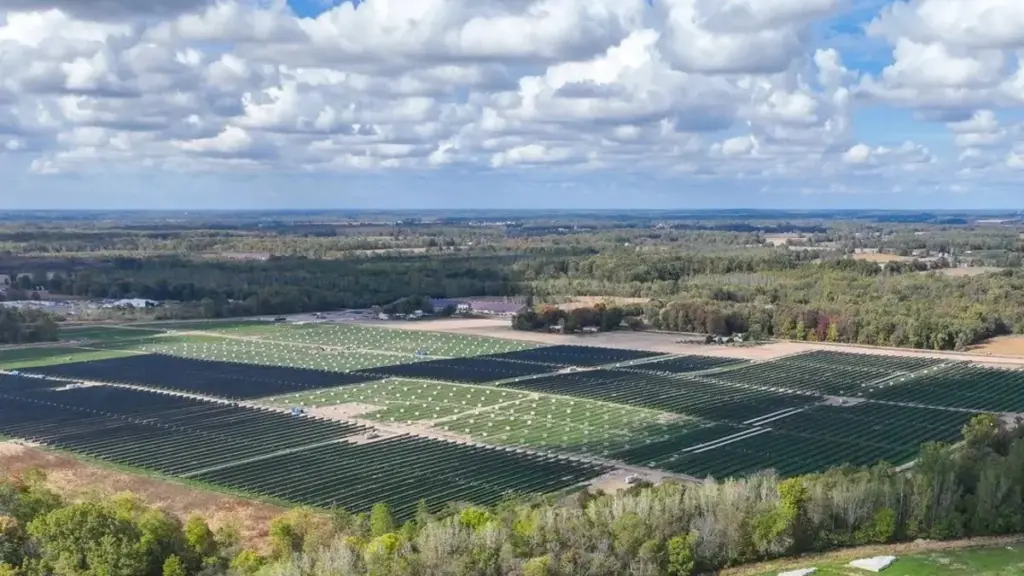
In a significant milestone for industrial decarbonization in the American Midwest, Detroit-based energy provider DTE Energy has officially completed construction on the Cold Creek Solar Park. Situated near Coldwater, Michigan, this sprawling 100-megawatt (MW) photovoltaic facility represents a vital cornerstone in a multi-year strategy to green the manufacturing footprint of one of the world’s most iconic automakers: Ford Motor Company.
Funded through a staggering $194 million investment by Ford via DTE’s voluntary green energy initiative, CleanVision MIGreenPower, the Cold Creek project is designed to pour substantial volumes of renewable electricity directly into the local grid. Functionally, the solar farm produces enough clean, emissions-free electricity to power the equivalent of 23,000 to 25,000 typical Michigan households annually. More importantly, it serves as the vanguard for a much larger wave of solar and wind infrastructure slated to come online in the state, all dedicated to satisfying Ford’s aggressive corporate sustainability targets.
However, this transition has not been entirely without shifts in scope and timing. While the partnership was originally forged with a breathless timeline, recent disclosures reveal that Ford has slightly adjusted its target completion date for its domestic carbon-free manufacturing goals. Even with this minor timeline adjustment, the launch of Cold Creek Solar Park underscores a broader, irreversible shift within heavy industry: legacy automakers are no longer waiting for grid modernization to happen organically—they are actively financing and shaping the commercial renewable energy landscape to secure their corporate futures.
Detailed Chronology of the Cold Creek Project
The realization of the Cold Creek Solar Park is the result of years of strategic planning, regulatory navigation, and intensive engineering. To understand the magnitude of this 100 MW achievement, one must examine the timeline of commitments and development phases that brought the project from a conceptual agreement on paper to reality in the Michigan countryside.
The 2022 Watershed Agreement
The genesis of the Cold Creek project traces back to August 2022. At the time, Ford Motor Company made headlines by announcing an unprecedented procurement agreement with DTE Energy. Under the banner of DTE’s MIGreenPower program, Ford agreed to purchase up to 650 MW of renewable energy. This was not merely a symbolic purchase of carbon credits; it was a foundational commitment to pump private capital directly into the development of new utility-scale wind and solar projects across Michigan.
When the deal was struck, executives from both companies set a high-water mark for American manufacturing: Ford aimed to assemble every vehicle manufactured in its home state using the equivalent of 100% carbon-free electricity by the end of 2025.
Groundbreaking and Construction Phases
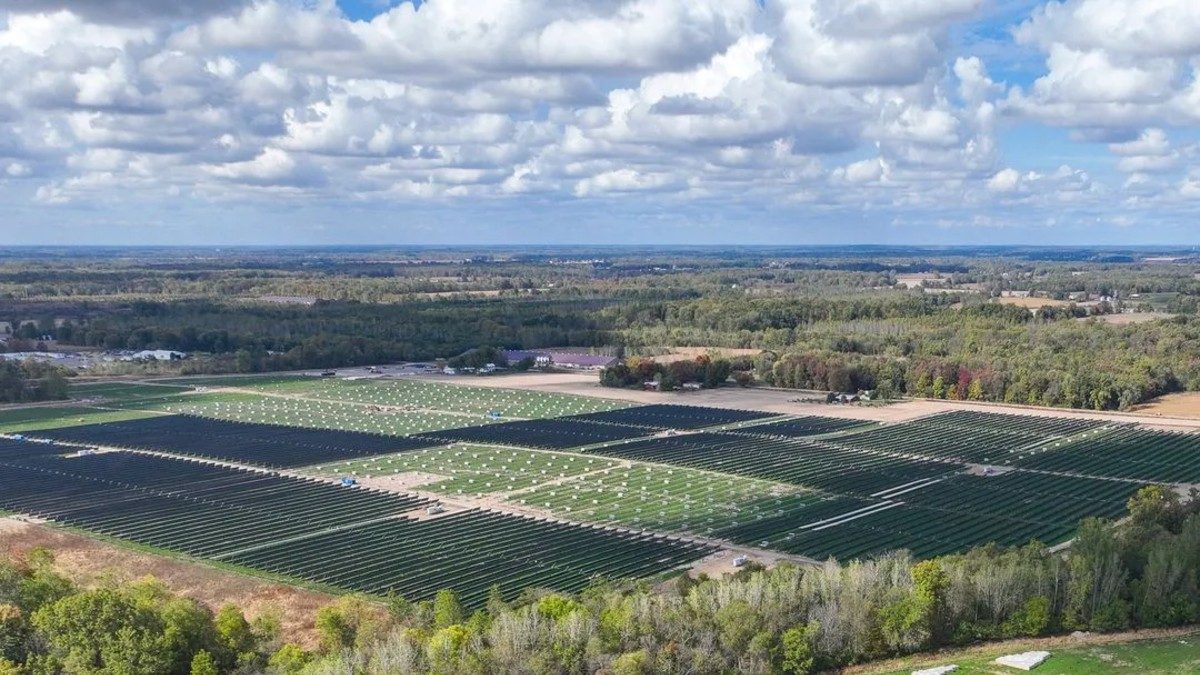
Following years of site acquisition, environmental impact assessments, and grid-interconnection studies, physical development accelerated in the spring. Construction on the Cold Creek facility officially broke ground in April 2025.
Partnering with specialized engineering and construction firms—such as Roncelli, which captured key milestones of the buildout—DTE transformed hundreds of acres of rural Michigan land into a modern technological powerhouse. Over the course of roughly a year and a half, installation crews mounted hundreds of thousands of high-efficiency photovoltaic panels equipped with single-axis trackers designed to follow the sun from east to west, maximizing energy capture throughout the day.
Despite supply chain headwinds, labor market fluctuations, and complex regulatory hurdles inherent in utility-scale energy projects of this magnitude, the construction schedule held remarkably firm, culminating in its completion in late 2026. Cold Creek stands proudly as the first major solar park delivered under the landmark 650 MW procurement agreement, setting a precedent for subsequent projects currently moving through DTE’s pipeline.
Supporting Context & Metrics: The Mechanics of MIGreenPower
To fully grasp how the Cold Creek Solar Park operates within Michigan’s energy ecosystem, it is essential to examine the program that made it possible: DTE’s CleanVision MIGreenPower.
How MIGreenPower Works
Voluntary renewable energy programs allow commercial, industrial, and residential customers to attribute a portion of their monthly electricity consumption to specific wind and solar assets within the utility’s portfolio. For major corporations like Ford, these programs offer a direct pathway to meet Scope 2 emissions reduction targets (emissions associated with the generation of purchased electricity) without needing to construct and operate private on-site microgrids.
Through MIGreenPower, participants essentially pool their demand, providing utilities with the financial certainty required to secure capital and build multi-million-dollar utility-scale renewable installations. The $194 million poured into Cold Creek by Ford is a textbook example of this mechanism in action: private enterprise financing the clean energy transition, resulting in grid-wide decarbonization benefits that extend far beyond a single corporate entity.
Generation Capacity and Scale
- Total Capacity: 100 Megawatts (MW)
- Capital Investment: $194 million (funded by Ford)
- Household Equivalency: Powers roughly 23,000 to 25,000 average Michigan homes.
- Land Footprint: Spans vast acreage optimized for high-efficiency solar tracking arrays.
The Timeline Shift: 2025 to 2027
A noteworthy detail emerging from DTE’s latest announcements involves a subtle pivot in Ford’s timeline. When the 650 MW agreement was initially publicized in August 2022, Ford and DTE established a target date of 2025 for assembling all Michigan-made vehicles with 100% carbon-free electricity.
However, the latest operational updates from DTE indicate that this deadline has been extended to the end of 2027. Neither DTE nor Ford issued an explicit, detailed explanation for the two-year adjustment. Industry analysts suggest that the delay likely stems from the complex realities of modernizing vast automotive manufacturing complexes—such as the Dearborn Rouge Complex or the Michigan Assembly Plant—alongside the intricate grid-interconnection timelines required to bring the remaining phases of the 650 MW procurement online. Despite the shifted deadline, the commitment remains fully funded and actively under construction.
Economic Ripple Effects and Community Impact
While the primary driver of the Cold Creek Solar Park is corporate decarbonization, utility-scale renewable energy projects of this scale act as powerful economic engines for rural host communities.
Job Creation and Local Labor
During the initial announcement of the broader 650 MW agreement back in 2022, DTE estimated that the wave of construction projects required to fulfill the contract would generate roughly 250 temporary, high-paying construction jobs, alongside approximately 10 permanent operations and maintenance positions. While these figures represent the aggregate totals for the wider portfolio rather than Cold Creek in total isolation, the influx of specialized trade labor—ranging from heavy equipment operators to electrical engineers—provides an immediate, tangible boost to local economies.
Municipal Tax Revenues and Community Enrichment
Beyond employment, solar parks like Cold Creek offer rural municipalities a predictable, long-term stream of tax revenue. Unlike traditional manufacturing facilities that may experience volatile production cycles, solar infrastructure provides steady, reliable property tax assessments for decades.
Host communities frequently channel these additional public funds toward critical civic infrastructure:

- Upgrading and paving local roads and bridges to handle agricultural and industrial traffic.
- Funding public school districts to enhance educational technology and programming.
- Supporting local libraries and community centers.
- Bolstering first responders (volunteer fire departments, emergency medical services, and local law enforcement) with updated equipment and training resources.
Future Outlook: The Road to 2035 and Beyond
The completion of the Cold Creek Solar Park is not an isolated finish line, but rather a vital milestone in a much grander environmental strategy mapped out by Ford Motor Company.
The Path to Global Carbon Neutrality
Ford’s localized investments in Michigan are part of a tiered, global roadmap designed to systematically eliminate carbon emissions across every facet of its operations:
- Michigan Manufacturing (2027): Every vehicle built in Ford’s home state will be assembled using the equivalent of 100% carbon-free electricity.
- Global Manufacturing Facilities (2035): Ford has committed to transitioning all of its manufacturing plants worldwide to 100% carbon-free electricity.
- Complete Carbon Neutrality (No later than 2050): The automaker aims to achieve total carbon neutrality across its entire global footprint—encompassing vehicle use, manufacturing facilities, and its sprawling upstream supply chain.
The Broader Energy Transition in Michigan
For DTE Energy, projects like Cold Creek are essential components of the utility’s own CleanVision plan, which aims to aggressively phase out coal-fired generation, rapidly expand renewable energy portfolios, and modernize the grid to handle distributed energy resources. As more corporate giants follow Ford’s lead and enroll in programs like MIGreenPower, the economic viability of utility-scale wind and solar in the Midwest is cemented, proving that aggressive environmental stewardship and industrial competitiveness can—and must—go hand in hand.
As the panels at Cold Creek begin absorbing the Michigan sunlight and converting it into clean electrons for Ford’s assembly lines, the project stands as a physical manifestation of the industrial sector’s low-carbon future—one megawatt at a time.



