As the global energy transition accelerates, electrical grids originally engineered for unidirectional power flow face an unprecedented convergence of stress factors. Utilities are grappling simultaneously with surging electricity demand from electric vehicles (EVs), the rapid proliferation of distributed renewable energy sources, residential storage systems, smart thermostats, and the immense power footprints of artificial intelligence data centers. Compounding these technical challenges are increasingly volatile weather patterns that frequently push local grids to their absolute breaking points.
Into this high-stakes environment steps Texture, an innovative grid software startup that has successfully closed a $12.5 million Series A funding round. Co-led by VoLo Earth Ventures and Equal Ventures, with additional participation from Lerer Hippeau and Abstract Ventures, this latest financial injection brings Texture’s cumulative venture backing to approximately $23 million.
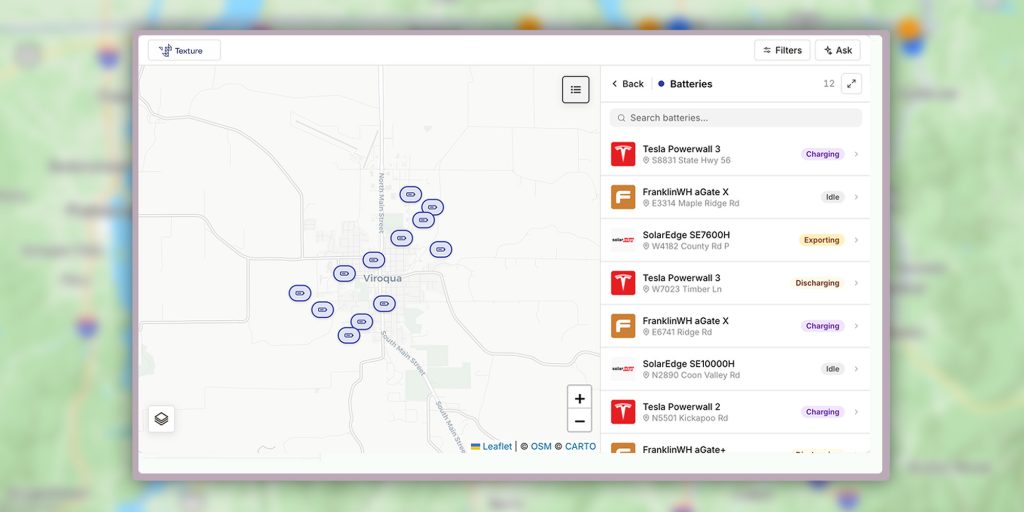
Texture’s core value proposition addresses a glaring operational inefficiency in the utility sector: operators are routinely forced to navigate a fragmented ecosystem of disconnected software tools. By synthesizing disparate data streams—ranging from smart meters and advanced metering infrastructure (AMI) to supervisory control and data acquisition (SCADA) systems—into a single, real-time operational layer, Texture aims to give grid managers a unified "pane of glass" view. Crucially, the platform bypasses the arduous, multi-year legacy software rollouts that have historically plagued the utility industry, allowing operators to deploy plug-and-play solutions in a matter of days.
Detailed Chronology and Strategic Partnerships
Texture’s journey from a nascent software concept to an emerging critical infrastructure player has been defined by rapid technological iteration and strategic market positioning. Rather than initially pursuing massive, slow-moving investor-owned utilities (IOUs), the company carved out a niche by focusing on utility cooperatives. These rural co-ops—which collectively serve roughly 42 million Americans—experience the exact same modernization pressures as major metropolitan utilities, yet operate under severe capital and staffing constraints.
The Genesis of a Market Need
Reflecting on the founding thesis of the company, Texture Co-founder and CEO Sanjiv Sanghavi noted the recurring frustrations voiced by rural utility executives. "Co-ops kept telling me the same thing," Sanghavi explained. "They wanted to run modern grid programs but didn’t have software built for their scale or budget." Recognizing this systemic gap, Texture engineered its architecture to integrate smoothly with pre-existing utility infrastructure, eliminating the necessity for heavy capital expenditures or the hiring of large, specialized engineering teams.
Integrating the Distributed Energy Ecosystem
Over the past several years, Texture has focused heavily on establishing robust application programming interfaces (APIs) and direct hardware integrations. To date, the company has forged direct integration pathways with more than 50 original equipment manufacturers (OEMs) and energy technology firms. This expansive roster includes industry heavyweights such as:
Tesla
FranklinWH
Honeywell
Ecobee
SolarEdge
Leap Energy
WattTime
These integrations have proved instrumental in real-world deployments. Earlier this year, for instance, the Sustainable Energy Utility in Ann Arbor, Michigan, successfully launched an innovative community battery program leveraging FranklinWH systems integrated across 100 residential homes, coordinated seamlessly through advanced software architecture.
The NRTC Alliance
In a major milestone for its expansion strategy, Texture recently announced a landmark partnership with the National Rural Telecommunications Cooperative (NRTC). Representing a vast network of 850 utility co-ops across the United States, the NRTC collaboration opens the floodgates for widespread commercial adoption. Through this partnership, NRTC member cooperatives gain direct access to Distributed Energy Resource Management Systems (DERMS) software powered by Texture. This capability allows rural providers to coordinate residential batteries, smart thermostats, and local microgeneration assets in real-time, effectively bridging a critical gap that has long hindered virtual power plants (VPPs) and demand response platforms.
Supporting Context & Metrics: The Anatomy of Modern Grid Strain
The urgency behind Texture’s Series A funding is underscored by stark macroeconomic and engineering metrics that define the current state of electrical infrastructure.
The Localized Threat of EV Charging
While utility-scale solar farms and massive data centers frequently dominate industry headlines, local distribution grids face their most acute vulnerabilities closer to home. The uncoordinated clustering of residential EV chargers creates sharp, localized load spikes that legacy distribution transformers were never designed to accommodate.
Texture’s software platform directly targets this vulnerability by providing automated meter-level analytics. The system can detect sudden surges in electricity demand at individual service points and dynamically trace how that load propagates backward through local transformers and medium-voltage feeders. By identifying thermal overloads and voltage sags before they cause catastrophic component failure, operators can execute proactive load management.
The Transformer Crisis
This predictive capability carries immense financial and operational weight. According to market data from Wood Mackenzie, global supply chain disruptions and surging material costs have caused utility transformer prices to jump by as much as 95% since 2019. Furthermore, lead times for procuring large distribution transformers have stretched beyond two years in many regions.
When a transformer fails unexpectedly today, a utility cannot simply order a replacement off the shelf. Consequently, software solutions like Texture’s—which extend the operational lifespan of existing hardware by preventing overloads—transition from nice-to-have tools to essential risk-mitigation assets.
Real-World Validation: Vermont Electric Cooperative
Early adopters are already reaping tangible operational benefits from this approach. The Vermont Electric Cooperative—widely recognized as one of the few carbon-neutral utilities in the United States—relies on Texture’s platform to maintain stringent oversight of its regional grid. By utilizing the software to monitor grid parameters and dynamically manage hundreds of distributed residential and commercial batteries, the co-op can balance local supply and demand autonomously, mitigating the need for costly grid reinforcement projects.
Official Statements and Industry Perspective
The transition toward decentralized, software-defined electrical grids represents one of the most significant structural shifts in modern industrial history. Industry analysts and venture capital backers view Texture’s technology not merely as a software utility, but as an indispensable connective tissue for the future clean energy economy.
"Utilities are under pressure from all sides now," industry analysts note, observing that grids built for passive, one-way power transmission must now instantly adapt to bi-directional power flows, volatile renewable generation, and hyper-localized EV charging spikes.
The traditional model of dispatching human engineers to manually analyze system bottlenecks is no longer viable in an era characterized by sub-second demand fluctuations and extreme weather events. By consolidating fragmented data streams into a singular, responsive architecture, Texture aims to eliminate the operational blind spots that frequently precipitate major outages.
Furthermore, the participation of seasoned energy-tech investors in the $12.5 million Series A round signals robust institutional confidence in Texture’s go-to-market strategy. VoLo Earth Ventures and Equal Ventures, alongside Lerer Hippeau and Abstract Ventures, recognize that scaling the energy transition requires software that empowers smaller, resource-constrained utilities just as effectively as it serves multi-billion-dollar investor-owned monopolies.
Future Outlook: The Road Ahead for Texture and Grid Software
With $23 million in total venture funding now securely on its balance sheet, Texture’s leadership team has outlined a clear trajectory for the medium term. The primary focus for the newly acquired capital will center on aggressive talent acquisition and accelerated platform expansion.
Scaling the Engineering and Deployment Pipeline
As the NRTC partnership begins to translate into active deployments across hundreds of rural cooperatives, Texture will need to scale its customer success and engineering teams. The ability to onboard new utility clients within days—a stark contrast to the multi-year implementation cycles typical of legacy enterprise software—will remain a cornerstone of the company’s competitive advantage.
Overcoming the VPP Data Deficit
Looking further ahead, Texture is positioned to capitalize on the explosive growth of Virtual Power Plants (VPPs) and aggregated demand response markets. Many existing VPP platforms suffer from a fundamental handicap: they lack direct access to real-time, high-resolution meter data. Without precise visibility into actual, on-the-ground grid conditions at the transformer level, dispatch decisions made by aggregators can sometimes exacerbate local grid stress rather than alleviate it. By embedding real-time telemetry directly into its DERMS architecture, Texture is carving out a vital role as the trusted arbiter of grid stability between market operators, asset owners, and utilities.
As extreme weather events become more frequent—evidenced by ongoing recovery efforts from severe grid shocks like Storm Fern—the mandate for resilient, self-healing local infrastructure has never been clearer. For Texture, the $12.5 million Series A is not just a financial milestone, but a validation that the future of grid management belongs to agile, software-driven unification.