

Executive Overview
The intersection of e-mobility and grid infrastructure has reached a critical inflection point in the Northeast. Major Massachusetts utility providers Eversource and National Grid are officially expanding their established virtual power plant (VPP) initiatives—known collectively as ConnectedSolutions—to incorporate residential vehicle-to-grid (V2G) charging technology. This development allows everyday electric vehicle (EV) owners to monetize their parked assets by channeling stored battery power back into the utility grid during periods of peak energy demand.
With over 150,000 electric vehicles currently registered on Massachusetts roadways and the number of bidirectional-capable models steadily growing, the state sits atop a massive, decentralized energy reservoir. By leveraging smart-charging and grid-integration technology supplied by industry leaders EnergyHub, Sunrun, and The Mobility House, this pilot program seeks to transform stationary commuter cars into an active stabilizing force for the regional power grid.
While initial utility rollouts often suffer from ambiguity regarding hardware compatibility and compensation rates, recent updates have shed light on concrete financial incentives. Participants enrolled through National Grid’s framework can earn up to $275 per average kilowatt (kW) of performance over the summer season, translating to estimated payouts between $1,375 and $2,750 per residential participant, depending heavily on charger capacity and overall system performance.
This article provides an in-depth look at the Massachusetts V2G rollout, analyzing the technological framework, financial structures, qualifying vehicles, and the broader implications for the American energy landscape.
Detailed Chronology: The Evolution of Massachusetts V2G
The path toward residential vehicle-to-grid integration in Massachusetts has evolved through a deliberate progression of pilot projects, technological partnerships, and regulatory adjustments.
1. The Foundation: ConnectedSolutions and Early VPPs
Long before passenger cars were considered viable grid assets, Massachusetts utilities utilized the ConnectedSolutions program to manage peak energy loads. Initially, the program relied on commercial and industrial demand-response assets, stationary residential battery storage systems (such as Tesla Powerwalls), and smart thermostats. These devices shaved critical load peaks during scorching summer heatwaves and freezing winter nights, saving utilities millions of dollars in expensive peak-generation costs and passing savings along to participating consumers.
2. Fleet Electrification as a Stepping Stone
Before trusting individual residential drivers with grid-support duties, utilities tested bidirectional capabilities within controlled, light- and medium-duty commercial fleets. National Grid successfully pioneered V2G applications with electric school buses under the ConnectedSolutions umbrella. Simultaneously, Eversource began engaging with local school districts to incorporate V2G frameworks through its emerging ConnectedSolutions+ initiative. These fleet projects proved that bidirectional charging hardware—allowing electricity to flow both from the grid to the car and from the car back to the grid—was reliable, scalable, and safe for vehicle battery longevity.
3. Transitioning to Residential Scale
Building on the success of commercial fleet trials, Eversource and National Grid took the logical next step: opening the virtual power plant ecosystem to residential drivers. Partnering with specialized aggregators like EnergyHub, Sunrun, and The Mobility House, the utilities developed the software infrastructure needed to seamlessly orchestrate thousands of individual residential vehicles into a unified, responsive power plant.
Supporting Context & Metrics: Unlocking the Driveway Battery
To truly understand the impact of the Massachusetts initiative, one must examine the raw numbers driving the transition. The state’s 150,000+ EVs represent an enormous pool of underutilized battery capacity. When parked—which, statistically, is roughly 95% of the time—these vehicles sit idle, holding hundreds of megawatt-hours of energy that could otherwise support local grids during stress events.
How V2G Mitigates Grid Strain
When electricity demand spikes—typically on hot summer afternoons when air conditioning units run at maximum capacity—power grids face severe strain. Traditionally, utilities meet this demand by firing up expensive, carbon-intensive peaker power plants, which are costly to operate and heavily polluting.
By tapping into residential EV batteries instead, utilities can draw clean energy instantaneously, preventing system overloads and stabilizing voltage frequencies without burning additional fossil fuels. This decentralized approach lowers overall infrastructure costs, which ultimately protects all ratepayers from skyrocketing utility bills.
Eligible Vehicles and Hardware Ecosystem
Uncertainty has historically plagued the rollout of residential V2G programs, with consumers left guessing which cars and chargers qualify for incentives. However, program updates have clarified the initial lineup of eligible vehicles. The current compliance list features several prominent bidirectional-capable models:

- Ford F-150 Lightning (a pioneer in residential backup and V2G applications)
- Nissan LEAF (utilizing CHAdeMO-based bidirectional capabilities)
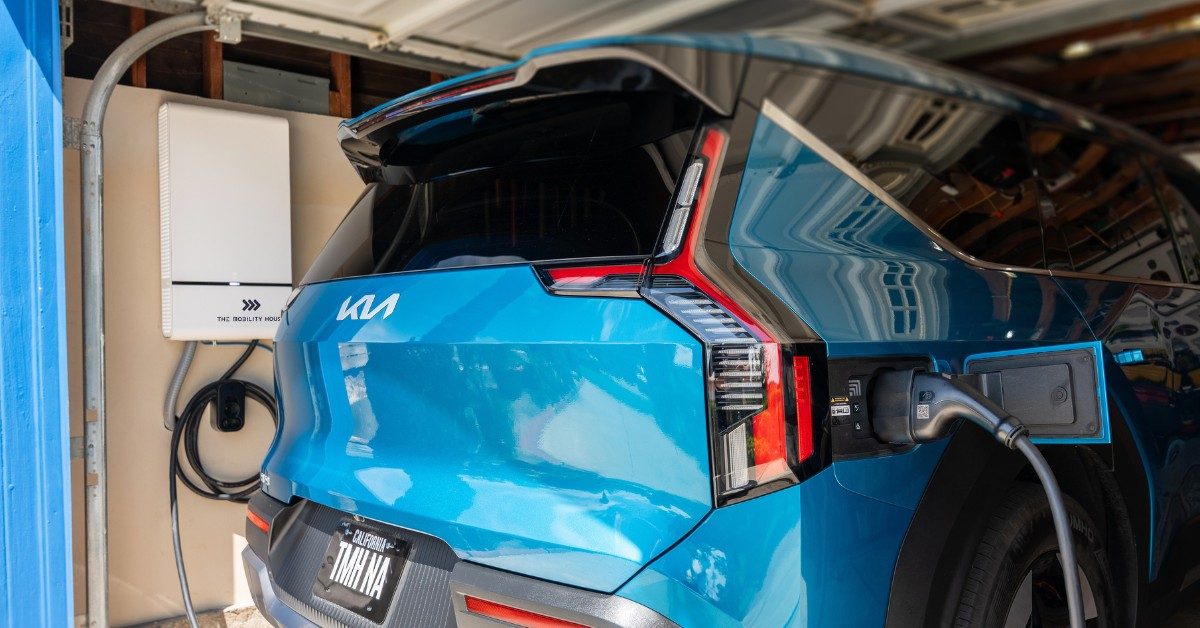
- Kia EV9
- Polestar 3
- Volvo EX90
Because hardware requirements necessitate specific bidirectional chargers and certified smart-charging software gateways provided by tech partners like The Mobility House and Sunrun, participants must ensure their home charging setups meet strict utility specifications.
Official Statements and Financial Incentives
The success of any demand-response program ultimately hinges on consumer participation, which is driven by financial transparency and attractive incentives. Program administrators have detailed specific compensation structures to entice early adopters.
Performance-Based Compensation
Participants in National Grid’s ConnectedSolutions program can earn performance-based incentives structured around grid contribution during high-demand windows.
"The program has announced an initial list of eligible vehicles—including the Ford F-150 Lightning, Nissan LEAF, Kia EV9, Polestar 3, and Volvo EX90, and participants will earn performance-based incentives that vary by technology provider, battery capacity, and participation," noted an official utility spokesperson.
"For National Grid customers participating through ConnectedSolutions, incentives are currently available at up to $275 per average kilowatt (kW) of performance over the summer season, which could translate to approximately $1,375–$2,750 for many residential participants, depending on charger capacity and performance."
Industry Perspectives on Grid Stabilization
Grid experts and corporate partners view the Massachusetts initiative as a blueprint for the rest of the nation. As renewable energy penetration grows, intermittent sources like solar and wind require sophisticated storage solutions. Vehicle batteries offer a distributed, highly mobile alternative to stationary utility-scale battery installations.

Chip Silverman, Sunrun’s director of grid services, emphasized the collaborative nature of this technological leap:
"We are excited to bring our dispatching expertise to Massachusetts and help expand our vehicle-to-grid technology to more customers. Vehicle batteries play a critical role in stabilizing the grid, providing backup power to homes, and lowering energy costs for everyone."
Future Outlook: The Road Ahead for V2G in America
Massachusetts is not operating in a vacuum. Earlier milestones—such as the launch of the United States’ first residential V2G power plant utilizing fleets of Ford F-150 Lightning trucks—demonstrate that the technology has moved past the experimental phase and into commercial viability.
However, several challenges remain before V2G achieves ubiquitous adoption:
- Standardization and Interoperability: Automakers must universally adopt bidirectional charging standards (such as SAE J3072 and ISO 15118-20) to ensure seamless communication between vehicles, chargers, and utility aggregators.
- Warranty Concerns: Early EV adopters have expressed anxiety regarding battery degradation caused by frequent discharge cycles. Automakers will need to clarify how participating in V2G programs affects existing high-voltage battery warranties.
- Streamlined Enrollment: Simplifying the onboarding process for everyday consumers will be essential. If configuring a bidirectional charger requires complex permits, expensive electrical upgrades, and convoluted software registration, mass-market appeal will stall.
Conclusion
The expansion of Eversource and National Grid’s ConnectedSolutions program marks a watershed moment for Massachusetts energy policy. By turning driveways into miniature power plants, the state is demonstrating how distributed energy resources can secure grid reliability, accelerate decarbonization, and put cash directly back into the pockets of EV owners. As technical hurdles are cleared and more automakers unlock bidirectional charging capabilities, the Massachusetts pilot may well serve as the gold standard for nationwide grid integration in the clean energy era.



