As modern power grids groan under the immense, compounding pressures of widespread electrification, the rapid proliferation of electric vehicles (EVs), decentralized renewable energy generation, and the explosive energy footprints of artificial intelligence data centers, the infrastructure supporting modern society is reaching a critical inflection point. Traditional electrical grids, originally engineered decades ago for a predictable, one-way flow of electricity from centralized fossil-fuel power plants down to passive consumers, are fundamentally unequipped to manage the chaotic, bi-directional energy dynamics of the 21st century.
Enter Texture, an innovative grid software startup tackling this structural bottleneck head-on. Texture has officially announced a successful $12.5 million Series A funding round, bringing its total venture backing to approximately $23 million. The latest investment round was co-led by prominent climate and infrastructure tech funds VoLo Earth Ventures and Equal Ventures, with strategic participation from Lerer Hippeau and Abstract Ventures.
The fresh capital injection will primarily fuel aggressive corporate hiring, accelerate the deployment of Texture’s proprietary software platform, and scale its rapidly growing roster of utility partnerships. By offering a unified, real-time intelligence layer that integrates seamlessly with existing utility infrastructure—without requiring costly hardware overhauls or massive engineering teams—Texture aims to bridge the widening gap between surging electrical demand and grid reliability.
Detailed Chronology & Market Evolution
The journey toward modern grid orchestration has been characterized by fragmented software solutions, legacy systems resistant to change, and a massive surge in edge-of-grid devices. For decades, utilities relied on siloed databases, SCADA (Supervisory Control and Data Acquisition) systems, and Advanced Metering Infrastructure (AMI) that rarely communicated effectively with one another.
The Convergence of Modern Grid Pressures
In recent years, the acceleration of the clean energy transition has compounded these technological limitations. The modern grid is no longer a simple distribution pipeline. Instead, it is a complex, multi-directional web comprising:
Utility-scale and rooftop solar arrays, which create massive fluctuations in generation output based on weather conditions.
Home and commercial energy storage batteries, capable of both drawing from and feeding power back into the grid.
Smart thermostats and connected home appliances, which participate in demand-response programs.
Exponential EV adoption, introducing heavy, localized power draws that concentrate heavily during evening peak hours.
AI and cloud computing data centers, driving continuous, high-density baseload demand that strains regional transmission lines.
Texture’s Architectural Solution
Recognizing that utilities were being overwhelmed by disconnected software tools, Texture’s founding team set out to build a unified operational dashboard. Rather than forcing grid operators to rip and replace legacy software—a multi-year, multi-million-dollar ordeal that municipal and rural utilities simply cannot afford—Texture engineered a lightweight, plug-and-play integration layer.
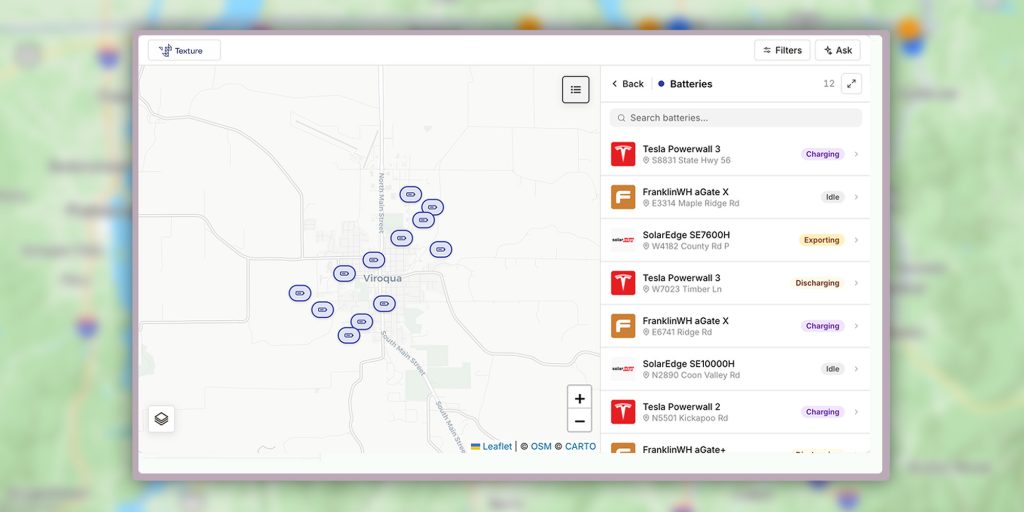
By pulling data directly from smart meters, utility field devices, and over 50 original equipment manufacturer (OEM) energy platforms, Texture consolidates disparate data streams into a single, real-time operational window. This capability allows grid operators to monitor localized conditions instantly, predict failure points before they cascade into outages, and dispatch distributed energy resources (DERs) dynamically.
Supporting Context & Metrics: The Crisis at the Edge
To understand why investors are pouring millions into grid software startups like Texture, one must examine the severe structural economics currently plaguing local distribution grids.
The Localized Impact of EV Charging
While national media headlines often focus on massive high-voltage transmission lines, the most acute stress points are occurring at the local neighborhood level—specifically at the transformer and feeder levels. When multiple homeowners on a single residential street plug in their EVs simultaneously after work, local transformers experience unprecedented thermal and electrical loads.
Texture’s software is specifically designed to detect these sudden spikes in electricity demand directly at the meter level. By tracing how localized usage impacts upstream transformers and distribution feeders, the platform grants utilities a vital window for proactive intervention.
The Transformer Crunch
This proactive monitoring is more critical than ever due to severe supply chain constraints affecting essential grid hardware. According to market intelligence data from Wood Mackenzie:
Global and domestic transformer prices have skyrocketed by as much as 95% since 2019.
Lead times for procuring large utility-grade transformers can now stretch beyond two years, leaving utilities highly vulnerable to equipment failures.
Preventing premature equipment burnouts through intelligent software load management is no longer just a matter of operational efficiency; it is an economic and operational necessity for utilities striving to avoid catastrophic blackouts.
Why Utility Co-ops Are Leading the Charge
While major investor-owned utilities (IOUs) command massive balance sheets and dedicated internal tech departments, a vital segment of America’s electrical grid has historically been left behind by expensive enterprise software vendors: utility cooperatives (co-ops).
Cooperative utilities serve roughly 42 million Americans, predominantly across rural and semi-rural landscapes. These organizations face the exact same modernization mandates and decarbonization pressures as their large urban counterparts, but they must do so operating on significantly leaner budgets and with fractional staff sizes.
"Co-ops kept telling me the same thing," explains Sanjiv Sanghavi, Co-founder and CEO of Texture. "They wanted to run modern grid programs, but didn’t have software built for their scale or budget."
Rapid Deployment Models
Addressing this market gap, Texture tailored its go-to-market strategy toward rural co-ops and municipal utilities. By cutting deployment timelines from years down to mere days, Texture allows resource-constrained organizations to launch sophisticated grid modernization initiatives rapidly.
A prime early adopter of this technology is the Vermont Electric Cooperative (VEC)—widely recognized as one of the few carbon-neutral utilities in the United States. VEC utilizes Texture’s platform to continuously monitor system health and coordinate hundreds of distributed home batteries deployed across its rugged territory.
Furthermore, Texture’s expanding interoperability ecosystem—featuring direct integrations with over 50 industry-leading hardware and software brands, including Tesla, FranklinWH, Honeywell, Ecobee, SolarEdge, Leap Energy, and WattTime—has unlocked innovative municipal applications. For instance, the Sustainable Energy Utility in Ann Arbor, Michigan, leveraged Texture’s integration framework earlier this year to successfully launch a community-wide virtual power plant (VPP) battery program spanning FranklinWH systems across 100 residential homes.
The NRTC Partnership: Scaling Nationwide
In a major validation of its business model, Texture recently announced a strategic partnership with the National Rural Telecommunications Cooperative (NRTC). Through this alliance, Texture’s advanced Distributed Energy Resource Management System (DERMS) software will become accessible to NRTC’s extensive network of 850 utility co-ops across the United States.
This partnership provides rural cooperatives with the enterprise-grade tools needed to coordinate home batteries, EV chargers, and smart thermostats in real time—capabilities previously restricted to major metropolitan utility providers.
Official Statements & Industry Perspectives
The convergence of venture capital backing and grassroots utility adoption underscores a fundamental shift in how the energy sector views software.
Industry analysts point out that traditional Demand Response (DR) and Virtual Power Plant (VPP) platforms have long suffered from a critical blind spot: they frequently lack access to real-time, high-resolution meter data. Without direct visibility into physical grid conditions, automated dispatch decisions can sometimes misalign with local feeder capacities, risking localized overloads. Texture’s unified data architecture explicitly solves this architectural flaw by anchoring VPP operations in genuine, real-time grid telemetry.
Investors in the $12.5 million Series A round emphasized the sheer urgency of Texture’s mission. Representatives from VoLo Earth Ventures and Equal Ventures noted that as extreme weather events—such as winter storms and summer heat domes—push regional grids to their absolute limits, utilities can no longer afford to operate in the dark regarding edge-of-grid dynamics.
Future Outlook: The Road Ahead for Texture
With $23 million in cumulative venture capital now secured, Texture is positioned for rapid scaling through the remainder of the decade. The company plans to dedicate its newly acquired resources toward expanding its engineering and product development teams, refining its predictive AI analytics engines, and deepening integrations with emerging energy hardware standards.
As the United States continues its multi-billion-dollar march toward vehicle electrification and decarbonized power generation, software layers like Texture will serve as the invisible connective tissue holding the grid together. By empowering small rural co-ops and large metropolitan utilities alike with real-time visibility, cost-effective deployment, and intelligent automation, Texture is helping ensure that the grid of the future remains resilient, reliable, and ready for whatever electrical demand comes next.