

Executive Overview
In a subtle yet consequential shift in climate policy, the UK government has quietly downgraded its official projections for clean-aviation technologies, acknowledging that breakthrough solutions like sustainable aviation fuels (SAFs) and battery-powered aircraft will deliver significantly fewer carbon reductions than previously claimed.
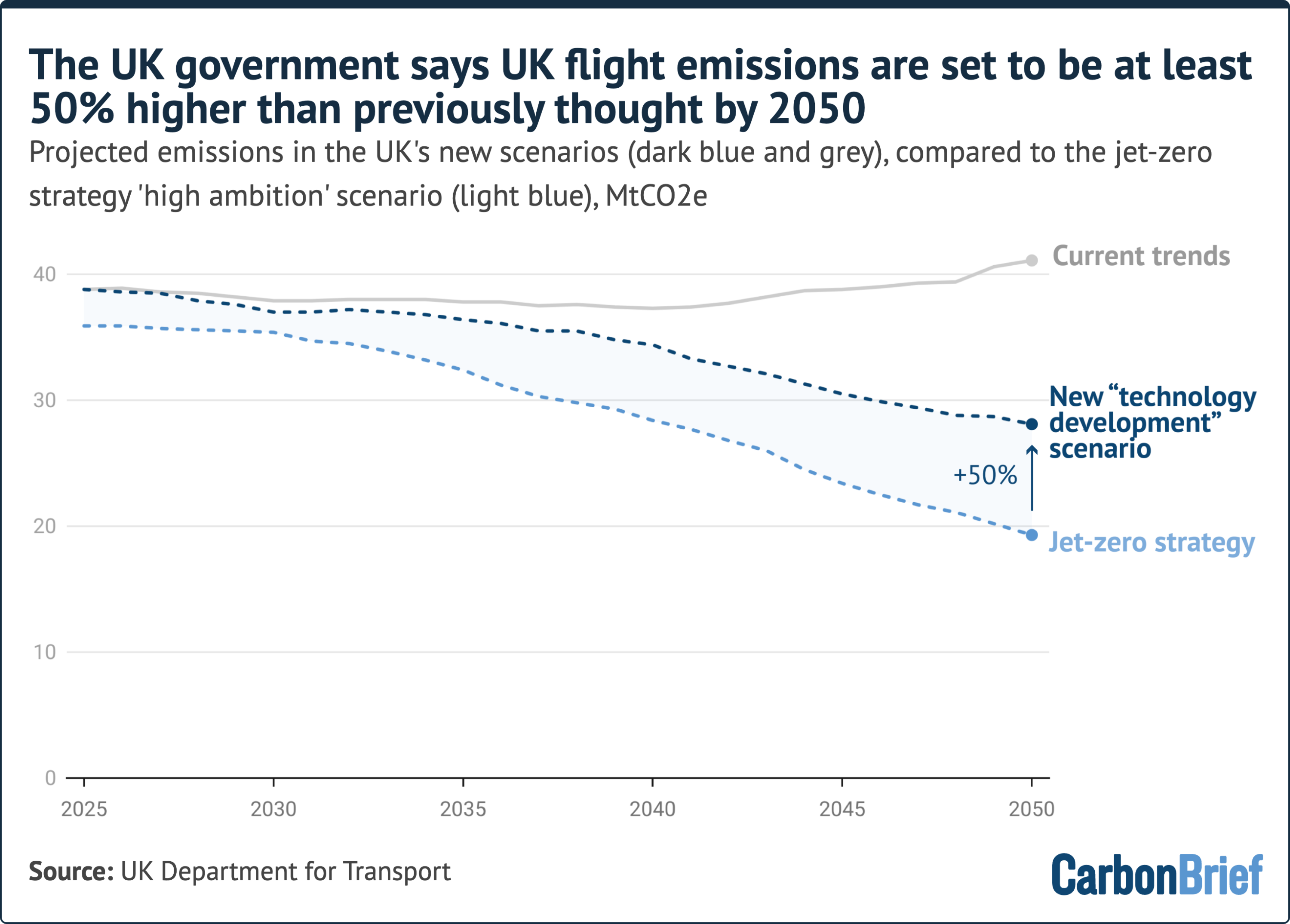
According to updated Department for Transport (DfT) forecasts released with minimal fanfare, an ambitious rollout of clean aviation technologies will reduce flight emissions by only a quarter over the next two decades. This revision leaves projected UK aviation emissions in 2050—the country’s legally binding deadline for net-zero greenhouse gas emissions—nearly 50% higher than the targets set out in the government’s flagship 2022 "Jet Zero" strategy.
This technical walk-back comes at a delicate political moment. The Labour administration has signalled support for a controversial third runway at London’s Heathrow Airport, with a final planning decision anticipated by 2029. Ministers have historically justified expanding airport capacity by assuring the public that technological innovations would neutralize the environmental cost of increased flight volumes.
However, the latest figures reveal a widening gap between infrastructure ambitions and technological realities. If the UK is to remain on track for its statutory climate goals, the excess carbon generated by a growing aviation sector will have to be actively removed from the atmosphere. This would require an unprecedented reliance on costly, energy-intensive, and largely unproven Carbon Dioxide Removal (CDR) technologies, or the afforestation of vast tracts of land.
Detailed Chronology: From ‘Jet Zero’ Optimism to Policy Realism
The trajectory of the UK’s aviation climate strategy has evolved from initial technological optimism toward an uncomfortable collision with physical and economic constraints.
       2022                          JUNE 2026                      2029                     2050
+-----------------+            +-------------------+       +--------------------+    +-------------------+
|  "Jet Zero"     |            |  DfT Forecasts    |       |  Final Decision on |    |  Net-Zero Target  |
|  Strategy Launched           |  Quietly Revised  |       |  Heathrow Expansion|    |  Deadline         |
+-----------------+            +-------------------+       +--------------------+    +-------------------+
  • Tech-heavy plan              • Tech gains cut            • Planning approval       • Tech pathway leaves
  • 2050 target:                 • SAF target cut              decision expected         28.1 Mt CO2e gap
    19.3 Mt CO2e                   to 30%                                                (50% over target)
                                 • 2050 projection:
                                   28.1 Mt CO2e
The 2022 "Jet Zero" Baseline
In July 2022, the Conservative government published its "Jet Zero" strategy. The document outlined a "high ambition" pathway in which international and domestic flight emissions were projected to peak at 38.2 million tonnes of carbon dioxide equivalent ($textMtCO_2texte$) in 2019 before steadily dropping to 19.3 $textMtCO_2texte$ by 2050.
The core premise of Jet Zero was politically attractive: the UK could expand airport capacity and increase passenger numbers by up to 70% while simultaneously meeting net-zero goals. This plan rested almost entirely on aggressive assumptions regarding:
- Rapid commercialization and scaling of Sustainable Aviation Fuels (SAFs).
- Breakthroughs in zero-emission aircraft architectures (electric and hydrogen propulsion).
- Continuous, high-rate operational and engine fuel-efficiency improvements.
The Political Transition and Retraction
Following the change in government, Labour ministers maintained public backing for airport expansion while continuing to cite SAFs as the primary mechanism for mitigating carbon growth. In early 2025, senior officials reiterated support for the Heathrow third runway project, subject to environmental conditions.
However, behind the scenes, the Department for Transport commissioned updated modeling to reflect realistic technological progression, market conditions, and feedstock availability. The resulting 2026 UK Aviation Forecasts quietly dismantled several key assumptions of the Jet Zero baseline, replacing them with lowered performance targets for clean aviation technologies.
Supporting Context & Metrics: The Math of Decarbonization
The updated government data presents a stark divergence between previous policy commitments and expected outcomes across several key parameters.
Projected Aviation Emissions (2019–2050)
| Scenario / Strategy | 2019 Peak Emissions | 2050 Projected Emissions | Variance vs. Jet Zero Target |
|---|---|---|---|
| Jet Zero "High Ambition" (2022) | 38.2 $textMtCO_2texte$ | 19.3 $textMtCO_2texte$ | Baseline (Target) |
| New "Technology Development" (2026) | 38.2 $textMtCO_2texte$ | 28.1 $textMtCO_2texte$ | +45.6% (+8.8 $textMtCO_2texte$) |
| New "Current Trends" (No Add. Policy) | 38.2 $textMtCO_2texte$ | 41.1 $textMtCO_2texte$ | +112.9% (+21.8 $textMtCO_2texte$) |
Under the newly modeled "Technology Development" scenario—which still incorporates ambitious carbon abatement measures—emissions reach 28.1 $textMtCO_2texte$ by mid-century. This leaves an offset requirement roughly 9 $textMtCO_2texte$ higher than previously budgeted.
If policy measures lag and technological deployment defaults to the "Current Trends" pathway, flight emissions will climb to 41.1 $textMtCO_2texte$ by 2050—more than double the target recommended by the government’s independent advisory body, the Climate Change Committee (CCC).
   Mt CO2e / year
    50 |
       |                                                 [Current Trends: 41.1]
    40 |-------(2019 Peak: 38.2)-----------------------------------|
       |                                                 [Tech Dev: 28.1]
    30 |                                                           |
       |                                                 [Jet Zero Target: 19.3]
    20 |___________________________________________________________|
     0 +-----------------------------------------------------------+
      2019                                                       2050
Key Technical Revisions
-
Sustainable Aviation Fuel (SAF) Blending Caps:
- Old Expectation: SAFs to constitute 50% of total UK aviation fuel supply by 2050.
- Revised Expectation: SAF uptake capped at 30% by 2050.
- Feedstock Constraints: The government conceded that lifecycle carbon savings from SAFs are lower than previously modeled. Meeting even an intermediate target of 22% SAF uptake by 2040 would require disproportionate quantities of hydroprocessed esters and fatty acids (HEFA)—primarily derived from waste cooking oil and animal fats—which face severe global supply shortages.
-
Fuel Efficiency Degradation:
- Old Expectation: Annual fleet-wide fuel efficiency gains of 2.0%.
- Revised Expectation: Annual gains reduced to 1.3%.
- Analytical Source: Modeling conducted by the Aviation Impact Accelerator (AIA) indicated that retrofitting existing fleets and deploying next-generation turbofans would yield diminished marginal returns compared to earlier estimates.
-
Electric and Zero-Emission Flight Scale-Back:

- Old Expectation: Substantial integration of battery-electric and novel propulsion aircraft across short-haul routes by the 2030s.
- Revised Expectation: Battery-powered flight will be restricted to small sub-regional craft (under 20 seats) operating niche routes by 2035, with negligible impact on overall sector emissions due to weight and energy density limitations.
-
Passenger Demand Growth:
- Across all revised scenarios, total passenger numbers are projected to grow by at least 50% by 2050, reflecting unchecked growth in passenger traffic despite rising climate concerns.
Official Statements & Expert Analysis
The widening rift between airport expansion plans and decarbonization reality has drawn sharp responses from climate scientists, policy analysts, and aviation experts.
The Aviation Environment Federation (AEF)
Tim Johnson, Director of the Aviation Environment Federation, noted that the revised DfT modeling offers a sober assessment of aviation’s technological limits, but warned of the policy vacuum it creates:
"The government’s updated forecasts offer a more honest and realistic vision of what’s possible in the next 24 years. However, relying less on cleaner technology and fuels reopens the fundamental debate about the role and scale of greenhouse gas removals, and how ministers intend to tackle the projected 50% growth in demand for air travel."
Analysis conducted by the AEF based on government datasets indicates that direct emissions from a third runway at Heathrow would add approximately 3.5 $textMtCO_2texte$ annually by 2050, with emissions expected to rise further past the 2050 mark as capacity reaches peak utilization.
HEATHROW EXPANSION IMPACT (2050)
+-------------------------------------------------------+
| Baseline Tech Pathway Emissions: 28.1 Mt CO2e         |
| + Direct Third Runway Contribution: ~3.5 Mt CO2e      |
| = Total Combined Sector Pressure: ~31.6 Mt CO2e       |
|                                                       |
| Statutory Target Ceiling: 19.3 Mt CO2e                |
| Resulting Deficit to Offset: ~12.3 Mt CO2e            |
+-------------------------------------------------------+
Academic and Scientific Assessment
Dr. Lois Pennington, Research Associate at the University of Manchester’s Tyndall Centre for Climate Change Research, emphasized that airport expansion cannot be reconciled with national carbon budgets under current tech trends:
"Our research demonstrates that we are projected to be well over aviation’s allocated share of the national carbon budget even before a third runway at Heathrow is added to the system.
For Heathrow, this means expansion can no longer be waved through on the promise of speculative technology. Any future approvals will be made in the full knowledge that they directly undermine our legally binding carbon budgets."
Future Outlook: The Offset Gamble and Policy Dilemmas
The government’s revised aviation outlook forces a critical policy trade-off: either actively curb passenger demand or commit to massive engineering and ecological carbon-offset schemes.
                          AIRPORT EXPANSION & FLIGHT GROWTH
                                          |
                                          v
                    +-------------------------------------------+
                    | Projected 2050 Emissions: 28.1-41.1 Mt    |
                    +-------------------------------------------+
                                          |
                     +--------------------+--------------------+
                     |                                         |
                     v                                         v
   OPTION A: Engineered Removal (CDR)        OPTION B: Massive Afforestation
   • Direct Air Capture (DAC)               • Requires thousands of hectares
   • Bioenergy with Carbon Capture (BECCS)  • Equivalent to multiple times
   • High capital & energy costs              the area of Greater London
   • Unproven at required gigaton scale     • Severe land competition
The Technological Offset Gap
To bridge the gap between the revised 28.1 $textMtCO_2texte$ trajectory and the 19.3 $textMtCO_2texte$ Jet Zero target—let alone reach absolute zero—the UK will need to remove an additional 8.8 to 21.8 million tonnes of $textCO_2$ from the atmosphere annually by 2050 specifically for the aviation sector.

Achieving this via biological sequestration would require planting thousands of square kilometers of new forests, consuming land areas multiple times the size of Greater London. Alternatively, relying on industrial Direct Air Capture (DAC) would demand vast amounts of zero-carbon electricity, competing directly with the grid decarbonization needs of heating, transport, and manufacturing sectors.
Demand Management vs. Infrastructure Growth
For years, the Climate Change Committee (CCC) has advised ministers to implement demand-management frameworks, such as:
- Imposing caps on regional airport expansions.
- Levying progressive taxes on frequent flyers.
- Restricting short-haul flights where rail alternatives exist.
By continuing to back major infrastructure developments like Heathrow’s third runway while lowering abatement expectations for SAFs and electric planes, the government is shifting the climate burden onto future carbon removal technologies that remain commercially unproven.
As the 2029 planning deadline for Heathrow approaches, ministers face a clear choice: re-examine airport expansion plans to align with realistic technology timelines, or defend a strategy that relies heavily on uncertain carbon removal techniques to balance the books.



