Across North America and Europe, municipal solid waste (MSW) management is undergoing its most significant structural shift since the introduction of curbside recycling in the late 20th century. Driven by aggressive climate mandates and a growing recognition of the environmental toll of organic waste decay, municipal "green bin" programs—curbside collection systems designed specifically for food scraps and organic matter—are expanding at an unprecedented rate. According to a nationwide survey by BioCycle, approximately 14.9 million United States households had access to curbside food waste collection in 2023, representing a staggering 49 percent increase from the 10 million households recorded just two years prior.
Yet, as municipal authorities rapidly roll out the physical infrastructure of collection—purchasing specialized trucks, distributing heavy-duty curbside carts, and retrofitting industrial composting and anaerobic digestion facilities—they are running headfirst into a silent, stubborn bottleneck: human behavior.
U.S. Households with Access to Food Waste Collection (2021 vs. 2023)
==================================================================
2021: ██████████ 10.0 Million
2023: ███████████████ 14.9 Million (+49%)
While access to green bins has surged, sustained household participation remains alarmingly low in many jurisdictions. While a handful of highly motivated, environmentally conscious municipalities report near-universal utilization, other regions see active participation rates plunge below 30 percent. This massive delta between infrastructure availability and actual citizen compliance is not merely an administrative headache; it is a major environmental failure. Food waste currently constitutes roughly 24 percent of the municipal solid waste stream entering U.S. landfills. Once buried in these oxygen-deprived environments, organic material undergoes anaerobic decomposition, turning landfills into super-emitters of greenhouse gases. The U.S. Environmental Protection Agency (EPA) estimates that food waste is responsible for a staggering 58 percent of all fugitive methane emissions released from municipal landfills.
To bridge this participation gap, behavioral scientists and waste management experts are shifting their focus from high-level policy mandates to the granular, daily realities of the household kitchen. The primary culprit behind low participation rates is what waste professionals colloquially call the "yuck factor." When food scraps are discarded directly into a large curbside bin, they inevitably break down into a putrid, liquid-laden sludge. The resulting odor, insect infestations, and grueling chore of manually hosing out a maggot-infested bin lead many households to quietly abandon the practice altogether.
This investigative report examines the mechanics of municipal organic waste programs, analyzes the behavioral economics of household participation, and evaluates emerging structural solutions—such as the Canadian-designed hardware innovation BagEZ—designed to eliminate the sensory barriers that threaten the success of global composting initiatives.
Detailed Chronology: The Evolution of Organic Diversion
The journey of municipal organic waste management from a niche, voluntary backyard activity to a mandatory, industrial-scale public utility has been marked by rapid scaling, regulatory pressures, and unforeseen operational challenges.
MUNICIPAL ORGANIC DIVERSION TIMELINE
──────────────────────────────────────────────────────────────────────────────────
1990s - Early 2000s:  Yard waste diversion programs establish the physical "green bin"
                      infrastructure in pioneering North American cities.
──────────────────────────────────────────────────────────────────────────────────
2010s:                Introduction of food scraps into municipal organic collection.
                      Haulers and processing facilities grapple with contamination.
──────────────────────────────────────────────────────────────────────────────────
2021:                 BioCycle survey records 10 million U.S. households with access
                      to curbside food waste collection.
──────────────────────────────────────────────────────────────────────────────────
2023:                 U.S. household access reaches 14.9 million. Major legislative
                      mandates (e.g., California's SB 1383) take full effect.
──────────────────────────────────────────────────────────────────────────────────
2023 - 2024:          The Essex County Council (UK) conducts its landmark Food Recycling
                      Project, demonstrating the power of behavioral interventions.
──────────────────────────────────────────────────────────────────────────────────
Present:              The waste management sector shifts focus to "micro-level" kitchen
                      and bin hardware to combat the behavioral "yuck factor."
The Infrastructure First Era (1990s–2010s)
In the late 20th century, municipal organic diversion was almost exclusively limited to yard trimmings—leaves, grass clippings, and branches. These materials were easy to collect, relatively odorless, and simple to process via windrow composting. During this period, the physical "green bin" (or organics cart) was introduced, primarily in West Coast municipalities and progressive European cities.
By the mid-2010s, recognizing that yard waste diversion alone could not meet ambitious municipal landfill-diversion targets, cities began integrating food scraps—including meat, dairy, and food-soiled paper—into the green bin stream. This transition drastically altered the biochemical profile of the collection bins, introducing high-moisture, high-nitrogen, and highly putrescible materials into carts designed for dry, carbon-rich yard waste.
The Scaling and Legislative Boom (2020–Present)
As climate metrics increasingly focused on short-lived climate pollutants like methane, state and provincial governments began enacting strict organic waste bans. California’s Senate Bill 1383, which went into effect in 2022, mandated a 75 percent reduction in organic waste disposal by 2025, legally requiring every jurisdiction in the state to provide organic waste collection services to all residents and businesses.
This legislative push drove the massive expansion documented by BioCycle in 2023, bringing curbside collection access to nearly 15 million American homes. However, the rapid rollout of collection services quickly outpaced the public’s willingness to tolerate the domestic side effects of storing decomposing food.
The Behavioral Intervention Pivot: The Essex County Case Study (2023–2024)
Recognizing that physical infrastructure alone could not guarantee participation, the Essex County Council in the United Kingdom launched a massive, year-long behavioral experiment known as the Food Recycling Project. Spanning 2023 and 2024, the council delivered a carefully structured intervention package to more than 375,000 households. The package was simple but highly strategic: an eye-catching instructional sticker placed directly on the general waste bin (acting as a point-of-decision prompt), an informational leaflet clarifying what materials were accepted, and a free roll of compostable liners designed to contain the wet mess of food scraps.
The results of the Essex County project were immediate and statistically significant. In the first three months following the distribution of the kits, food recycling tonnage across the intervention group surged by an average of 21 percent compared to a matched control group. This increase was more than double the council’s initial target of 10 percent.
The Essex County study provided empirical proof of a critical behavioral hypothesis: when municipalities provide residents with the physical tools to keep the organic collection process clean and convenient, participation rates skyrocket. However, the study also highlighted a fiscal bottleneck. Continuous, taxpayer-funded distribution of free compostable liners is an expensive, unsustainable subsidy for most local governments. This leaves a critical gap: how can cities maintain high participation rates when residents must secure their own bin-cleaning solutions?
Supporting Context & Metrics: The Physics of the "Yuck Factor"
To understand why household participation in green bin programs is so fragile, one must examine the physical and biological processes that occur inside a standard curbside organics cart.
THE ANATOMY OF BIN DECAY
┌────────────────────────────────────────────────────────┐
│  Decomposing Food Waste (High Water Content)           │
└───────────────────────────┬────────────────────────────┘
                            ▼
               [Moisture & Leachate Release]
                            ▼
┌────────────────────────────────────────────────────────┐
│  Anaerobic Pocket Formation (Bottom of Bin)            │
└───────────────────────────┬────────────────────────────┘
                            ▼
               [Volatile Fatty Acids & Odors]
                            ▼
┌────────────────────────────────────────────────────────┐
│  Pest Attraction (Flies, Maggots, Rodents)             │
└────────────────────────────────────────────────────────┘
The Thermodynamics of Food Decay and Leachate Accumulation
Fruits, vegetables, and cooked meals are comprised largely of water—often exceeding 80 to 90 percent by weight. As cellular structures break down during decomposition, this intracellular water is liberated, gravity-drawing it to the bottom of the collection container. This highly concentrated, nutrient-rich liquid is known in the waste industry as leachate.
In a standard curbside cart where organic waste is thrown loose or in flimsy bags, this leachate pools at the bottom of the bin. Because a standard plastic trash cart is entirely sealed at the bottom to prevent leakage onto the street, it creates an airtight, anaerobic pocket beneath the stacked waste. Without oxygen, anaerobic bacteria thrive, producing volatile organic compounds (VOCs), hydrogen sulfide (rotten egg odor), and volatile fatty acids. This biochemical cocktail is responsible for the intense, noxious odors that make opening a green bin a miserable sensory experience.
The Entomology of the Organics Cart
The combination of warmth, high moisture, and volatile odors makes the green bin an ideal breeding ground for Musca domestica (the common housefly) and Lucilia sericata (the common green bottle fly). Female flies are highly sensitive to the odor of decaying protein and can detect a green bin from miles away. Once inside, they lay hundreds of eggs in the moist organic material. Within 24 hours, these eggs hatch into larvae (maggots), which feed on the waste before migrating to the drier upper edges of the bin to pupate. For the average homeowner, the discovery of hundreds of crawling maggots inside their curbside cart is a psychological breaking point, frequently resulting in the permanent cessation of green bin usage.
A common misconception among both municipal planners and residents is that households require massive storage volumes for food waste. In the MITRE-Gallup survey—the largest and most comprehensive study of household food waste behavior conducted in the United States, surveying nearly 10,000 households—researchers meticulously quantified the actual volume of organic waste generated by the average American home.
The study revealed that the average household generates approximately 6.2 cups of edible food waste per week. When factoring in inedible bypass materials—such as fruit peels, vegetable cores, eggshells, and animal bones—the total volume rises to approximately 8.8 cups per week. This equates to just over half a gallon of material.
This metric exposes a stark operational disconnect. Municipalities frequently distribute 32-gallon, 64-gallon, or even 95-gallon rolling carts for curbside organic collection. When a household throws half a gallon of wet food scraps into a massive 64-gallon plastic void, the waste has an incredibly high surface-area-to-volume ratio exposed to the plastic walls of the cart. This accelerates drying, sticking, and residue buildup, while leaving the vast majority of the cart completely empty.
Technical Innovation: How Hardware Alters the Behavioral Equation
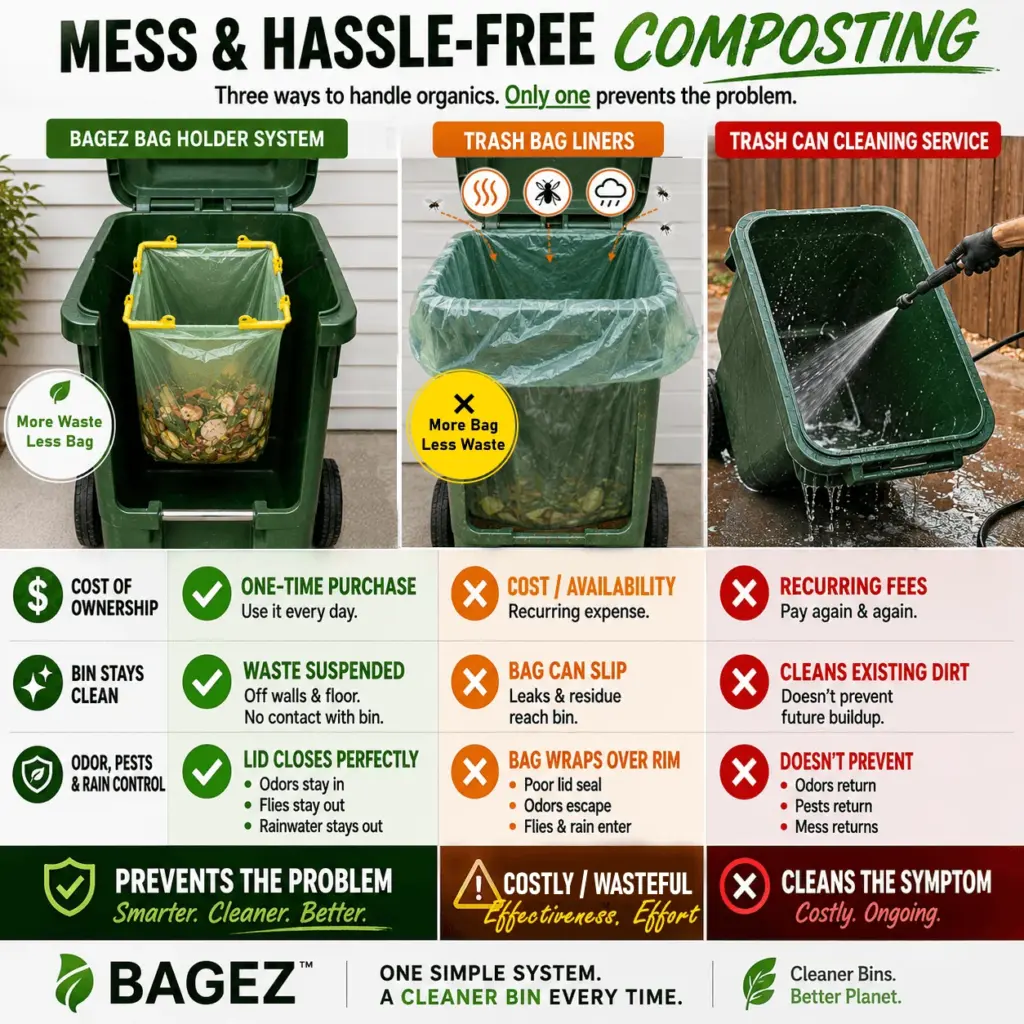
The market has responded to this behavioral and biological challenge with three primary approaches, each carrying distinct economic and operational trade-offs:
Solution Type
Operational Mechanics
Financial Model
Behavioral Friction
Environmental Impact
Professional Bin Cleaning Services
Mobile pressure-washing trucks clean bins at the curb on a monthly or bi-weekly schedule.
Zero bin cleaning required; simple bag replacement; maximizes airflow to eliminate odor.
Extremely low; optimizes bag size to match actual waste volume; reduces overall plastic/compostable material consumption.
The Physics of Suspension: Airflow vs. Anaerobic Pooling
The primary engineering insight behind BagEZ—a structural steel hanging frame designed by Canadian entrepreneur Sean Rana—is the deliberate manipulation of airflow within the micro-environment of the curbside cart.
When a compostable or paper liner bag is suspended by the BagEZ frame, it is held completely aloft, preventing it from resting against the cold plastic floor or walls of the curbside bin. This structural suspension creates a continuous, 360-degree boundary layer of air around the entire surface of the bag.
As moisture transpires through the semi-permeable walls of compostable plastic or paper bags, the moving air within the bin evaporates the condensation before it can pool. The bottom of the cart remains entirely dry, eliminating the anaerobic environment required by putrefactive bacteria. Consequently, the volatile organic compounds that attract flies and rodents are dramatically reduced.
Furthermore, by suspending a standard, highly affordable 13-gallon kitchen-sized bag rather than a massive, custom cart liner, the homeowner aligns the physical containment tool with the actual volume of waste identified in the MITRE-Gallup study. This right-sizing dramatically lowers the recurring cost of participation, removing a major financial barrier for low- and middle-income households.
Official Statements & Policy Perspectives
The debate over how to scale organic waste programs effectively involves a diverse array of stakeholders, from corporate innovators to municipal waste engineers.
The Manufacturer’s Perspective
Sean Rana, the founder of BagEZ, developed the suspended-frame system out of personal frustration with municipal waste guidelines. In an official statement regarding the product’s design philosophy, Rana noted:
"When municipalities transitioned from simple yard waste to complex food scrap collection, they offloaded a massive maintenance burden onto the individual citizen. We expected families to turn their high-end curbside bins into biological waste reactors, and then we wondered why they stopped participating when the bins began to smell and fill with maggots.
Our goal with BagEZ was to create a structural intervention that completely insulates the homeowner from the waste. By suspending the bag, we use basic thermodynamic principles—airflow and evaporation—to keep the container dry. If the container stays dry, the chore of bin cleaning is eliminated. If you eliminate the chore, you secure the habit. It is a simple hardware solution to a massive behavioral economics problem."
The Municipal Waste Management Challenge
Municipal solid waste coordinators across North America emphasize that household-level contamination and sorting compliance remain their biggest operational hurdles. A waste management official from a major Pacific Northwest metropolitan utility, speaking on the condition of anonymity, highlighted the delicate balance of local regulations:
"Every municipality has a different processing infrastructure. Some facilities use advanced anaerobic digesters that can easily strip out plastic or compostable bags at the front end. Others run low-tech, windrow composting facilities where any bag—even those certified as compostable—can survive the initial breakdown phase and degrade the quality of the final compost product.
Because of this, hauling rules are incredibly localized. Some cities require paper liners, others allow certified compostable plastics, and some demand that food scraps be thrown completely loose into the bin. Our advice to residents is always to check their local guidelines using resources like Earth911’s recycling directory before altering their containment methods. A skipped cart due to non-compliant liner bags is a loss for both the homeowner and our diversion metrics."
Future Outlook: The Next Frontier in Waste Diversion
As the climate crisis intensifies, the regulatory pressure on municipal organic waste is poised to accelerate. The future of waste management will likely be defined by three major trends:
1. Universal Mandates and Landfill Bans
Over the next decade, voluntary organic recycling will transition into mandatory compliance across most major metropolitan areas in the developed world. Following the precedents set by California, Vermont, and the European Union, cities will increasingly deploy "smart" waste carts equipped with RFID chips and optical sorting cameras mounted on collection trucks. Haulers will have the ability to scan carts for compliance, issuing real-time fines or refusing service to households that consistently discard organic waste into the general trash stream.
2. The Integration of Behavioral Science into Public Infrastructure
Municipalities are beginning to realize that purchasing cleaner, more efficient collection trucks is useless if citizens refuse to use the bins. Future public works budgets will allocate significant capital not just to heavy machinery, but to "micro-infrastructure" nudges. This includes subsidizing physical hardware like suspended bag frames, distributing high-quality educational materials, and designing kitchen spaces that natively accommodate three distinct waste streams (trash, recycling, and organics).
3. Decentralized and Localized Processing
To reduce the carbon footprint associated with hauling heavy, water-logged organic waste over long distances, cities will increasingly invest in neighborhood-scale anaerobic digesters. These micro-processing facilities will convert local food scraps into clean biogas for municipal fleets and nutrient-rich liquid fertilizer for local agriculture. For these decentralized systems to function efficiently, the incoming feedstock must be highly pure and free of synthetic plastic contamination, making clear, user-friendly household sorting tools more critical than ever.
Conclusion
The success of the global transition toward a circular economy does not depend solely on massive industrial facilities or sweeping legislative declarations. Ultimately, it hinges on the micro-decisions made by millions of individual citizens standing in their kitchens on collection eve. By acknowledging the reality of the "yuck factor" and utilizing smart, low-cost structural innovations to eliminate the physical friction of food recycling, society can transform the green bin from an avoided domestic chore into a seamless, clean, and highly effective tool for planetary preservation.