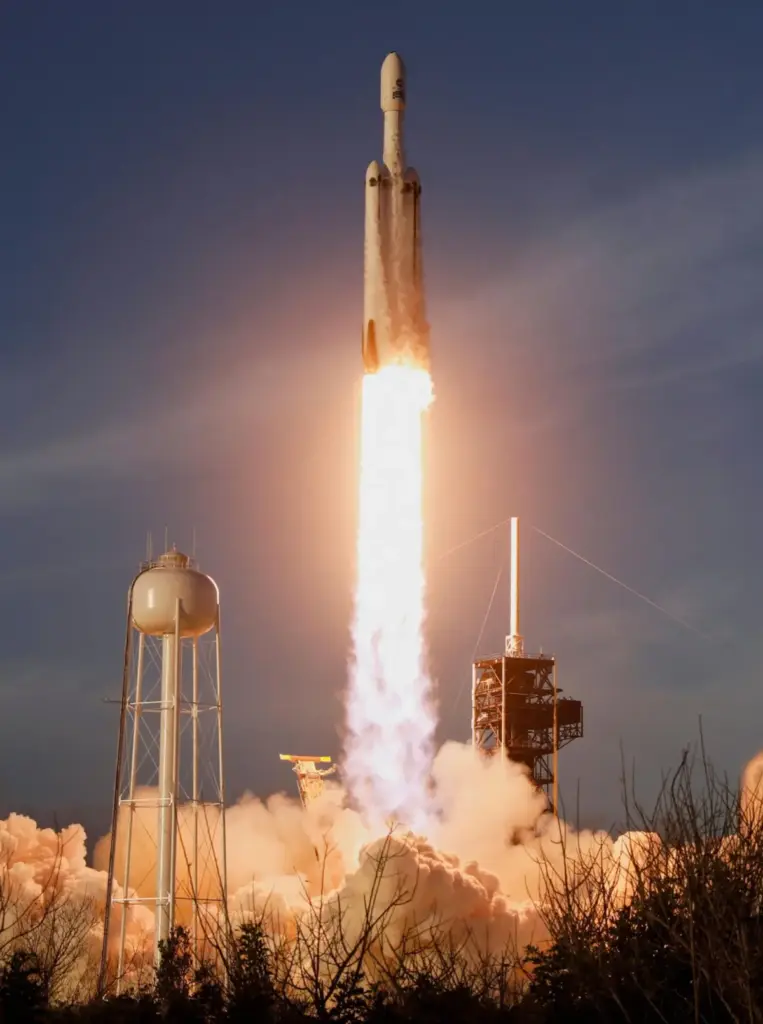
In a monumental milestone for modern astrophysics, NASA has successfully launched its next-generation observatory: the Nancy Grace Roman Space Telescope. Blasting off atop a powerful SpaceX Falcon Heavy rocket from historic Launch Complex 39A at the Kennedy Space Center in Florida on a crisp Sunday morning, the cutting-edge spacecraft has embarked on a high-stakes, multi-year mission to probe the deepest, most profound mysteries of the cosmos.
Designed to capture unprecedented, panoramic wide-field surveys of the universe, the Roman Space Telescope boasts a field of view at least 100 times larger than that of its celebrated predecessor, the Hubble Space Telescope. Over the course of its primary five-year mission—with an extended operational goal stretching to a decade—the observatory will journey to a gravitational sweet spot roughly one million miles from Earth. From this vantage point, it will map billions of galaxies, investigate the elusive properties of dark energy and dark matter, peer into the cosmic abyss of black holes, and revolutionize the search for worlds beyond our solar system.
Named in honor of Dr. Nancy Grace Roman—NASA’s pioneering first chief astronomer and the visionary often celebrated as the "Mother of Hubble"—this new instrument bridges the gap between historical space exploration and the future of deep-space discovery. As humanity seeks to answer fundamental questions about the nature of reality and whether we are alone in the universe, the Roman Space Telescope stands ready to reshape our fundamental understanding of the cosmos.
Detailed Chronology: Countdown, Lift-Off, and Departure
The Build-Up at Cape Canaveral
In the weeks leading up to the launch, the Kennedy Space Center was a hub of intense activity. Engineers and technicians from NASA, SpaceX, and international partner agencies conducted rigorous final checkouts of the spacecraft, ensuring its complex optical systems, solar arrays, and high-gain communication antennae could withstand the violent vibrational and acoustic stresses of atmospheric ascent.
The vehicle chosen for the heavy lifting was a SpaceX Falcon Heavy rocket, renowned for its immense thrust capability and reliability. Encased safely within the payload fairing, the Roman Space Telescope waited quietly on the pad, its gold-coated primary mirror and sophisticated instrumentation fully secured.
Liftoff and Separation
As the countdown clock reached zero on Sunday morning, the triple-core Falcon Heavy ignited its 27 Merlin engines, generating a combined 5 million pounds of thrust. The massive rocket clawed its way off the launchpad, slicing through the Florida skies and leaving a thunderous roar in its wake. Spectators gathered along the Space Coast watched as the rocket transformed into a brilliant point of light, piercing the stratosphere.
Approximately 30 minutes after ignition, the critical separation sequence occurred. Cleanly releasing from the upper stage of the SpaceX booster, the Nancy Grace Roman Space Telescope achieved free flight. Telemetry data downlinked to mission control confirmed that the spacecraft’s onboard computers had successfully booted, and its vital solar arrays had deployed, soaking in the unfiltered light of the sun to power its critical systems.
The Journey to L2
The spacecraft is currently engaged in a 100-day interplanetary cruise toward its operational home: the second Lagrange point (L2). Located approximately one million miles (1.5 million kilometers) away from Earth in the direction opposite the Sun, L2 offers a gravitationally stable environment where the combined pull of the Earth and the Sun allows the spacecraft to maintain a fixed position relative to our planet with minimal fuel expenditure.
Once it arrives at L2, the observatory will begin a meticulous, months-long commissioning phase. Engineers will calibrate its vast camera arrays, cool its sensitive infrared detectors, and focus its optics, paving the way for the historic first light images that are expected to redefine astrophysical research.
Supporting Context & Metrics: Unveiling the Dark Universe and Exoplanets
The Power of Panoramic Vision
What sets the Nancy Grace Roman Space Telescope apart from previous generations of space observatories is its revolutionary combination of wide-field capability and survey speed. While the Hubble Space Telescope is celebrated for its deep, ultra-high-resolution portraits of tiny patches of sky, Roman is designed to cast a much wider net.
Equipped with a 2.4-meter primary mirror—the same physical size as Hubble’s mirror—Roman features a specialized instrument called the Wide Field Instrument. This camera possesses a 300-megapixel field of view, allowing the telescope to image areas of the sky with Hubble-like sharpness over regions hundreds of times larger. In a single pointing, Roman can capture sweeping vistas of cosmic structures that would take Hubble decades to mosaic.
Tackling Dark Energy and Dark Matter
The primary scientific driver for the Roman mission is the investigation of the invisible scaffolding of the universe. Visible stars, planets, and glowing gas clouds account for a mere 5% of the total cosmos. The remaining 95% is composed of two mysterious components: dark matter and dark energy.
Dark Matter (approx. 27%): An invisible, non-luminous substance that acts as a cosmic gravitational glue, holding galaxies and galaxy clusters together. Without dark matter, spinning galaxies would fly apart.
Dark Energy (approx. 68%): A repulsive force that is driving the accelerated expansion of the universe.
By mapping the positions and shapes of billions of galaxies over cosmic time, the Roman Space Telescope will track how cosmic structures have grown under the influence of dark matter and how the expansion rate of the universe has shifted due to dark energy. These massive surveys will provide theorists with the unprecedented data sets needed to finally crack the code of these cosmic enigmas.
A Giant Leap in Exoplanet Discovery
Beyond cosmology, Roman is poised to become a premier exoplanet-hunting machine. Using a technique known as gravitational microlensing—where the gravity of a foreground star bends and magnifies the light of a background star, revealing the presence of orbiting planets—Roman will scout regions of the Milky Way that are impossible to observe effectively using traditional transit or radial velocity methods.
NASA experts project that the telescope will discover tens of thousands, and potentially up to 100,000, new exoplanets. These will range from cold, distant ice giants to rocky worlds scattered across the galactic bulge, significantly expanding our census of planetary systems. Furthermore, Roman carries a pioneering technological demonstration instrument: a coronagraphic mask designed to block the blinding light of nearby host stars, allowing scientists to directly image and characterize the atmospheres of large exoplanets for signs of potential habitability.
Official Statements and Political Resonance
The successful launch drew immediate reactions from the highest levels of scientific leadership and national governance.
During a dedicated NASA news conference held on Sunday morning, Dr. Nicky Fox, NASA’s Science Mission Directorate administrator, emphasized the transformative nature of the mission.
"Roman is going to change the way we look at the universe," Dr. Fox stated passionately. "It is going to discover tens of thousands, maybe even 100,000 new exoplanets."
Addressing the broader philosophical goals of space exploration, Fox added:
"One of our main goals at NASA is answering the question: are we alone in the universe? With Roman, we are going to make this giant leap forward… that is going to allow us to look at these distant, distant worlds and start to really resolve the atmosphere around them to let us know: could they be habitable?"
In an unexpected and notable moment during the briefing, US President Donald Trump dialed in live to the news conference to congratulate the assembled scientists, engineers, and mission specialists. Expressing national pride in the achievement, the President remarked:
"You’re the hottest in space, and we have the hottest country anywhere in the world. So let’s keep it all going. You’re a big part of it."
Future Outlook: A New Era of Synergy in Space Exploration
Honoring a Trailblazer: Dr. Nancy Grace Roman
The legacy baked into the telescope’s hardware is as profound as its scientific goals. Named after Dr. Nancy Grace Roman (1925–2018), the mission honors a pioneering astronomer who overcame systemic gender barriers in mid-20th-century science to become NASA’s first chief astronomer and its first female executive.
Dr. Roman was the intellectual force behind the planning stages of the Hubble Space Telescope, tirelessly lobbying Congress and the scientific community to prove that space-based astronomy was worth the immense investment. Fittingly, before her passing, she noted that dark energy—the very phenomenon her namesake telescope is designed to decode—would ultimately prove to be Hubble’s most profound and unexpected contribution to science.
Complementary Observatories in the Deep Cosmos
The Roman Space Telescope will not operate in a vacuum; rather, it will serve as a vital linchpin in a coordinated fleet of NASA observatories operating across the solar system:
The Hubble Space Telescope (Launched 1990): Operating from a low-Earth orbit approximately 300 miles high, Hubble continues to provide unmatched ultraviolet and optical imaging of nearby cosmic targets.
The James Webb Space Telescope (Launched 2021): Positioned alongside Roman at the L2 Lagrange point one million miles from Earth, JWST specializes in high-resolution, deep-infrared spectroscopy of the earliest galaxies and exoplanetary atmospheres.
The Nancy Grace Roman Space Telescope (Launched 2025): Operating at L2, Roman will provide the wide-angle, panoramic context that bridges the targeted deep dives of Hubble and Webb.
When scientists spot an interesting anomaly or a cluster of candidate exoplanets in Roman’s sweeping cosmic surveys, they can hand off the coordinates to the James Webb Space Telescope for high-resolution, targeted spectral analysis. This powerful synergy promises to accelerate discoveries across every branch of astronomy.
As the Roman Space Telescope continues its silent, steady cruise toward the dark quiet of the L2 Lagrange point, humanity stands on the precipice of a golden age of discovery. Over the next decade, the data beamed back from this remarkable observatory will challenge our assumptions, test the boundaries of physics, and perhaps finally answer the timeless question of whether life exists beyond our fragile blue home.